
Biology What Is Altruism
What is altruistic behaviour biology? And how has it evolved over time?
In evolutionary biology, an organism is said to behave altruistically when its behaviour benefits other organisms, at a cost to itself. The costs and benefits are measured in terms of “reproductive fitness”, or the expected number of offspring.
Take African grey parrots, for example. A recent study revealed that they voluntarily gave the tokens they were trained to exchange for food to parrots that had no tokens. The biologists who conducted this study were surprised when they realized that the parrots seemed to have a genuine understanding of when and why their partners needed their help. They would rarely give the tokens over when the window to exchange them for food was closed.
An altruistic act is one that benefits another at its own expense. This is confusing to many biological scientists because the biological perspective is that the main imperative of life is for genes to replicate themselves as much as possible to increase their frequency in the gene pool, but if this is the case, why would animals act in a way that results in a detriment to themselves?
The question ‘what is altruism in biology’ often comes up. I studied altruism early on in my Evolution and Behaviour model at the University of Cambridge.
At first glance, it appears to go against everything that Natural Selection predicts.




Looking at the above table we would expect most organisms only to act in cooperative or selfish ways, as these are the only ways that benefit their survival.
Selfish actions only benefit that individual and have no effect on anyone else. Unsurprisingly, this type of behaviour is very common and includes things such as not sharing food.
Cooperation also has many advantages for an individual. Group hunting can be more effective than individual hunting and therefore result in a higher food yield per individual.
Living in a larger group causes what is called “the dilution effect”. This describes how being in a large group reduces the chance that a predator will catch an individual. Additionally, living with a larger group increases the vigilance in watching for predators.
However, this only really helps if the organism that spots the predator alerts the others, which can be considered an altruistic act as it calls attention to itself and so is more likely to be targeted by the predator.
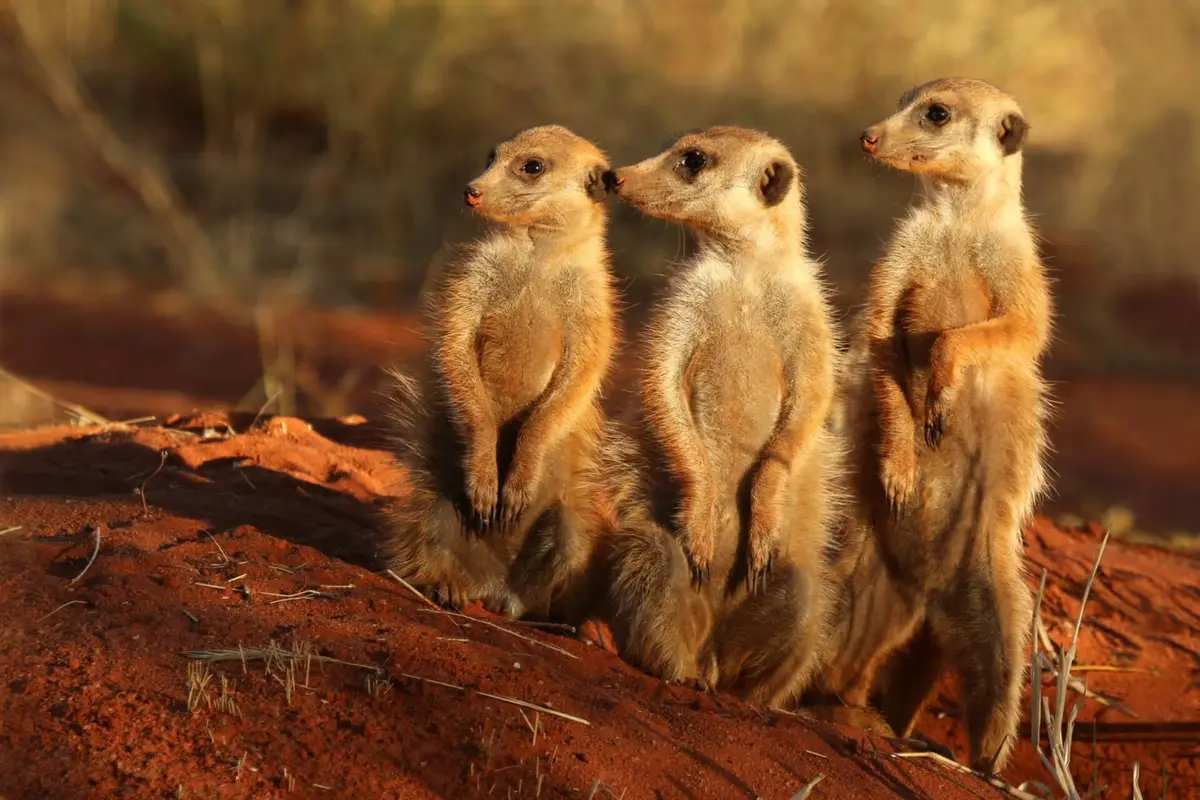
A good example of this is in meerkat groups where adults will stand-watch at higher vantage points on their hind legs and alert the rest of the group if they see a predator.
Is it a gene thing?
If we consider altruistic acts at the level of an individual, it can be hard to determine how altruism has evolved in the natural world. Where there is one altruist in a group of selfish animals, the altruist would be at a disadvantage because helping others does not necessarily result in help being returned, and may even result in their imminent death.
However, in a primarily altruistic group, a selfish individual would have an advantage over the others as they may be the recipient of altruistic acts but not return them. This means that they would have higher reproductive success and as a result, the allele for selfish acts would rapidly increase in frequency within the gene pool.
Join the Immerse Education 2027 Essay Competition
Follow the instructions to write and submit your best essay for a chance to be awarded a 100% scholarship.
Subversion from within
In Vervet monkey populations, monkeys will sound an alarm call to warn others of the presence of a predator – this is an altruistic act as it calls more attention to themselves – making them more likely to be targeted by the predator.
Surely a monkey with a selfish trait that did not warn the others would be at an advantage as it would be able to escape quietly, while the predator targeted the others? This was described by Darwin as “subversion from within” as any altruistic group will eventually give rise to a selfish individual which will be at an advantage and therefore increase the frequency of that selfish gene.
At the level of the group, however, it is possible to see that groups that contain all, or primarily altruists, would have an advantage over selfish groups in bad years when food is scarce.
As a result, the selfish groups might all die, leaving a greater proportion of altruists in the population. However, in good years selfish groups will do better than altruists as they can put all of their resources towards producing as many offspring as possible.







Unlock Inspiring Opportunities with the Immerse Education Newsletter
Join our newsletter to stay ahead with exclusive updates, exciting programme highlights, and expert insights from the world of immersive education.
Learn how Immerse can transform your life
An in-depth overview of our university and career preparation programmes
Get a glimpse into the life of an Immerse participant
Find the right programme for you with sample timetables, location showcases, and more