What Is GCSE Chemistry? Everything You Need to Know for Exams
Few GCSE sciences have a reputation quite like Chemistry, thanks to its mix of abstract concepts and calculation-heavy questions. But GCSE Chemistry becomes far more manageable once you see how the topics, papers, and route options fit together.
GCSE Chemistry is tested across two exam papers. Paper 1 covers the first five topic areas, the foundational chemistry concepts, while Paper 2 covers the remaining five, more applied and environmental topics. The subject can be taken as Triple Science or as part of Combined Science.
In this article, we'll discuss the topics you'll study, how the papers are structured, how Triple and Combined Science differ, how required practicals are actually examined, and how difficult the subject really is.
Let's get right into it.
Key Takeaways
- GCSE Chemistry covers ten core topic areas under AQA, from atomic structure and bonding through to organic chemistry and using resources.
- Under AQA, the subject is assessed across two exam papers, each worth 50% of your final grade and lasting 1 hour 45 minutes.
- Triple Science gives you a standalone Chemistry GCSE with eight required practicals, while Combined Science covers the same broad topic areas with six required practicals and some Separate Chemistry-only content not included.
- Required practicals aren't tested in a separate exam. Instead, they're assessed through written questions worth at least 15% of your marks, though WJEC runs a separate practical unit worth around 10%.
- You're given a periodic table in the exam, but no equation sheet, so key formulae for calculations need to be memorised.
- Around 20% of your marks are calculation-based. For context, 91.5% of GCSE Chemistry students achieved a grade 4 or above in 2025, while 46.1% achieved a grade 7 or above.
What Are the GCSE Chemistry Topics?
GCSE Chemistry covers ten core topic areas under the AQA specification, spanning atomic structure through to environmental and resource-based chemistry. Other boards, including Edexcel, OCR, and WJEC, cover similar ground but group and name the topics differently.
Here are the ten core areas you'll study under AQA:
- Atomic structure and the periodic table - explains how atoms are structured, how the periodic table organises elements by properties, and how atomic models have developed through evidence over time.
- Bonding, structure, and the properties of matter - looks at ionic, covalent, and metallic bonding, and how each affects material properties, including polymers, nanomaterials, and carbon structures like diamond and graphite.
- Quantitative chemistry - calculations involving mass, concentration, moles, and chemical formulas sit at the heart of this topic, making up roughly a fifth of the exam's total marks.
- Chemical changes - the reactivity of metals, reactions between acids and bases, salt formation, and electrolysis all fall here, an area many students find tricky.
- Energy changes - exothermic and endothermic reactions, reaction profiles, and how batteries, fuel cells, and hydrogen fuel cells convert chemical energy are the focus of this topic.
- The rate and extent of chemical change - temperature, concentration, pressure, surface area, and catalysts are examined here, alongside reversible reactions and how equilibrium shifts under changing conditions.
- Organic chemistry - carbon compounds, including fossil fuels, alkanes, alkenes, alcohols, and polymers, form the basis of this topic, along with how chemists use them commercially.
- Chemical analysis - identifying gases and ions through practical tests, plus purity, formulations, and chromatography, are the main skills developed within this section.
- Chemistry of the atmosphere - this topic traces how Earth's early atmosphere evolved and examines the human impact of pollution and fossil fuel combustion today.
- Using resources - producing drinking water and fertilisers responsibly, alongside recycling, life cycle analysis, and sustainable material use, round out the final topic.
Ten topics is a lot to hold in your head at once, and knowing what's covered is only half the battle. If you're aiming for a top grade rather than just a pass, our GCSE Chemistry Grade 9 Strategy Guide gives you a fuller revision strategy for prioritising your time across these topics.



How Many GCSE Chemistry Papers Are There and What Is on Each One?
GCSE Chemistry is assessed through two exam papers. Under AQA, both are weighted equally and structured almost identically, just with different content.
Here's how the two papers break down under AQA.
- Paper 1: covers topics 1 to 5 (atomic structure and the periodic table, bonding and properties of matter, quantitative chemistry, chemical changes, and energy changes), worth 50% of the final grade, marked out of 100, and lasting 1 hour 45 minutes.
- Paper 2: covers topics 6 to 10 (the rate and extent of chemical change, organic chemistry, chemical analysis, chemistry of the atmosphere, and using resources), also worth 50% of the final grade, marked out of 100, and lasting 1 hour 45 minutes.
Triple Science vs. Combined Science: How the Chemistry Content and Paper Length Differ
Not every GCSE Chemistry student sits the same exam. Depending on your route, the content depth, paper length, and number of required practicals can all look quite different.
In the next sections, we'll break down exactly how Triple Science and Combined Science compare.
Triple Science
Triple Science means you take three separate GCSEs rather than one combined award, with each subject examined and graded independently.
Alongside Chemistry, this includes:
- Biology - cell biology, organisation, infection and response, bioenergetics, homeostasis, inheritance, and ecology make up this subject's content, tested across two papers.
- Physics - energy, electricity, the particle model of matter, atomic structure, forces, waves, and magnetism form the core of this subject, also tested across two papers.
For Chemistry specifically, this route goes further than Combined Science. It includes additional content, such as extra depth in quantitative chemistry and instrumental methods of analysis, and includes eight required practicals.
Who this suits: students who want useful preparation for Chemistry at A-Level, or those who simply enjoy the subject enough to want the extra depth.
Combined Science
Combined Science, known as Trilogy under AQA, awards you two GCSEs instead of three, covering Biology, Chemistry, and Physics within a single combined qualification. You'll sit six papers in total, two per science, and each paper counts for 16.7% of your overall Combined Science grade.
For Chemistry, you'll cover the same broad topic areas as Triple Science, with some Separate Chemistry-only content, such as further quantitative chemistry and instrumental analysis methods, not included.
You'll also only need to know six required practicals rather than eight, since the two Chemistry-only practicals aren't examined.
Who this suits: if you want a strong grounding in all three sciences alongside a broad science foundation.
Required Practicals: How They're Tested in the Written Papers
Rather than sitting a separate practical exam, everything you do in the lab for GCSE Chemistry gets assessed through written questions woven across both papers, accounting for at least 15% of your total marks.
Under AQA, the eight required practicals are:
- Making salts - you'll prepare a pure, dry sample of a soluble salt from an insoluble oxide or carbonate.
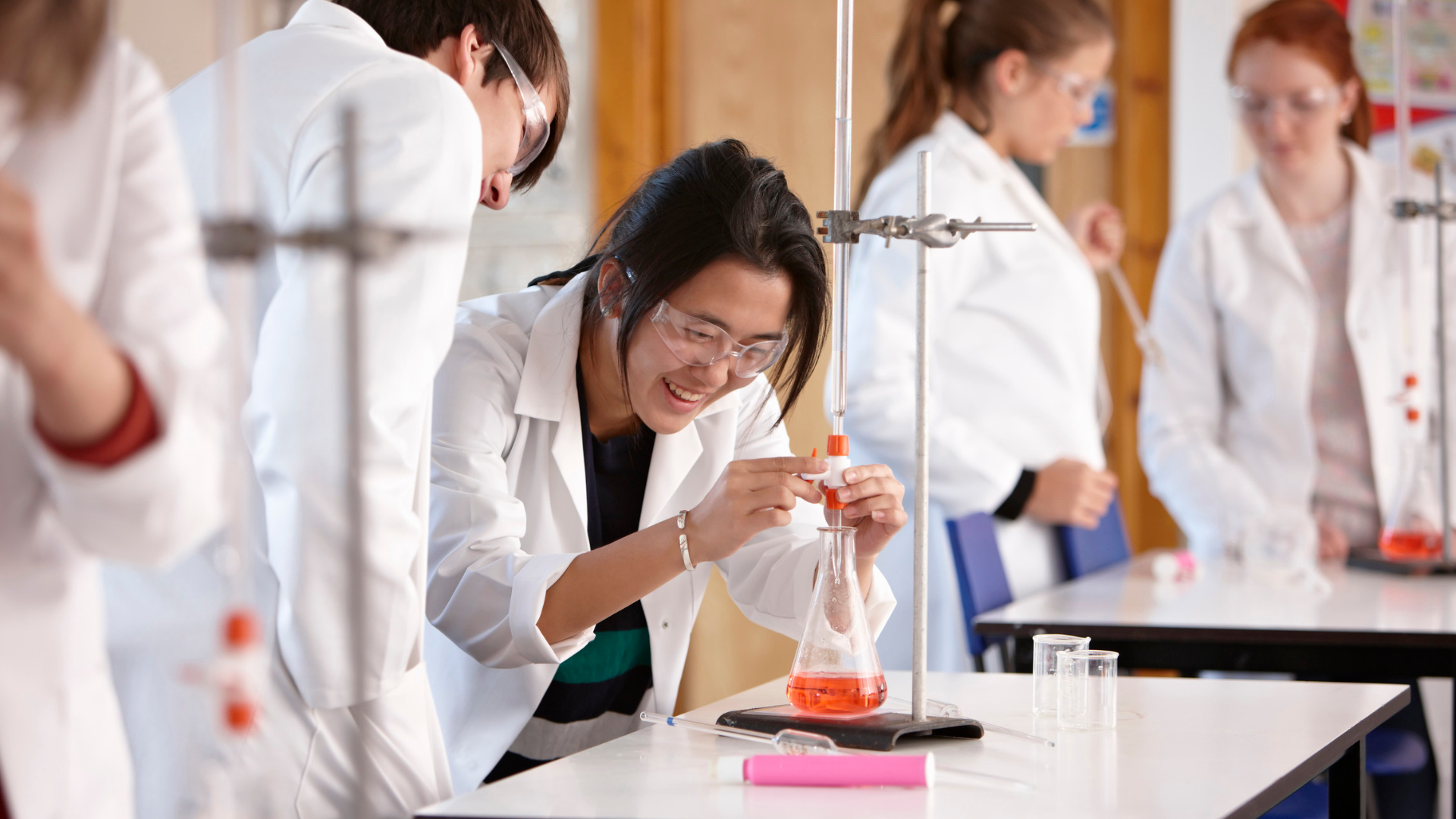
- Neutralisation (titration) - Triple Science only, this practical has you finding the volume of acid needed to neutralise an alkali.
- Electrolysis - expect to investigate what happens when you pass electricity through aqueous solutions.
- Determining temperature changes - you'll measure the temperature change in reactions like dissolving, neutralisation, and displacement.
- Investigating rates of reaction - this one asks you to explore how different variables affect how quickly a reaction happens.
- Chromatography - you'll separate and identify substances within mixtures using paper chromatography.
- Identification of ions - Triple Science only, here you'll use chemical tests to work out which ions are present in an unknown sample.
- Water purification - the final practical has you distilling a sample of water to assess its purity.
If you're sitting WJEC rather than AQA, this doesn't apply to you in the same way. Under WJEC's current specification, Chemistry includes a separate, externally marked practical assessment worth around 10% of your final grade, rather than folding practical questions into the written papers alone. WJEC has confirmed a new Unit 3 for teaching from September 2026, so this structure may change for students starting their course from that point onward.
How Difficult Is GCSE Chemistry?
GCSE Chemistry sits between Biology and Physics in difficulty, largely due to its heavier reliance on calculations. Under AQA, a minimum of 20% of your marks come from calculation-based questions, covering moles, concentration, and energy change calculations, compared to a minimum of 10% in Biology and 30% in Physics.
For context, according to data from the Association for Science Education, 91.5% of students achieved a grade 4 or above in the 2025 GCSE Chemistry results, while 46.1% achieved a grade 7 or above.
The subject rewards comfort with maths just as much as memorisation, which is why it can feel harder than expected if you're stronger in one area. If GCSE Chemistry already feels demanding, A-Level raises the bar further. Our A-Level Chemistry Syllabus deep-dive guide breaks down why, and how to prepare early.
Do You Get a Periodic Table in GCSE Chemistry?
Yes, you get a periodic table in the GCSE Chemistry exam, and you're allowed to refer to it throughout both papers. The exact format, whether it's printed on the inside cover or provided as a separate insert, can vary by exam board and specification.
What you don't get is an equation sheet. Unlike Physics, Chemistry expects you to memorise key formulae yourself, including calculations for moles, concentration, and relative formula mass, rather than relying on a reference sheet in the exam.
Join the Immerse Education 2027 Essay Competition
Follow the instructions to write and submit your best essay for a chance to be awarded a 100% scholarship.
Explore Chemistry With Immerse Education
GCSE Chemistry gives you a solid foundation, but it only scratches the surface of what the subject actually involves at a higher level. If you're already considering Chemistry at A-Level, or a chemistry-related degree, the jump in depth and complexity can catch students off guard.
Immerse Education's Chemistry Summer School is designed to get you ahead of that curve. Held at the University of Cambridge for students aged 16 to 18, the programme covers organic chemistry, physical chemistry, and biochemistry, including atomic structure, thermodynamics, and bonding theories like Lewis structures and hybridisation.
You'll also complete a personal research project guided by expert tutors, working alongside like-minded students who are just as serious about the subject as you are. It's a genuine preview of what studying chemistry looks like once you move past GCSE.
FAQs
What Are the GCSE Chemistry Topics?
GCSE Chemistry covers ten core areas under AQA: atomic structure, bonding, quantitative chemistry, chemical changes, energy changes, rates of reaction, organic chemistry, chemical analysis, the atmosphere, and using resources.
How Many GCSE Chemistry Papers Are There and What Is on Each One?
There are two papers, each worth 50% and lasting 1 hour 45 minutes. Paper 1 covers topics 1 to 5, and Paper 2 covers topics 6 to 10.
How Difficult Is GCSE Chemistry?
It sits between Biology and Physics in difficulty. Around 20% of marks are calculation-based, compared to a minimum of 10% in Biology and 30% in Physics.
Do You Get a Periodic Table in GCSE Chemistry?
Yes, it's provided throughout both papers. There's no equation sheet, so key formulae still need to be memorised.
Conclusion: Understanding the Structure Makes GCSE Chemistry Manageable
It can feel like a lot to take in at first, but GCSE Chemistry isn't as complicated as it seems once you break it down.
Ten topics, two papers, a periodic table, and a choice between Triple and Combined Science are really all it comes down to.
Knowing how required practicals are tested, and where the real difficulty lies, means you can walk into your exams with a clear sense of what to expect.
If you're ready to push further than the GCSE syllabus, our Chemistry Summer School is the natural next step. The subject only gets more interesting from here.





Unlock Inspiring Opportunities with the Immerse Education Newsletter
Join our newsletter to stay ahead with exclusive updates, exciting programme highlights, and expert insights from the world of immersive education.
Learn how Immerse can transform your life
An in-depth overview of our university and career preparation programmes
Get a glimpse into the life of an Immerse participant
Find the right programme for you with sample timetables, location showcases, and more