What Is GCSE Physics? The Complete Student Guide
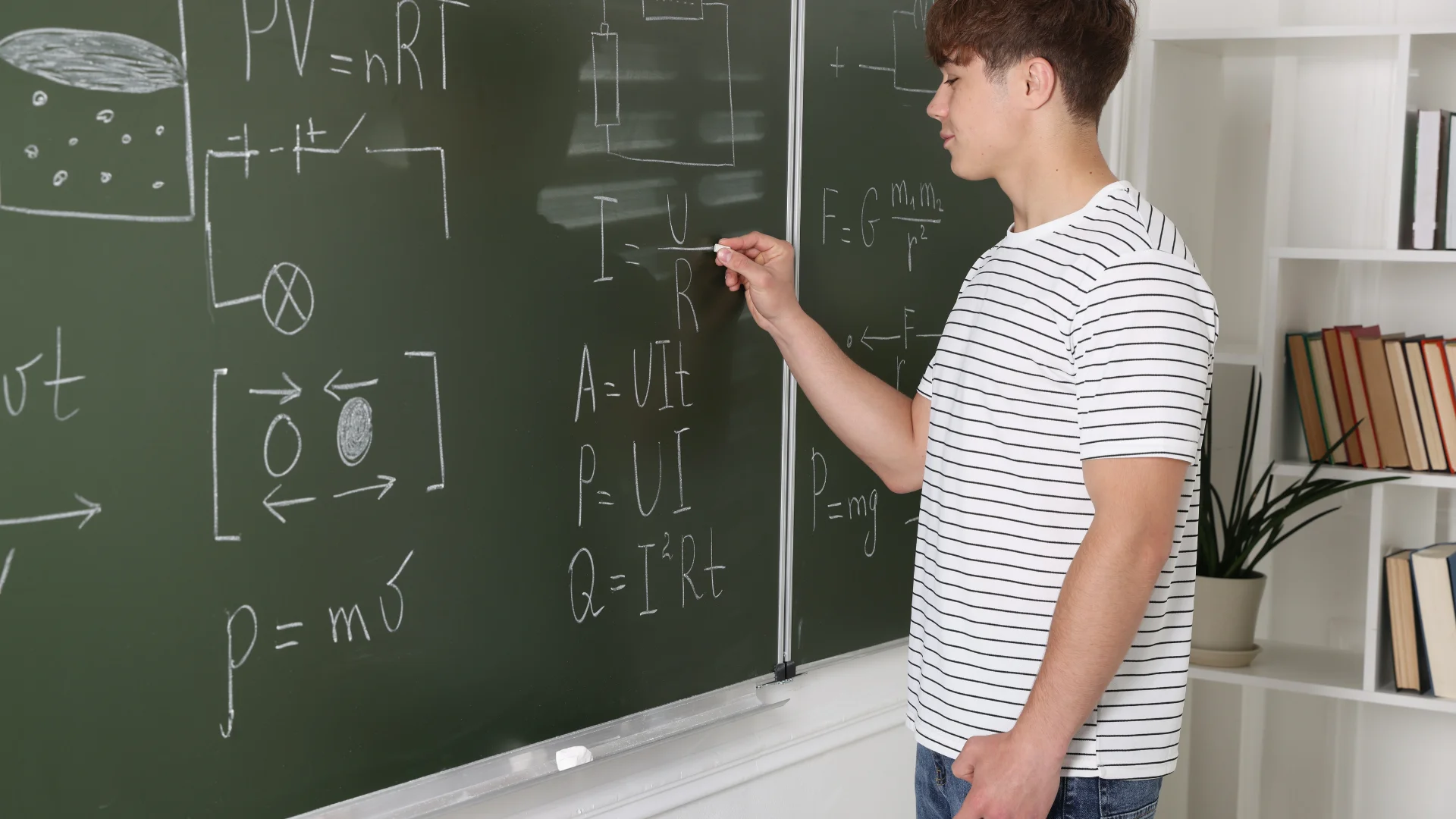
If you've heard that GCSE Physics is the hardest of the three sciences, it's easy to see why the reputation exists. It's the most maths-heavy GCSE science, and it comes with a long list of topics and equations to master. Here's exactly what that workload actually looks like.
In the AQA specification, GCSE Physics covers two exam papers, each 1 hour 45 minutes, spanning eight topics: energy, electricity, the particle model of matter, atomic structure, forces, waves, magnetism and electromagnetism, and space physics.
In this article, we'll cover exactly what topics GCSE Physics includes, how Triple and Combined Science differ, what's on the equation sheet for your exam series, and what grade you need to progress to A-level Physics.
Let's start with the topics themselves.
Key Takeaways
- AQA GCSE Physics covers eight topics: energy, electricity, particle model of matter, atomic structure, forces, waves, magnetism and electromagnetism, and space physics, with the last one exclusive to Triple Science.
- Triple Science awards three separate GCSEs across six papers, while Combined Science folds physics, chemistry, and biology into one qualification worth two grades, also across six papers.
- Triple-only content includes space physics, static electricity, electromagnetic induction, transformers, and lenses, all of which Combined Science skips entirely.
- GCSE Physics has two exam papers, each 1 hour 45 minutes and worth 100 marks, together making up 100% of your final grade.
- AQA provides every equation on a printed formula sheet in both papers, and this concession now covers exams through at least 2030 or 2031.
- The 10 required practicals make up at least 15% of total marks, and a minimum of 30% of marks assess mathematical skills across the qualification.
What topics does GCSE Physics cover?
It's easy to picture GCSE Physics as an unmanageable list of random facts and formulas, but the specification is far more contained than that. Under AQA, the whole course sits within eight defined topic areas, seven of which are common to both Triple and Combined Science.
Here's what each one covers.
- Energy - when a kettle heats water or a ball rolls to a stop, you're seeing energy transfer in action, and this topic covers stores, transfers, and calculating efficiency.
- Electricity - the biggest risk here is mixing up series and parallel circuit calculations, so this topic centres on using V = IR correctly under both setups.
- Particle Model of Matter - why does ice float on water? This topic answers that through density, states of matter, and internal energy changes.
- Atomic Structure - covers atomic models, radioactive decay, and half-life, including working out protons, neutrons, and electrons from atomic and mass numbers.
- Forces - think of a car braking or a ball being thrown, this topic covers motion and momentum through Newton's three laws.
- Waves - this topic is calculation-heavy, built around finding wave speed from frequency and wavelength across transverse and longitudinal waves.
- Magnetism and Electromagnetism - a scrapyard crane lifting scrap metal is an electromagnet in action, and this topic covers magnetic fields and the motor effect behind it.
If you're studying AQA GCSE Physics, these seven topic areas form the backbone of your revision, whichever science route you're taking, though Separate Physics goes into more depth within several of them. Edexcel organises this same content into 15 smaller units, and OCR splits it across 8 units carrying fewer total marks, so the topic list looks different on paper even though the underlying physics is similar.
Space physics and other Triple-only content
Space physics is the only entire topic exclusive to Separate Physics. The other four, static electricity, electromagnetic induction, transformers, and lenses, aren't standalone extra topics. They're physics-only content that sits inside the shared Electricity, Magnetism and Electromagnetism, and Waves topics.
That's what separates the two routes: one exclusive topic, plus extra content folded into topics both routes otherwise share.



Triple Science vs Combined Science: what's the difference?
Triple Science and Combined Science cover the same eight topics, but they lead to different qualifications and different depth of study. Triple Science awards three separate GCSEs, one each for physics, chemistry, and biology, while Combined Science awards one qualification worth two grades across all three subjects.
Here are the key structural differences between the two routes.
Triple Science
Triple Science awards physics as one of three standalone GCSEs, alongside separate chemistry and biology GCSEs, sat across six exam papers in total, two per subject. Because each subject gets its own two papers, Triple Physics covers more content in more depth than Combined Science's physics portion.
This is where the Triple-only material sits: space physics, static electricity, electromagnetic induction, transformers, and lenses. None of that appears in Combined Science.
Who this suits: students who want more depth in Physics specifically, including the additional content and full space physics topic that Combined Science doesn't cover.
Combined Science
Where Triple Science splits physics into its own standalone GCSE, Combined Science folds physics, chemistry, and biology into a single qualification worth two grades, sat across six exam papers, two per subject.
Because content is shared across three subjects rather than split into three dedicated GCSEs, Combined Science physics covers less depth than Triple Physics. It skips space physics, static electricity, electromagnetic induction, transformers, and lenses entirely.
Who this suits: students who want a solid grounding in physics without committing to three separate science GCSEs.
How many GCSE Physics papers are there, and what's on each?
In the AQA specification, GCSE Physics is assessed across two exam papers. Both mix question types rather than sticking to one format, including multiple choice, short answer, calculation questions, and six-mark extended response questions that test how clearly you can structure a longer written answer.
Here's what each paper covers.
- Paper 1 - covers topics 1 to 4 (energy, electricity, particle model, atomic structure), 1 hour 45 minutes, 100 marks, 50% of your final grade.
- Paper 2 - covers topics 5 to 8 (forces, waves, magnetism and electromagnetism, and space physics for Triple only), 1 hour 45 minutes, 100 marks, 50% of your final grade.
Always show your working on calculation questions. AQA's mark schemes can award follow-through credit for correct steps after an early mistake, under an "error carried forward" rule, which is exactly why showing your working matters, marks a blank answer can never earn.
The GCSE Physics equation sheet: what you need to know
AQA provides you with the official formulae and equations sheet inside both exam papers for the current specification. Following the March 2026 Ofqual consultation outcome, this concession now runs for the remaining lifetime of the current GCSE Physics specification, covering every exam series through at least 2030 or 2031.
Reformed GCSEs aren't expected until 2029 or 2030 at the earliest, and the government hasn't yet confirmed whether a memorise-and-apply split will return under the new specification.
Having the sheet doesn't mean the exam gets easier. You still need to know which equation to use, how to rearrange it, and how to substitute values with the correct units under exam pressure.
GCSE Physics required practicals explained
AQA specifies 10 required practicals across the two papers, and questions on them make up at least 15% of the total marks. You won't repeat the experiment in the exam hall, but you'll be expected to describe the method, identify variables, and interpret or evaluate results as if you had.
Here are the 8 practicals common to Triple and Combined Science.
- Specific heat capacity - calculating the energy needed to raise a substance's temperature using an immersion heater and timed readings.
- Resistance in circuits - wire length changes resistance, and this practical uses an ammeter, voltmeter, and V = IR to prove it.
- I-V characteristics - a resistor, filament lamp, and diode each produce a different graph shape when current is plotted against voltage.
- Density - two methods, one for each object type: displacement for irregular shapes, direct measurement for regular ones.
- Force and extension - where does a spring stop obeying Hooke's law? Plotting force against extension reveals the limit of proportionality.
- Acceleration - light gates or a ticker timer record velocity and time as an object accelerates down a ramp.
- Waves - frequency, wavelength, and speed get measured two ways, in a ripple tank and along a stretched string.
- Radiation and absorption - black, white, and shiny surfaces absorb and radiate infrared radiation at noticeably different rates.
And here are the 2 practicals exclusive to Triple Science.
- Thermal insulation - why does a flask keep a drink hot longer than a mug? Testing different materials answers that.
- Light reflection and refraction - measuring how light bends through glass or water explains why a straw looks bent in a glass.
The exam rarely asks whether you did the experiment, it asks whether you understand what you measured and why. Calculating percentage uncertainty and telling random from systematic error are where students most often lose marks, across all 10 practicals.
Is GCSE Physics hard?
GCSE Physics carries a reputation for being the hardest of the three sciences, and its maths content is a big part of why. At least 30% of marks assess mathematical skills, more than Chemistry or Biology, so students who find algebra, rearranging equations, or working with units difficult may find Physics particularly demanding.
Beyond the maths, examiners consistently flag the same recurring slips: misapplied equations, missing units, weak written explanations, and shaky required-practical knowledge. Most of these are fixable with focused, targeted revision rather than simply working harder.
What grade do you need in GCSE Physics for A-level?
Many sixth forms and colleges ask for a grade 6 or 7 in GCSE Physics and Maths before accepting students onto A-level Physics, and 6-6 for Combined Science students, though this varies significantly by institution.
Triple Science students may have some advantage here, since Combined Science doesn't cover space physics or some other physics-only content, which can give some prior exposure to concepts encountered again at A-level.
If you're wondering what a specific percentage, like 67%, translates to, there's no fixed answer. Grade boundaries are set annually and vary by paper and exam series, so check your own year's published boundaries rather than assuming a universal conversion.
Join the Immerse Education 2027 Essay Competition
Follow the instructions to write and submit your best essay for a chance to be awarded a 100% scholarship.
Explore GCSE Physics with Immerse Education
GCSE Physics gives you a solid foundation, but sticking strictly to the syllabus can leave you underprepared for how much harder A-level Physics gets. Topics like quantum mechanics, astrophysics, and particle physics barely feature at GCSE, yet they're central to what makes Physics genuinely interesting.
For students applying to competitive university courses, syllabus knowledge alone rarely stands out either.
On our Physics Summer School in Cambridge, you can explore topics like quantum mechanics and astrophysics properly, working alongside university tutors in small groups. It's designed for students aged 13 to 18 who want to go beyond the GCSE syllabus, building the kind of academic depth that strengthens both your A-level preparation and future university applications.
FAQs
What are the GCSE Physics topics?
AQA GCSE Physics covers eight topics: energy, electricity, particle model of matter, atomic structure, forces, waves, magnetism and electromagnetism, and space physics. Seven are shared between Triple and Combined Science, while space physics is exclusive to Triple Science, along with static electricity, electromagnetic induction, transformers, and lenses.
Do I need Triple Science for A-level Physics?
No, not strictly. Whether it's preferred depends on the individual sixth form or college. Although, it does cover additional content, including the full space physics topic, that Combined Science doesn't, giving some prior exposure to concepts you'll meet again at A-level.
How many GCSE Physics papers are there and what is on each one?
There are two papers, each 1 hour 45 minutes and worth 100 marks. Paper 1 covers energy, electricity, particle model, and atomic structure. Paper 2 covers forces, waves, magnetism and electromagnetism, and space physics for Triple students.
Do I need to memorise equations for my GCSE Physics exam?
No. AQA provides every equation on a printed formula sheet inside both papers, and this concession now runs for the remaining lifetime of the current specification, covering exams through at least 2030 or 2031.
Is Physics a hard GCSE?
Physics has the heaviest maths weighting of the three sciences, with a minimum of 30% of marks assessing mathematical skills. Common student slips include misapplied equations, missing units, and weak written explanations, most of which are fixable with focused revision.
What grade is 67% in GCSE Physics?
There's no fixed conversion. Grade boundaries are set annually and vary by paper and exam series, so 67% could land on different grades depending on the year. Check your specific exam series' published boundaries rather than assuming a universal percentage-to-grade mapping.
Conclusion: making sense of GCSE Physics
After everything you've heard from older students, forums, and worried group chats, GCSE Physics can feel like the GCSE to fear most. In reality, it's a fixed, learnable structure once you break it down.
Eight topics, two papers, a full equation sheet through at least 2030 or 2031, and required practicals worth 15% of your marks, none of it is a mystery once you know what to expect. GCSE Physics rewards structure and steady revision far more than natural talent.
Once the maths-heavy reputation stops feeling like a mystery, it becomes just another part of the exam to prepare for, and one you can genuinely get good at.
Ready to go beyond the syllabus? Explore quantum mechanics, astrophysics, and more on our Physics Summer School in Cambridge.







Unlock Inspiring Opportunities with the Immerse Education Newsletter
Join our newsletter to stay ahead with exclusive updates, exciting programme highlights, and expert insights from the world of immersive education.
Learn how Immerse can transform your life
An in-depth overview of our university and career preparation programmes
Get a glimpse into the life of an Immerse participant
Find the right programme for you with sample timetables, location showcases, and more