How to Get a 45 in IB: Study Strategies from Top Students

You already know how IB scoring works, and that 45 is the maximum you can earn. But one question keeps coming back: is a 45 in IB really within your reach?
It is, as long as you earn a 7 in all six subjects and all three bonus points from Theory of Knowledge (TOK) and the Extended Essay (EE). Attaining this score is rare and leaves no room for error, but you can learn the habits top scorers share.
In this guide, we’ll break down the math behind a 45 and how rare it is. Then we’ll cover nine strategies tied to where marks are won: coursework, exams, and the core.
Let’s start with the numbers.
Key takeaways
- A 45 requires a 7 in all six subjects plus all three bonus points, earned with an A in TOK or the EE and at least a B in the other.
- Typically fewer than 1% of students reach 45, with 772 (0.87%) in May 2022, but no US college requires one. A score of 40 or above already places you among roughly the top 10%.
- Subjects that fit your strengths serve you better than “easy” 7s, and IAs, worth 20-30% of most final grades, let you bank marks before exam season.
- Self-testing and spaced practice outperform rereading, so pair active recall with timed past papers marked strictly against the official mark scheme.
- Mock exams may inform the predicted grades colleges review, depending on your school’s timeline, so treat them as seriously as your final May exams.
- Steady routines beat cramming across both years: start coursework in year one, finish it early in year two, and pair rigorous study with eight to ten hours of sleep.
What it takes to get a 45 in IB
Getting a 45 in IB means topping every subject, securing the best core grades, and completing Creativity, Activity, Service (CAS).
In the sections below, we’ll look at each, starting with the math.
The math behind a perfect IB score
Before we get into the strategies, it’s best to first understand where each of your 45 points comes from. Your six subjects supply 42 of them, while the core adds the final three.
Here’s the math behind a perfect score.
That leaves no room for slack anywhere. A single 6 in any subject caps your total at 44, while a B in both TOK and the EE earns only two bonus points.
How rare is a 45?
Getting a 45 is rare. According to the IB’s May 2022 statistical bulletin, only 772 candidates, or 0.87%, reached it. That’s fewer than one in 100. The IB stopped publishing this figure from May 2023, to discourage comparisons between students and schools.
A score of 40 or above, earned by 9.8% of candidates in May 2025, is now the clearest top-tier benchmark, and the nine strategies below help you get there.



Strategy 1: Choose subjects you can score 7s in
Choosing a subject just because it seems easy to score a 7 in rarely pays off. According to the IB’s May 2025 statistical bulletin, 19.2% of Physics Higher Level (HL) students earned a 7. In History HL, it was just 2.6%. Yet few students would ever call Physics the easier option. Those rates reflect who takes each course, not how easy it is.
Instead, pick subjects that fit your strengths and your goals, including the college majors you’re considering. Then check how your HL workloads combine across a typical week. Settle your choices before your school’s subject-change deadline.
Strategy 2: Treat your internal assessments as marks in the bank
Your internal assessments (IAs) are coursework pieces your teacher marks and the IB moderates. They usually make up 20–30% of your final grade. Unlike exams, IAs give you time to draft, check, and polish before anyone grades them.
To make the most of that time, build these three habits.
- Pick a topic you can investigate with data or sources at your school. A Chemistry experiment you can run in a few lab sessions beats a global theme you can only describe.
- Once you’ve drafted it, check it against each marking criterion, such as analysis or communication. Each one describes what full marks look like, so fix anything your draft doesn’t yet show.
- Since your teacher can usually comment on only one draft, complete this self-check before submitting it. Along the way, log every source and AI tool you use, following your school’s integrity rules.
Strategy 3: Secure all 3 bonus points with TOK and the Extended Essay
In May 2025, just 10.3% of students earned an A in TOK, and 11.2% in the EE. Because A’s are this rare, aim for an A in one and a B or better in the other. That combination still earns all three bonus points.
Either way, the EE goes best with a subject you enjoy, ideally one you take at HL, and a narrow focus. That focus matters, since discussion and evaluation now earns 8 of its 30 marks, the most of any criterion. If you want to learn more, our IB Extended Essay guide shows how to narrow a broad topic into a focused research question.
TOK, by contrast, has an exhibition worth 33% and an essay worth 67%. Plan the exhibition early, since it usually falls in year one. For the essay, choose the title you can argue from both sides. To go deeper, our Theory of Knowledge guide covers both tasks in detail.
Strategy 4: Study with active recall, not rereading
Rereading and highlighting feel productive, but they build weak recall. According to a 2013 study of learning techniques, both rank low, while self-testing and spaced practice rank highest.
Active recall puts both into practice. Here’s how it works, using rates of reaction in Chemistry as an example:
- Pick one syllabus point from your subject guide, such as how temperature, concentration, and catalysts affect reaction rate.
- Close your notes and write everything you remember on a blank page. You might cover collision theory, activation energy, and why heating speeds up a reaction.
- Check your page against your notes, then add anything you missed in a different color. Perhaps you forgot that catalysts lower activation energy without being used up.
- Return to rates of reaction after a day, a week, and a month, starting from a blank page each time. Gaps you keep missing show you exactly what to review next.
Strategy 5: Master past papers and mark schemes
Past papers show how the IB asks questions, so sit them under timed conditions in your second year. If a paper runs two hours, give yourself exactly two hours, with no notes. Then mark it strictly against the official mark scheme, awarding only the points it lists.
Command terms decide what earns those points. “Explain” asks for reasons or causes, while “evaluate” means weighing strengths and limitations. The IB’s subject reports, which your teacher can access, show where students commonly lose marks.
Once you know why marks slip, log every lost mark as a content gap, technique error, or timing issue. Then redo those questions a week later.
Strategy 6: Adapt your study method to each subject group
Active recall and past papers work in every subject, but each subject group tests different skills. A Math exam rewards fast, accurate problem-solving, while an English paper rewards close analysis of an unseen text.
Here’s how to adapt your study method for each group:
- Group 1: Language and Literature. Paper 2 is closed-book, so build a quote bank for each studied work. Timed practice with unseen texts then sharpens your Paper 1 analysis.
- Group 2: Language Acquisition. A few minutes of vocabulary every day, scheduled with spaced practice, beats weekend cramming. Speaking regularly then prepares you for the individual oral.
- Group 3: Individuals and Societies. In History, a strong essay ranks causes instead of just naming them. Build essay plans that compare and weigh factors the same way.
- Group 4: Sciences. Rather than rewriting the textbook, map your notes to each syllabus point. Then practice data-based questions, using the wording past mark schemes reward.
- Group 5: Mathematics. Math is learned by doing. Spend most of your study time solving problems, and keep note-taking to a minimum.
- Group 6: The Arts. Your grade reflects how your work develops, not just the final piece. Document your process weekly, so the record builds itself.
Strategy 7: Treat mock exams like the real thing
Your school sets mock exams in your second year, often using past IB papers. Although they don’t affect your final grade, they’re the closest rehearsal for your May IB exams. That’s why you should sit them under exam timings, with no notes.
Once your results come back, list every lost mark by topic, then focus your plan on those topics before May. Your results also test your study methods: if active recall topics outscored reread ones, keep using it.
Those same results can matter beyond your own studying. Depending on your school’s timeline, teachers may draw on them for predicted grades, which many colleges review. Final IB results arrive in July, far beyond US college deadlines, which usually fall between November and January. This is exactly why your mock exams deserve serious effort.
Strategy 8: Build a two-year study routine
Attaining a 45 doesn’t mean saving all your effort for second-year exams. It takes a steady routine across both years, starting in your very first week.
The sections below show what that routine should cover in each year.
DP1: Build foundations and start coursework early
Your first year sets up everything that follows. Each week, file your class notes under the matching syllabus points, so year two means review, not relearning.
Coursework should start now, too. Shortlist possible IA and EE topics by the end of the year, so you can start research over the summer. Start CAS early as well, since it runs for at least 18 months.
Finally, use end-of-unit tests to find weak topics while the stakes are low. Ask your teacher for extra questions on those topics before the next unit begins. A gap fixed in year one won’t resurface when you start past papers.
DP2: Finish coursework, then revise
Coursework and exam review compete for the same hours in your second year. To avoid that clash, aim to finish your IAs, EE, and TOK essay by the end of the first term. If your school’s deadlines fall later, finish each piece as early as they allow.
Clearing coursework early frees your spring for exam preparation. That timing matters, because your May exams run over about three weeks and cover two years of content.
Use that time for mocks, timed past papers, and cumulative review cycles. In each cycle, revisit every subject, adding newer topics while retesting older ones with active recall. By May, each topic will have been tested several times, not just once.
Strategy 9: Protect your sleep and wellbeing
Top scores don’t mean you should review up to 16 hours daily. The American Academy of Sleep Medicine recommends eight to ten hours of sleep for teens aged 13 to 18. During sleep, your brain locks in what you studied.
Movement helps, too. The CDC recommends at least 60 minutes of activity daily for teens. Regular activity is linked to better concentration and memory, and fewer symptoms of anxiety.
Still, watch for burnout signs like constant tiredness or falling grades despite longer hours. If they appear, scale back your plan and talk to a teacher, your IB coordinator, or a counselor.
Join the Immerse Education 2027 Essay Competition
Follow the instructions to write and submit your best essay for a chance to be awarded a 100% scholarship.
Is a 45 worth chasing?
Yes, a 45 is worth aiming for if you commit to steady work across both years. Even if you fall short, those same habits can lift you above the 30.6 global average.
That won’t hurt your college chances, since no US college requires a 45. Instead, admissions weigh your grades alongside essays and activities. So a 40+ from a full IB diploma, which demands more than AP’s individual exams, already stands out.
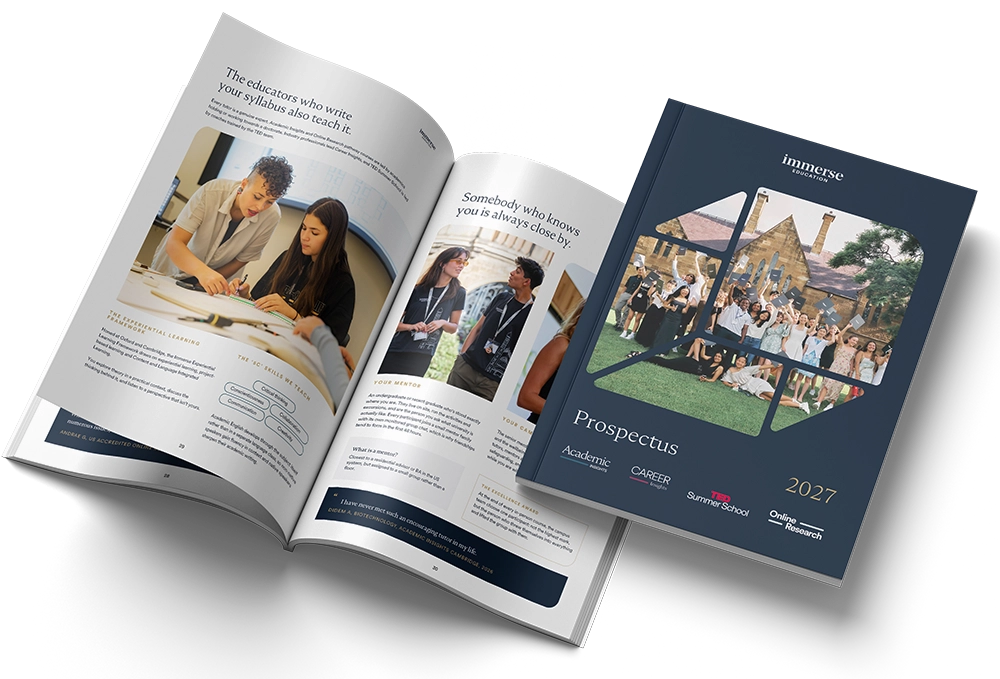
Build top-scorer skills with Immerse Education
Top IA and EE marks reward research, academic writing, and independent study. Yet a packed IB timetable leaves little room to practice them before second-year deadlines.
That’s where Immerse Education can help. Our Pre-University Summer School offers university-style study in 20+ subjects for ages 13 to 18. Small seminars average seven students, and you’ll present a personal project at the end.
If you’re still exploring careers, our Career Insights summer school adds industry visits that show how your subject works in the real world. And when travel isn’t an option, our Online Research pathway pairs you 1:1 with an Oxford, Cambridge, or Ivy League tutor. Together, you’ll complete a full research paper, excellent practice for your EE.
No matter which pathway you choose, you’ll start your second year with clearer direction and stronger independent study habits.
FAQs
What does a 45 in IB mean?
A 45 is the highest possible IB Diploma score. It combines 42 points from six subjects, each graded 1 to 7, with up to three bonus points from TOK and the Extended Essay.
Do you need all 7s to get a 45?
Yes, you need a 7 in all six subjects, since a single 6 caps your total at 44. The core then needs an A in one component and at least a B in the other.
What percent of people get IB 45?
Typically fewer than 1% of students get a 45. In May 2022, the last session with published figures, 772 candidates scored 45, or 0.87%. The IB stopped publishing this number from May 2023.
Which IB subjects are easiest to get a 7 in?
No subject is objectively easiest. In May 2025, 19.2% of Physics HL students earned a 7, versus 2.6% in History HL. Those rates reflect who takes each course, so choose subjects that match your strengths.
Is the IB harder than AP?
For most students, the full IB Diploma can be more demanding than AP. That’s because it combines six subjects over two years with TOK, the EE, and CAS.
Do colleges care if you get a 45?
No. Colleges value strong IB results, but no US college requires a 45. A score of 40 or above places you among roughly the top 10% of IB students worldwide.
Conclusion: aiming for 45, landing at the top
Reaching a 45 in IB takes near-perfection across six subjects and the core. Yet every strategy behind that score is something you can control, starting today.
Start by choosing subjects that fit you, banking your IA marks, and securing all three bonus points. Then combine active recall, past papers, and subject-specific methods with mocks, a steady routine, and sleep.
Even if you land at 42 or 43, that system puts you among the top tier of IB students. For subject-specific advice, explore our IB preparation resources.
Want a head start on these skills before your second year begins? Explore Immerse Education Summer Schools and find the course that fits your goals.






Unlock Inspiring Opportunities with the Immerse Education Newsletter
Join our newsletter to stay ahead with exclusive updates, exciting programme highlights, and expert insights from the world of immersive education.
Learn how Immerse can transform your life
An in-depth overview of our university and career preparation programmes
Get a glimpse into the life of an Immerse participant
Find the right programme for you with sample timetables, location showcases, and more