Choosing an IB Chemistry IA Topic: Ideas, Examples and Tips
It's 11pm, your cursor is blinking on an empty page, and the deadline is closing in while every "topic idea" you've found feels either painfully obvious or wildly out of reach. The good news is that we'll walk you through topics that are focused, doable, and genuinely score well.
For your IA topic, you can investigate anything from water hardness across sources by EDTA titration to how temperature affects the rate of reaction between sodium thiosulfate and hydrochloric acid, provided your research question is focused, measurable, and grounded in real chemistry rather than something answerable from a textbook.
In this guide, we'll cover what the IA is now called, how it's marked under the current criteria, how many words you have, and topic ideas organised practically by method, from titration and calorimetry to kinetics.
Let's get right into it.
Key takeaways
- The IB Chemistry IA is officially called the Scientific Investigation as of the syllabus first assessed in May 2025, contributing 20% of the final grade at both SL and HL.
- The report has a maximum word count of 3,000 words, excluding data tables, equations, calculations, citations, and the bibliography.
- The Scientific Investigation is marked against four criteria, Research Design, Data Analysis, Conclusion, and Evaluation, each worth 6 marks, for 24 marks total, rather than the older, now-retired five-criteria model.
- One effective approach is to adapt a standard, well-understood method, such as titration, calorimetry, kinetics, or pH and equilibrium, to a focused, measurable research question grounded in real chemistry rather than a textbook answer.
- Secondary-data investigations are permitted and are assessed against the same four criteria, but they still need genuine processing of the data rather than just plotting existing numbers.
- Starting early matters: talk to a teacher before committing to a topic, write a research proposal, and get the risk assessment approved before any practical work begins.
What is the IB Chemistry IA now called?
The IB Chemistry IA is officially called the Scientific Investigation under the syllabus first assessed in May 2025. It's the same requirement at both SL and HL, contributing 20% of your final Chemistry grade.
The Scientific Investigation is open-ended and self-formulated, meaning you design your own research question rather than following a set experiment. Depending on your investigation, you gather and/or select appropriate data, analyse it to answer your question, and present your findings as a written report that your teacher marks and the IB later moderates.
If you want the full picture of how the Scientific Investigation fits into your wider Chemistry course, our IB Chemistry guide covers the syllabus and exam structure alongside it.


How many words is the IB Chemistry IA?
The IB Chemistry IA has a maximum word count of 3,000 words. This limit applies to the full written report, regardless of whether you're taking SL or HL.
Several elements are excluded from that count, including data tables, equations, calculations, citations, and the bibliography. This means your actual analysis and discussion can go further than 3,000 words might suggest, since the numerical and referencing content sits outside the limit.
Your report also needs to state a few details at the start, with no cover or contents page required: the title of the investigation, your IB candidate code (plus the codes of any group members, if applicable), and your word count.
How is the IB Chemistry IA marked?
The IB Chemistry IA, now called the Scientific Investigation, is marked against four criteria under the syllabus first assessed in May 2025. Each criterion is worth 6 marks, giving a maximum of 24 marks, and the same criteria apply at both SL and HL. Your teacher marks your report, and the IB externally moderates the results.
Here are the four criteria and how they're assessed:
- Research Design (6 marks): How clearly you've defined your research question and planned your method.
- Data Analysis (6 marks): Rewards accurate data processing and clear handling of uncertainty and error.
- Conclusion (6 marks): Your conclusion needs to be justified by your data and compared meaningfully to accepted science.
- Evaluation (6 marks): Identifying real weaknesses and proposing relevant, realistic improvements earns marks here.
What makes a strong IA topic?
One of the most effective ways to build a strong IB Chemistry IA topic is to adapt a standard, well-understood method to a real-world sample, rather than inventing something entirely new.
Below, we'll walk through IB Chemistry IA ideas organised by method, covering titration, calorimetry, kinetics, and pH and equilibrium.
Titration-based topic ideas
Titration is one of the most reliable methods for an IB Chemistry IA because it produces precise, quantifiable results using equipment most schools already have.
Here are three titration-based topics worth considering:
- Water hardness across sources: Using EDTA complexometric titration with Eriochrome Black T indicator, you can compare calcium and magnesium ion concentrations across at least three water sources, such as tap water, a specific bottled brand, and water from a different region.
- Vitamin C degradation in stored orange juice: DCPIP titration lets you track how ascorbic acid concentration in orange juice changes over a set number of days, comparing samples stored in the fridge against samples left at room temperature.
- Antacid neutralising capacity by active ingredient: Back titration lets you compare how much hydrochloric acid antacids containing calcium carbonate or magnesium hydroxide neutralise per gram, by titrating the leftover acid with sodium hydroxide.
Calorimetry and enthalpy topic ideas
If your interest leans toward energy and thermodynamics rather than concentration and equilibrium, calorimetry-based investigations give you a direct, hands-on way to explore that.
Each of these four topics turns a basic calorimetry setup into a real comparison:
- Enthalpy of combustion across an alcohol homologous series: You can burn methanol, ethanol, propan-1-ol, and butan-1-ol under a calorimeter of water, then calculate each enthalpy of combustion per mole and see how it changes as carbon chain length increases.
- Specific heat capacity comparison across metals: Using an immersion heater and a joulemeter or known current, voltage, and time, you can compare how quickly aluminium, copper, iron, and lead blocks heat up, and relate the differences to their atomic structure.
- Enthalpy of neutralisation across acid strengths: Reacting 1.0 mol dm⁻³ sodium hydroxide with equal volumes of 1.0 mol dm⁻³ hydrochloric acid, then 1.0 mol dm⁻³ ethanoic acid, in a polystyrene cup calorimeter shows how acid strength changes the heat released. Expect small differences, so insulate carefully and repeat each run.
- Enthalpy of dissolution for different salts: Dissolving a fixed mass of ammonium chloride, calcium chloride, and other common salts in water and tracking the temperature change shows why some dissolve exothermically and others endothermically.
Kinetics and rate topic ideas
From how fast a fizzy tablet dissolves to how quickly rust forms, reaction rates shape everyday chemistry, and a kinetics-based IA lets you measure that precisely instead of just observing it.
Here are three specific research questions you can build on:
- Effect of temperature on reaction rate: Timing the sodium thiosulfate and hydrochloric acid reaction from 20°C to 50°C in 5°C steps gives you rate data for an Arrhenius plot and an estimate of the activation energy. Run a trial first, since the top of the range can be too fast to time by eye.
- Effect of concentration on reaction rate: Varying potassium iodate(V) concentration from 0.005 to 0.025 mol dm⁻³ in the iodine clock reaction, with everything else held constant, gives clock times you can convert into initial rates. A log rate against log concentration plot then shows the order with respect to iodate.
- Effect of surface area on reaction rate: Reacting sieved marble chips of several known sizes with excess dilute hydrochloric acid, while a gas syringe tracks carbon dioxide volume, lets you test whether the initial rate rises in proportion to surface area.
pH and equilibrium topic ideas
Where kinetics measures speed and calorimetry measures energy, pH and equilibrium investigations measure balance, how a system responds when it's pushed away from a stable state.
From enzymes to fermentation, these four systems all shift in response to changing conditions.
- Equilibrium constant of the iron(III) thiocyanate system: Mixing iron(III) and thiocyanate solutions at several starting concentrations and reading absorbance with a colorimeter lets you calculate Kc for Fe³⁺ + SCN⁻ ⇌ FeSCN²⁺ and test whether it stays constant.
- Buffering capacity of a phosphate buffer system: A pH probe lets you measure how much acid or base a phosphate buffer solution can absorb before its pH changes significantly, compared to an unbuffered solution under the same conditions.
- Determining the Ka of a weak acid: Half-neutralisation with a pH probe reveals the dissociation constant of a weak acid such as ethanoic acid, which you can compare against a second weak acid to relate acid strength to molecular structure.
- Solubility product of calcium hydroxide at different temperatures: Titrating saturated calcium hydroxide solutions with hydrochloric acid gives you Ksp at each temperature, which you can link to whether dissolving is exothermic or endothermic.
Can you use secondary data?
Yes, secondary-data investigations are permitted, and they're assessed against the same four criteria as any other Scientific Investigation. The key requirement is genuine processing, not simply plotting numbers someone else already collected.
A strong secondary-data IA still needs a focused research question, a clearly justified dataset, and real analytical work. What that involves depends on your question and your data, but it might include comparing datasets, calculating derived quantities, or testing how reliable your source is. Whichever techniques you choose, what counts is how well you process, interpret, and evaluate the data.
If you choose this route, make sure your data source is reliable and clearly documented, since Research Design and Evaluation both depend on being able to justify the dataset you selected.
Getting started
Before committing to a topic, talk it through with your Chemistry teacher early, since they can flag safety concerns or equipment limitations before you invest time in planning.
Once you have a research question, write a research proposal that outlines your method, materials, and expected data, and get your risk assessment approved before you begin any practical work. Starting this process early gives you room to adjust your approach if your first attempt doesn't go as planned.
Don't confuse this process with your IB Extended Essay, which follows a different structure, word count, and set of requirements entirely.
Join the Immerse Education 2027 Essay Competition
Follow the instructions to write and submit your best essay for a chance to be awarded a 100% scholarship.
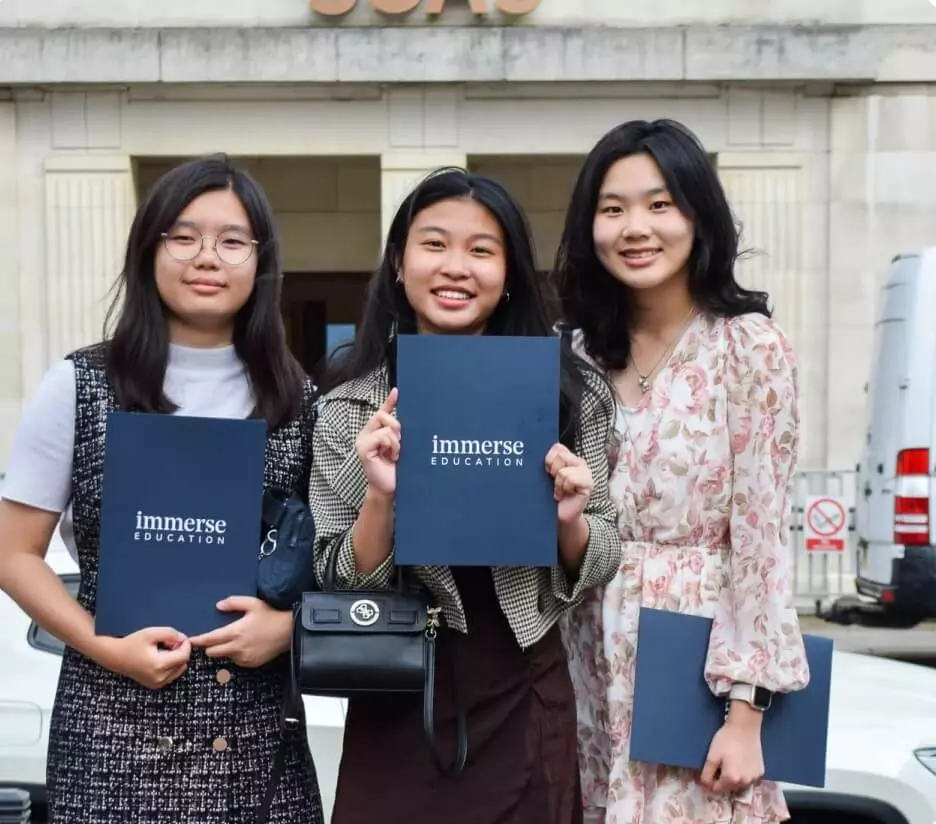
Explore chemistry with Immerse Education
You'll choose a stronger IA topic much more easily once you've had hands-on experience designing and running an investigation, rather than facing a research question for the first time under deadline pressure.
Our Chemistry Summer School gives you broader exposure to experimental chemistry, with hands-on lab work and a personal research project led by expert tutors, so you can discover which areas of the subject interest you most.
If you'd prefer a flexible, remote option, our Online Chemistry Summer School gives you the same expert guidance and research-focused structure, so you can build confidence with experimental design and data analysis from wherever you are.
Either way, you'll walk into your IA with a clearer sense of what interests you and how to investigate it properly, rather than guessing at a topic the week before your proposal is due.
FAQs
What is the IB Chemistry IA now officially called?
The IB Chemistry IA is officially called the Scientific Investigation, under the syllabus first assessed in May 2025. It's the same requirement at SL and HL, contributing 20% of your final grade.
How many words is the IB Chemistry IA?
The IB Chemistry IA has a maximum word count of 3,000 words. Data tables, equations, calculations, citations, and the bibliography are excluded from that count.
How is the IB Chemistry IA marked?
The Scientific Investigation is marked against four criteria: Research Design, Data Analysis, Conclusion, and Evaluation. Each is worth 6 marks, for 24 marks total.
What makes a good IB Chemistry IA topic?
A strong topic adapts a standard method, like titration or calorimetry, to a focused, measurable research question grounded in real chemistry rather than a textbook answer.
Can I use secondary data instead of running my own experiment?
Yes, secondary data is allowed and can score full marks, provided you genuinely process and analyse it rather than simply plotting existing numbers.
When should I start my IA?
Start early by discussing your topic with your teacher, writing a research proposal, and getting your risk assessment approved before any practical work begins.
Conclusion: Execution beats novelty
Choosing an IB Chemistry IA topic doesn't need to feel overwhelming once you know what the current criteria actually reward. A focused, well-executed idea will always outperform an ambitious topic you can't fully support with data.
The topics covered here, from titration and calorimetry to kinetics and pH investigations, each give you a proven, adaptable starting point you can shape into a genuinely personal research question.
Talk to your teacher early, write your proposal with care, and let your method do the work, rather than chasing something unusual for its own sake.
If you want to build real research confidence before your IA even begins, explore our Chemistry Summer School and get hands-on with the skills that turn a good topic into a strong one.






Unlock Inspiring Opportunities with the Immerse Education Newsletter
Join our newsletter to stay ahead with exclusive updates, exciting programme highlights, and expert insights from the world of immersive education.
Learn how Immerse can transform your life
An in-depth overview of our university and career preparation programmes
Get a glimpse into the life of an Immerse participant
Find the right programme for you with sample timetables, location showcases, and more