Debate skills for students: 8 tips to argue with confidence

You’re halfway through your point in English class when a classmate leans back and says, “Wait, isn’t it the other way around?” Every head turns your way and your mind goes blank, and for many students, that’s the moment they realise debate skills are worth working on.
To improve your debating skills, start by learning to pause, restate the other person’s point, and answer with evidence. Then build the preparation behind those replies by researching both sides and practising out loud.
In this guide, we’ll discuss what debate skills are, why they matter, and eight tips in detail, plus weekly drills, common mistakes to avoid, and a seven-day plan that works with or without a team.
Let’s start by defining what debate skills are.
Key takeaways
- Debate skills combine research, argument building, rebuttal, listening, and delivery, and they help students think clearly, speak with confidence, and handle follow-up questions in class and college interviews.
- The eight tips cover the whole debate, from learning your format and researching both sides to rehearsing with a timer, studying recorded rounds, and treating every loss as feedback.
- In many competitive formats, an unanswered argument can count as conceded, so take two-column notes of each claim and its evidence and answer the other side’s most important points first.
- A five-day drill routine, from one-minute arguments and switching sides to rebutting an AI chatbot, lets you practise debate skills at home or in class without a team.
- Common debate mistakes include reading a full script, leaving evidence unexplained, going over time, and logical fallacies such as straw men, personal attacks, and offering only two choices.
- The Learning to Be Heard Challenge, a free global public speaking competition from Immerse Education, offers full or partial scholarships to TED Summer School, a two-week public speaking course for ages 15-18 in person or 14-18 virtually.
What are debate skills?
Debate skills are the abilities you use to challenge someone’s point, or defend your own, in a structured and evidence-based way. The aim is to reason clearly rather than win loudly.
Every debate, in class or at a tournament, draws on five core abilities.
- Research: Defining key terms, such as whether a phone “ban” covers the whole school day, and finding credible sources.
- Argument building: Linking a clear claim to evidence, such as a study or statistic, and explaining why it matters.
- Rebuttal: Answering the other side’s strongest point first, then showing why your case still stands.
- Listening: Tracking each claim and its evidence so you respond to exactly what was said.
- Delivery: Controlling pace, eye contact, and timing, such as fitting your whole case into a four-minute speech.
You'll leave with a certificate of completion, and on in-person courses, your talk is professionally recorded for you to keep.
Strong debaters pair these abilities with curiosity, composure, and a willingness to change their mind. Together, they help you respond calmly when someone challenges your point.
Why debate skills matter for students
The importance of debate skills for students shows up every time you speak to a group. Presenting a project, leading a discussion, or answering questions after a talk all require a clear idea, solid support, and calm replies to pushback. Regular practice under a time limit can build the confidence to share your own ideas in class and handle follow-up questions in college interviews.
Debate also sharpens how you think and listen, two academic skills you’ll use in every subject. Preparing both sides of a motion trains you to weigh evidence, spot weak reasoning, and question claims before you accept them. Answering an opponent means understanding their point well enough to restate it, a habit that helps in group projects, seminars, and everyday conversations.




8 tips to improve your debate skills
The clearest way to improve is to train one stage of a debate at a time. Tips 1-5 cover preparation, Tip 6 covers the round itself, and Tips 7-8 cover what happens afterwards.
In the sections below, we break down each tip with a practical step you can use in your next class discussion or debate round.
Tip 1: know the format inside out
Every debate format has its own rules, and knowing them helps you plan a case that fits. In the US, most school competitions use formats from the National Speech & Debate Association (NSDA).
Here’s how the four most common formats differ.
- Public Forum: A common starting point for new debaters, with teams of two arguing a current events topic that changes every month or two.
- Lincoln-Douglas: Suits students drawn to philosophy, with two debaters arguing one-on-one about values such as justice, privacy, and security.
- Policy: Rewards deep research, since teams of two argue one evidence-heavy topic for the whole school year.
- Congressional Debate: Lets each student speak individually as a legislator, arguing for or against bills and resolutions in a mock session.
Whichever format you use, check the rules before you start writing, especially speech times, speaking order, and cross-examination.
Tip 2: research both sides
Start by circling every key term in the motion. For example, in a debate on whether schools should start later in the morning, write down what “later” means, such as a 10am start instead of 9am.
Next, research both sides. List the three strongest arguments for each side, with evidence for all six. Supporters might point to better sleep, while opponents might raise bus costs or clashes with after-school sports. Spend about a third of your prep time on the side you oppose. As you read their sources, note weak spots you can use in rebuttal, such as outdated data or a small sample.
Keep an evidence bank with each source, its date, and a one-line takeaway, so every fact is ready when you’re challenged.
Tip 3: build arguments that hold up
Your research left you with three arguments for each side. Now build your side’s three in four parts, which are a claim, evidence, reasoning, and an impact.
With later start times, the claim is that they help students learn. For evidence, you could cite the American Academy of Pediatrics’ 2014 policy statement, which found that sleep-wake cycles begin to shift up to 2 hours later at the start of puberty, so the average teenager has difficulty falling asleep before 11 p.m. That means early starts cut their sleep short, which is your reasoning. The impact follows, with students arriving alert enough to take part in first-period classes.
Once each argument follows this pattern, stop there, since three developed arguments carry more weight than six thin ones. Then introduce them in your first 30 seconds with a one-line roadmap, such as, “Schools should start later for three reasons: learning, health, and attendance.”
Tip 4: prepare your rebuttals early
Most rebuttals can be written before the debate starts, which takes much of the pressure off thinking on your feet. The method is called steelmanning, where you write down the strongest version of each objection the other side could make.
For each of your three arguments, note its biggest objection, then find evidence that answers it directly. The figure below shows how this works in the later start times debate, from objection to rebuttal.
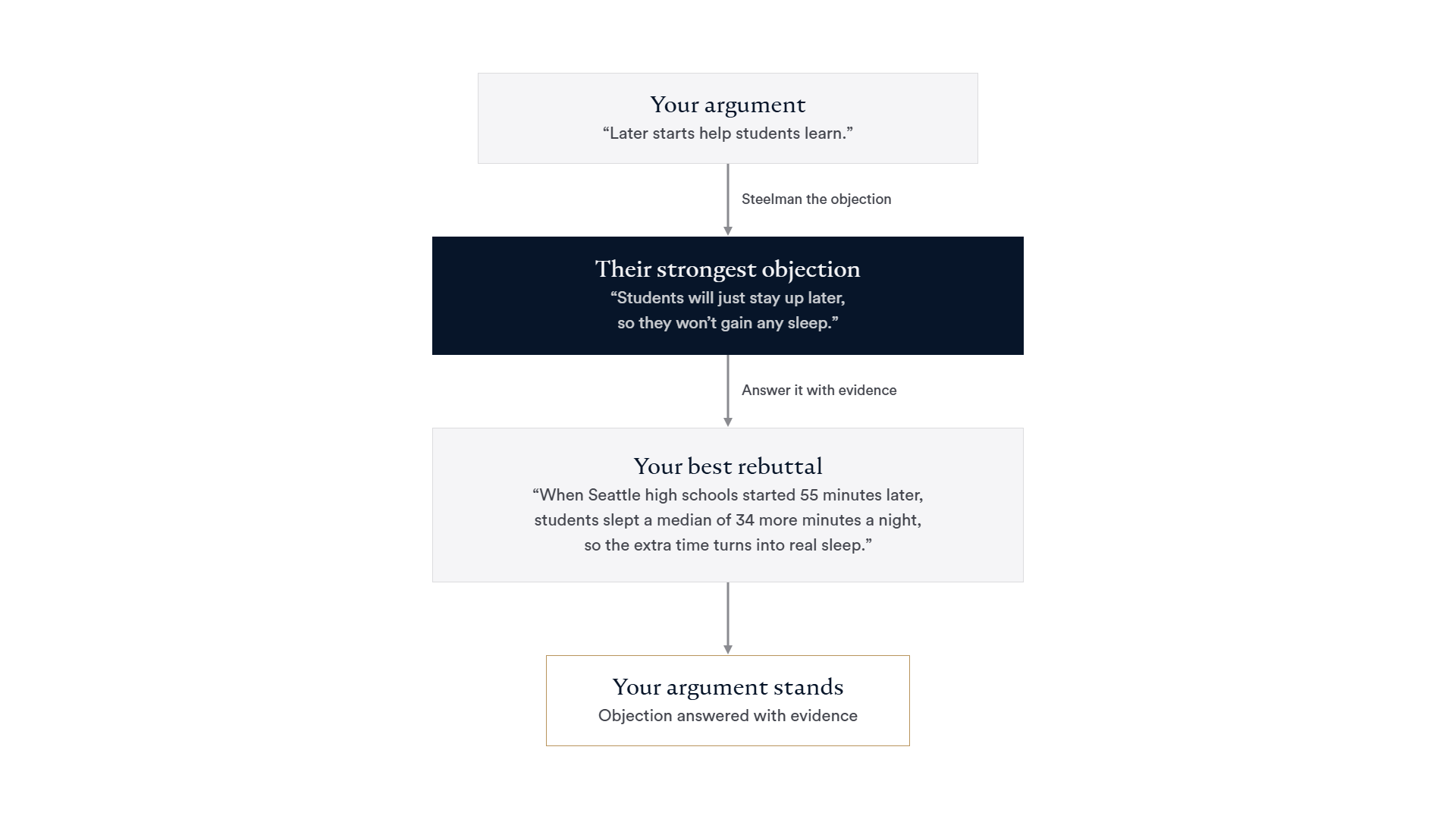
Write each rebuttal as one sentence on an index card. When the objection comes up mid-debate, you’ll answer it calmly, because the hardest thinking is already done.
Tip 5: practice out loud
You can have the strongest arguments and rebuttals in the room, but if you can’t deliver them clearly, they won’t persuade anyone. That’s why the next step is saying your case out loud, standing up, with a timer set to your exact speech length.
Record each run on your phone, then play it back and check three things.
- Pace: If a four-minute speech finishes in three, you’re rushing, so slow down and let each point land.
- Filler words: Count every “um”, “like”, and “you know”, then replace each one with a short pause.
- Eye contact: Glance at your notes for a cue, then look up to finish the sentence.
There’s no need to memorise your whole speech word for word. Learn your opening and closing lines by heart, and keep the rest as keywords on a card, so you sound natural and can adapt as the round unfolds. For your opening line, try one of these three approaches.
- A surprising fact: “When Seattle high schools started 55 minutes later, students gained 34 minutes of sleep a night.”
- A short story: “At 7am last Tuesday, I watched my friend fall asleep on the bus before first period.”
- What’s at stake: “Every school morning, first period starts with students too tired to take in what they hear.”
Regular runs, such as three a week, make your delivery feel familiar, and that familiarity plays a big part in building confidence. If nerves are your main obstacle, these public speaking anxiety tips can help before any speech or debate.
Tip 6: listen before you respond
In many competitive formats, an argument you don’t answer can count as conceded, especially if it’s central to the other side’s case. Listening closely shows you which points matter most, so you can answer those first and spend less time on minor ones.
During the round, split your page into two columns, writing each claim on the left and its evidence on the right. Then answer in four steps, as the figure below shows.
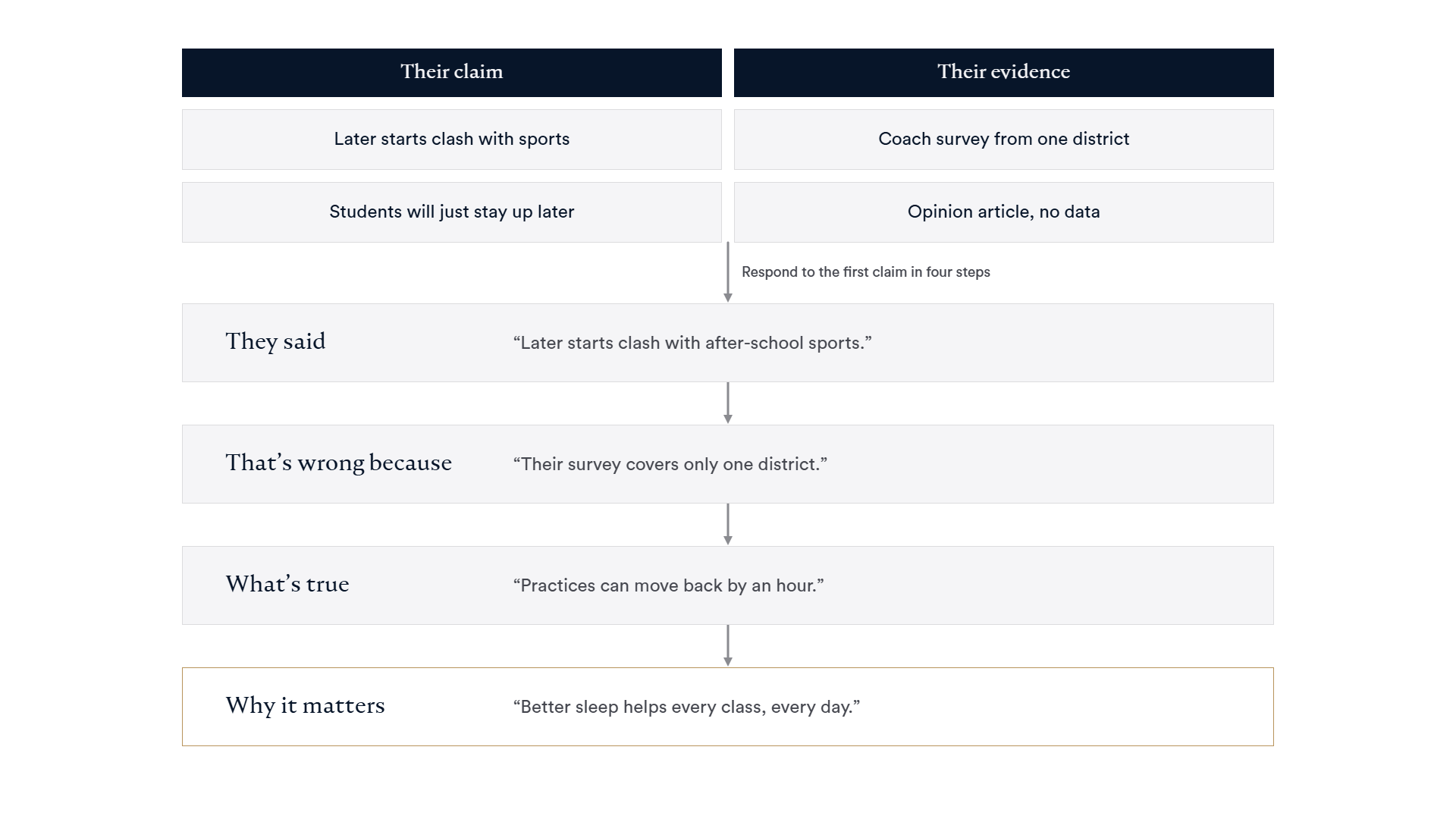
Gaps in the right-hand column, such as a missing source or outdated data, are where your rebuttals hit hardest. To buy thinking time, restate their point in one sentence before you answer.
Tip 7: learn from great debaters
Watching skilled debaters shows you techniques that are hard to learn from a guide, such as when to pause or how to turn a point around. Study each round with one clear goal, such as structure, rebuttal, or delivery.
These three sources each show a different side of debate.
- National Speech & Debate Association: Its national final rounds use the same formats from Tip 1, with high school students as the speakers. They’re the best place to watch the format you plan to compete in.
- Open to Debate: Formerly Intelligence Squared US, it features scholars, journalists, and experts debating major political and social issues. The audience votes before and after, and the side that changes more minds wins, which shows how to persuade a general audience.
- World Schools Debating Championship: National teams of high school students aged 14-19 compete in English, so you’ll see how speakers from different countries build and present a case.
After each round you watch, pick one technique the speaker used, such as a clear roadmap or a calm pause before a rebuttal. Compare it with a recording of your own speech, then try that technique in your next debate.
Tip 8: accept you won’t win every debate
Losing is part of debate at every level, and accepting that early takes the fear out of each round. It also keeps your attention on what each result can teach you. After a loss, read the judge’s ballot closely and look for comments that repeat across rounds, since those point to the skill worth working on next.
The same mindset helps during rounds, where conceding a fair minor point makes the rest of your case more believable. Over a season, steady improvement matters more than your win record.
Join the Immerse Education 2027 Essay Competition
Follow the instructions to write and submit your best essay for a chance to be awarded a 100% scholarship.

Debate drills for high school students
You don’t need a debate team or a tournament to practise your debating skills, because short drills let you train one skill at a time, at home or in class. Most take 15 minutes or less and need nothing more than a phone timer.
Here’s a five-day routine you can follow each week.
Classroom discussions count as practice too, and joining or starting a school debate team gives you regular rounds and judge feedback. If you need topics to debate, our guide to 300 debate topics organised by category has practice motions for every drill above.
Common debate mistakes to avoid
Most debate mistakes come from habits that feel safe during prep but fall apart in the round. Each one has a simple fix you can practise before your next debate.
Here are seven common mistakes and how to fix each.
- Reading from a full script: Speak from a keyword outline for your own explanations, and read word for word only when quoting evidence.
- Listing evidence without explaining it: After every statistic or quote, add a sentence starting with “This matters because...” to link it to your claim.
- Ignoring the other side’s strongest point: Answer their best argument first, because an unanswered point usually counts against you.
- Going over time: Mark one point on your card that you can drop if you’re running long, so your closing line never gets cut.
- Using a straw man: Restate their argument in a way they’d agree with before you rebut it. Twisting a 10am start into “letting students sleep all day” weakens your case.
- Attacking the person: Respond to the argument itself, because a speaker’s character doesn’t change whether their evidence holds. “She’s always late, so of course she wants later starts” ignores her case entirely.
- Offering only two choices: Acknowledge the middle options before defending yours. “Either we start later or students keep failing” overlooks alternatives, such as later starts for older grades only.
Explore public speaking with Immerse Education
Mistakes such as reading from a script or rushing to beat the clock are delivery problems, and practice with feedback helps. At TED Summer School, a public speaking course, you’ll research, write, and deliver a TED-style talk about your idea, guided by our Communication Tutors.
In small groups averaging nine participants, you’ll also practise giving and receiving feedback. You can join for two weeks in London, New York, Singapore, or Sydney (ages 15-18), or virtually (ages 14-18). You'll leave with your talk, recorded for you to keep, along with a certificate of completion.
You can also earn your place through the Learning to Be Heard Challenge, a free public speaking competition for students aged 14-18. Entrants record a one-minute video answering, “Imagine the world 100 years from now. What difference would excite you the most? Why?” The strongest win full or partial scholarships, and entries close on 10 January 2027 at 23:59 UK time.
FAQs
What qualities make a good debater?
A good debater combines curiosity, careful preparation, close listening, composure, and a willingness to change their mind. These qualities help you build strong cases, catch weak evidence, and stay calm when someone challenges your argument.
How can I improve my debate skills at home?
You can improve at home with short daily drills, such as giving a one-minute argument, arguing both sides of a motion, or rebutting a newspaper opinion piece. Record yourself to track pace and filler words.
How do I stop getting nervous when debating?
Thorough preparation reduces nerves before a debate. Rehearse your speech out loud with a timer, memorise your opening line, and write rebuttal cards in advance, so fewer moments surprise you.
How do you begin a good debate?
Begin by stating your position clearly, then give a one-line roadmap of your main arguments within the first 30 seconds. For example, “Homework should be optional for three reasons: wellbeing, independence, and fairness.”
What are good debate opening lines?
Strong opening lines usually use a surprising fact, a short story, or a clear statement of what’s at stake. For example, “Last Monday, my alarm went off at 6am, and my first class felt like a blur.”
How can I think faster in a debate?
You can think faster in a debate by preparing your answers before the round. Write rebuttals to the other side’s likely arguments, so during the round you only need to recall and adapt them.
Conclusion: your first week of practice
Confident debaters build their skills one stage at a time, from researching a motion to answering objections under pressure. You can start this week, with or without a team.
Pick a motion on day one, research both sides on day two, and write three arguments on day three. Then prepare rebuttals, record a speech, watch one round, and choose one fix.
By day seven, you’ll have practised every stage of a debate. For high school students, these debate skills are a strong start, because they support academic achievement and help you speak up with confidence in every class.
If you’d like feedback on your delivery, explore TED Summer School, where our Communication Tutors help you shape and deliver your own TED-style talk, recorded for you to keep.





Unlock Inspiring Opportunities with the Immerse Education Newsletter
Join our newsletter to stay ahead with exclusive updates, exciting programme highlights, and expert insights from the world of immersive education.
Learn how Immerse can transform your life
An in-depth overview of our university and career preparation programmes
Get a glimpse into the life of an Immerse participant
Find the right programme for you with sample timetables, location showcases, and more