15 University Preparation Summer Schools for Year 13 Students

TL;DR
You’ll find 15 university preparation summer schools, from free schemes like Oxford UNIQ and the Sutton Trust to paid courses at Imperial, King’s College London, and NUS. The main split is between fully funded programmes, which often limit places by nationality or school type, and tuition-based options open worldwide. Many target Year 12 students, so check age rules closely if you’re already in Year 13. Imperial’s Global Summer School, for example, ends with a cross-disciplinary Innovation Challenge. Immerse Education's Academic Insights pathway welcomes ages 13 to 18 in cities including Oxford, Cambridge, and Singapore.
A university preparation summer school puts you on a university campus for anywhere from one to six weeks, studying a single subject the way an undergraduate would. You sit in lectures and small seminars, work through problems or texts with the academics who teach the subject, and live alongside students who share the interest. It is a close look at the workload, independence, and pace of higher education, taken while you still have room to change your mind about what and where to study.
The programs below go further than a taster. Many are run by universities or government bodies, several are free or funded, and the most competitive admit only a small share of applicants. A summer on campus can also strengthen your applications, giving you subject knowledge, a mentor or two, and a clearer answer to the question of which course and which university actually fit you. Some award a certificate, or even transferable credit you can point to later.
How do you choose the right university preparation summer school for Year 13 students?
With so many options, the right fit depends on what you want out of the summer. If you already know your subject, a program that goes deep into one field, taught by that department’s own faculty, will tell you the most about studying it at degree level. If you are still deciding, a broader program that mixes disciplines or pairs academics with application support can help you narrow things down.
The list runs from highly selective research-university programs to open, application-supported access schemes, across the US, UK, and beyond. To help you get started, we’ve put together 15 university preparation summer schools for Year 13 students, chosen for their academic depth, campus experience, and the strength of the institutions behind them.
15 University Preparation Summer Schools for Year 13 Students
1. Yale Young Global Scholars
Location: Yale University, New Haven, CT
Cost/Stipend: Tuition varies; need-based financial aid can cover up to the full cost of tuition
Acceptance rate/cohort size: Highly selective; small seminars with a 12:1 student-to-instructor ratio
Dates: Three 2-week sessions in 2027: June 20th to July 2nd, July 4th to July 16th, and July 18th to July 30th
Application Deadline: Early Action October 15th, 2026; Regular Decision January 6th, 2027
Eligibility: High school students worldwide aged 16 to 18, in their sophomore or junior year (or international equivalent); open to international students
Yale Young Global Scholars, or YYGS, brings together high school students from more than 150 countries for a two-week academic session on Yale’s campus. You pick one of three academic tracks and build your session around it.
Your days move between lectures from Yale faculty and small seminars led by Yale undergraduate and graduate students, where you pull apart what you just heard. You live in Yale’s residential colleges alongside students from around the world. There are no grades and no course credit, so you set your own limits and follow ideas wherever they lead.
Why it stands out: It lets you choose between science and technology, law and economics, or global problem-solving, so you can test the kind of thinking each degree path would ask of you.
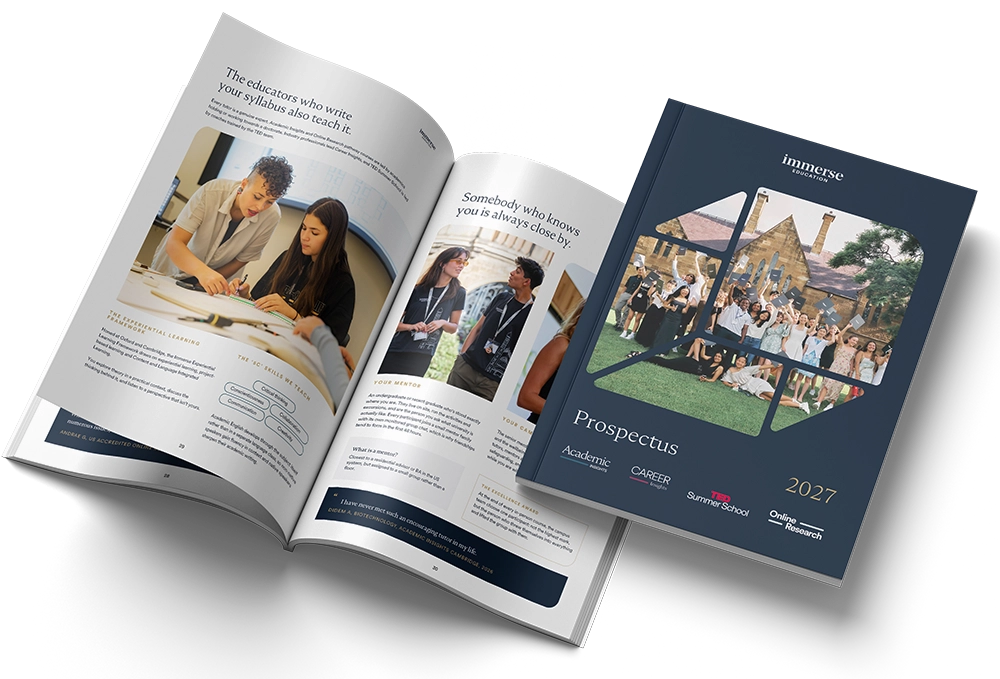
2. Immerse Education’s Pre-University Summer School

Location: Cambridge, London, Oxford, Singapore, Sydney, and Toronto
Cost/Stipend: Varies; summer school scholarship available through our bursary programme
Acceptance rate/cohort size: Selective; an average of 7 participants per class
Dates: 2 weeks during the summer
Application Deadline: Multiple cohorts with rolling admissions
Eligibility: Students aged 13 to 18; open to international students from around the world
Immerse Education's Academic Insights pathway lets you experience university life firsthand. You will study in tutor-led seminars averaging 7 students, with two 1:1 tutorials, masterclasses, and guest speakers across your two weeks. You can explore more than 20 subjects, including Architecture, Business Management, Computer Science, Economics, Medicine, and Philosophy, with residential or commuter options.
By the end of the programme, you’ll present a personal project on the final Friday, and accredited options let you earn 8 UCAS points or 3 US college credits from age 14. You can find more details about the application here.
Why it stands out: You’ll get an early start at university life and academics because the program includes an independent project, discussion-based classes, and living in a historic university city.
3. Lumiere Research Scholar Program
Location: Remote, you can participate in this program from anywhere in the world!
Cost: Varies depending on program type. Full financial aid available.
Application Deadline: Varies by cohort.
Program Dates: Varies by cohort: summer, fall, winter, or spring. Options range from 12 weeks to 1 year.
Eligibility: You must be currently enrolled in high school and demonstrate a high level of academic achievement.
The Lumiere Research Scholar Program is a rigorous research program tailored for high school students. The program offers extensive 1-on-1 research opportunities for high school students across a broad range of subject areas. The program pairs high school students with Ph.D. mentors to work 1-on-1 on an independent research project.
At the end of the 12-week program, you’ll have developed an independent research paper! You can choose research topics from subjects such as psychology, physics, economics, data science, computer science, engineering, chemistry, international relations, and more. You can find more details about the application here, and check out students’ reviews of the program here and here.
Why it stands out: You get 1-1 mentorship with a Ph.D. mentor and produce an independent research project by the end.
4. Oxford UNIQ
Location: University of Oxford, Oxford, UK
Cost/Stipend: Free
Acceptance rate/cohort size: Highly selective
Dates: One-week, subject-specific residential between late June and late July (June 29th to July 31st in 2026), arriving Monday and leaving Friday
Application Deadline: January 13th (2026 cycle; applications opened December 15th)
Eligibility: UK state-school students in Year 12 or equivalent; not open to international students
UNIQ is the University of Oxford’s free access programme for UK state-school students, and it runs subject by subject across the summer. Your residential week gives you a taste of undergraduate study at Oxford through seminars, lectures, labs, and tutorials in a single chosen subject.
Before the residential, you join a small-group online conversation with the UNIQ team and regional in-person events in the spring. You choose your subject when you apply, matching the programme to the degree you are weighing up. For a full walkthrough, see our complete guide to UNIQ Oxford.
Why it stands out: You’ll keep the programme’s guidance through online support from August to December, helping you make a competitive application to Oxford after the residential ends.
5. MITES Summer
Location: Massachusetts Institute of Technology, Cambridge, MA
Cost/Stipend: Free
Acceptance rate/cohort size: Highly selective
Dates: Six weeks, late June to early August
Application Deadline: February 1st
Eligibility: US citizens or permanent residents in 11th grade (rising seniors); not open to international students
MITES Summer condenses a demanding slice of college STEM into six weeks on MIT’s campus. You take rigorous courses in math, science, and the humanities, plus a project-based elective, and build toward a final project you present at the end.
Weekdays run through lectures, recitations, and workshops, with exams along the way. Outside class you tour MIT labs and nearby companies and hear from working STEM professionals. Your instructors also write evaluations of your strengths and growth.
Why it stands out: It connects you to an alumni community that outlasts the six weeks, with many alumni going on to top universities.


6. Telluride Association Summer Seminar
Location: Recent sites include Cornell University, Ithaca, NY, and the University of Maryland, College Park, MD
Cost/Stipend: Free; tuition, books, room and board, field trips, and facilities fees covered, with extra aid available to replace summer earnings
Acceptance rate/cohort size: Highly selective
Dates: Five weeks in June and July (June 21st to July 25th in 2026)
Application Deadline: 2027 applications open in fall 2026; the 2026 regular deadline was December 3rd, 2025
Eligibility: High school sophomores and juniors; international students must apply as sophomores
The Telluride Association Summer Seminar, or TASS, is a free humanities and social-science program. The heart of it is a college-level, discussion-based seminar, closer to a small graduate discussion than a high school class.
You read closely, then write essays through the summer with help and feedback from your instructor team. TASS courses study how power and privilege shape social structures, and the program also teaches the principles and practice of democratic community living. There are no grades and no college credit.
Why it stands out: It hands much of daily life to the students themselves, so you practice the shared, independent decision-making that living on a campus asks for.
7. Stanford Summer Humanities Institute

Location: Stanford University, Stanford, CA
Cost/Stipend: $8,850 (2026), covering housing, meals, activities, and field trips; need-based financial aid available
Acceptance rate/cohort size: Highly selective
Dates: Two 3-week sessions in 2026: June 21st to July 10th and July 12th to July 31st
Application Deadline: February 2nd (2026 cycle)
Eligibility: Rising high school juniors and seniors who are under 18 when they apply; international eligibility not specified
The Stanford Summer Humanities Institute gives you three weeks inside a single humanities question, in seminars led by Stanford professors with Stanford Ph.D. students. You focus on one course in writing, philosophy, literature, art, or history, going deeper than a survey class allows.
You live in a supervised Stanford residence hall alongside students who chose the humanities for the same reasons you did. Field trips are included in tuition. To apply, you submit a sample of your own work in the humanities or social sciences.
Why it stands out: It asks you to stay with one subject for three full weeks, which is the closest thing to choosing a humanities major before you have to.
8. Notre Dame Leadership Seminars
Location: University of Notre Dame, Notre Dame, IN
Cost/Stipend: Tuition, housing, and meals covered; $75 application fee
Acceptance rate/cohort size: Highly selective
Dates: Two sessions in 2027: June 19th to June 30th and July 10th to July 21st
Application Deadline: January 20th, 2027 (applications open October 19th, 2026)
Eligibility: High school juniors entering their senior year who are at least 16 by August 1st; open to international students
Notre Dame’s Leadership Seminars gathers academically strong students for 10 days on the university’s Indiana campus. You pick one seminar from a set that changes each year, taught by Notre Dame faculty.
The seminars are discussion-driven and push you to take and defend a position on a hard, current question rather than sit through a lecture. You work through readings and debate in a small group, then present your thinking to peers by the end of the program. The focus is as much on how you reason and lead a discussion as on the subject itself.
Why it stands out: You get 10 days of faculty-led seminars at Notre Dame with tuition, housing, and meals covered.
9. Carnegie Mellon Summer Academy for Math and Science
Location: Carnegie Mellon University, Pittsburgh, PA
Cost/Stipend: Free; fully funded
Acceptance rate/cohort size: Highly selective
Dates: Six weeks (June 20th to August 1st in 2026)
Application Deadline: February 1st (2026 cycle)
Eligibility: US citizens or permanent residents in 11th grade at application who are at least 16 by the start date; not open to international students
The Summer Academy for Math and Science is a six-week residential program at Carnegie Mellon. You take core seminars in math and science and work on a research project with faculty or graduate student guidance, presenting it at a closing symposium. Weekly workshops on the college application essay run alongside the science. Mentoring groups and workshops with alumni and industry leaders round out the six weeks.
Why it stands out: It combines fully funded STEM coursework with research and college application support in one summer.
10. Sutton Trust Summer Schools
Location: Multiple UK universities
Cost/Stipend: Free; tuition, accommodation, meals, and travel covered
Acceptance rate/cohort size: Highly selective; roughly seven applicants per place
Dates: One week between June and August
Application Deadline: March 5th (2026 cycle; applications opened January 12th)
Eligibility: UK state-school students in Year 12 (England and Wales), Year 13 (Northern Ireland), or S5 (Scotland); not open to international students
The Sutton Trust runs some of the few completely free university preparation summer schools in the UK, hosted at a network of leading universities. You spend a week at one partner university, taking undergraduate-level taster sessions in a subject you choose.
You live in a hall of residence, take classes in your subject, and get to know academics and staff, so you find out what studying there would actually be like. Workshops cover UCAS, personal statements, and student finance. You can compare more options in our list of summer schools in the UK for Year 12 students.
Why it stands out: It can change your actual odds of getting in, since some partner universities give students who complete a summer school a contextual offer.
11. Imperial Global Summer School

Location: Imperial College London, London, UK
Cost/Stipend: £7,695 (2026); no scholarships or bursaries
Acceptance rate/cohort size: Selective; places allocated first-come, first-served
Dates: Two-week sessions in 2026: June 29th to July 10th or August 3rd to August 14th
Application Deadline: Rolling until places fill
Eligibility: Students aged 16 or 17 before the start of the programme with strong academic ability and English; open to UK and international students
Imperial’s Global Summer School is a two-week residential programme for 16- and 17-year-olds at one of the world’s top science and engineering universities. In week one you pick a STEM stream, from chemistry and data science and AI to engineering, medicine and life sciences, or physics, and learn it through lectures and lab sessions.
In week two you join the Innovation Challenge, teaming up with students from other streams to solve a pressing problem. You live in student accommodation at Prince’s Gardens in South Kensington, and you leave with a certificate of participation. For more detail, read our complete guide to Imperial’s Global Summer School.
Why it stands out: It brings together students from around the world for the STEM streams, so the team you solve problems with in week two is truly international.
Join the Immerse Education 2027 Essay Competition
Follow the instructions to write and submit your best essay for a chance to be awarded a 100% scholarship.
12. Summer@Brown
Location: Brown University, Providence, RI
Cost/Stipend: 2026 residential tuition from $3,748 (1 week) to $10,858 (5-week hybrid)
Acceptance rate/cohort size: Moderately selective
Dates: June 15th to July 25th (2026); 1-, 2-, and 3-week on-campus sessions and a 5-week hybrid option
Application Deadline: Rolling admissions until May 15th (2026 cycle) or until courses fill
Eligibility: Rising sophomores, juniors, or seniors aged 14 to 18; open to international students
Summer@Brown is among the broadest university preparation summer schools here, letting you build your own experience from a catalog of more than 230 non-credit courses drawn from Brown’s Open Curriculum.
You take college-level classes without the pressure of formal grades or credit, in subjects from neuroscience to philosophy to engineering. Brown leaves much of your time to you, which is a first real test of the independence university asks for. You live on campus in Providence alongside students from around the world.
Why it stands out: You’ll come away with a Course Performance Report on courses of two weeks or longer, a written read on how you handle college-level work.
13. King’s College London Pre-University Summer School
Location: King’s College London, London, UK
Cost/Stipend: £3,195 tuition per one-week course (£3,965 with accommodation); multi-week discounts available; £65 application fee
Acceptance rate/cohort size: Moderately selective
Dates: One-week sessions in July 2026: July 6th to 10th, July 13th to 17th, July 20th to 24th, and July 27th to 31
Application Deadline: April 10th (2026 cycle)
Eligibility: Students aged 16 or 17 in their final three years of high school; English requirements apply; open to international students
King’s College London builds its Pre-University Summer School around one-week courses, so you can spend a single week on one subject or stack up to four weeks across several. Each course explores your chosen subject at degree level, covering the key debates, themes, and research areas King’s academics work on.
Subjects range across law, international relations, politics, and media, communication and digital culture, among others. Residential students stay in single en-suite rooms at Stamford Street Apartments in central London, with breakfast and dinner included, and join weekly activities across the city.
Why it stands out: It is one of the more flexible university preparation summer schools here, letting you take a different one-week course each week if you are still deciding what to study.
14. NUS College Summer School
Location: National University of Singapore, Singapore
Cost/Stipend: SGD 5,450 for international students (SGD 2,725 for Singaporeans and permanent residents; SGD 3,978.50 for ASEAN students)
Acceptance rate/cohort size: Moderately selective
Dates: June 21st to June 27th (2026)
Application Deadline: Rolling admissions until places fill
Eligibility: Pre-university students aged 16 to 18; open to international students
NUS College is the honours college of the National University of Singapore, and its one-week summer school gives pre-university students a compressed version of its interdisciplinary approach. You attend university-style classes taught by NUS faculty in fields like engineering, business, and psychology.
Running through the week is The Synthesis Lab, a team project on a complex problem that ends in a final pitch. You also take part in skill-building workshops and field excursions, and the week closes with an admissions talk and campus tour.
Why it stands out: It gives you a week inside one of Asia’s top universities, a distinctly different academic setting from the US and UK programs on this list.
15. National Youth Science Camp
Location: Monongahela National Forest, WV, and Washington, DC
Cost/Stipend: Free; housing, meals, academic programming, and transportation covered
Acceptance rate/cohort size: Highly selective; typically two delegates per US state and DC
Dates: July 11th to August 1st (2026)
Application Deadline: Mid-to-late March, varying by state (2026 cycle)
Eligibility: Graduating high school seniors and rising seniors; international delegates take part through the US State Department
The National Youth Science Camp is a residential STEAM program in the mountains of West Virginia for students heading toward university. Daily lectures and seminars with leading scientists anchor the academic side, and directed studies let you work with visiting and resident STEAM professionals.
Between the science, you can hike, backpack, rock climb, go caving, kayak, or bike in the surrounding national forest. Part of the program also takes place in Washington, DC.
Why it stands out: It is one of the few programs here open to graduating seniors, pairing serious science with time in the wilderness.
Frequently asked questions: University Preparation Summer Schools for High School Students
What is a university preparation summer school?
A university preparation summer school is a short programme that lets you study at degree level before you start university. You usually attend lectures and seminars in one subject, complete university-style work, and live on campus. Many also include application support, such as UCAS workshops or admissions talks. Some, like UNIQ and the Sutton Trust, are free access schemes, while others charge tuition.
Can Year 13 students attend university preparation summer schools?
Yes, but many programmes are built for Year 12 students or US juniors, so check age and year rules carefully. King’s College London accepts 16- and 17-year-olds in their final three years of school, NUS College welcomes ages 16 to 18, and the National Youth Science Camp is open to graduating seniors. Immerse Education's Academic Insights pathway is open to students up to age 18 in six cities worldwide. Applying in Year 12 gives you the widest choice.
Are there free university preparation summer schools?
Yes, several of the most selective ones are free. Oxford UNIQ and the Sutton Trust cover costs for UK state-school students, while TASS, MITES, and Carnegie Mellon’s SAMS are free for eligible US students. Notre Dame’s Leadership Seminars covers tuition, housing, and meals, and the National Youth Science Camp covers travel too. Free places are limited, so apply as early as you can.
Do summer schools help with UCAS applications?
They can give you strong material for your personal statement and interviews. The Sutton Trust’s partner universities may make contextual offers to students who complete a summer school, and UNIQ offers online support through the autumn of your application year. Immerse’s accredited options also earn 8 UCAS points. You can find more ideas in our guide to getting extra UCAS points.
Can international students join university preparation summer schools?
Yes, though the free UK and US programmes are often limited to home students. Yale Young Global Scholars, Imperial’s Global Summer School, King’s College London, NUS College, and Summer@Brown all accept international applicants. UNIQ and the Sutton Trust are for UK state-school students, while MITES and SAMS are for US citizens and permanent residents. Check visa timelines early if you plan to travel.
When should you apply for university preparation summer schools?
Start in the autumn term, since several deadlines fall early. Yale Young Global Scholars has an Early Action deadline of October 15th, 2026, and UNIQ closed on January 13th in the 2026 cycle. MITES and SAMS close on February 1st, and the Sutton Trust closed on March 5th in 2026. Paid programmes like King’s College London and Summer@Brown run into April and May, but popular courses fill sooner.
Preparing for undergraduate study in Year 13
Your final years of school are the best time to test a subject properly, before you commit to three or four years of it.
The right university preparation summer schools for Year 13 students give you seminars, feedback, and a clearer sense of which course suits you.
Many free programmes close between January and March, so it pays to plan your applications early in the autumn term.
For more help with personal statements, UCAS choices, and settling into student life, explore our University Preparation blogs before your next term begins.






Unlock Inspiring Opportunities with the Immerse Education Newsletter
Join our newsletter to stay ahead with exclusive updates, exciting programme highlights, and expert insights from the world of immersive education.
Learn how Immerse can transform your life
An in-depth overview of our university and career preparation programmes
Get a glimpse into the life of an Immerse participant
Find the right programme for you with sample timetables, location showcases, and more