15 STEM Summer Programs in London for High School Students

TL;DR
This list covers 15 STEM summer programs in London, most hosted at Imperial College London or UCL, ranging from free, UK state-school-only placements to a £7,695 residential program open to international students. Formats vary widely, from single-week research placements in real laboratories to structured, multi-week courses covering engineering, medicine, physics, and maths. Several options, like the Royal Observatory Greenwich placement, run at just three students per week, giving you close, hands-on access. Most programs target Year 10 through Year 13 students. Immerse Education also runs an Engineering Summer School for students aged 13 to 18, with bursary scholarships available.
If you're thinking about a STEM major, summer is probably one of the easiest times to give yourself an academic head start. You have more time, fewer school assignments, and a chance to spend a few weeks going down one particular academic rabbit hole. A STEM summer program can be a good way to use that time without turning your entire summer into another school year.
You could learn how AI systems work, build an engineering project, explore physics, study biomedical science, or learn how to code. Many programs are taught more like university courses, with seminars, practical work, projects, and instructors who expect you to actually use what you've learned. Some programs offer college credit, while others are mainly about getting exposure to a subject and figuring out if you want to keep pursuing it.
Why should I do a STEM summer program in London?
London is home to universities such as Imperial College London and UCL, both of which have major research activity across STEM fields. The city also has strong connections to medicine, technology, engineering, finance, and the life sciences. That gives students a chance to see how subjects they learn about in a summer program connect to actual research and industries.
There is also plenty to explore outside the program itself. You can visit science and technology museums, attend public lectures and events, explore university campuses, and meet students from different parts of the world. If you're trying to work out what studying STEM in college might feel like, London gives you quite a lot to investigate.
For related options, have a look at STEM internships and STEM competitions in London for high schoolers.
With that in mind, we've put together 15 STEM summer programs in London for high school students!
15 STEM Summer Programs in London for High School Students
1. Imperial College London Year 12 Work Experience Programme
Location: Imperial College London, London, UK
Cost: Free; course fees, materials, and lunch covered, with travel assistance available if cost is a barrier
Acceptance rate/cohort size: Around 20 applications per place in a recent cycle
Dates: June 29th – July 3rd
Application Deadline: March 5th; applications open January 12th
Eligibility: Year 12 students at UK state schools who meet widening participation criteria, with at least eight GCSEs including five at grades 7-9; not open to international students
Imperial College London’s Year 12 Work Experience Programme lets you spend a week inside one of its departments and see what the work actually looks like. You can choose from areas including Bioengineering, Biomedical Research, Chemical Engineering, Materials, Mathematics, the National Heart and Lung Institute, and the Grantham Institute for Climate Change and the Environment.
Once you’re placed, you’ll spend your days in the department, using research and teaching laboratories, workshops, and specialist technical spaces. There’s also a very real-world part to it: you commute to Imperial each day, work to deadlines, and present your group’s work to staff and guests at the end of the week. A student ambassador also stays with your group throughout the week.
Why it stands out: It matches each stream to specific A-level combinations, so your placement builds directly on the subjects you already study.
2. Immerse Education's Engineering Summer School

Location: London
Cost: Varies; summer school scholarship available through our bursary programme.
Acceptance rate/cohort size: Selective; an average of 7 participants per class
Dates: 2 weeks during the summer
Application Deadline: Multiple cohorts with rolling admissions.
Eligibility: Students around the world aged 13-18 currently enrolled in middle or high school
The Academic Insights Engineering Summer School offers a structured introduction to university-level engineering, taught by expert academics. Delivered in small classes averaging just 7 students, the program blends theory with applied learning. For students aged 13–15, the course introduces foundational principles, including mechanics, forces, materials, and basic electronics. Guided workshops and design tasks help students understand how engineers approach problem-solving.
For students aged 16–18, the curriculum advances into mechanical systems, electrical circuits, sustainability, and applied engineering design. You will complete more independent projects and analyze real engineering challenges, developing reasoning expected at the undergraduate level. Across all ages, learning includes university-style lectures, problem-solving sessions, weekly 1:1 tutorials, and a personal engineering project, ending with written feedback and a certificate.
Why it stands out: Age-specific syllabi tailored to students' academic stages, expert tutors from leading universities, small-group teaching that encourages discussion, and personalized feedback that supports meaningful academic growth and university readiness.
3. UCL Sutton Trust Summer Schools
Location: UCL, London, UK
Cost: Free; travel, accommodation, and meals all covered
Acceptance rate/cohort size: Around 250 students attend each summer
Dates: July 27-31 (Chemical Engineering) or August 17-21 (Natural Sciences and Pharmacy)
Application Deadline: March 5th through the Sutton Trust portal; teacher verification closes March 11th
Eligibility: Year 12 students (S5 in Scotland, Year 13 in Northern Ireland) at UK state schools who meet Sutton Trust eligibility criteria; not open to international students
The UCL Sutton Trust Summer Schools give you a full week to test out a subject while living at UCL. What you actually do depends on your stream: Chemical Engineering includes laboratory experiments, process simulation software, and a team design challenge; Natural Sciences moves across areas such as protein visualization, coding, and physics; and Pharmacy combines laboratory work with clinical skills workshops.
You’ll also attend lectures and seminars, explore London with current UCL students, and take part in sessions on UCAS, personal statements, and student finance. You stay in UCL halls for the entire week, with your own en-suite room, so living on campus is built into the experience.
Why it stands out: You'll join a Sutton Trust alumni community of more than 3,500 members once you finish, with access to events and career opportunities.
4. Imperial Global Summer School
Location: Imperial College London, London, UK
Cost: £7,695 for the two-week residential program
Acceptance rate/cohort size: Selective
Dates: June 29th – July 10th or August 3-14
Application Deadline: Rolling; subject streams close as they fill
Eligibility: Ages 16-17 with excellent academic ability and strong English language skills; open to international students
The Imperial Global Summer School starts with a week focused on a single subject, so you can spend several days delving deeply into a field. Depending on your session, you could study Chemistry, Data Science and Artificial Intelligence, Engineering, Physics, or Medicine and Life Sciences. The Medicine stream includes clinical skills practice at St Mary’s Hospital, while the other streams mix lectures, practical sessions, and workshops.
Then comes the fun part: week two puts you into a mixed-subject team for an Innovation Challenge run by Imperial’s Enterprise Lab, where you develop and pitch a solution to a current problem. You’ll also get masterclasses on UK university applications and interviews, with evenings and a weekend of activities around London.
Why it stands out: You'll sleep in Prince's Gardens, the same South Kensington accommodation first-year undergraduates use, a short walk from the Science and Natural History museums.
5. In2STEM by In2scienceUK
Location: Multiple London sites, including UCL, the Royal Veterinary College, and St Bartholomew's Hospital, London, UK
Cost: Free, with a bursary covering travel and lunch during placements
Acceptance rate/cohort size: Highly competitive; more than 5,350 students supported to date
Dates: July 20th – August 21st, built around a 1- 2 week in-person placement
Application Deadline: Applications open in December and close in April
Eligibility: Year 12 students aged 16 or over at non-selective UK state schools, meeting at least one widening participation criterion; not open to international students
In2STEM puts you alongside people who are already doing science and engineering for a living. You’ll spend one or two weeks in a real placement, which could be in a university teaching laboratory, PhD research lab, hospital, or another research setting matched to your interests. The placement is supported by live online workshops covering employability, skills, and STEM careers, along with public engagement competitions where you get to communicate scientific ideas.
Before the summer begins, there’s an induction to get you ready, and the programme ends with a celebration event. You can also turn work from your placement into a CREST Award submission, giving you something concrete to take forward into university or apprenticeship applications.
Why it stands out: It lets you convert your placement work into a CREST Award submission, which strengthens a university or apprenticeship application.



6. Imperial College London Year 10 Insights Summer School

Location: Imperial College London, London, UK
Cost: Free; fully funded, covering course fees, materials, accommodation, and three meals a day (travel not included)
Acceptance rate/cohort size: Competitive
Dates: July 29th – August 1st
Application Deadline: March 11th; applications open January 12th, and references close March 18th
Eligibility: Year 10 students who live and attend school in the UK, on track for at least five GCSEs at grades 7-9, including maths and sciences; not open to international students
Imperial’s Year 10 Insights Summer School gives you a few days to poke around different parts of STEM before you have to start making bigger decisions about subjects and university. You choose either a science or engineering stream and then move through workshops covering areas such as biology, chemistry, physics, and different branches of engineering.
The workshops take place in Imperial’s undergraduate teaching laboratories, so you get to work in the same kind of spaces used for university teaching. You’ll stay in halls, take part in evening activities, and have an undergraduate mentor with your group throughout the week. The programme also ends with a poster conference where you present what you have worked on to workshop leaders and guests.
Why it stands out: You'll have an undergraduate mentor attached to your small group all week, answering your questions about degree options as they come up.
7. UCL Year 12 Maths Summer School: Maths in Action
Location: UCL, London, UK
Cost: Free; food provided and travel funded for eligible students
Acceptance rate/cohort size: Selective; prioritizes groups least represented at UCL
Dates: July 20-24, non-residential
Application Deadline: June 3rd
Eligibility: Year 12 students studying Mathematics and Further Mathematics; not open to international students
This five-day course, run by UCL's Mathematics department, shows you what the subject is like outside the classroom. You'll model blood flow with differential equations, trace how viruses spread through populations, and get an introduction to cryptography and secure communication. The emphasis is on how mathematicians build models, choose assumptions, and interpret results, rather than on drilling methods.
University sessions on student finance, personal statements, and life at UCL run alongside the maths. By the end, you'll have a clearer answer to whether a mathematics degree is right for you. Most STEM summer programs in London for high school students survey a whole field; this one goes deep on a single discipline.
Why it stands out: It teaches you to question a model's limitations, a habit that separates degree-level mathematics from school work.
8. NPL Academy at the National Physical Laboratory
Location: National Physical Laboratory, Teddington, London, UK
Cost: Free; travel and subsistence not covered
Acceptance rate/cohort size: 30-50 students per year
Dates: One week during the summer, 10 am – 3:30 pm daily; exact dates are published when applications open in December
Application Deadline: Applications open in December
Eligibility: Years 10-13 who can demonstrate an interest in science, engineering, or business beyond the classroom; not open to international students
NPL is the UK's national measurement laboratory, and its Academy gives you a week inside it. You join a small team under an NPL host who sets a project and mentors you through it. Projects have covered atomic clocks, quantum science, fiber optics, microscopy, electronics, and computer programming. Monday brings induction, demonstrations, and team building; Wednesday afternoon adds a cohort-wide challenge on site.
You spend the rest of the week on project work, then write up and present your results to the full cohort and guests on Friday. No prior reading or preparation is required. Among STEM summer programs in London for high school students, this is one of the very few set inside a working government laboratory.
Why it stands out: It puts you alongside the scientists who maintain the UK's measurement standards, from the definition of the second to the kilogram.
9. Work Experience at the Royal Observatory Greenwich
Location: Royal Observatory Greenwich (currently based at the National Maritime Museum), London, UK
Cost: Free
Acceptance rate/cohort size: Nine placements per summer, three students per week
Dates: One week in August; three placement weeks run each summer
Application Deadline: TBA; decisions are sent by late April; contact ROGEducation@rmg.co.uk
Eligibility: Secondary school students in Years 10-13; not open to international students
The Royal Observatory Greenwich puts you on the science communication side of astronomy for a week. You’ll sit in on sessions for school groups and visitors, help create social media content, and review those sessions to suggest ways they could work better.
One of your projects is to write a script about what people can see in the night sky during a particular month, which can then be used for the Observatory’s Look Up! podcast. You’ll also have a conversation with an astronomer about university choices and careers in astronomy. One day is completed from home, while the rest takes place with the Observatory team at the National Maritime Museum during the refurbishment of the Greenwich building.
Why it stands out: It gives you a science communication credit you can point to, since your podcast script reaches the observatory's public audience.
10. King's Maths School "Step up to A level" Summer School
Location: King's College London (Strand Campus), London, UK
Cost: Free; lunch provided and financial support available for travel
Acceptance rate/cohort size: Selective
Dates: July 13-17, roughly 9:45 am – 3:15 pm daily
Application Deadline: May 24th
Eligibility: Year 11 students planning to study Maths and Physics in Year 12, with an interest in Further Maths helpful; not open to international students
King’s Maths School takes five days to bridge the slightly awkward gap between GCSE and A-level. You’ll work through Maths, Physics, and Further Maths each day, with sessions designed to introduce the ideas and problem-solving approaches you’ll meet in sixth form. There are lectures, group problem-solving sessions, and practical physics experiments in university laboratories.
You’ll be working alongside other Year 11 students who are heading towards Maths and Physics, so the problems can get a little more interesting than the usual GCSE worksheet. The programme also gives you a look at what studying these subjects at a specialist sixth form can feel like before September arrives.
Why it stands out: You'll begin Year 12 having already met the ideas your A-level courses open with, which takes pressure off the hardest transition year.
11. UCL UnlockSTEM

Location: UCL, London, UK
Cost: Free
Acceptance rate/cohort size: Selective
Dates: June 29th – July 1st
Application Deadline: Applications open in spring on UCL's Access Initiatives page
Eligibility: Year 12 and Year 13 students at UK state schools; not open to international students
UnlockSTEM is a three-day summer school run by the UCL Division of Medicine, one of the world's leading centers for medical research. You work alongside practicing scientists and gain hands-on experience in UCL laboratories, seeing how research is actually conducted day to day. The program maps the full range of career pathways inside biomedical science, not just the route through medical school.
You'll meet academic staff and other students weighing the same choices between medicine, biomedical sciences, and research. It is short, focused, and useful if you need evidence to decide between clinical and laboratory directions.
Why it stands out: It concentrates on biomedical research as a career in its own right, a path most school careers advice skips past.
Join the Immerse Education 2027 Essay Competition
Follow the instructions to write and submit your best essay for a chance to be awarded a 100% scholarship.
12. King's College London Pre-University Summer School
Location: King's College London, London, UK
Cost: £3,195 per one-week course plus a £65 application fee; residential package £3,965
Acceptance rate/cohort size: Selective
Dates: Weekly sessions from July 6-10 through July 27-31
Application Deadline: April 27th
Eligibility: Ages 16-17 with strong recent grades and B2-level English; open to international students
King’s lets you pick a one-week subject course and see how it is taught at university level. The STEM options include Medical Science, Neuroscience, Computer Science, and Science, Technology, and Engineering, with lectures, seminars, interactive sessions, and assignments built around each subject. The Medical Science course, for example, takes you through areas such as anatomy and the cardiovascular system.
Your assignments receive written feedback, and completing the course earns you a King’s certificate. If you choose the residential option, you’ll stay in a single en-suite room at Stamford Street Apartments, with meals and 24-hour staff support included. You can also take courses in consecutive weeks if you want to build a broader summer around more than one subject.
Why it stands out: You'll be able to stack two or three different courses across consecutive weeks and build a multi-subject program of your own.
13. Mission Discovery Summer School at King's College London
Location: King's College London (Strand and Waterloo campuses), London, UK
Cost: £799 (day program) or £1,999.99 (residential in King's College London halls)
Acceptance rate/cohort size: Selective
Dates: July 6-10, with residential arrival the day before
Application Deadline: Rolling; booking closes when places sell out
Eligibility: Students aged 14-18; open to international students
Mission Discovery turns your team into a tiny space mission design office for five days. You’ll work with a dedicated mentor to design an experiment that could eventually be carried out in space, while learning about experiment design, budgeting, leadership, teamwork, and public speaking. NASA astronauts, NASA personnel, and King’s academics take part in the programme, giving you plenty of opportunities to hear how space research works beyond the movies.
At the end, each team pitches its experiment to a judging panel. The winning team gets the chance to have its experiment built at King’s and launched to the International Space Station. Residential students stay in King’s halls with 24-hour supervision and escorted travel to campus.
Why it stands out: You'll take home a completion certificate signed by a NASA astronaut and King's College London professors.
14. EDT Insight into University: Mechanical Engineering at UCL
Location: UCL, London, UK
Cost: £475, with bursaries available
Acceptance rate/cohort size: 36 students
Dates: June 22-25, residential (three nights)
Application Deadline: No published deadline; apply early to secure a spot
Eligibility: Students with an interest in engineering and problem solving; Mathematics and Physics A-levels (or equivalent) are needed for UCL's degree; not open to international students
Run by the Engineering Development Trust with UCL Mechanical Engineering, this course compresses the shape of a first-year student's week into four days. You stay in undergraduate halls of residence and move between lectures, practical workshops, laboratory sessions, and team challenges. You'll work through how a typical mechanical engineering project is approached and tackled, from the skills it requires to the way problems get broken down.
Admissions staff explain what the degree requires and where it leads, and engineering role models talk through their own routes into the field. Social events each evening round out the residential experience. The course suits you if you love maths and physics but do not necessarily see yourself as a mathematician or a scientist.
Why it stands out: It shows you the difference between studying physics and applying it, which is the exact question a mechanical engineering degree answers.
15. UCL Self-Balancing Robotic Car: An Introductory Engineering Summer School
Location: UCL, London, UK
Cost: Free
Acceptance rate/cohort size: Selective
Dates: July 6-10
Application Deadline: Applications open in spring on UCL's Access Initiatives page
Eligibility: Students studying A-level Mathematics or equivalent; UCL access programs prioritize UK state school students; not open to international students
Run as part of UCL's Engineering for All summer program, this five-day course is built around a single project. You'll design, build, and program a self-balancing, self-driving robotic car in one week. You work in a small team, solving challenges as your build progresses and testing ideas as you go.
No prior experience is needed; the course asks only for curiosity and creativity. Along the way you'll get a feel for how engineers move from an idea to a working machine, and for what studying engineering at a university like UCL involves.
Why it stands out: It shows you how electronics, code, and 3D design interlock in one build, a crossover that single-subject courses rarely cover.
Frequently Asked Questions: STEM Summer Programs in London for High School Students
Can international students attend STEM summer programs in London?
Eligibility varies sharply across this list, so checking each program's rules matters more than usual. Most UK state-school placements, including Imperial's Year 12 and Year 10 Insights Summer Schools, the UCL Sutton Trust Summer Schools, and In2STEM, are explicitly not open to international students. Paid, selective programs like the Imperial Global Summer School and King's College London Pre-University Summer School do accept applicants from anywhere in the world. Immerse Education's Engineering Summer School, delivered across eight locations including London, welcomes students worldwide aged 13 to 18, with bursary scholarships available.
Are there free STEM summer programs in London for high school students?
Yes, several programs on this list charge no tuition at all, though most are restricted to UK state-school students. Imperial College London's Year 12 Work Experience Programme and Year 10 Insights Summer School are both fully funded, covering materials and meals, while the UCL Sutton Trust Summer Schools cover travel, accommodation, and food as well. In2STEM and the Royal Observatory Greenwich placement are also free, with In2STEM adding a bursary for travel and lunch during placements. For more information, look through our list of scholarships for stem students.
What age do you need to be for a STEM summer program in London?
Age requirements vary by program and typically correspond to UK school years. Imperial's Year 10 Insights Summer School targets Year 10 students specifically, while several others, including the UCL Sutton Trust Summer Schools and In2STEM, are aimed at Year 12 students aged 16 and above. Programs open to international students, like the Imperial Global Summer School and King's College London Pre-University Summer School, set a minimum age of 16 or 17. Mission Discovery at King's College London has the widest range, accepting students aged 14 to 18.
Do STEM summer programs in London help with university applications?
Many of these programs are built specifically with future university applications in mind. In2STEM lets you convert placement work into a CREST Award submission, while UCL's Maths in Action and Self-Balancing Robotic Car courses run alongside sessions on personal statements and student finance. The Imperial Global Summer School includes masterclasses on UK university applications and interviews. Programs like the Royal Observatory Greenwich placement give you concrete, specific work, such as a published podcast script, to reference directly in your application essays.
What subjects can you study in a London STEM summer program?
London's STEM summer programs span a wide academic range, so your options depend on your specific interest. You can study engineering and robotics through UCL's Self-Balancing Robotic Car course or Imperial's engineering streams, medicine and clinical skills through the Imperial Global Summer School's Medicine stream, or mathematics in depth through UCL's Maths in Action program. Physics, chemistry, and biomedical science are covered across multiple Imperial and UCL placements, while the National Physical Laboratory Academy adds specialized areas like quantum science and atomic clocks.
How selective are STEM summer programs in London?
Selectivity varies widely, from highly competitive UK-only placements to more accessible paid options. Imperial College London's Year 12 Work Experience Programme receives around 20 applications per place, while In2STEM has supported more than 5,350 students to date but remains highly competitive for each placement. The Royal Observatory Greenwich offers only nine placements per summer, at three students per week. Paid, international programs like the Imperial Global Summer School and King's College London Pre-University Summer School are also selective, though acceptance depends more on meeting academic and English-language criteria than on a fixed number of spots.
Preparing for university through STEM in London
Spending a week or two inside an actual research lab teaches you far more about university-level STEM than any classroom lecture back home ever could.
Whether you land a free placement or enrol in a paid program, a stem summer program in london for high school students gives your application something concrete to reference.
Working alongside academics, mentors, and current undergraduates lets you test whether a subject truly fits before committing years of study to it.
For guidance on turning this experience into a stronger application, visit Immerse Education's University Preparation blogs to plan your next steps.







Unlock Inspiring Opportunities with the Immerse Education Newsletter
Join our newsletter to stay ahead with exclusive updates, exciting programme highlights, and expert insights from the world of immersive education.
Learn how Immerse can transform your life
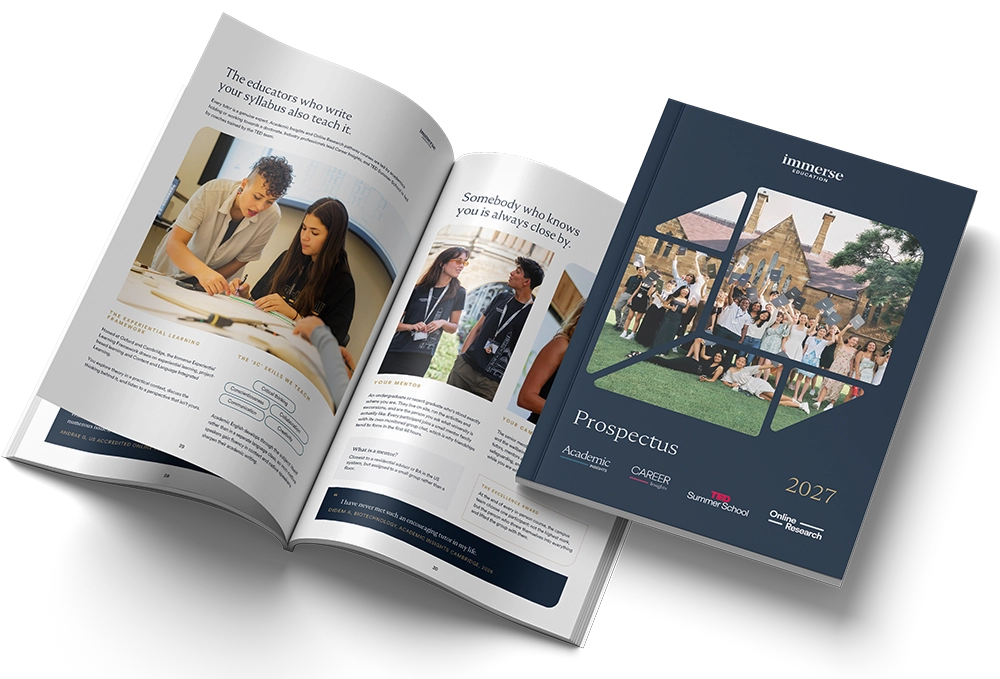
An in-depth overview of our university and career preparation programmes
Get a glimpse into the life of an Immerse participant
Find the right programme for you with sample timetables, location showcases, and more