15 Pre-College Programs for International High School Students

TL;DR
On this page, you’ll find pre-college programs to consider as an international student, from free research programs like RSI and Rockefeller’s SSRP to tuition-based math intensives such as PROMYS and Ross. Eligibility varies widely, and several programs on this list, including Simons, Clark, and BU’s RISE, are limited to U.S. citizens or permanent residents. The Summer Science Program is free for families earning $75,000 or less, and its aid covers international students too. Immerse Education’s Academic Insights pathway welcomes students aged 13 to 18 from around the world in cities such as Cambridge, Singapore, and Toronto.
As an international high school student, you may already be thinking about what comes next after graduation. Perhaps you’re curious about studying abroad, exploring a specific academic field, or experiencing university life before submitting college applications. While classroom learning can help you build a strong academic foundation, it often offers only a limited glimpse into what higher education is really like.
Imagine spending part of your summer attending lectures taught by university faculty, conducting research alongside experienced mentors, collaborating with students from around the world, or working on projects that challenge you to think beyond your school curriculum. Pre-college programs provide opportunities to explore academic interests in greater depth while developing skills such as critical thinking, communication, problem-solving, and independent learning.
How do you choose the right pre-college programs for international high school students?
With so many options available, finding the right program can feel overwhelming. Some focus on academic exploration, while others emphasize research, leadership, career preparation, or cultural exchange. Certain programs are highly selective and fully funded, whereas others offer scholarships or financial aid to make participation more accessible.
The best pre-college programs combine rigorous academics with meaningful practical experiences. They allow you to learn from university professors, tackle challenging problems, and experience life on a college campus. Whether you’re interested in STEM, the humanities, social sciences, business, public policy, or interdisciplinary studies, there are programs designed to help you explore your interests while preparing for future university studies.
15 Pre-College Programs for International High School Students
1. RSI (Research Science Institute)
Location: Massachusetts Institute of Technology (MIT), Cambridge, Massachusetts, with a second site at Stanford University from 2027 (run by the Center for Excellence in Education)
Cost/Stipend: Free
Acceptance rate/cohort size: About 100 students at MIT each summer, plus 50 at Stanford in 2027
Program Duration: About six weeks in the summer
Application Deadline: December 11th, 2026, for RSI 2027; international students should also review CEE’s international outreach pathways
Eligibility: High school juniors (seniors are not eligible); open to international students
The Research Science Institute (RSI) is an intensive STEM research program that introduces you to university-level scientific inquiry through advanced coursework and mentored research. You’ll begin with a week of intensive STEM classes taught by accomplished professors, then spend five weeks on an individual research project under the guidance of experienced scientists and researchers.
You’ll read current literature in your field, carry out a detailed research plan, and engage with research design, data analysis, and scientific communication. During the final week, you’ll prepare conference-style written and oral presentations on your findings. The program emphasizes the full research process, from identifying a research question to presenting results. Through close mentorship and exposure to active research environments, you’ll gain insight into how scientific investigation is conducted at the university and professional levels.
Why it stands out: RSI combines advanced STEM coursework with mentored independent research, letting you experience the complete research cycle at no cost alongside some of the world’s most accomplished high school students.
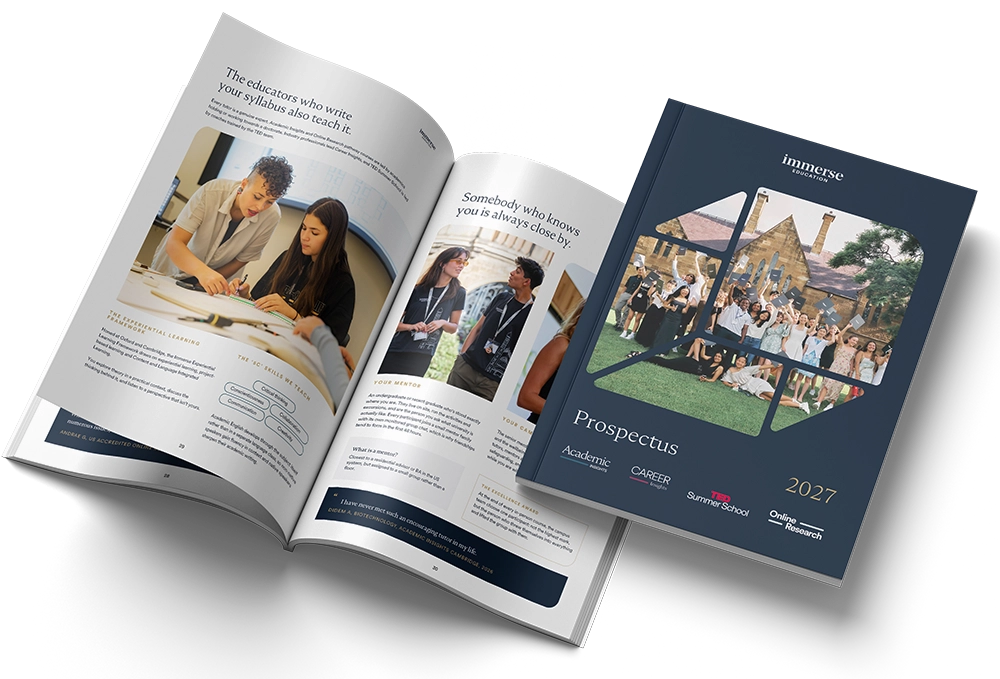
2. Immerse Education’s Pre-University Summer School

Location: Cambridge, London, Oxford, Singapore, Sydney, and Toronto
Cost: Varies; summer school scholarship available through our bursary programme
Acceptance rate/cohort size: Selective; an average of 7 participants per class
Program Dates: 2 weeks during the summer
Application Deadline: Multiple cohorts with rolling admissions
Eligibility: Students aged 13 to 18; open to international students from around the world
Immerse Education’s Academic Insights pathway gives you two weeks of undergraduate-level study in one subject while you live and learn in cities such as Cambridge, Oxford, Singapore, and Toronto. You’ll learn in tutor-led seminars averaging 7 students, with two 1:1 tutorials, masterclasses, and guest speakers built into your timetable.
You can choose from more than 20 subjects, including Architecture, Artificial Intelligence, Business Management, Economics, Engineering, Law, and Medicine. By the end of the course, you’ll complete a personal project and present it on the final Friday. From age 14, you can also opt in to earn 8 UCAS points or 3 US college credits. You can find more details about the application here.
Why it stands out: You get an early start on university life and academics through small, discussion-based classes, a personal project, and time living alongside students from around the world.
3. Lumiere Research Scholar Program
Location: Remote, you can participate in this program from anywhere in the world!
Cost: Varies depending on program type. Full financial aid available.
Application Deadline: Varies by cohort.
Program Dates: Varies by cohort: summer, fall, winter, or spring. Options range from 12 weeks to 1 year.
Eligibility: You must be currently enrolled in high school and demonstrate a high level of academic achievement.
The Lumiere Research Scholar Program is a rigorous research program tailored for high school students. The program offers extensive 1-on-1 research opportunities for high school students across a broad range of subject areas. The program pairs high school students with Ph.D. mentors to work 1-on-1 on an independent research project. At the end of the 12-week program, you’ll have developed an independent research paper!
You can choose research topics from subjects such as psychology, physics, economics, data science, computer science, engineering, chemistry, international relations, and more. You can find more details about the application here, and check out students’ reviews of the program here and here.
Why it stands out: You get 1-1 mentorship with a Ph.D. mentor and produce an independent research project by the end.
4. Simons Summer Research Program
Location: Stony Brook University, Stony Brook, New York, USA
Cost/Stipend: No program fees or tuition; residential participants pay for housing and dining; $75 application fee, with waivers for significant financial need
Acceptance rate/cohort size: 60 fellows selected from 1,864 applications in 2026
Program Duration: June 28th to August 6th, 2027
Application Deadline: February 5th, 2027, with teacher recommendations due February 12th; your school must nominate you (up to three nominees per school)
Eligibility: 11th graders who are at least 16 by the start of the program and are U.S. citizens or permanent residents. International students are not eligible. Prior research experience is not required.
The Simons Summer Research Program places you inside a faculty research group at Stony Brook University for six weeks. You’ll work alongside faculty mentors from departments such as chemistry, computer science, geosciences, marine science, and neurobiology. You’ll run experiments, analyze data, and take on a research question of your own, then finish by presenting a research poster.
Mentors volunteer their time, and you’ll join research already underway, doing some of the same kinds of work the lab carries out during the academic year. Throughout the experience, you’ll develop research, communication, and analytical skills while gaining insight into how scientific investigations are conducted.
Why it stands out: The program integrates you into active research groups, and 10 of its 2026 fellows were named Regeneron STS Scholars.
5. Stanford Inspiring Future Scientists through Shadowing (IFSS)
Location: Stanford University Department of Chemistry, Stanford, California
Cost/Stipend: Free; no funding for room, board, or transportation
Acceptance rate/cohort size: A small cohort; the volunteer-run program has limited capacity
Program Duration: June 15th to 26th, Monday to Friday, 9 a.m. to 12 p.m. (2026 dates; 2027 dates not yet posted)
Application Deadline: March 1st at 11:59 p.m., including your recommendation letter (2026)
Eligibility: Rising high school juniors and seniors who are at least 16 by the first day of the program and who live and attend school in Alameda, Santa Clara, San Francisco, or San Mateo County. Students who will have graduated are not eligible. International students living outside these counties are not eligible.
Inspiring Future Scientists through Shadowing (IFSS) is a two-week program run by Stanford’s Department of Chemistry that introduces you to cutting-edge chemical research. Instead of running your own project, you’ll shadow and talk with several chemistry graduate students, which gives you a broad view of many research topics and techniques. The program includes required safety training and activities, so you must attend the full two weeks.
Your application includes a personal form and a one-page recommendation that speaks to your interest in chemistry and your maturity. The program prohibits the use of AI in preparing applications, since it wants to understand your personal interest. By the end of the program, you’ll have a clearer picture of what chemistry research looks like day to day.
Why it stands out: Shadowing multiple Stanford researchers gives you a wide-angle view of chemical research that single-project programs rarely offer.



6. Princeton University Laboratory Learning Program
Location: Princeton University, Princeton, New Jersey (in person; there are no virtual or remote projects)
Cost/Stipend: Free; no stipend, housing, or transportation provided
Acceptance rate/cohort size: More than 3,000 applications each year; available projects change annually
Program Duration: Typically five to six weeks in the summer, scheduled by each research group
Application Deadline: Applications open February 15th, 2027, and close in mid-March; 2027 details will be announced in February 2027
Eligibility: Students who are at least 16 by June 15th, attend a local New Jersey high school, and are U.S. citizens (permanent residents are not accepted). International students are not eligible.
The Princeton University Laboratory Learning Program is a full-time research experience in the sciences or engineering for local high school students. You’ll join ongoing research programs where you’re closely supervised by Princeton faculty and research staff. Depending on the project, you may work on experimental design, data analysis, computational modeling, literature review, or laboratory techniques.
Safety training is required before you begin lab work. At the end of the summer, you’ll submit a two-page research summary covering your research question, methods, data, and conclusions. The program doesn’t award academic credit, but it gives you a close look at how scientific questions are investigated at the university level.
Why it stands out: You contribute to active Princeton research projects at no cost, working inside labs rather than completing pre-designed coursework.
7. PROMYS (Program in Mathematics for Young Scientists)
Location: Boston University, Boston, Massachusetts (residential)
Cost/Stipend: Up to $8,000 for the six-week residential program (2026), depending on financial aid; free for domestic students whose families earn under $80,000; financial aid for international students considered case by case
Acceptance rate/cohort size: About 80 high school students and 25 undergraduate counselors
Program Duration: June 27th to August 7th, 2027
Application Deadline: End of February 2027 (exact date to be confirmed)
Eligibility: Students aged 14 to 18 who have completed 9th grade and are not yet enrolled full time in college; open to international students. Your application includes solutions to a challenging problem set.
PROMYS is a six-week residential mathematics program that introduces you to proof-based mathematical thinking through advanced study of number theory. You’ll work through challenging daily problem sets designed to develop logical reasoning, mathematical writing, and independent problem-solving skills. Undergraduate counselors live and work alongside you, so help is close by when you get stuck on something difficult.
You’ll take part in lectures and discussions and receive feedback on your work while collaborating with peers from across the U.S. and around the world. Throughout the program, you’ll learn how mathematicians formulate conjectures, test ideas, and construct rigorous proofs. The experience prepares you for university-level mathematics by emphasizing analytical thinking and mathematical communication.
Why it stands out: PROMYS emphasizes deep, proof-based reasoning rather than accelerated coursework, and its need-based aid model keeps it accessible to students from many backgrounds.
8. Ross Mathematics Program
Location: Otterbein University (Columbus, Ohio) and Rose-Hulman Institute of Technology (Terre Haute, Indiana)
Cost/Stipend: Program fee varies; financial aid available, including some aid for international students (travel costs are rarely covered)
Acceptance rate/cohort size: About 60 first-year students per site; about 15% of complete applications were accepted in 2023
Program Duration: June 14th to July 24th (2026 dates; 2027 dates not yet posted)
Application Deadline: The 2026 application window has closed; 2027 dates not yet posted
Eligibility: Pre-college students, nearly all aged 15 to 18; open to international students with reasonable English fluency
The Ross Mathematics Program is an intensive six-week residential program built around number theory and the idea of thinking deeply about simple things. You’ll work through mathematics with pencil and paper, attending lectures and seminars and spending much of your time on problem sets that push you to write careful proofs.
Phones and other devices are set aside, so the focus stays on the mathematics and your conversations with counselors and peers. Each year, several talented students from outside the U.S. are accepted, and past participants have come from countries including China, India, Japan, Singapore, and Turkey. Since Ross isn’t a credit-bearing college program, international students can attend on a B-2 tourist visa. By concentrating on a single subject for the whole session, you’ll build the depth of reasoning used in university mathematics.
Why it stands out: Its focus on one mathematical area for the full six weeks builds a depth of understanding that short, survey-style programs rarely reach.
9. Anson L. Clark Scholars Program
Location: Texas Tech University, Lubbock, Texas, United States
Cost/Stipend: No program fees; on-campus room, board, and meals covered; $750 stipend when you complete your research project report; $25 application fee and travel not covered
Acceptance rate/cohort size: Twelve scholars each summer
Program Duration: June 20th to August 5th, 2027
Application Deadline: 2027 deadline not yet posted
Eligibility: Rising high school seniors and recent graduates who are at least 17 by the start date; U.S. citizens or permanent residents only. International students are not eligible.
The Anson L. Clark Scholars Program is a seven-week residential research program at Texas Tech University where you work closely with a faculty mentor on an individual research project. You can pursue research in fields ranging from the sciences and engineering to the humanities, depending on available faculty projects.
Rather than taking traditional classes, you’ll spend most of your time doing research and learning methods used in university labs and academic departments. The program also includes weekly seminars, social activities, and weekend programming. At the end of the program, you’ll complete a formal research report summarizing your findings.
Why it stands out: The program’s tiny cohort gives you substantial one-on-one interaction with a faculty mentor and focused time on your own project.
10. Summer Science Program (SSP)
Location: Host university campuses across the United States (residential)
Cost/Stipend: Free for families earning $75,000 or less, with discounts for family incomes under about $140,000; financial aid is available to international students and can cover airfare
Acceptance rate/cohort size: Research teams of three; cohort size varies by campus
Program Duration: Five weeks in the summer (2027 dates not yet posted)
Application Deadline: 2027 deadlines not yet posted; international applicants have a separate deadline and receive decisions in mid-March
Eligibility: Current high school juniors who are at least 15 but not yet 19 during the program and have completed the required coursework. International students are eligible and must submit test scores showing English proficiency.
The Summer Science Program (SSP) is a five-week residential research experience where you work in a team of three on a research project in astrophysics, biochemistry, bacterial genomics, or cell biology. In the astrophysics track, for example, you work out the orbit of a near-Earth asteroid, while the biochemistry track focuses on enzyme characterization and inhibitor design. The pace is closer to a working lab than a classroom, with long days spent on experiments, computation, and analysis alongside scientists and academics.
Admissions decisions are made without regard to financial need, and aid applications open after you’re admitted. Note that SSP research can’t be entered into science competitions without SSP’s approval. By the end of the program, you’ll receive a letter of completion and join an alumni network of more than 4,300 people.
Why it stands out: You do team-based research with expert guidance, and SSP’s aid policy extends to international students, including help with travel.
11. The Rockefeller University Summer Science Research Program (SSRP)
Location: The Rockefeller University, New York City, New York (in person)
Cost/Stipend: Free, with no application fee; you receive an OMNY card for NYC public transit, and need-based stipends may be awarded
Acceptance rate/cohort size: 32 to 40 students each summer, split into four research teams
Program Duration: June 21st to August 5th, 2027
Application Deadline: January 4th, 2027, at 5 p.m. ET, including your letter of recommendation
Eligibility: Current high school juniors or seniors who are at least 16 by June 21st, 2027; no minimum GPA. Students outside the U.S. may apply, but RockEDU cannot help with housing, transportation, or visas.
The Rockefeller University Summer Science Research Program (SSRP) introduces you to biomedical research through a team-based, mentor-guided experience. You’ll join one of four teams of 8 to 10 scholars, each designed and guided by scientific trainees from Rockefeller, Memorial Sloan Kettering, and Weill Cornell Medicine. In the first week, you’ll learn lab techniques and norms, then choose a research question to explore with your team’s scientist-mentors through week five.
During the final two weeks, you’ll analyze your data and design a poster for the end-of-program symposium. The program also includes elective courses, guest lectures, workshops, and networking events. Findings from SSRP cannot be used in high school science competitions.
Why it stands out: SSRP is free and open to applicants from outside the U.S., giving you a structured, collaborative research experience in one of New York’s leading biomedical institutions.
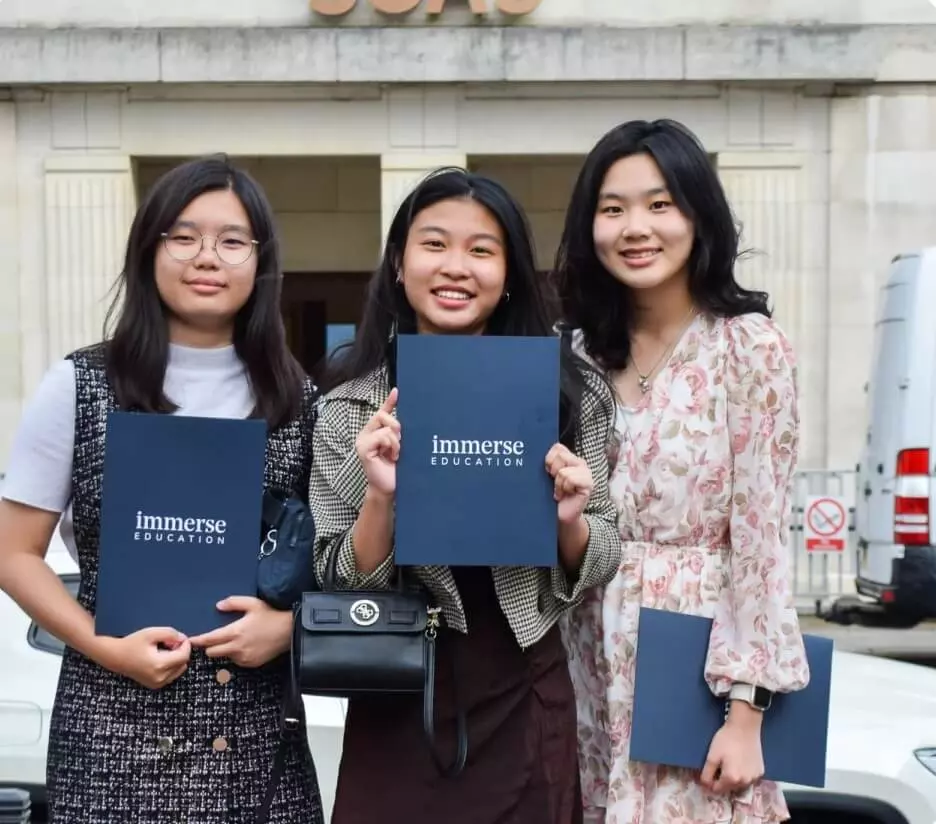
Join the Immerse Education 2027 Essay Competition
Follow the instructions to write and submit your best essay for a chance to be awarded a 100% scholarship.
12. Boston University RISE (Research in Science & Engineering)
Location: Boston University, Boston, Massachusetts
Cost/Stipend: Tuition varies by track; financial aid available (apply by the program deadline); no stipend
Acceptance rate/cohort size: Not publicly disclosed
Program Duration: Six weeks in the summer (2027 dates not yet posted)
Application Deadline: February 3rd, 2027, at 11:59 p.m. ET, including your recommendation; applications open December 17th
Eligibility: Rising high school seniors who are U.S. citizens or permanent residents. International students are not eligible.
Boston University’s Research in Science & Engineering (RISE) program offers you university-level STEM research through either the Internship or Practicum track. In the Internship track, you’ll work full time in faculty-mentored research across fields such as biology, neuroscience, engineering, and public health.
As an Internship applicant, you list three faculty members you’d like to work with and explain how their research aligns with your interests. The Practicum track combines instructor-led lectures with structured group research. You’ll attend weekly workshops on academic and professional development, and both tracks end with a poster symposium where you present your findings.
Why it stands out: RISE offers two distinct research formats at a major research university, with a formal symposium that builds your scientific communication skills.
13. UC Santa Cruz Scholar Immersion Program (SIP)
Location: University of California, Santa Cruz, California (in person, with on-campus housing offered)
Cost/Stipend: 2027 costs will be posted by December 2026; $68 application fee, with waivers on request; need-based aid covers 25% to 100% of tuition and program fees for scholars who qualify; no stipend
Acceptance rate/cohort size: Not disclosed
Program Duration: Online Research Week June 14th to 17th, in-person research June 21st to August 6th, and Final Presentation Day on August 7th, 2027 (tentative)
Application Deadline: February 26th, 2027, at 12 p.m. PST; academic reference due March 5th, 2027; the portal opens January 15th, 2027
Eligibility: Students aged 14 to 17 for the whole program (some projects require 16+); students who will have graduated high school are generally ineligible. International eligibility not specified on the application page.
UC Santa Cruz’s Scholar Immersion Program, formerly the Science Internship Program, lets you work on research projects under the mentorship of UC Santa Cruz researchers. You’ll explore questions across science, engineering, social sciences, humanities, and art through open-ended investigation.
The experience begins with an online research week, followed by seven weeks of in-person research on campus. Many projects are computational, so some prior programming experience strengthens your application. You’ll collaborate with mentors, develop research skills, and present your work at the program’s Final Presentation Day.
Why it stands out: You spend eight weeks on mentored research across a wide range of disciplines, with need-based aid that can cover your full tuition.
14. Stanford University Mathematics Camp (SUMaC)
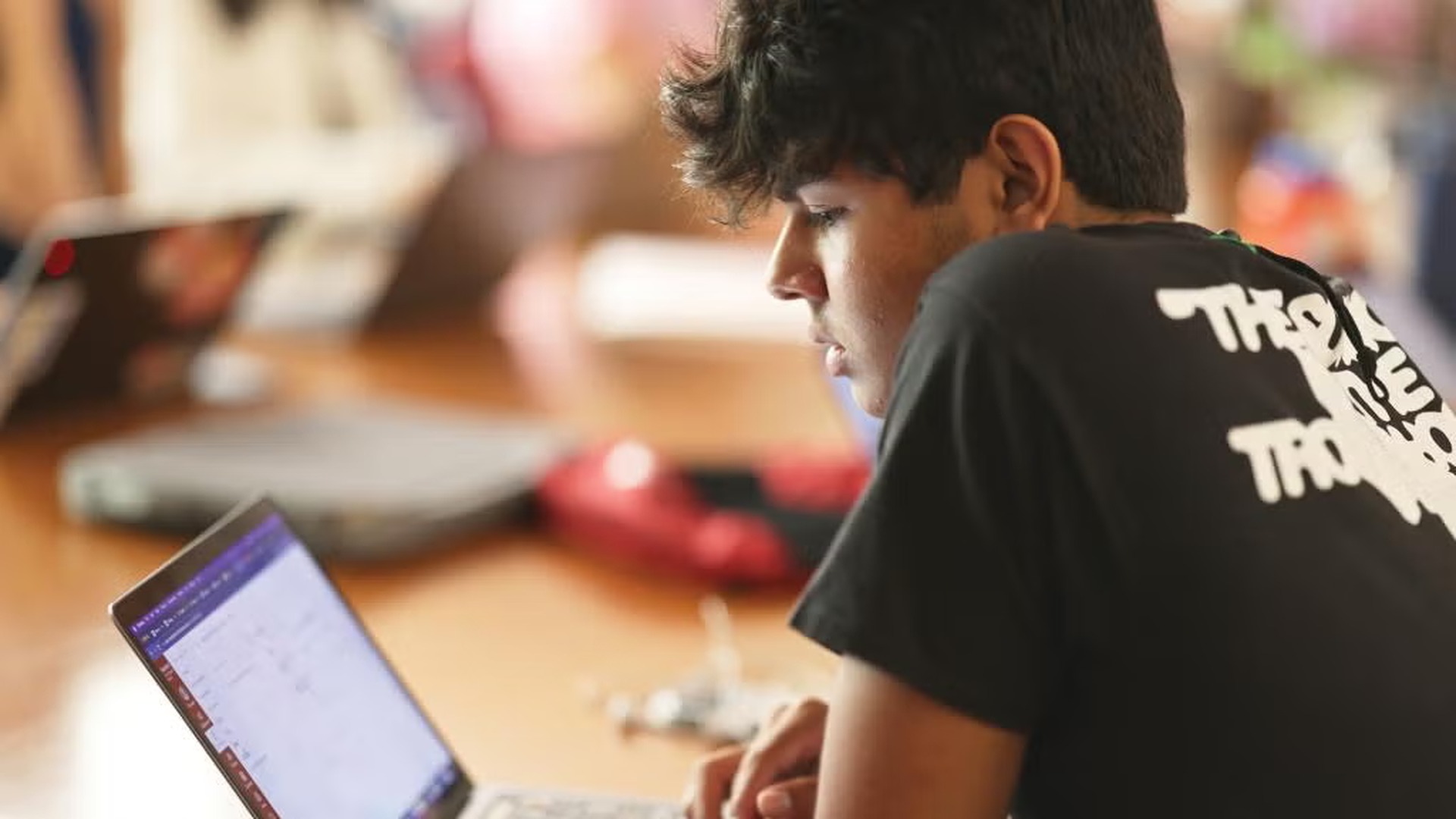
A student attending an online class using their laptop
Location: Online, with a residential option at Stanford University, Stanford, California
Cost/Stipend: Varies by online or residential option; financial aid available
Acceptance rate/cohort size: 64 online participants and 40 residential participants, with an average class size of 16
Program Duration: Online sessions June 15th to July 3rd and July 6th to 24th; residential June 21st to July 17th (2026 dates; 2027 dates not yet posted)
Application Deadline: 2026 applications have closed; 2027 deadline not yet posted
Eligibility: Students currently in 10th or 11th grade; open to students from around the world
Stanford University Mathematics Camp (SUMaC) introduces you to advanced areas of mathematics that go well beyond a typical high school curriculum. You’ll study either Abstract Algebra and Number Theory or Algebraic Topology through lectures, guided research, and group problem-solving.
The online program runs on a faster-paced three-week curriculum with daily live classes, problem-solving sessions, and virtual guest lectures from mathematicians. You’ll work with undergraduate and graduate instructional assistants and complete a heavy load of assignments outside class. Courses carry no credit or grades, so the focus stays on mathematical enrichment. You’ll finish by presenting a final research project.
Why it stands out: The online option lets you study graduate-flavored, proof-based math with a Stanford program from anywhere in the world.
15. Hampshire College Summer Studies in Mathematics (HCSSiM)
Location: Moving to a new campus in 2027, after its 2026 session at Hampshire College, Amherst, Massachusetts (residential)
Cost/Stipend: $7,208 (2026); financial aid available; no stipend
Acceptance rate/cohort size: Not disclosed
Program Duration: Six weeks in the summer (the 2026 session ran June 28th to August 8th)
Application Deadline: 2026 applications closed April 17th, with an “Interesting Test” due April 25th; 2027 details will be shared in late 2026
Eligibility: Talented, highly motivated high school students; open to students from around the world
Hampshire College Summer Studies in Mathematics (HCSSiM) is a six-week residential program that treats mathematics as something to explore rather than a set of answers to memorize. You’ll spend a large part of each day actively doing mathematics, with four hours of morning classes, a pre-supper Prime Time Theorem, and evening problem sessions.
Courses reach well beyond the standard school curriculum, and you’re expected to build and defend your own proofs. Faculty are unusually accessible in classrooms, at meals, and in the program dorm. The program has run for more than fifty years, and its alumni come from around the world.
Why it stands out: It rewards curiosity and creative reasoning over speed, inside a close community where you live and work alongside faculty.
Frequently asked questions: Pre-College Programs for International High School Students
Can international students attend pre-college programs in the US?
Yes, but you’ll need to check each program’s eligibility carefully. RSI, PROMYS, Ross, the Summer Science Program, SSRP, SUMaC, and HCSSiM all welcome applicants from outside the U.S. Others, including Simons, the Clark Scholars Program, and BU’s RISE, are limited to U.S. citizens or permanent residents. Princeton’s Laboratory Learning Program and Stanford’s IFSS go further and only accept local students, so read the residency rules before you start an application.
Do you need a visa for a pre-college program in the US?
It depends on the program and whether it awards academic credit. Ross, for example, explains that international students can attend on a B-2 tourist visa because it isn’t a credit-bearing college program. Rockefeller’s SSRP accepts students from outside the U.S. but can’t help with visas, housing, or transportation, so you’ll need to plan those yourself. If you’re heading to New York, this guide to life for international students in New York can help you prepare.
Are there free pre-college programs for international students?
Yes, a few strong programs cost nothing or offer generous aid to international applicants. RSI is free to attend, and Rockefeller’s SSRP charges no fees, although you’ll need to arrange your own housing in New York. The Summer Science Program offers financial aid to international students that can also cover airfare, and PROMYS considers international aid case by case. Immerse Education’s Academic Insights pathway offers summer school scholarships through its bursary programme, and you can find more options in this guide to top scholarships for STEM students.
Do you need to prove English proficiency to apply?
Many programs expect you to follow fast-paced, English-language classes, and some ask for proof. The Summer Science Program requires international applicants to submit test scores that show English proficiency. Ross asks for reasonable fluency in English, since its seminars and problem sessions rely on discussion. Check each program’s admissions page for the exact tests and scores it accepts, and give yourself time to book an exam before the deadline.
When should international students apply to pre-college programs?
You should start planning in the fall, since several deadlines fall early in the year. RSI’s 2027 applications close on December 11th, 2026, and Rockefeller’s SSRP closes on January 4th, 2027. The Summer Science Program sets an earlier deadline for international applicants than for domestic ones, and PROMYS closes at the end of February 2027. Leave extra time for transcripts, recommendations, and any visa paperwork once you’re accepted.
Are there pre-college programs outside the US for international students?
Yes, and they can be easier to access if you’d rather study closer to home or in another region. Immerse Education’s Academic Insights pathway runs two-week courses in Cambridge, London, Oxford, Singapore, Sydney, and Toronto for students aged 13 to 18, with classes averaging 7 participants. Online options such as SUMaC’s virtual sessions also let you study with a U.S. university from anywhere. For more remote choices, browse these online STEM programs for high school students.
Plan your path to university overseas
Spending a summer studying in another country shows you exactly how you handle new classrooms, new routines, and new ways of thinking far from home.
The right pre-college programs for international high school students let you test a subject and a campus before committing to four years of university abroad.
Check eligibility, visa rules, and financial aid early, since several top programs on this list are limited to U.S. citizens or have earlier international deadlines.
When you’re ready to plan your next move, our Study Abroad blogs help you compare countries, prepare applications, and settle confidently into student life overseas.





Unlock Inspiring Opportunities with the Immerse Education Newsletter
Join our newsletter to stay ahead with exclusive updates, exciting programme highlights, and expert insights from the world of immersive education.
Learn how Immerse can transform your life
An in-depth overview of our university and career preparation programmes
Get a glimpse into the life of an Immerse participant
Find the right programme for you with sample timetables, location showcases, and more