15 Best STEM Summer Camps for Teens in 2026

TL;DR
This list rounds up STEM summer camps hosted by universities and research labs, covering everything from aerospace engineering to cybersecurity and biomedical research. Costs vary enormously: you'll find several university camps completely free, while others, like Stanford's math camp, charge up to 8,950 dollars for a residential spot. Most options suit you if you're in grades 9 through 12, though a few accept you as young as 13 or limit eligibility to US residents. Among these options, Immerse Education's Academic Insights pathway lets you explore STEM alongside 20-plus other subjects at ages 13 to 18, with a bursary available.
As a high schooler interested in STEM, you may be looking for ways to take your learning beyond the classroom and gain hands-on experience in the field. You may want to learn how to do things like applying the scientific method, planning controlled investigations, or interpreting and presenting results well before college. One of the best ways to do this is to join a STEM summer camp. In 2026, this can look like working at a university laboratory, where you will deal with datasets, technical questions, and lab equipment.
Picture yourself designing an experiment, testing a mathematical model, analysing public-health data, or investigating how emerging technology is used in medicine and engineering. By spending your 2026 summer attending a STEM camp, you will collaborate with global peers and learn to use specialised tools and software under the guidance of faculty members and experienced instructors.
How do you choose the right STEM Summer Camp?
Participating in a STEM summer camp in 2026 can serve as an early foundation for your college journey. However, the process of choosing the right program can be difficult. You’ll have to consider things like the curriculum, opportunities for applied work, access to experienced instructors, and more. That’s why it’s useful to have guidance on discovering the right STEM camp for you.
Many rigorous STEM summer camps are hosted by leading institutions like universities or research facilities. As a participant, you’ll get to work on advanced projects, engage with faculty, researchers, and current students, and gain access to higher-level STEM subjects and concepts. Whether you’re interested in biology, mathematics, physics, or engineering, there’s something for everyone.
You can also get a taste of college-level STEM through STEM research opportunities or online STEM programs for high school students.
Of course, no matter the complexity of the camp, you’ll have to work hard once it starts. To aid your search, we’ve compiled a list of the best STEM summer camps for teens in 2026, all offering academic challenge, strong reputations, and more.
15 Best STEM Summer Camps for Teens in 2026
1. Camp SOAR (Summer Opportunities in Aerospace Research)
Location: Texas A&M University, College Station, TX
Cost: Not explicitly stated; $35 application fee (need-based scholarships available)
Dates: Session A: June 13-18; Session B: July 11-16
Application Deadline: Opens January 1st
Eligibility: Rising high school juniors and seniors; May not be open to international students
Camp SOAR lets you explore aerospace engineering through technical instruction, design work, and exposure to university research. After selecting a focus such as aircraft, rotorcraft, space mission design, or space robotics, you’ll begin applying concepts to challenges within that area. Faculty-led sessions establish the scientific principles behind each project, while practical work requires you to build, test, and improve your ideas.
Much of the experience centers on the engineering design process, giving you practice responding to failed tests and revising a solution methodically. You’ll also go on visits to research facilities to see how aerospace investigations are conducted using specialized laboratories, equipment, and technical spaces.
Why it stands out: Its specialized tracks let you explore a specific branch of aerospace engineering rather than receiving only a general introduction.
2. Immerse Education’s Pre-University Summer School

Location: Oxford, Cambridge, London, Singapore, Sydney, and Toronto
Cost: Varies; summer school scholarship available through our bursary programme
Acceptance rate/cohort size: Selective; an average of 7 participants per class
Dates: 2 weeks during the summer
Application Deadline: Multiple cohorts with rolling admissions
Eligibility: Students across the globe aged 13-18 currently enrolled in middle or high school; open to international students
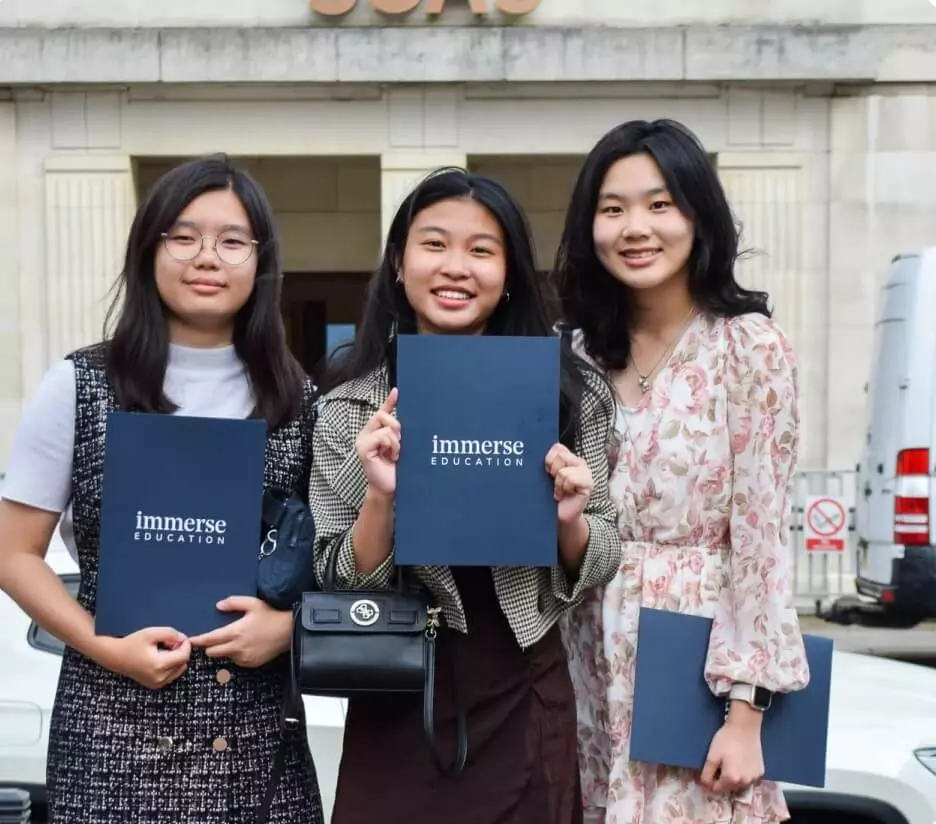
Immerse Education’s Academic Insights pathway lets you experience university life firsthand. You will live on campus and study in small groups with an average of 7 participants per class, learning from tutors from top universities like Oxford and Cambridge. As a participant, you can explore over 20 subjects, including STEM, AI, Computer Science, Biology, Medicine, Mathematics, and more.
The courses are experiential and hands-on, meaning you may find yourself conducting dissections in medicine, designing a robotic arm in engineering, or conducting laboratory research. By the end of the program, you'll complete a personal project, receive written feedback, and receive a certificate of completion. You can find more details about the application here.
Why it stands out: You’ll get an early start at university life and academics because the program includes an independent project, discussion-based classes, and living at a college campus.
3. Veritas AI
Location: Virtual
Cost: Varies depending on program type. Full financial aid available.
Dates: Multiple 12-15-week cohorts throughout the year, including spring, summer, fall, and winter.
Application deadline: Rolling. Spring (January), Summer (May), Fall (September), and Winter (November). You can apply to the program here.
Eligibility: High school students. AI Fellowship applicants should either have completed the AI Scholars program or exhibit experience with AI concepts or Python; open to international students
Veritas AI, founded and run by Harvard graduate students, offers programs for high school students who are passionate about artificial intelligence. Students who are looking to get started with AI, ML, and data science would benefit from the AI Scholars program. Through this 10-session boot camp, students are introduced to the fundamentals of AI & data science and get a chance to work on real-world projects.
Another option for more advanced students is the AI Fellowship with Publication & Showcase. Through this program, students get a chance to work 1:1 with mentors from top universities on a unique, individual project. A bonus of this program is that students have access to the in-house publication team to help them secure publications in high school research journals. You can also check out some examples of past projects here and read about a student’s experience in the program here.
Why it stands out: You get 1-1 mentorship with a Ph.D. mentor and produce an independent research project by the end.
4. Idaho STEM Scholars Camps
Location: Idaho National Laboratory, Idaho Falls, ID
Cost: Free
Dates: Multiple dates in June - July (varies by camp)
Application Deadline: April (rolling)
Eligibility: Students in grades 9-12; Not open to international students
Idaho STEM Scholars Camps allow you to explore how scientific and technical knowledge is used in research, cybersecurity, environmental work, and public safety. Your activities depend on the selected pathway, with options that may focus on nuclear science, computing, networking, or cyber defense. The program asks you to work with data, examine technical systems, and solve guided problems.
You will also take part in field-based activities and demonstrations that help clarify how scientific principles are tested outside a conventional classroom. You may also meet laboratory specialists, industry mentors, and community partners who can explain the skills required in different technical careers. Its connection to applied national-laboratory work makes it one of the best STEM summer camps for teens in 2026 interested in seeing how large-scale research addresses practical challenges.
Why it stands out: Students encounter STEM hands-on through the work of national-laboratory specialists rather than through classroom activities alone.
5. North Carolina State University: VetCAMP
Location: NC State University, Raleigh, NC + Virtual
Cost: $750 (day campers) + additional $250 (overnight campers) + $28 application fee for each week
Dates: Week 1: July 6-10; Week 2: July 13-17; Virtual: June 22-26
Application Deadline: January 29th - March 26th
Eligibility: Rising high school sophomores to graduating seniors (15+); Students who have previously attended in-person VetCAMP are not eligible to apply for in-person VetCAMP but may still apply to Virtual VetCAMP; Only open to students from the U.S. or U.S. territories, not international students
NC State’s VetCAMP introduces veterinary medicine through animal-care activities, laboratory exercises, and exploration of professional training environments. You’ll examine how veterinarians work with both household pets and larger animals, helping you understand the breadth of the profession. You’ll attend practical sessions involving horses, sheep, and pigs to see how clinical approaches must be adapted across species and care settings.
You’ll also take part in activities such as suturing and dissection, connecting anatomy and scientific observation with skills used in veterinary education. The program also offers tours of facilities that reveal how teaching, clinical care, and research operate within a college of veterinary medicine.
Why it stands out: Its combination of hands-on small- and large-animal experiences gives you a broader view of veterinary medicine than a typical animal-care program.



6. The Marillyn A. Hewson Cybersecurity Summer Camp
Location: University of Alabama, Tuscaloosa, AL
Cost: Free
Dates: Camp 1: June 1-5; Camp 2: June 8-12
Application Deadline: Rolling until full
Eligibility: High school students in the Tuscaloosa area; Not open to international students
The Marillyn A. Hewson Cybersecurity Summer Camp teaches you how digital systems are examined, protected, and defended against potential attacks. Guided labs cover areas such as network defense, web infrastructure, system vulnerabilities, and cyber risk. Different levels of instruction allow newer students to establish technical foundations while more experienced participants take on increasingly complex challenges.
Several activities reflect the logic of real cybersecurity work, requiring you to identify weaknesses and decide how a system should be secured. Faculty sessions connect these exercises with current research, data analysis, and the wider consequences of digital security failures. By working through simulated defense scenarios, you develop technical reasoning alongside the ability to respond calmly and systematically to unfamiliar problems.
Why it stands out: Its tiered structure gives both beginners and more experienced students a suitable entry point into cybersecurity.
7. Sam Houston State University (SHSU): COHS Summer Camp
Location: Sam Houston State University, Huntsville, TX
Cost: Accepted students will receive details of the camp fees
Dates: June 29th - July 1st
Application Deadline: April 3rd
Eligibility: High school juniors and seniors with a minimum GPA of 3.0; May or may not be open to international students (not specified)
COHS Summer Camp is designed to help you compare several health science disciplines before committing to one academic or career direction. You will attend faculty-led workshops that introduce you to nursing, kinesiology, public health, and related healthcare fields through simulations and case-based exercises. You’ll examine how professionals from different specialties contribute to patient care and respond to broader community health challenges.
You’ll also take part in applied activities that make it easier to distinguish between clinical responsibilities, research-oriented work, and system-level health roles. Visits to specialized training facilities show you how university students practise technical procedures and prepare for professional environments.
Why it stands out: The camp lets you evaluate several interconnected health careers within one experience rather than studying a single profession in isolation.
8. University of Minnesota: IMA-MathCEP Math Modeling Camp
Location: University of Minnesota, Minneapolis, MN; Limited virtual slots available
Cost: Free
Dates: June 22-26
Application Deadline: May 31st
Eligibility: High school students who have completed a year-long course in single-variable calculus by the end of the school year; May be open to international students (not specified)
The IMA-MathCEP Math Modeling Camp explores how mathematics can be used to investigate complex systems and public-facing problems. Working in a small team, you may study questions involving disease transmission, transportation patterns, climate effects, or infrastructure planning. Faculty mentors will guide you through building a model, testing its assumptions, and revising it when the results do not accurately reflect the situation.
This process demonstrates that mathematical modeling depends as much on judgment and interpretation as it does on calculation. Collaboration also develops your ability to divide technical work, compare approaches, and explain quantitative reasoning to others. A final team presentation challenges you to communicate your conclusions, limitations, and methodology clearly to an audience.
Why it stands out: You’ll gain hands-on experience in math, using advanced mathematics to examine realistic civic and scientific questions rather than solving isolated textbook problems.
9. WNE-MHC Golden Bear Summer Camp
Location: Western New England University, Springfield, MA
Cost: Free
Dates: June 28th - July 2nd
Application Deadline: Opens in January; First-come, first-served basis until 35 students have registered
Eligibility: High school students ages 13-18; Not open to international students
The Golden Bear Summer Camp introduces you to several healthcare disciplines through laboratories, demonstrations, and career-focused academic sessions. You’ll explore pharmacy, pharmaceutical sciences, occupational therapy, and neuroscience and learn how each field approaches health and patient care. You’ll participate in medication compounding activities that demonstrate how scientific accuracy affects the preparation and delivery of treatments.
You’ll also attend DNA extraction and neuroscience sessions that connect laboratory methods with research into genetics, disease, and the nervous system. Aside from this, you’ll take part in activities focused on occupational therapy that show you how rehabilitation and daily functioning fit into healthcare practice.
Why it stands out: It’s a short-term program that combines pharmaceutical science, neuroscience, and rehabilitation-focused healthcare within the same curriculum.
10. MathCON Summer Camp
Location: Loyola Water Tower Campus, Chicago, IL
Cost: $1,600 for students who participated in the MathCON Online Test; $2,400 for students who didn’t ($800 MathCON Online Test Scholarship may be offered)
Dates: June 15-19
Application Deadline: June 10th
Eligibility: 7th-12th graders; Not open to international students
MathCON Summer Camp is structured for students who want to tackle mathematics beyond the pace and scope of a standard school course. You’ll examine topics such as number theory, combinatorics, geometry, and algebraic reasoning through challenging problems and instructor-led discussions. The lessons taught during the camp will emphasize elegant reasoning and multiple solution methods, encouraging you to evaluate whether an answer works and why an approach is effective.
It also offers competition-focused practice that can strengthen habits required for competitions such as the American Mathematics Competitions. You’ll take part in team challenges, learn to compare strategies, defend your reasoning, and learn from peers who approach problems differently.
Why it stands out: The curriculum links advanced mathematical exploration directly with competition strategy and proof-based reasoning.
11. University of Chicago S.M.A.R.T. (Science, Mathematics, and Research Training) Program
Location: University of Chicago, Chicago, IL + partner sites in the Chicago area
Cost: Free
Dates: July 16-21
Application Deadline: March 31st
Eligibility: High school students; Priority given to qualifying Chicago students; May not be open to international students (unspecified)
The S.M.A.R.T. program gives you a hands-on introduction to several areas of science, mathematics, and research through sessions led by scientists and researchers. You will explore topics such as renewable energy, materials science, and quantum physics. You will also get hands-on experience and may get to build and race a solar-powered car, design and 3D-print an object, or investigate superconductivity through activities involving the Meissner effect.
Other sessions introduce quantum concepts through experiments that explore ideas such as entanglement and particle behavior. Visits to University of Chicago laboratories give you a closer look at how scientific research is conducted, while field trips to places such as the Adler Planetarium, Yerkes Observatory, and Argonne National Laboratory expand that exposure beyond campus.
Why it stands out: You’ll get to move between very different areas of STEM, from solar energy and 3D printing to superconductivity and quantum physics, within a single program.
Join the Immerse Education 2027 Essay Competition
Follow the instructions to write and submit your best essay for a chance to be awarded a 100% scholarship.
12. Stanford University Mathematics Camp (SUMaC)
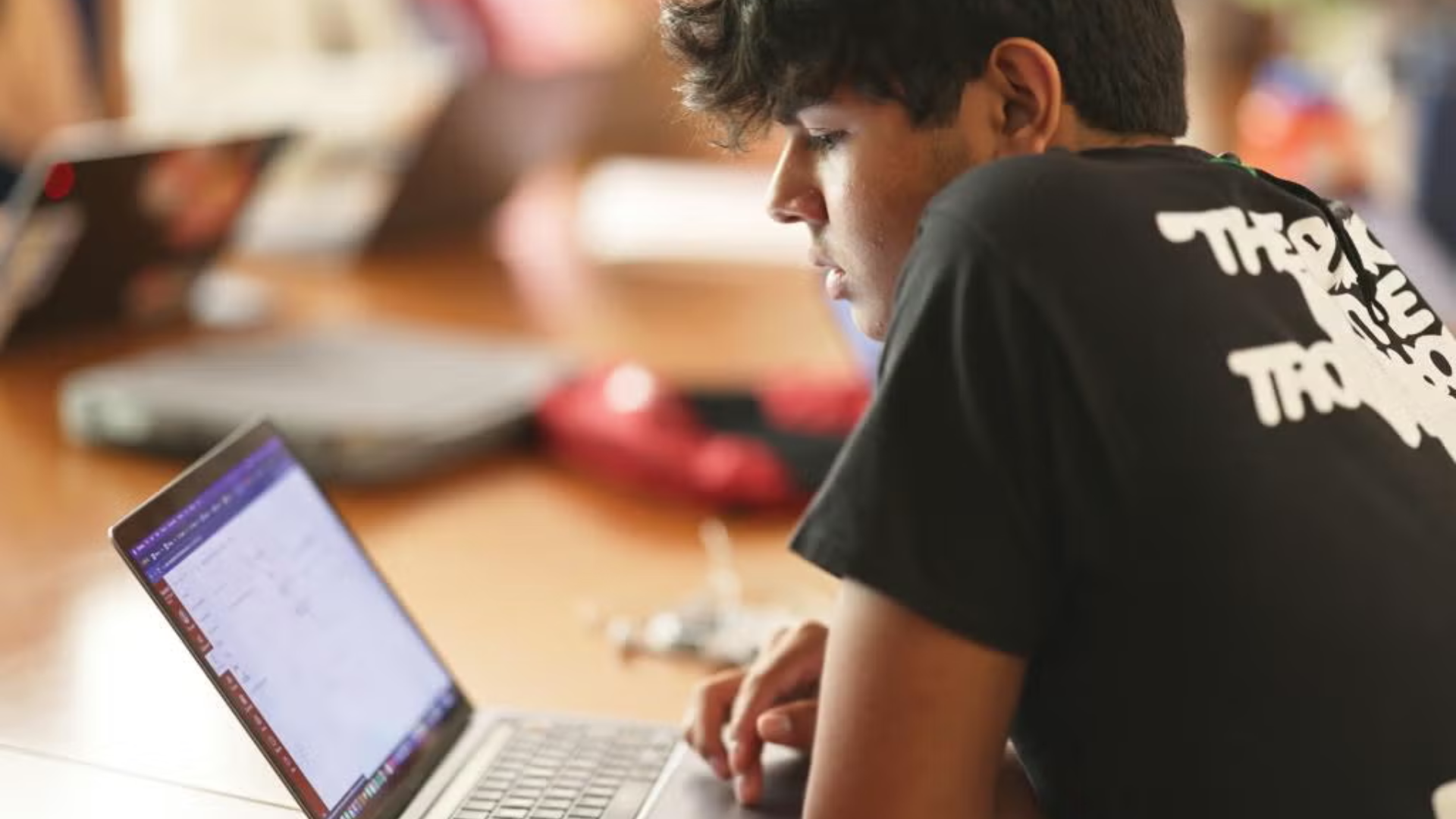
A student attending an online class using their laptop
Location: Stanford University, Stanford, CA + Virtual options
Cost: $3,750 (online); $8,950 (residential); Need-based financial aid available
Dates: Online: June 15th - July 3rd or July 6-24; Residential: June 21st - July 17th
Application Deadline: February 2nd
Eligibility: 10th-11th graders (15+); Participants who are 18+ are not eligible for SUMaC residential but are eligible for SUMaC online; Open to international students
Stanford University Mathematics Camp is intended for students ready to move from computational mathematics into proof-based and theoretical study. As a participant, you will attend daily lectures introducing advanced concepts that demand abstraction, logical precision, and sustained engagement with unfamiliar ideas. You will also join problem sessions that require you to construct arguments, identify gaps in your reasoning, and communicate each step with greater clarity.
Independent assignments give you additional practice working through mathematical questions without relying on routine formulas or familiar methods. The program culminates in research-style work that asks you to organize complex material and present your conclusions in a rigorous, understandable form.
Why it stands out: Its sustained focus on formal proof and abstraction closely resembles the way mathematics is studied at the university level.
13. Boise State STEM Gems Summer Camp
Location: Boise State University, Boise, ID
Cost: Free
Dates: June 12-13
Application Deadline: April 24th
Eligibility: Students currently in grades 9-11 (ages 14-17); Not open to international students
Boise State STEM Gems introduces engineering and technology through workshops that connect technical principles with creative, digital, and physical applications. You may explore subjects such as artificial intelligence, game animation, construction management, or the physics involved in movement-based activities. You will participate in workshops led by students, professionals, and engineering organizations that give you access to several perspectives on academic preparation.
You’ll also take part in practical activities that encourage you to experiment with ideas while asking questions about how different systems are designed and improved. The campus setting adds an early glimpse of how engineering, computing, and construction-related subjects are taught at college.
Why it stands out: Its workshop selection shows how STEM can connect digital creativity, physical systems, and the built environment.
14. University of Illinois College of Medicine: STEM Camp
Location: College of Medicine, University of Illinois, Rockford, IL
Cost: Free
Dates: June 22-26 (tentative)
Application Deadline: April 17th (tentative)
Eligibility: High school students (16+); Not open to international students
The University of Illinois College of Medicine STEM Camp examines how biomedical research contributes to new treatments, technologies, and scientific discoveries. You’ll learn how laboratory investigations are planned, conducted, and evaluated while following standard research and safety practices. You’ll take part in hands-on activities and gain experience with scientific tools and the process of designing experiments around specific questions.
Instructors also present current biomedical challenges, explaining how researchers approach problems that may not have immediate or straightforward answers. The camp also offers demonstrations of emerging technologies that show how bioengineering can lead to new medical devices, methods, and healthcare products.
Why it stands out: The program connects foundational laboratory practice with the development of cutting-edge biomedical technologies.
15. Stanford AIMI Summer Health AI Bootcamp
Location: Virtual
Cost: $2,000 + $45 application fee (tentative); Financial aid is available
Dates: Session A: June 15-26; Session B: July 6-17 (tentative)
Application Deadline: November 10th - February 1st
Eligibility: U.S. high school students (14+); Not open to international students
The Stanford AIMI Summer Health AI Bootcamp explains how artificial intelligence systems are designed, evaluated, and used within healthcare. You’ll begin with foundational machine-learning concepts before examining applications in medical imaging, diagnostics, and clinical decision-making. You’ll take part in case-based discussions to assess why a technically accurate model may still encounter difficulties when applied to real patient populations.
The curriculum also examines how healthcare datasets are created, tested, and affected by bias, unequal access, and population differences. Expert sessions introduce emerging areas such as generative AI and foundation models while connecting technical developments to medicine, industry, and public health.
Why it stands out: Responsible AI principles are integrated into the technical curriculum rather than treated as a separate or secondary topic.
Frequently asked questions: STEM Summer Camps for Teens in 2026
Are STEM summer camps worth it?
Yes, especially if you want direct exposure to a field before committing to it at university, since many camps let you work with real lab equipment, data, or faculty mentors. You'll get a much clearer sense of whether a subject like aerospace engineering or cybersecurity actually suits you than a single high school class could offer. Camps hosted by universities and research labs also give you access to specialized facilities and current researchers you wouldn't otherwise meet as a high schooler. A short camp is a low-risk way to test an interest before applying to something longer or more competitive.
What are the most prestigious STEM summer camps for high schoolers?
Prestige in STEM camps usually comes down to which institution runs the program and how selective its admissions process is. Programs at research universities like Stanford, such as its Mathematics Camp or AIMI Summer Health AI Bootcamp, carry weight because of the faculty and facilities behind them. University of Chicago's S.M.A.R.T. program and similar research-lab-based camps also stand out for connecting you directly with active researchers rather than a general curriculum. Rather than chasing a single "most prestigious" label, focus on which program's specific subject and selectivity level actually matches your academic goals.
What is the best age to start STEM?
There's no single best age, since camps on this list accept students anywhere from 13 to 18, with most clustering around grades 9 through 12. Starting earlier, like WNE-MHC's Golden Bear Summer Camp which accepts 13 year olds, can help you explore multiple STEM fields before narrowing your focus in later high school years. Starting later, closer to junior or senior year, works well for more advanced programs like Stanford's Mathematics Camp that expect prior coursework such as single-variable calculus. The right starting point depends more on your current coursework and interests than on a fixed ideal age.
Do you need a strong GPA to get into a STEM summer camp?
Some competitive camps do set a minimum GPA, such as Sam Houston State's COHS Summer Camp, which requires at least a 3.0. Many others, especially free camps run by state universities or national laboratories, don't publish a GPA requirement and instead rely on an application and essay. If a program doesn't list grades as a prerequisite, strong academic performance still helps your application stand out against other applicants. Checking each camp's specific eligibility section is the only reliable way to know whether grades factor into admission.
Are STEM summer camps free?
Several are, particularly those hosted directly by public universities or national laboratories, like Idaho STEM Scholars Camps or the University of Chicago's S.M.A.R.T. program. Paid options vary widely in cost, from a few hundred dollars for a short regional camp to several thousand dollars for a residential university program. Free camps often come with narrower eligibility, such as being restricted to in-state students or US citizens only. If cost is your main constraint, filter first by free or need-based aid options before comparing program content.
Can international students attend STEM summer camps in the US?
It depends heavily on the specific camp, since many US university and lab-based programs on this list explicitly restrict enrollment to domestic students. Camp SOAR, Idaho STEM Scholars Camps, and several other university-run camps state they may not be open to international applicants. A smaller number of programs, including Immerse Education's Academic Insights pathway and SUMaC, explicitly welcome international students. If you're applying from outside the US, check a program's eligibility section closely rather than assuming any STEM camp automatically accepts international applicants.
From summer lab work to university confidence
Few things sharpen a college application quite like weeks spent running real experiments at a university lab before you've even applied.
Sorting through the best STEM summer camps for teens in 2026 shows admissions officers you sought out rigor on your own.
You'll leave with specific findings to discuss in interviews, not vague enthusiasm about liking science and math in a general, unfocused way.
If you're mapping summer choices onto a bigger university plan, our University Preparation blogs can help you plan your next concrete steps.







Unlock Inspiring Opportunities with the Immerse Education Newsletter
Join our newsletter to stay ahead with exclusive updates, exciting programme highlights, and expert insights from the world of immersive education.
Learn how Immerse can transform your life
An in-depth overview of our university and career preparation programmes
Get a glimpse into the life of an Immerse participant
Find the right programme for you with sample timetables, location showcases, and more