15 Summer Research Programs for High School Seniors

TL;DR
On this page, you’ll find research opportunities for your senior-year summer, from paid federal internships at NIH, NASA, and the Air Force Research Laboratory to university lab placements and virtual projects. Some programs are free or pay a stipend, while others charge fees, such as Garcia’s $4,000 laboratory usage fee. Federal internships are limited to U.S. citizens, with NIH also accepting permanent residents. Immerse Education’s Academic Insights pathway welcomes students aged 13 to 18 from around the world, with a bursary programme to help with costs.
If you’re preparing to move from high school to higher education, research can offer a powerful opportunity to go beyond classroom learning and engage directly with the process of knowledge creation. Summer research programs for high school seniors allow you to investigate open questions, work alongside researchers and faculty mentors, and gain first-hand experience with the methods used in academic and scientific inquiry.
These programs span a variety of disciplines, including biology, engineering, computer science, medicine, psychology, economics, environmental science, social sciences, and the humanities. Depending on the program, you may conduct laboratory experiments, analyze datasets, review academic literature, develop independent projects, participate in fieldwork, or contribute to ongoing research initiatives under expert supervision.
What kinds of summer research programs are available for high school seniors?
Summer research programs for high school seniors vary widely in subject focus, structure, and level of independence. Some programs place you within active research laboratories where you contribute to ongoing projects, while others provide guided research experiences designed to introduce you to academic inquiry and research methodology.
Universities, research institutes, government agencies, and scientific organizations offer opportunities across fields ranging from life sciences and engineering to social sciences, business, and public policy. You may work individually or as part of a research team while learning how to design studies, collect and analyze data, evaluate evidence, and communicate findings using professional academic standards.
15 Summer Research Programs for High School Seniors
1. Ashoka Young Scholars Programme (YSP)
Location: Ashoka University, Sonepat, Haryana, India (residential)
Cost: ₹49,500 + GST (5-day programmes); ₹85,000 + GST (10-day programmes)
Program Dates: Edition 1 begins May 18th and Edition 2 begins June 1st, with 5-day and 10-day options (2026 dates; 2027 dates not yet posted)
Application Deadline: 2026 applications have closed; updates on the next cycle will be posted on the programme website
Eligibility: Students entering grades 9 to 12; international eligibility not specified on the programme page
The Ashoka Young Scholars Programme is a certified, residential pre-college programme that introduces you to university-level liberal arts and sciences education through interdisciplinary academic streams. You’ll examine subjects such as Economics, Psychology, Artificial Intelligence, Computational Thinking, International Affairs, Design Thinking, Writing with Impact, Business, Policy, and the Sciences. The programme emphasizes intellectual exploration across disciplines rather than focusing on a single subject area.
You’ll engage with Ashoka faculty members and industry experts through academic sessions, discussions, and structured learning experiences. Beyond the classroom, you’ll participate in networking activities, cultural programming, documentary screenings, and campus life experiences. You’ll gain exposure to university-style learning, interdisciplinary thinking, and academic inquiry. By the end of the programme, you’ll develop broader academic perspectives and greater clarity about potential areas of study in college.
Why it stands out: The programme combines interdisciplinary academic study with a fully residential university experience, allowing you to explore multiple fields while experiencing campus life firsthand.
2. Immerse Education’s Pre-University Summer School

Location: Cambridge, London, Oxford, Singapore, Sydney, and Toronto
Cost: Varies; summer school scholarship available through our bursary programme
Acceptance rate/cohort size: Selective; an average of 7 participants per class
Program Dates: 2 weeks during the summer
Application Deadline: Multiple cohorts with rolling admissions
Eligibility: Students aged 13 to 18; open to international students from around the world
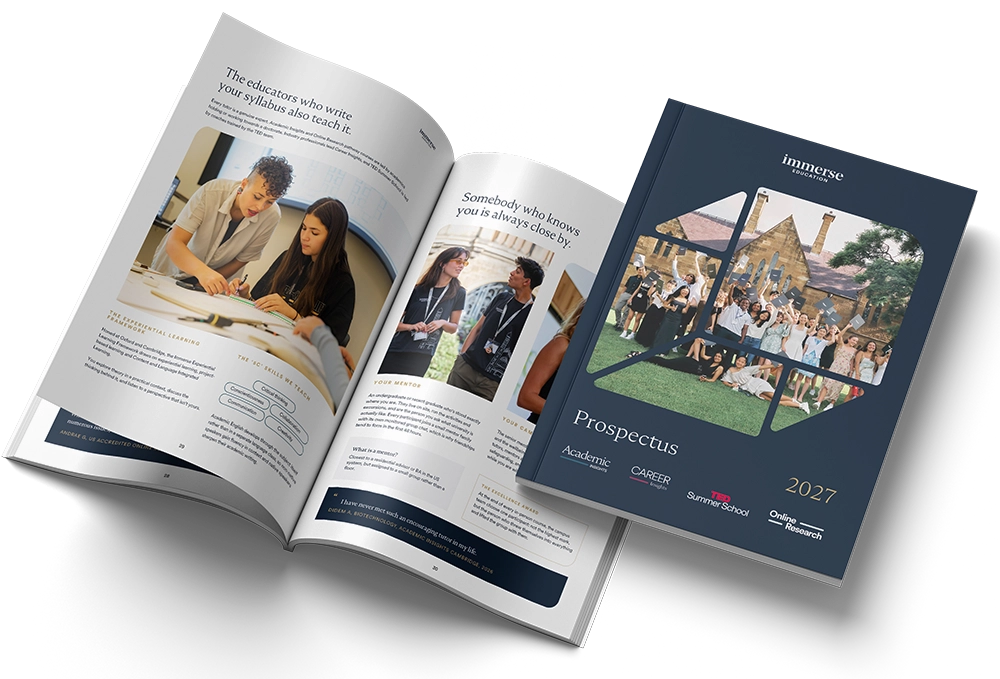
Immerse Education’s Academic Insights pathway gives you two weeks of undergraduate-level study in one subject while you live and learn in cities such as Cambridge, Oxford, and Toronto. You’ll learn in tutor-led seminars averaging 7 students, with two 1:1 tutorials, masterclasses, and guest speakers built into your timetable.
You can choose from more than 20 subjects, including Architecture, Artificial Intelligence, Business Management, Economics, Engineering, Law, and Medicine, and some courses include activities such as a moot court in law. By the end of the course, you’ll complete a personal project and present it on the final Friday. From age 14, you can also opt in to earn 8 UCAS points or 3 US college credits. You can find more details about the application here.
Why it stands out: You study one subject at undergraduate level in a small group, supported by mentors outside class, and leave with a personal project you can point to in future applications.
3. Lumiere Research Scholar Program
Location: Remote, you can participate in this program from anywhere in the world!
Cost: Varies depending on program type. Full financial aid available.
Application Deadline: Varies by cohort.
Program Dates: Varies by cohort: summer, fall, winter, or spring. Options range from 12 weeks to 1 year.
Eligibility: You must be currently enrolled in high school and demonstrate a high level of academic achievement.
The Lumiere Research Scholar Program is a rigorous research program tailored for high school students. The program offers extensive 1-on-1 research opportunities for high school students across a broad range of subject areas. The program pairs high school students with Ph.D. mentors to work 1-on-1 on an independent research project. At the end of the 12-week program, you’ll have developed an independent research paper!
You can choose research topics from subjects such as psychology, physics, economics, data science, computer science, engineering, chemistry, international relations, and more. You can find more details about the application here, and check out students’ reviews of the program here and here.
Why it stands out: You get 1-1 mentorship with a Ph.D. mentor and produce an independent research project by the end.
4. Garcia Summer Research Program
Location: Garcia Center for Polymers at Engineered Interfaces, Stony Brook University, Stony Brook, New York, USA
Cost: $4,000 laboratory usage fee and a $50 non-refundable registration fee; optional housing is $2,599, with a $66 student health services fee and an optional meal plan (2026)
Program Dates: June 24th to August 7th (2026 dates; 2027 dates not yet posted)
Application Deadline: 2026 applications have closed; 2027 deadline not yet posted
Eligibility: You must be at least 16 on or before July 4th of the program year, have a minimum unweighted GPA of 95/100 (3.8/4.0), have standardized test scores at or above the 60th percentile, and have coursework in at least three of the following: English, Chemistry, Mathematics or Calculus, Physics, and Biology. International students may apply if they can legally reside in the United States for the duration of the program; visa support is not provided.
The Garcia Summer Research Program is a seven-week university research experience focused on polymer science, materials engineering, and laboratory investigation. You’ll conduct independent research while working alongside faculty, graduate students, and research staff in an active university laboratory. The program emphasizes experimental design, data analysis, scientific communication, and problem-solving through original research projects. You’ll apply laboratory techniques and develop research questions under the guidance of experienced mentors.
Throughout the program, you’ll participate in formal instruction while contributing to ongoing scientific investigations. Past participants have presented their work at Materials Research Society meetings, and the program keeps a record of student publications. By the end of the program, you’ll gain practical research experience, stronger analytical skills, and a clearer understanding of academic research pathways in STEM fields.
Why it stands out: You design and conduct original research projects within a university laboratory while working closely with faculty, graduate researchers, and STEM mentors.
5. Summer Internship Program (SIP) - National Institutes of Health (NIH)
Location: NIH Intramural Research Program campuses, including the main campus in Bethesda, Maryland
Cost: Paid; stipends are adjusted annually and based on education level; NIH does not provide housing
Program Dates: Between May 10th and August 31st, 2027, with exact dates set with your Principal Investigator
Application Deadline: January 26th, 2027, at 12 p.m. ET; reference letters due February 2nd, 2027
Eligibility: U.S. citizens or permanent residents. Graduating high school seniors can apply if they will be 18 by September 30th, 2027 (applicants who are 17 on June 1st, 2027 must live within 40 miles of an NIH campus) and will graduate before the internship starts. You must have health insurance and commit full time.
You’ll work full time in a research group within the NIH Intramural Research Program under the supervision of a Principal Investigator. The program spans the biomedical, behavioral, and social sciences, with opportunities in fields such as biology, engineering, epidemiology, psychology, mathematics, chemistry, physics, and computer science. To be considered, you reach out to NIH Principal Investigators whose work interests you and direct them to your completed application.
You’ll apply research methods through direct lab or project-based work while contributing to ongoing studies in a professional research environment. You’ll also have access to professional development, educational and career programming, and a well-being program. In early August, you can share your research with the NIH community at Summer Poster Day. By the end of the program, you will gain practical experience in large-scale biomedical research systems and clarity on research-driven career pathways.
Why it stands out: It is a paid, nationally run biomedical research internship with direct Principal Investigator mentorship and full-time research immersion in federal labs.




6. NASA Office of STEM Engagement (OSTEM) Internship Program
Location: NASA centers across the United States (placement depends on your project)
Cost: Most interns receive a stipend based on academic level and session length
Program Dates: The summer session runs 10 weeks (fall and spring sessions run 15 weeks)
Application Deadline: March 1st, 2027, at 11:59 p.m. ET for summer 2027
Eligibility: U.S. citizens who are 18 or older by the published session start date, with at least a 3.0 GPA. High school seniors can apply for the summer session immediately following graduation.
You’ll work on project-based research and engineering tasks within NASA’s Office of STEM Engagement internship system. Each year, more than 2,000 students contribute to NASA’s mission to advance science, technology, aeronautics, and space exploration through OSTEM internships. You’ll apply technical and analytical skills in supervised environments while working under NASA mentors. You’ll engage in research workflows, data analysis, and mission-related problem-solving aligned with your assigned project area.
Letters of recommendation are not part of the application, and you can apply to multiple opportunities across centers through the NASA STEM Gateway. NASA also offers internships for non-STEM majors, so the program isn’t limited to science and engineering students. By the end of the program, you will gain practical experience in large-scale aerospace and research environments and understand how NASA projects operate from a technical and organizational perspective.
Why it stands out: It is a national-level aerospace internship offering direct exposure to NASA mission work, structured mentorship, and project experience across multiple research centers.
7. Anson L. Clark Scholars Program - Texas Tech University
Location: Texas Tech University, Lubbock, Texas
Cost: No program fees; on-campus room, board, and meals are covered, and you receive a $750 stipend when you complete your research project report; $25 application fee
Program Dates: June 20th to August 5th, 2027
Application Deadline: 2027 deadline not yet posted
Eligibility: Rising high school seniors and recent graduates who are at least 17 by the start date; U.S. citizens or permanent residents. Only twelve scholars are selected each summer.
You’ll spend seven weeks in a university-based research environment at Texas Tech University, working on a project in fields that range from the sciences and engineering to the humanities. The program places you with a faculty mentor, where you will engage in structured inquiry. You’ll apply experimental and analytical methods relevant to your assigned field, including lab work, computational analysis, or theoretical modeling.
You’ll participate in weekly seminars that support your project development, along with social activities and weekend programming. You’ll build a research project under close mentorship and refine your communication skills through presentations. By the end of the program, you will have developed foundational research skills and exposure to academic research expectations at the undergraduate level.
Why it stands out: It is a highly selective, fully funded residential research program with direct faculty mentorship at a major public university.
8. YTS+ (Young Technology Scholars) - Plaksha University
Location: Plaksha University, Mohali, India (residential)
Cost: ₹1,05,000 + GST (2026); a limited number of need-based scholarships available
Program Dates: May 24th to June 7th (2026 dates; 2027 dates not yet posted)
Application Deadline: 2026 applications opened January 28th, with a final round deadline of April 19th; 2027 dates not yet posted
Eligibility: Students in grades 9 to 12 from any academic stream; open to international students
You’ll participate in a two-week interdisciplinary program built around problem-solving across engineering, biology, economics, and mathematics. The program begins with a shared exploratory phase that introduces first-principles thinking and ways to frame practical problems. You’ll then choose one of three tracks, Robotics in Action, Biology Beyond Medicine, or Data Science, Economics and Business, and spend a week on a team project with faculty guidance.
You’ll apply analytical and design thinking through project work, workshops, and mentorship from academics and industry leaders. No prior preparation is required, and selection looks at your curiosity and mindset rather than minimum grades. The program ends with a Demo Day where you present your project, and every participant receives a Certificate of Completion from Plaksha University.
Why it stands out: It is an interdisciplinary, project-based program combining engineering, data science, and biology with faculty-led mentorship at a university setting.
9. Summer Science Research Program (SSRP) - RockEDU Science Outreach, The Rockefeller University
Location: The Rockefeller University, New York, New York
Cost: Free, with no application fee; RockEDU provides an OMNY card for NYC public transit, and need-based stipends may be awarded
Program Dates: June 21st to August 5th, 2027
Application Deadline: January 4th, 2027, at 5 p.m. ET, including your letter of recommendation
Eligibility: Current high school juniors or seniors who are at least 16 by June 21st, 2027; no minimum GPA. Students outside the U.S. may apply, but RockEDU cannot help with transportation, housing, or visas.
You’ll participate in a mentored, team-based laboratory research program at The Rockefeller University. Each summer, 32 to 40 students are accepted and divided into four research teams of 8 to 10 scholars, each with at least three dedicated mentors. Teams are designed and guided by scientific trainees from Rockefeller, Memorial Sloan Kettering, and Weill Cornell Medicine.
You’ll spend the first week learning techniques and lab norms, choose a research question in week two, and explore it through weeks three to five. In the final two weeks, you’ll analyze your data and design a poster for the end-of-program symposium. Note that SSRP findings cannot be used for high school science competitions. By the end of the program, you will have developed foundational laboratory research experience and scientific communication skills through formal presentation.
Why it stands out: It is a highly structured, lab-based research program with small-team mentorship and full-time experimental training that leads to a scientific symposium presentation.
10. Research in Science & Engineering (RISE) Internship/Practicum - Boston University
Location: Boston University, Boston, Massachusetts
Cost: Tuition varies by track; financial aid available (apply by the program deadline)
Program Dates: Six weeks in the summer (2027 dates not yet posted)
Application Deadline: February 3rd, 2027, at 11:59 p.m. ET, including your recommendation; applications open December 17th
Eligibility: Rising high school seniors who are U.S. citizens or permanent residents; standardized tests are optional for summer 2027
You’ll participate in a structured university research program at Boston University through either the Internship or Practicum track. In the Internship track, you’ll work full time in faculty-mentored research across fields such as biology, neuroscience, computer science, engineering, chemistry, physics, and public health. As an Internship applicant, you list three faculty members you’d like to work with and explain how their research aligns with your interests.
In the Practicum track, you’ll follow a structured syllabus combining lectures and group-based computational or experimental research. You’ll attend weekly workshops focused on academic and professional development. Both tracks culminate in a poster symposium where you present your research findings. By the end of the program, you will have gained structured research experience and clarity on academic pathways in STEM.
Why it stands out: It offers two structured tracks, a lab internship and a practicum, with full-time mentorship and a formal research symposium at Boston University.
11. Scholar Immersion Program (SIP) - UC Santa Cruz
Location: University of California, Santa Cruz, California (in person, with on-campus housing offered)
Cost: 2027 costs will be posted by December 2026; $68 application fee, with waivers on request; need-based aid covers 25% to 100% of tuition and program fees for scholars who qualify
Program Dates: Online Research Week June 14th to 17th, in-person research June 21st to August 6th, and Final Presentation Day on August 7th, 2027 (tentative)
Application Deadline: February 26th, 2027, at 12 p.m. PST; academic reference due March 5th, 2027; the portal opens January 15th, 2027
Eligibility: Students aged 14 to 17 for the full program, with some projects requiring you to be at least 16. Students who will have graduated high school by the summer are generally ineligible, so it fits the summer before senior year. International eligibility not specified.
UC Santa Cruz’s Scholar Immersion Program, formerly the Science Internship Program, lets you work on research projects under the mentorship of UC Santa Cruz researchers. You’ll examine questions across science, engineering, social sciences, humanities, and art through open-ended investigation. The experience includes an online research week followed by seven weeks of in-person research, allowing you to engage deeply with a chosen topic.
Many projects are computational, so some prior programming experience helps your application. You’ll collaborate with mentors, develop research skills, and present your work at the program’s Final Presentation Day. By the end of the program, you’ll gain practical research experience and a stronger understanding of university-level scholarship.
Why it stands out: You spend eight weeks conducting research across a wide range of disciplines under direct mentorship from UC Santa Cruz researchers.
Join the Immerse Education 2027 Essay Competition
Follow the instructions to write and submit your best essay for a chance to be awarded a 100% scholarship.
12. Applied Research Innovations in Science and Engineering (ARISE)

Location: New York University Tandon School of Engineering, Brooklyn, New York, USA
Cost: Free (tuition-free, funded by the Pinkerton Foundation)
Program Dates: 10 weeks in the summer (2027 dates not yet posted)
Application Deadline: 2027 deadline not yet posted
Eligibility: New York City students currently in 10th or 11th grade with a demonstrated interest in STEM; not open to international applicants, since you must attend a New York City high school
The ARISE program is a research-focused STEM experience that combines structured instruction with laboratory-based investigation. During the final six weeks, you’ll work in one of more than 80 NYU research labs, assisting faculty and researchers on their projects. Labs cover fields such as biomedical engineering, chemical engineering, computer science, robotics, AI, and machine learning. You’ll apply laboratory techniques, contribute to ongoing research objectives, and develop an understanding of professional research practices.
In addition to research work, you’ll receive presentation and public speaking training in partnership with the Irondale Ensemble Project, along with group and one-on-one college application support. The experience concludes with a research colloquium where you present your findings to the NYU community. By the end of the program, you’ll gain substantial exposure to STEM research and a stronger understanding of university laboratory environments.
Why it stands out: You spend six weeks conducting research in NYU laboratories while receiving faculty mentorship through a fully funded STEM research program.
13. AFRL Scholars Program (USRA)
Location: U.S. Air Force Research Laboratory sites across the country
Cost: Paid; stipend based on education level
Program Dates: Full-time summer internship (exact dates vary by site)
Application Deadline: Summer 2027 applications open October 12th, 2026, and close January 11th, 2027, at 11:59 p.m. Central
Eligibility: U.S. citizens only (permanent residents are not eligible). You must be at least 16 by the application deadline (18 for California locations), be enrolled at least half time, be in good academic standing, work 40 hours a week, relocate temporarily if needed, and pass a background check that may result in a Secret security clearance or higher. A 3.0 GPA is highly encouraged.
You will participate in a full-time research internship within U.S. Air Force Research Laboratory environments under the supervision of professional researchers. The program emphasizes applied research exposure in engineering, science, and technology domains relevant to aerospace and defense systems. You’ll engage in structured project work where you apply technical methods, experimental design, and data analysis used in federal research settings.
You will gain exposure to professional research workflows, including documentation, reporting, and problem-solving within regulated environments. The program includes mentorship from scientists and engineers working on advanced technical projects. You’ll also be responsible for arranging your own daily transportation to and from the worksite. By the end of the program, you will develop applied research experience, strengthen technical skills, and understand how government research systems operate in practice.
Why it stands out: It provides paid, federally backed research experience in aerospace and defense environments.
14. EnergyMag Virtual Internship in Energy Storage Research
Location: Remote (virtual internship)
Cost: Unpaid
Program Dates: Half-time internships of 2 to 8 weeks (about 20 hours a week) in summer, or quarter-time internships of 1 to 9 months (about 8 hours a week) year-round
Application Deadline: Rolling; apply through the online form
Eligibility: High school sophomores, juniors, and seniors with a GPA above 3.25 and at least one honors science or honors English class (exceptions possible); college students can also apply. Selection includes a Skype or voice interview and, on request, a writing sample. International eligibility not specified.
You will participate in a virtual research internship focused on energy storage and renewable energy. Depending on your academic record and experience, you’ll research and analyze a specific company, technology, or narrow market in the energy sector. You’ll contact people who hold relevant information, then analyze and synthesize what you gather into a written report.
A mentor briefs you, supervises your work, and answers your questions throughout the internship. Your draft analysis report carries your name and is published on the EnergyMag site after editing. If you produce a publishable report, you’ll also receive a Letter of Accomplishment summarizing your work. By the end of the program, you will gain experience in technical research, industry analysis, and professional communication, along with a stronger ability to work independently in remote environments.
Why it stands out: It builds industry-focused research and communication skills through published analytical work in the energy sector.
15. Genomics Research Internship Program at Stanford (GRIPS)
Location: Stanford University School of Medicine, Stanford, California, USA (hybrid in 2026)
Cost: No participation fee; $55 application fee, with need-based fee waivers and a small number of scholarships
Program Dates: June 15th to August 6th (2026 dates; 2027 dates not yet posted)
Application Deadline: February 28th (2026), including your letter of recommendation
Eligibility: You must be at least 16 by the internship start date, have an unweighted GPA of at least 3.0, have some prior knowledge of biology, chemistry, or computer programming, and live in Alameda, Contra Costa, San Francisco, San Mateo, Santa Clara, or Santa Cruz County. Not open to international students, since the program is restricted to local residents.
GRIPS is an eight-week research experience focused on genetics and genomics. You’ll spend 20 hours a week, typically 9 a.m. to 1 p.m. on weekdays, in a research laboratory under the supervision of a lab mentor. The program emphasizes scientific investigation, research methodology, and data-driven problem-solving in a biomedical research setting. You’ll apply concepts from biology, chemistry, and computational science while developing practical research skills.
Your placement is supported by regular check-ins with your mentor and weekly required sessions with the full cohort. Prior programming experience in languages like Python, R, or Java is helpful but not required, and the program welcomes students without previous research experience. By the end of the program, you’ll gain lab research experience and a deeper understanding of genetics and genomics research in a university environment.
Why it stands out: You conduct mentor-guided genomics research at Stanford in an entry-level program built for students new to biomedical research.
Frequently asked questions: Summer Research Programs for High School Seniors
Can you do a summer research program after you graduate high school?
Yes, several programs accept you in the summer right after graduation. NIH’s Summer Internship Program takes graduating seniors who will be 18 by September 30th, 2027, and NASA’s OSTEM internships let high school seniors apply for the summer session immediately after graduating. The Clark Scholars Program also accepts recent graduates. Others, like UC Santa Cruz’s Scholar Immersion Program, generally exclude students who have already graduated, so check each program’s grade rules before you apply.
Are there paid summer research programs for high school seniors?
Yes, the federal programs on this list pay you. NIH interns receive stipends based on education level, most NASA OSTEM interns receive a stipend, and AFRL Scholars are also paid according to education level. The Clark Scholars Program covers room and board and adds a $750 stipend when you complete your research report. Rockefeller’s SSRP is free and may award need-based stipends to students facing financial hardship.
When should you apply to summer research programs?
You should start in the fall, since many deadlines fall in January and February. Rockefeller’s SSRP closes on January 4th, 2027, AFRL Scholars on January 11th, 2027, and NIH’s Summer Internship Program on January 26th, 2027. BU’s RISE closes on February 3rd, 2027, UC Santa Cruz’s program on February 26th, 2027, and NASA’s summer internships on March 1st, 2027. If you miss these windows, you can look at winter research programs for high school students.
Can international students apply to summer research programs in the US?
Some can, but most federal programs are closed to you without U.S. citizenship or permanent residency. NIH accepts citizens and permanent residents, while NASA OSTEM and AFRL require citizenship. Rockefeller’s SSRP welcomes applicants from outside the U.S. but cannot help with housing or visas, and Garcia accepts students who can legally stay in the U.S. for the program. Immerse Education’s Academic Insights pathway is open to students from around the world, with courses in Cambridge, London, Oxford, Singapore, Sydney, and Toronto.
Do you need research experience to get into a summer research program?
Not always, since several programs are designed as a first step into research. Rockefeller’s SSRP has no minimum GPA and asks for a transcript only to confirm enrollment, and GRIPS describes itself as an entry-level program that welcomes students without lab experience. Others set clear academic bars, such as Garcia’s 3.8 unweighted GPA and NASA’s 3.0 minimum. If you are starting from scratch, this guide on how to do research in high school can help you prepare.
Can you publish research from a summer program?
It depends on the program, so read the rules before you start. Rockefeller’s SSRP does not allow you to use program findings in high school science competitions, while EnergyMag publishes your edited analysis report on its site under your name. Garcia also lists past student publications on its website. Immerse Education’s Online Research pathway ends in a research paper with an optional route to journal submission, and you can explore outlets in this list of research journals for high school students.
Find your academic direction through summer research
A summer spent testing real questions in a lab or online project shows you which subjects truly hold your attention long after the novelty fades.
Whether you choose a paid federal internship or a university lab, summer research programs for high school seniors help you test a possible major early.
Start your applications in the fall, since several of the most competitive deadlines arrive in January, right when your school year tends to get busy.
To keep building on that momentum, our University Preparation blogs walk you through choosing a course, writing strong applications, and getting ready for university study.






Unlock Inspiring Opportunities with the Immerse Education Newsletter
Join our newsletter to stay ahead with exclusive updates, exciting programme highlights, and expert insights from the world of immersive education.
Learn how Immerse can transform your life
An in-depth overview of our university and career preparation programmes
Get a glimpse into the life of an Immerse participant
Find the right programme for you with sample timetables, location showcases, and more