15 Math Summer Programs in Japan for High School Students

TL;DR
You can explore math summer programs across Japan, most of them free single-day lectures or seminars hosted directly by university math departments. Many of these are open internationally but expect Japanese proficiency, so your choices narrow if you need an English-language, multi-week option. You can find a fit whether you're a proof-curious beginner or an Olympiad-level problem-solver. Kyushu University's free public lecture alone draws up to 90 in-person seats and 500 more joining online. Among them, Immerse Education runs a Tokyo-based Mathematics Summer School for students aged 15 to 18, with bursary support available.
Math summer programs offer high school students a bridge between the standard classroom curriculum and mathematical exploration, engaging them in disciplines like proof-writing, Olympiad-style competition math, applied statistics, and computational problem-solving.
By spending weeks living and learning on campus, you gain an authentic preview of university life that involves navigating collegiate lecture halls, collaborating through late-night problem sessions in dorm lounges, and bonding with an inspiring community of mathematically driven peers. Beyond tackling complex challenges, you build academic experience through university-level seminars and faculty mentorship, cultivating the technical depth, analytical resilience, and intellectual independence essential for future STEM pursuits.
What kind of math summer programs are available to high school students in Japan?
In Japan, you'll find mathematics seminars, Olympiad training camps, public lecture series, and science programs with a strong mathematical focus. Because dedicated math summer schools are relatively limited in number, we've also included a selection of highly regarded online programs from leading international institutions. That way, you'll find both in-person and virtual ways to explore the subject.
You don't need to know exactly where your interests lie just yet. You might discover that you love Olympiad-style problem-solving. Or perhaps you'll enjoy research, applied mathematics, or working through challenging ideas with students from around the world. The best program is the one that leaves you excited to keep learning after the summer ends.
For more opportunities, consider the online math program and summer programs in Japan.
To help you choose a program, we've compiled a list of 15 math summer programs for high school students in Japan.
15 Math Summer Programs in Japan for High School Students
1. Tokyo Metropolitan University - Mathematics for High School Students: Summer School
Location: Hachioji, Tokyo, Japan
Cost: None
Acceptance rate/cohort size: Open admission; cohort size not stated
Dates: August 1st
Application Deadline: July 30th or earlier once capacity is reached
Eligibility: High school students of any grade; open to international students
In this program, you spend a single Saturday on the Minami-Osawa campus hearing three mathematics lectures pitched just beyond the school syllabus. You explore what a distance function really is and how mathematicians generalise everyday notions of near and far, then follow division from integers to polynomials and multivariable equation systems.
A third session shows you how computers represent numbers with finite precision, solve equations numerically, and how that accuracy can be guaranteed mathematically. The three lectures are given by faculty from the university's Department of Mathematical Sciences, and the day closes with a short completion ceremony. This is the 31st edition of the department's open class, continuing a tradition inherited from the university's original mathematics department.
Why it stands out: It gives high school students of any grade a free, full day of university-level mathematics taught directly by the department's own researchers.
2. Immerse Education’s Tokyo Mathematics Summer School
Location: Tokyo, Japan
Cost: Varies; summer school scholarship available through our bursary program
Acceptance rate/cohort size: Selective; 7-10 students per class
Dates: Multiple summer cohorts
Application Deadline: Rolling admissions. Contact Immerse Education directly for current availability
Eligibility: Students aged 15 to 18; open to international students
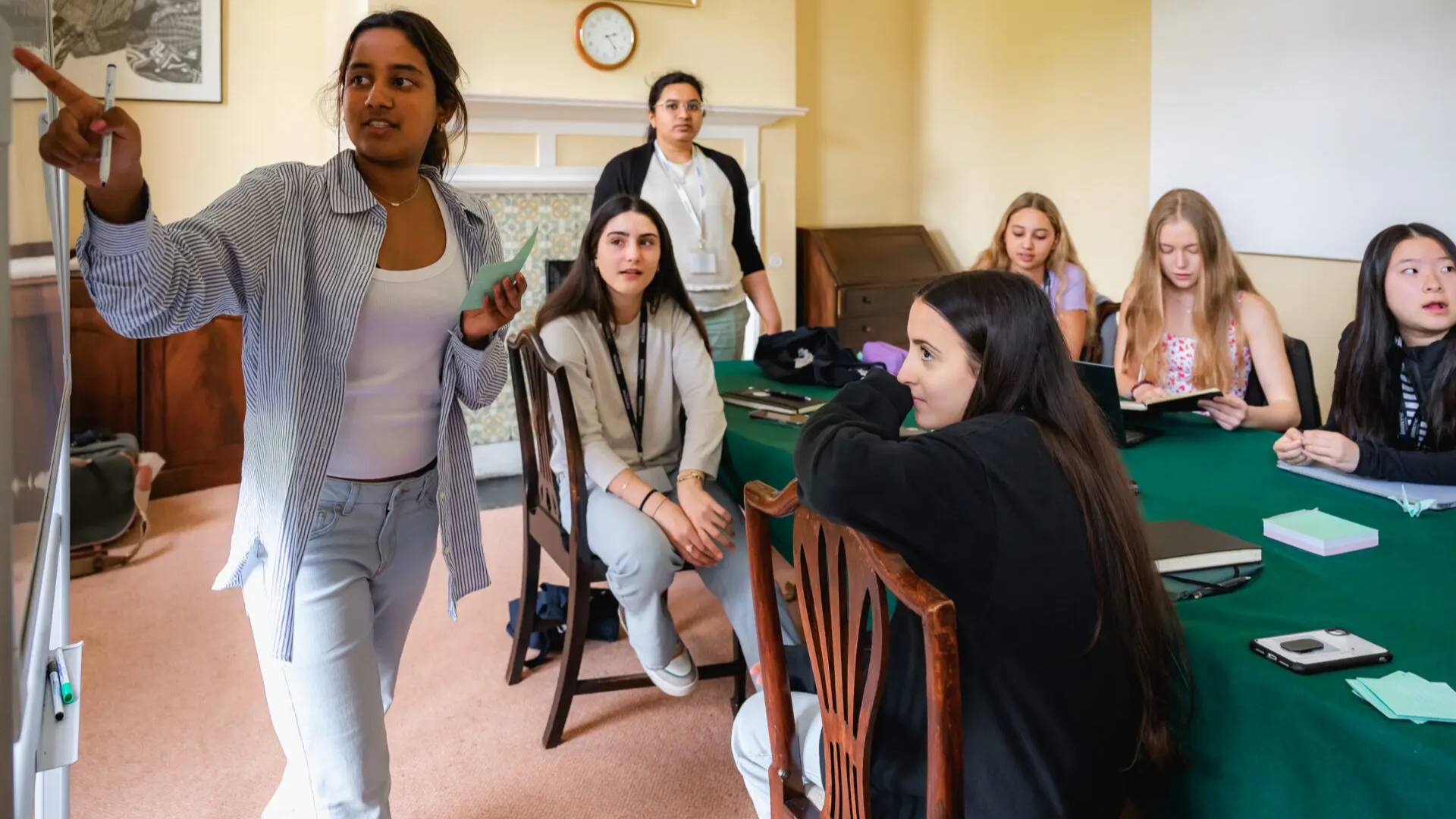
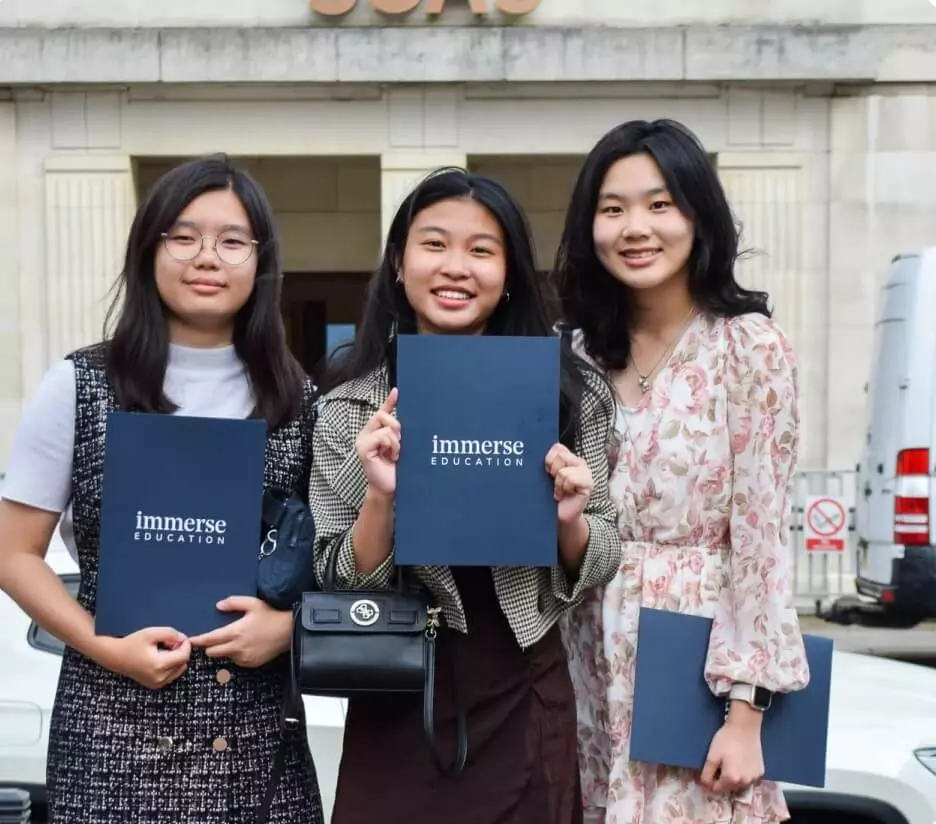
Designed for high school students from around the world, Immerse Education's Mathematics Summer School brings an international learning experience to Tokyo. You'll study university-level mathematics in small classes of 7 to 10 students, under the guidance of tutors from leading universities such as Oxford and Cambridge.
The curriculum covers logic, proof, algebra, and calculus, with an emphasis on problem-solving and collaborative learning. Outside the classroom, you'll participate in cultural activities and explore Tokyo with fellow participants. The program concludes with a graduation ceremony, a formal dinner, and personalised feedback from your tutor. You can apply here.
Why it stands out: It's one of the few international residential mathematics programs in Tokyo, with rigorous academic learning and exposure to Japan's technology and innovation ecosystem.
3. Tokyo University of Science - Science Program for High School Students: Be a University Student for a Day - The World of Mathematical Research and Mathematics Education
Location: Tokyo, Japan
Cost: None
Acceptance rate/cohort size: Non-competitive; 25 participants
Dates: July 16th
Application Deadline: July 8th or until it reaches capacity
Eligibility: High school students; third-year junior high students and secondary-school teachers also permitted; not open to international students
In this program, you experience university-level mathematics through lectures, research activities, and interaction with mathematics students. You attend sessions on single-variable calculus and mathematics education, including approaches to teaching, instructional methods, and assessment. You also experience mathematical research through a seminar in the Yokota Laboratory and hands-on mathematical teaching materials at the Mathematics Experience Museum.
The calculus component extends high-school differentiation and integration into limits, improper integrals, and ordinary differential equations. You participate in discussions and exchanges with current students. The program provides direct exposure to both pure mathematics and mathematics education at university level.
Why it stands out: It combines authentic university mathematics classes with a research-seminar experience and hands-on exploration of mathematical teaching materials.
4. Kanazawa Institute of Technology - KIT Mathematics Seminar
Location: Nonoichi, Ishikawa, Japan
Cost: None
Acceptance rate/cohort size: Non-competitive; 50 students
Dates: July 18th
Application Deadline: July 10th; first-come, first-served
Eligibility: High school students; open to international students
In this program, you explore advanced mathematical concepts and their practical applications through hands-on exercises. You engage with mathematical physics to examine how moving objects experience the passage of time differently. You also investigate mathematical induction by working through physical tile-paving activities that model complex theoretical proofs.
As a participant, you actively apply mathematical reasoning to solve abstract puzzles and verify scientific phenomena. You perform calculations based on the special theory of relativity to understand how time dilation affects everyday technologies like smartphone GPS. By connecting these theoretical frameworks to real-world functions, you develop a deeper understanding of the vital role mathematics plays in modern physics and engineering.
Why it stands out: It allows high school students to explore complex mathematical induction and the special theory of relativity through accessible, hands-on activities like tile paving.
5. University of Tsukuba College of Mathematics - Experiential Learning Program
Location: Tsukuba, Ibaraki, Japan
Cost: None
Acceptance rate/cohort size: Open admission; 50 places
Dates: July 25th
Application Deadline: July 15th
Eligibility: High school students; not open to international students
In this program, you spend a single day on the University of Tsukuba's Tsukuba Campus exploring university-level mathematics explained for high school students. Morning and afternoon blocks pair lectures with guided exercises on one theme, investigating electric circuits using random walks.
You revisit Ohm's law and Kirchhoff's law equations from school science, then see how a particle stepping randomly across a grid encodes the same voltages, with a short experiment. The day ends with small-group conversations alongside the lecturer, the organising faculty member and several current Tsukuba mathematics undergraduates, and every participant receives a completion certificate. Attendance is free, capacity is capped at fifty students, and you bring your own lunch.
Why it stands out: It turns a working mathematician's own research topic into one free day of lecture, exercises and direct conversation with current mathematics undergraduates, for only fifty high school students.


6. Nihon University - Mathematics Summer School
Location: Nihon University, Sakurajosui Campus, Setagaya, Tokyo
Cost: None
Acceptance rate/cohort size: Non-selective; cohort size not specified
Dates: August
Application Deadline: Not specified
Eligibility: All high school students; open to international students (Japanese proficiency required)
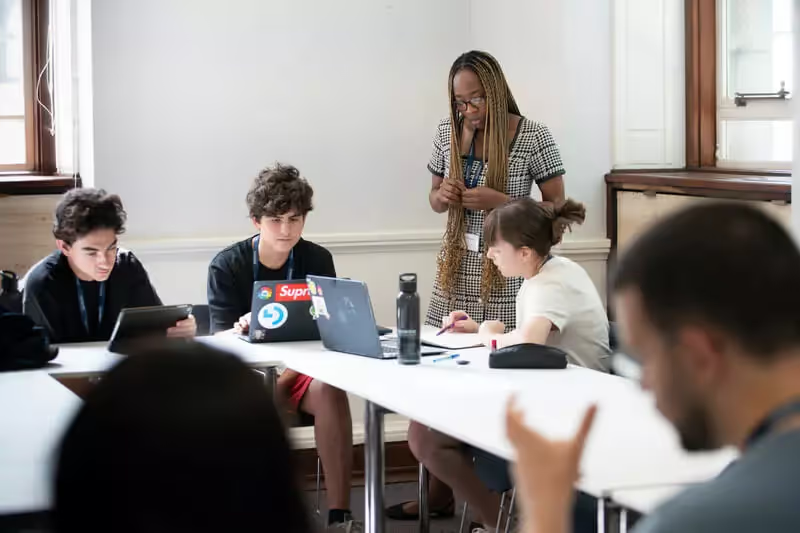
The Nihon University Mathematics Summer School is an annual program designed to put "mathematics in everyone's hands". You will explore introductory modern mathematics and various math-related topics that are completely understandable using your basic high school math knowledge.
During the event, you will attend accessible lectures, participate in organized tea time sessions, discuss concepts directly with math department staff, and converse with fellow attendees. Its unique features include being entirely free of charge and seamlessly blending diverse age groups into one shared environment. Ultimately, you will learn to comprehend foundational modern math concepts and develop the skill to discuss academic ideas confidently.
Why it stands out: This program distinguishes itself by removing all financial barriers and academic exclusivity, successfully making university-level modern mathematics welcoming and accessible to the general public.
7. Kyushu University - MATH FOR THE FUTURE VOL.3
Location: Fukuoka, Fukuoka
Cost: None
Acceptance rate/cohort size: Selective; ~150 students
Dates: August 21st
Application Deadline: July 18th
Eligibility: First- and second-year high school students attending schools in Fukuoka Prefecture; not open to international students
In this program, you explore how advanced mathematics connects with practical problems and modern technologies. You attend a lecture on mathematical approaches supporting logistics reform and study how linear algebra underlies Google’s PageRank through a combined lecture and exercise session.
The program gives you direct exposure to applied mathematics through both real-world logistics problems and the mathematics behind a major web-search algorithm. You also learn about Kyushu University’s mathematics department, tour the campus and science library with university students, and join a discussion with them. These activities combine mathematical problem-solving with exposure to university-level study and research.
Why it stands out: It connects high-school mathematics directly with logistics optimization and Google PageRank while giving you firsthand exposure to university mathematics.
8. Meiji University - Advanced Mathematical Sciences Visit for High School Students
Location: Tokyo, Japan
Cost: None
Acceptance rate/cohort size: Selective; up to 150 participants
Dates: October 11th
Application Deadline: Poster presentations close September 18th; general attendance closes October 7th
Eligibility: High school students, technical college students in grades 1-3, and secondary school students in grades 4-6 studying in Japan; not open to international students
In this program, you explore the application of mathematics to real-world phenomena. You attend a lecture on phenomenological mathematics, learning how computational models decode complex systems. During the event, you review independent research projects at a poster session and exchange insights with peers. You interact with faculty to discuss computational workflows, logical reasoning, and data-driven methodologies.
Organized by the Meiji Institute for Advanced Study of Mathematical Sciences, the program uniquely bridges academic mathematics with practical inquiry through personalized faculty feedback. Ultimately, you expand your understanding of university-level research and build a strong scientific network.
Why it stands out: It offers high schoolers a rare opportunity to present their independent phenomenological mathematics research and receive direct feedback from specialized university faculty.
9. Iwate Prefectural University - Summer Seminar: Discovering the Wonders of Mathematics - A Mathematical Exploration Beginning with Sets and Topology
Location: Takizawa, Iwate
Cost: None
Acceptance rate/cohort size: Non-competitive; 40 participants
Dates: August 5th
Application Deadline: July 21st
Eligibility: High school students; open to international students (Japanese proficiency required)
In this program, you explore how increasingly abstract mathematics can create greater freedom for mathematical thinking. You spend the morning studying sets and the afternoon exploring topological spaces, progressing from foundational concepts to more advanced mathematical ideas. You examine how mathematical objects can be defined consistently and consider unconventional possibilities such as negative-dimensional spaces.
The seminar emphasizes reasoning, abstraction, and formulating mathematically valid ideas rather than routine calculation. You learn directly from faculty in the School of Software and Information Science. The four-hour format provides a focused introduction to university-level mathematical exploration.
Why it stands out: It introduces high school students to sets and topology through a concentrated university-level exploration of abstract mathematical thinking.
10. Kyushu Sangyo University - Enjoy Mathematics with AI Tools: An Invitation to Experimental Mathematics
Location: Fukuoka, Fukuoka
Cost: ¥1,500
Acceptance rate/cohort size: Non-competitive; 20 participants
Dates: July 23rd
Application Deadline: First-come, first-served until all 20 places were filled
Eligibility: General public ages middle-school level and above; elementary-school students permitted with a guardian; open to international students
In this program, you explore mathematics experimentally using the computational tool Wolfram Alpha. You investigate everyday questions by entering mathematical problems, examining calculated results, and experimenting with different possibilities. You use Wolfram Alpha to explore questions such as whether your friends’ friends tend to have more friends than you and how password length affects strength.
The session emphasizes trying ideas computationally rather than relying only on conventional hand calculations. You can develop mathematical curiosity, computational problem-solving skills, and an understanding of how digital tools help investigate numerical and real-world patterns. The course is designed to remain accessible even if mathematics is not your strongest subject.
Why it stands out: It introduces experimental mathematics through hands-on use of Wolfram Alpha to investigate familiar real-world questions.
11. Kumamoto University - Remainders in Division and How Cryptography Works
Location: Kumamoto, Kumamoto, Japan
Cost: None
Acceptance rate/cohort size: Non-competitive; 20 participants
Dates: August 17th; August 21st
Application Deadline: First-come, first-served until all places are allocated
Eligibility: Junior high and high school students; open to international students (Japanese proficiency required)
In this program, you explore the mathematical principles underlying prime numbers and cryptography. You begin by investigating prime numbers and analyzing the math hidden within remainders when dividing by primes. In a practical application of these mathematical concepts, you participate in a cryptography game where teams create ciphers, decrypt them using a private key, and attempt to crack codes without one.
Throughout these exercises, you apply prime factorization and remainder properties to understand real-world secure communication systems. You gain hands-on experience with the logical reasoning and computational workflows essential to data security. Ultimately, this lecture and experimental game deepen your applied mathematical skills in a university environment.
Why it stands out: It allows students to experience the practical application of abstract number theory by roleplaying as both cryptographic creators and codebreakers in an interactive, team-based simulation.
Join the Immerse Education 2027 Essay Competition
Follow the instructions to write and submit your best essay for a chance to be awarded a 100% scholarship.
12. University of Tsukuba - Public Lecture: Stories of Boundless Mathematics
Location: Tsukuba, Ibaraki, Japan
Cost: None
Acceptance rate/cohort size: Non-competitive; maximum 60 students
Dates: July 25th
Application Deadline: June 25th
Eligibility: High school students and above, with general adult participants also admitted; open to international students
In this program, you spend one afternoon on the University of Tsukuba campus with two of the university's research mathematicians, looking at how mathematics handles the infinite. The first talk walks you from Cantor's leap beyond endless counting to Russell's paradox and Gödel's results on what any set of starting rules can and cannot prove.
You also work through the underlying logic calculations yourself, an exercise the organisers state needs no special preparation. The second talk starts from the Basel problem, adding up one over every square number, and reaches Euler's answer, products over the prime numbers, and Apéry's proof that ζ(3) is irrational. You finish on questions mathematicians still cannot settle.
Why it stands out: It puts two working University of Tsukuba mathematicians in front of a small free audience for an afternoon that runs from the foundations of infinity all the way to zeta-function problems that remain unsolved.
13. Kyushu University - Public Lecture: Introduction to Modern Mathematics
Location: Fukuoka, Fukuoka Prefecture, Japan
Cost: None
Acceptance rate/cohort size: Non-competitive; 90 in-person places, 500 online
Dates: August 6-7
Application Deadline: In-person deadline: July 24th; Online: accepted until the event day
Eligibility: High school students and other members of the public with strong interest in mathematics; open to international students (Japanese proficiency required)
In this program, you explore advanced mathematical ideas through university-level public lectures designed to make modern mathematics accessible to strongly interested learners. You study non-integer dimensions and fractal figures, including how fractal dimension is defined and how fractals appear in nature and pure mathematics.
You also encounter knot mathematics and a separate session connecting Ukraine with Banach mathematics. You can attend in person at Kyushu University’s Ito Campus or join by Zoom, and participation is free. You may participate on one or both days, giving you direct exposure to contemporary mathematical topics presented by Kyushu University faculty.
Why it stands out: It gives high school students direct access to contemporary university mathematics through free lectures on topics extending well beyond the standard school curriculum.
14. Josai University - Hirameki Tokimeki Science: Mathematics of Shapes Made with Origami - Designing from Crease Patterns
Location: Tokyo, Japan
Cost: None
Acceptance rate/cohort size: Non-competitive; 20 students
Dates: August 17th
Application Deadline: First-come, first-served until all places are filled
Eligibility: High school students; open to international students (Japanese proficiency required)
In this program, you will explore the mathematical properties of curved surfaces through hands-on geometric modeling. You will learn the theoretical foundations of positive and negative curvature, using computer-based origami design workflows to translate complex spatial information into two-dimensional plans. As you process these designs, you will operate a cutting machine to precisely transfer guide lines onto paper, reinforcing practical technical skills.
Through direct application of mathematics and computer-assisted design, you will construct physical representations of mathematical models traditionally difficult to visualize. You will receive support from university faculty and student mentors throughout the process, ensuring a comprehensive learning experience.
Why it stands out: It uniquely combines abstract geometrical mathematics with computer-assisted design and physical origami construction to materialize complex spatial theories.
15. The University of Tokyo - Science Café Universe: A Mathematical Story of “Counting” Invisible Shapes - How to Reach 2875 Without Counting from 1
Location: Nishitokyo, Tokyo
Cost: ¥400 participation fee + ¥520 entrance fee
Acceptance rate/cohort size: Non-competitive; 50 participants
Dates: June 28th
Application Deadline: First-come, first-served basis
Eligibility: Junior high school students through adults; content intended for high-school level; open to international students
In this program, you explore enumerative geometry through the mathematical problem of counting shapes that satisfy specific conditions. You examine the classical problem of circles tangent to three given circles and extend the idea to objects in spaces that cannot be visualized directly.
You learn how intersection theory converts geometric conditions into algebraic methods for counting otherwise invisible curves in higher-dimensional spaces. You also explore the famous result that a general quintic threefold contains exactly 2,875 lines. The talk connects geometry and algebra with Calabi - Yau manifolds and developments arising from string theory. You experience these ideas through an English-language mathematics talk designed at approximately high-school level.
Why it stands out: It introduces high-school students to advanced enumerative geometry while showing how abstract mathematics and modern theoretical physics intersect.
Frequently asked questions: Math Summer Programs in Japan for High School Students
What math summer programs are available in Japan for high school students?
Japan's options split mainly into free single-day university lectures and selective, paid multi-week residentials. University departments such as Tokyo Metropolitan University, Kyushu University, and the University of Tsukuba run one-day lecture and workshop sessions open to any high schooler, usually in Japanese. Public lecture series, like Kyushu University's Introduction to Modern Mathematics, let you attend in person or online. For a longer, English-language option, Immerse Education runs a two-week residential Mathematics Summer School in Tokyo for students aged 15 to 18, with small classes of 7 to 10.
Are there free math summer programs in Japan for high school students?
Yes, most of the programs on this list cost nothing. Tokyo Metropolitan University, Kanazawa Institute of Technology, Nihon University, and the University of Tsukuba's public lecture all run free sessions, usually lasting a single day. A few charge a small fee instead, such as Kyushu Sangyo University's workshop at 1,500 yen or the University of Tokyo's Science Café at roughly 900 yen combined. If you want a longer, residential option rather than a single free lecture, expect to pay for it.
Can international students join math summer programs in Japan?
It depends heavily on the specific program. Free university lectures, such as those at Tokyo Metropolitan University, Kanazawa Institute of Technology, and the University of Tsukuba's day seminar, are open to international applicants, though many still require Japanese proficiency to follow the lecture. A handful, like the Science Café Universe talk at the University of Tokyo, are delivered in English specifically for an international audience. If you want a program that doesn't require any Japanese ability at all, Immerse Education's Tokyo Mathematics Summer School teaches entirely in English for students aged 15 to 18.
Do you need to be good at math to join a math summer program in Japan?
No, most programs welcome a wide range of ability levels. Nihon University's summer school is explicitly built for anyone with basic high school math knowledge, and the University of Tokyo's Science Café talk is pitched at approximately high school level for general audiences. Competitive, invitation-based options exist too, such as Kyushu University's MATH FOR THE FUTURE, which is selective and limited to around 150 students. If you're unsure of your level, start with a free, open-admission lecture before applying anywhere selective.
What is the best math summer program in Japan for high school students?
There isn't a single best option, since the right program depends on what you want. If you're drawn to pure theory, the University of Tsukuba's public lecture on infinity and zeta functions or Iwate Prefectural University's seminar on sets and topology go deeper into abstract ideas. If you prefer applied or computational work, Kyushu Sangyo University's Wolfram Alpha workshop or Kumamoto University's cryptography session connect math to real tools and problems. Start by deciding whether you want theory, application, or a short taste of a university lecture before comparing specific dates and costs.
How long do math summer programs in Japan typically last?
Most run for a single day, sometimes just a few hours, since they're structured as one-off university lectures or workshops rather than residential courses. A small number stretch over two days, like Kyushu University's Introduction to Modern Mathematics public lecture series. If you want an extended, multi-week experience rather than a single lecture, options narrow considerably and usually involve travelling from abroad and paying program fees rather than attending a free local event.
Take your math interests abroad to Japan
You don't need to already be a confident math person to benefit from spending a summer exploring the subject somewhere completely new this year.
Most math summer programs in Japan for high school students run as single free lectures rather than full residential courses.
Picking the right one means deciding how much structure, language ability, and time commitment you're truly ready to take on this summer.
If studying abroad feels like the right next step, our Study Abroad blogs can help you plan with more confidence.






Unlock Inspiring Opportunities with the Immerse Education Newsletter
Join our newsletter to stay ahead with exclusive updates, exciting programme highlights, and expert insights from the world of immersive education.
Learn how Immerse can transform your life
An in-depth overview of our university and career preparation programmes
Get a glimpse into the life of an Immerse participant
Find the right programme for you with sample timetables, location showcases, and more