15 Summer Schools for Year 9 Students

TL;DR
You’ll find 15 summer schools here for Year 9 students, mostly residential programmes run by universities in the US and UK, plus Stanford’s online institutes. The biggest difference is access, since free UK schemes like Imperial’s Year 9 Girls Engineering Summer School prioritise under-represented students, while US gifted programmes like CTY and VAMPY often ask for test scores. Year 9 usually lines up with 8th grade in the US, and costs range from free to more than $6,000. Immerse Education’s Academic Insights pathway offers two-week courses in Cambridge and Oxford for students aged 13 to 15, alongside older age groups.
As a Year 9 student, a summer school gives you a stretch of time in one subject alongside people who teach it at university level. You live or study on a campus, take a single course, and work in a small group led by a professor or a doctoral researcher. Across these programs, you’ll do things school labs rarely allow, from programming a robot you designed yourself to isolating a virus nobody has cataloged.
The subjects run wide, covering engineering, neuroscience, mathematics, creative writing, artificial intelligence, and biology. Most programs also fold in evening activities, weekend trips, and time with current undergraduates. You come away with a project, a written evaluation, or a certificate, and a clearer picture of what the subject actually involves day-to-day.
Why pursue a summer school in year 9?
These programs can act as a foundation for your college journey, giving you a taste of what university life is like at a top institution, in person. Some are residential, so you sleep in halls and eat in the dining hall for the length of the course. Others are commuter or online, which keeps the cost down when travel is the obstacle.
A summer school for Year 9 students can be free, fully funded, or several thousand dollars, and many of the paid ones offer need-based financial aid. Entry usually rests on your school record, a teacher reference, or a standardized test score. To help you find the right fit, we’ve put together 15 summer schools for Year 9 students, most of them run by universities.
15 Summer Schools for Year 9 Students
1. Johns Hopkins Center for Talented Youth
Location: Six residential sites in 2026, including Johns Hopkins University (Baltimore, MD), Loyola Marymount University (Los Angeles, CA), and UC Santa Cruz (Santa Cruz, CA)
Cost/Stipend: Varies by course and length
Acceptance rate/cohort size: Selective; requirements vary by course
Dates: Three-week residential sessions in summer (2027 dates not yet posted)
Application Deadline: 2027 enrollment dates not yet posted
Eligibility: Residential options for grades 7 to 12 at all sites and grades 5 to 12 at select sites; course requirements vary | International eligibility not specified
CTY’s residential sites give you three weeks of living, eating, and studying on a college campus alongside other advanced learners. Morning class sessions run for three hours with breaks built in, and you return to the same course for more learning and activities after lunch. Evenings bring dinner in the dining hall, a final class session, supervised free time, and a hall meeting to close the day.
Resident assistants organize afternoon activities, and weekends fill with staff-run sports, games, dances, talent shows, carnivals, and movie nights. Most students at the residential sites are between 12 and 15, so you’ll be among peers close to your own age.
Why it stands out: You get three weeks of focused study in one advanced subject, inside a residential community built around students your age.
2. Immerse Education's Pre-University Summer School

Location: Cambridge, London, Oxford, Singapore, Sydney, and Toronto
Cost: Varies; summer school scholarship available through our bursary programme
Acceptance rate/cohort size: Selective; an average of 7 participants per class
Application Deadline: Multiple cohorts with rolling admissions
Program Dates: 2 weeks during the summer
Eligibility: Students across the globe aged 13-18 currently enrolled in middle or high school; open to international students
Immerse Education's Academic Insights pathway lets high school students experience university life firsthand. You can live on campus or join as a commuter, study in small seminar groups averaging 7 students, and learn from tutors from eminent top universities like Oxford and Cambridge. You can explore a wide range of subjects, spanning over 20 options, including Architecture, Business Management, Computer Science, Economics, Engineering, Medicine, and more.
The courses are experiential and focus on hands-on learning. You may find yourself conducting dissections in medicine, designing a robotic arm in engineering, participating in a moot court for law, or building creative writing portfolios and business case studies. By the end of the program, you'll complete a personal project, receive written feedback, and receive a certificate of completion. You can find more details about the application here.
Why it stands out: You'll get an early start at university life and academics because the program includes an independent project, discussion-based classes, and living at a college campus.
3. Lumiere Research Scholar Program
Location: Remote; you can participate in this program from anywhere in the world!
Cost: Varies depending on program type. Full financial aid available.
Application Deadline: Varies by cohort.
Program Dates: Vary by cohort: summer, fall, winter, or spring. Options range from 12 weeks to 1 year.
Eligibility: You must be currently enrolled in high school and demonstrate a high level of academic achievement.
The Lumiere Research Scholar Program is a rigorous research program tailored for high school students. The program offers extensive 1-on-1 research opportunities for high school students across a broad range of subject areas. The program pairs high school students with Ph.D. mentors to work 1-on-1 on an independent research project. At the end of the 12-week program, you’ll have developed an independent research paper!
You can choose research topics from subjects such as psychology, physics, economics, data science, computer science, engineering, chemistry, international relations, and more. You can find more details about the application here, and check out students’ reviews of the program here and here.
Why it stands out: You’ll get an early start on university-level study through small seminars, 1:1 tutorials, and an independent project, with residential or commuter options.
4. Brown University STEM for Rising 9th and 10th Graders
Location: Brown University, Providence, RI
Cost/Stipend: Listed on Brown’s Program Dates & Costs page; scholarships and application fee waivers available
Acceptance rate/cohort size: Not specified
Dates: 12 days; 2026 ran July 12th to 24th (2027 dates not yet posted)
Application Deadline: Not specified on the program page
Eligibility: Students completing grades 8 to 9, aged 13 to 15 by June 14th, 2026 | Open to international students
STEM 9/10 is a 12-day residential program where you choose one course from a range of STEM subjects. Each course combines academic content and laboratory or field exercises with a research project or design challenge that anchors your work across the two weeks. You may also meet Brown graduate students and learn about their research.
Classes run in the morning, and twice a week your class meets in the afternoon to continue its research project. You close with a final presentation for your peers, instructors, and families, and you receive a Digital Certificate of Completion and a Course Performance Report. Resident Assistants live in the residence hall and supervise evening and weekend activities.
Why it stands out: There are no formal grades, so you can take on advanced STEM material and still come away with a written report on your performance.
5. Imperial College London Year 9 Girls Engineering Summer School

Location: Imperial College London, South Kensington, London, UK
Cost/Stipend: Free; covers course fees, materials, and lunch (travel not included)
Acceptance rate/cohort size: Competitive; Imperial’s outreach programmes are often oversubscribed
Dates: 4 to 7th August 2026 (2027 dates not yet posted)
Application Deadline: 2026 applications ran from 12th January to 18th March (2027 dates not yet posted)
Eligibility: Year 9 girls studying at least eight GCSEs, on track for at least five at grades 7 to 9 including maths and sciences and grade 5 in English Language, and able to travel to campus daily; widening participation criteria apply | International eligibility not specified
Imperial runs this four-day, non-residential engineering summer school for Year 9 girls through its schools outreach team. You meet your mentor on the first day, take part in team-building activities, and tackle a group challenge using what you already know about engineering. Over the following days, you explore engineering through taster sessions from departments that have recently included Bioengineering, Civil Engineering, Design Engineering, Earth Science and Engineering, Materials Science, and Mechanical Engineering.
Each day ends with a short reflection on what you learned and what surprised you. On the final day, your team creates a poster on one engineering discipline and presents it at an exhibition for students, academic leaders, families, and invited guests.
Why it stands out: You sample engineering taught by the same departments that run Imperial’s degree courses, for free.



6. Vanderbilt Summer Academy
Location: Vanderbilt University, Nashville, TN
Cost/Stipend: Listed on VSA’s Tuition & Financial Assistance page; payment plans available; financial assistance isn’t available to international students
Acceptance rate/cohort size: Selective; you submit eligibility materials to show an accelerated course is a good fit
Dates: One-week residential sessions in summer (dates on VSA’s Eligibility & Session Dates page)
Application Deadline: Not specified on the program page
Eligibility: Students in grades 7 to 12 | Open to international students with proof of English proficiency, such as an IELTS score of 7.0
Vanderbilt Summer Academy is a one-week residential program run by Vanderbilt’s Programs for Talented Youth, where you take one accelerated, choice-based course. With up to six hours a day of academic learning, you get real depth in topics such as nanotechnology, biomedical ethics, and philosophy, history, and medicine. Many courses include visits to campus libraries, labs, archives, and studios.
Vanderbilt content experts teach most courses, and every course has a dedicated instructor and teaching assistant. You live in a first-year residence hall and join a small proctor group, alongside students who have come from 46 states and 25 countries in recent years.
Why it stands out: You get a dedicated instructor, a teaching assistant, and a small proctor group, so you’re never just one student in a crowd.
7. Northwestern Center for Talent Development Academic Summer Camps
Location: Northwestern University, Evanston, IL
Cost/Stipend: 2026 tuition: $1,005 (one-week day), $1,830 (one-week residential), $3,025 (three-week day), $5,430 (three-week residential), up to $6,105 for partnership camps; need-based aid available, though 2026 aid was fully allocated
Acceptance rate/cohort size: Selective; eligibility tiers vary by course
Dates: 2026 sessions ran from June 28th to August 7th (2027 dates not yet posted)
Application Deadline: One week before each session’s start date
Eligibility: Students entering grades 6 to 12 in the fall, with qualifying test scores or a transcript and teacher recommendation; TOEFL or IELTS for some applicants whose first language isn’t English | Open to international students
CTD runs one-week and three-week courses on Northwestern’s Evanston campus, and you can attend as a day student or a resident. Class runs from 9 am to 3 pm with an hour for lunch, and courses split into advanced enrichment and accelerated tracks that cover one to two semesters of content in three weeks. Courses are built to produce something by the end, such as a writing portfolio, an original iOS app, or a community action plan.
Expect one to three hours of homework a night, depending on your track. Residents spend Saturdays on off-campus excursions such as museums, amusement parks, sporting events, and theater. You finish with a narrative evaluation of your class performance with recommendations for future study, and residents get a second evaluation on their community contributions.
Why it stands out: You can choose between one week and three weeks, and between day and residential formats, to fit your budget and schedule.
8. UC Berkeley Academic Talent Development Program, Secondary Division
Location: University of California, Berkeley, CA, or live online
Cost/Stipend: Tuition varies by course
Acceptance rate/cohort size: Selective; classes are capped at 20 to 24 students
Dates: June 22nd to July 31st, 2026 (2027 dates not yet posted)
Application Deadline: In 2026, February 25th (early), March 23rd (standard), and May 29th (extended)
Eligibility: Students currently in grades 7 to 11; some courses have prerequisites | Open to students attending school outside the US
ATDP puts you in a single subject for six weeks, with classes meeting two or three times a week in a morning or afternoon window, either on campus or live on Zoom. You choose from more than 40 courses, and half-year equivalent courses cover about a semester of content while full-year courses cover two. Expect three to ten hours of preparation for each class meeting.
There are no excused absences, so the program expects full commitment. Final evaluations go into your educational record, and many courses now count toward UC and CSU entrance requirements.
Why it stands out: Many courses carry UC and CSU A-G approval, so your summer work can count toward California public university entrance requirements.
9. Stanford Pre-Collegiate Summer Institutes

A student attending an online class using their laptop
Location: Online; run by Stanford Pre-Collegiate Studies
Cost/Stipend: Listed on the Tuition and Financial Aid page; financial aid available
Acceptance rate/cohort size: Selective; average class size of 16
Dates: Two-week sessions; 2026 ran June 15th to 26th and July 6th to 17th (2027 dates not yet posted)
Application Deadline: 2026 applications are closed; join the mailing list for 2027 updates
Eligibility: Students currently in grades 8 to 11 | Open to international students
Stanford Pre-Collegiate Summer Institutes offers intensive study in a single online course over two weeks. You choose from more than 75 courses in subjects such as artificial intelligence, creative writing, engineering, mathematics, and philosophy, all designed and taught by experts in their fields. Courses are ungraded and don’t carry credit.
Classes meet live every weekday with your camera and microphone on, and asynchronous assignments prepare you for the next day’s session. Students typically join from all 50 US states and more than 50 countries.
Why it stands out: Missing more than one class can cost you your certificate, so it holds you to a university-style attendance standard.
10. Purdue GER²I Summer Residential Camps
Location: Purdue University, West Lafayette, IN
Cost/Stipend: Not specified on the program page
Acceptance rate/cohort size: Selective
Dates: 2026 camps ran from June 28th to July 25th (2027 dates not yet posted)
Application Deadline: 2026 registration opened on February 2nd (2027 dates not yet posted)
Eligibility: Gifted, creative, and talented students in grades 5 to 12, enrolling by current grade level | Open to international students
Purdue’s Gifted Education Research and Resource Institute has run these residential camps for over 45 years, with small, fast-paced, interactive classes. Morning and afternoon class sessions use Purdue’s laboratories, computing facilities, and libraries. You enroll by your current grade, so an 8th grader registering in spring joins the Star program for 7th and 8th graders.
Outside class, you’re placed in a group of ten or fewer with a camp counselor who lives on your residence hall floor. Star and Pulsar campers take a Saturday field trip, which has gone to museums and zoos in Chicago and Indianapolis. Evenings bring activity challenges, a Global Gala, and a talent show.
Why it stands out: Placement by current grade means the course level matches the work you’ve actually done.
11. Western Kentucky University VAMPY
Location: Western Kentucky University, Bowling Green, KY
Cost/Stipend: $4,200 registration fee, plus a $400 deposit with the application (2026)
Acceptance rate/cohort size: Selective; an ACT or SAT score is required
Dates: June 20th to July 10th, 2027
Application Deadline: Applications open January 15th, 2027
Eligibility: Students who have completed grades 7 to 10 | Open to international students
VAMPY is a three-week residential camp where you focus on one course for the whole run. That course fills six class hours every weekday, followed by an hour-long study hall each night. WKU faculty and high school teachers lead the classes.
You live in an air-conditioned residence hall supervised by counselors, most of whom are college students who attended VAMPY themselves. They design the evening Optionals, from Capture the Flag to chalk art, and weekends bring cookouts, baseball games, and dances.
Why it stands out: Six class hours a day in a single subject gives you a depth of study few summer programs match.
Join the Immerse Education 2027 Essay Competition
Follow the instructions to write and submit your best essay for a chance to be awarded a 100% scholarship.
12. Texas State Mathworks Junior Summer Math Camp, Residential
Location: Texas State University, San Marcos, TX
Cost/Stipend: $2,200, covering room, board, books, and supplies; need-based scholarships available
Acceptance rate/cohort size: Selective; enrollment is limited and the camp fills up
Dates: June 6th to 18th, 2027
Application Deadline: Applications open December 1st, with acceptances starting February 15th; rolling until full
Eligibility: Students currently in grade 6, 7, or 8 | International students have taken part
Mathworks runs this two-week residential camp for middle school students who are excited about mathematics. You arrive on a Sunday afternoon to meet your study group, counselors, and fellow campers. Each day includes mathematics classes taught by university professors, followed by study group sessions, recreation time, and camp outings.
The aim is to develop you as a problem solver and researcher. Campers can’t take online courses or join other programs while the camp runs, so you stay fully focused on math.
Why it stands out: You apply for a need-based scholarship on the same application form, so asking for help doesn’t mean a separate process.
13. University of Surrey Discover University Summer School
Location: University of Surrey, Guildford, UK
Cost/Stipend: Free, including meals, activities, and accommodation
Acceptance rate/cohort size: Selective; 60 participants
Dates: 27 to 30th July 2026 (2027 dates not yet posted)
Application Deadline: 2026 applications ran from 19th January to 29th March (2027 dates not yet posted)
Eligibility: Students in Years 9 and 10 who meet at least one widening participation criterion, such as receiving Free School Meals in the last six years, being a young carer, or having experience of living in care | International eligibility not specified
Surrey runs this fully funded residential summer school with the Higher Education Outreach Network. You choose one of four subject strands, Humanities, Creative Arts, Physical Sciences, or One Health, then work through taster workshops and complete a research project in that area. Example subjects have included law, music, physics, and psychology.
Sessions are delivered by Surrey and HEON staff, plus partner universities and colleges. You also meet current students and learn what studying and living at university is like.
Why it stands out: It’s completely free, with accommodation and meals included, so cost never stands in the way.
14. Joseph Baldwin Academy, Truman State University
Location: Truman State University, Kirksville, MO
Cost/Stipend: Listed on JBA’s Tuition and Scholarships page
Acceptance rate/cohort size: Selective; nomination required
Dates: Session I: June 5th to 25th, 2027; Session II: July 5th to 25th, 2027
Application Deadline: Applications open November 2026; priority deadline December 6th, 2026; final deadline January 3rd, 2027
Eligibility: Students completing 7th, 8th, or 9th grade who are high achievers by GPA, IQ, gifted coursework, or test scores, nominated by a school counselor, principal, gifted education teacher, or home-school parent | International eligibility not specified
The Joseph Baldwin Academy is a three-week residential program where you live like a college freshman on Truman State’s campus. You select one class from the liberal arts, spanning the humanities, fine arts, natural sciences, and social sciences. You share a residence hall room with a roommate and make friends from around the country.
Acceptance notifications go out in the first week of March, and course acceptance and deposits are due by April 1st. The early winter deadline means you’ll want to line up your nomination in the fall.
Why it stands out: It’s one of the few programs on this list built specifically for students finishing middle and junior high school.
15. Smith College Summer Science and Engineering Program
Location: Smith College, Northampton, MA
Cost/Stipend: Tuition of $4,985 for one two-week session or $9,970 for both (2026); $50 application fee
Acceptance rate/cohort size: Selective; up to 17 students per course
Dates: Session 1: July 4th to 17th, 2026; Session 2: July 19th to August 1st, 2026 (2027 dates not yet posted)
Application Deadline: Not specified on the program page
Eligibility: Students entering grades 9 to 12 in the fall; Smith is a residential women’s college | Open to international students
SSEP puts you in one lab-based course per two-week session, taught by Smith faculty with undergraduate science majors assisting. You might design and program your own robot from motors, sensors, and LEGO parts, build a digital logic circuit and test it with an Arduino, or isolate novel bacteriophages and image them by electron microscopy. Other courses cover solar cells and photosynthesis, neuroscience, and plant biodiversity.
Several courses have no prerequisites, including a chemistry course built for students who haven’t taken chemistry yet. Since 1990, nearly 1,800 students from 46 states and 53 countries have taken part.
Why it stands out: In 1999, Smith became the first women’s college in the US to establish its own engineering program.
Frequently asked questions: Summer Schools for Year 9 Students
Are there free summer schools for Year 9 students?
Yes, though most free options are UK widening participation programmes. Imperial’s Year 9 Girls Engineering Summer School is fully funded, covering course fees, materials, and lunch. Surrey’s Discover University Summer School is completely free for Years 9 and 10, including accommodation, meals, and activities. Both prioritise students from backgrounds under-represented in higher education. For more UK ideas, browse these summer camps in the UK for 14 year olds.
What grade is Year 9 in the US?
Year 9 in the UK usually lines up with 8th grade in the US, which matters when you check eligibility. Brown’s STEM program takes students completing grades 8 to 9, Joseph Baldwin Academy accepts students completing 7th to 9th grade, and Texas State’s camp is for current 6th to 8th graders. Stanford’s online institutes start at grade 8. If you’re comparing US options, these summer programs for 8th graders are a useful next list.
How much do summer schools for Year 9 students cost?
Costs range from free to several thousand dollars. Northwestern’s CTD charged $1,005 for a one-week day camp and $5,430 for a three-week residential camp in 2026, while Texas State’s two-week math camp costs $2,200 for 2027. VAMPY’s 2026 registration fee was $4,200, and Smith charged $4,985 per two-week session. Many programmes offer need-based aid, including Texas State, Berkeley’s ATDP, and Stanford.
Do you need test scores to attend a summer school in Year 9?
It depends on the programme. VAMPY requires an ACT or SAT score, and CTY and Northwestern’s CTD often use test scores, though CTD also accepts a transcript with a teacher recommendation. Joseph Baldwin Academy relies on a nomination from a counselor, principal, or gifted education teacher. UK programmes like Imperial’s and Surrey’s focus on your school record and widening participation criteria instead of test scores.
Can international students attend summer schools for Year 9 students?
Yes, several programmes welcome international applicants. Vanderbilt Summer Academy accepts international students with proof of English proficiency, though it can’t offer them financial aid, and Smith’s SSEP has hosted students from 53 countries. Stanford’s online institutes typically draw students from more than 50 countries. Immerse Education’s Academic Insights pathway in Cambridge and Oxford welcomes students aged 13 to 15 from around the world, with a bursary programme available.
When should you apply for summer schools for Year 9 students?
Start in the autumn, since several deadlines fall in winter. Joseph Baldwin Academy’s priority deadline is December 6th, 2026, Texas State opens applications on December 1st, and VAMPY opens on January 15th, 2027. In the UK, Imperial’s 2026 window ran from 12th January to 18th March, and Surrey’s ran until 29th March. If you’re planning a year ahead, these summer schools in London for Year 10 students can help.
From Year 9 summer to university-ready
A summer school after Year 9 lets you test a subject you might take at GCSE, A-level, or university before you commit to it.
Many summer schools for Year 9 students are residential, so you also practise living independently, managing your time, and making friends far from home.
Check grade cut-offs, test score rules, and nomination requirements early, since several programs close applications in winter, months before summer begins.
To keep building toward your degree choice and applications, explore our University Preparation blogs for practical advice on subjects, skills, and next steps.






Unlock Inspiring Opportunities with the Immerse Education Newsletter
Join our newsletter to stay ahead with exclusive updates, exciting programme highlights, and expert insights from the world of immersive education.
Learn how Immerse can transform your life
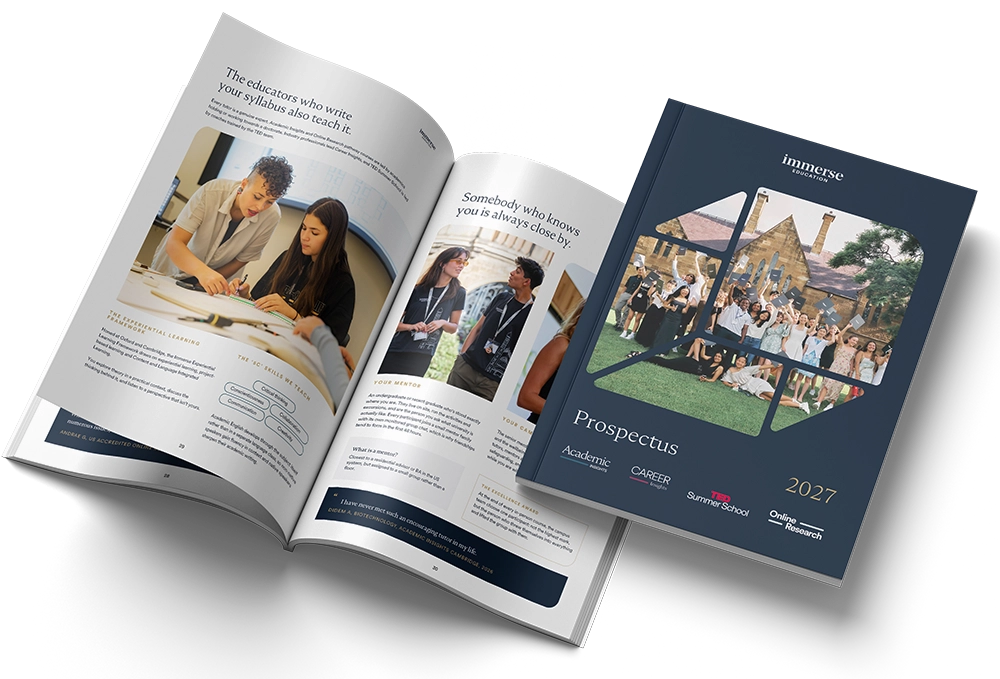
An in-depth overview of our university and career preparation programmes
Get a glimpse into the life of an Immerse participant
Find the right programme for you with sample timetables, location showcases, and more