If you’re a high school student curious about exploring mathematical concepts, a supportive and engaging environment can make the subject feel far more approachable. Whether you already excel in maths or are still deciding if it is a field you want to pursue seriously, math summer camps for high school students offer a structured way to explore advanced ideas with confidence.

Mathematics challenges you to think logically, approach abstract problems, and apply reasoning to real-world situations. A focused summer programme helps you develop these skills gradually, preparing you for more advanced study without the pressure of a traditional classroom.

Picture yourself debating number theory with peers, analysing data to understand traffic patterns, or using mathematical modelling to solve practical problems. In a summer camp setting, you can engage with higher-level mathematics in a balanced, encouraging space that allows you to discover your strengths and interests.

How to pick the best math summer camps for high school students?

If you begin to look for mathematics camps in the summer for high school students, you can easily feel overwhelmed by the multitude of options available. It is necessary for you to know what you might be looking for, what criteria are essential for you in a summer camp. You would have to look at the rigor of the camp, how it is structured, and what kind of mentorship opportunities are being offered.

Several universities and institutions offer math camps where you can find a variety of sub-disciplines: calculus, combinatorics, discrete mathematics, and more. Through expert faculty guidance and well-structured workshops, you can sharpen your analytical skills and approach complex problems with newfound creativity.

We’ve included camps that have you covered, no matter where you are in your math journey, from beginner-friendly camps to advanced-research, there’s something for everyone. To help you choose, here’s a list of the 15 Math Summer Camps for High School Students.

15 Math Summer Camps for High School Students  

1. Stanford University Mathematics Camp

Location: Virtual and residential sessions available
Cost/Stipend: Online: $3,750, Residential: $8,950; need-based financial aid is available
Acceptance rate/cohort size: Highly selective. Residential – 40 participants, Online – 64 participants
Dates: Session One: Online June 15th – July 3rd, Session One: Residential June 21st – July 17th, Session Two: Online July 6-24
Application Deadline: February 2nd
Eligibility: Open to rising juniors and seniors with a strong interest in mathematics, regardless of citizenship

The Stanford University Mathematics Camp is a three- to four-week mathematics camp for high school students interested in pursuing college-level mathematics. You will choose one of the two tracks: Abstract Algebra and Number Theory, or Algebraic Topology. There are structured lectures and problem sets for you to work on.

Both the residential and online tracks follow a similar academic structure. In the residential track, you’ll also join co-curricular activities and go on weekend field trips with peers. In the online track, you will attend virtual events with students from around the world.

Why it stands out: The curriculum includes proof-based mathematics and is on par with the graduate-level curriculum at Stanford.

2. Immerse Education’s Math Summer School

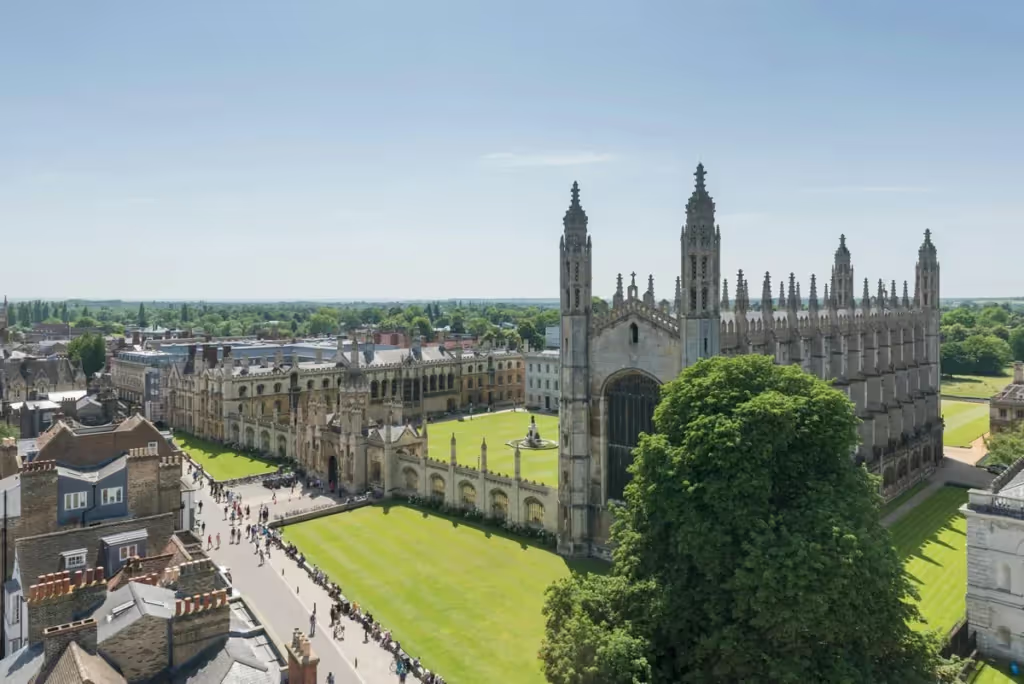
15 Math Summer Camps for High School Students 1

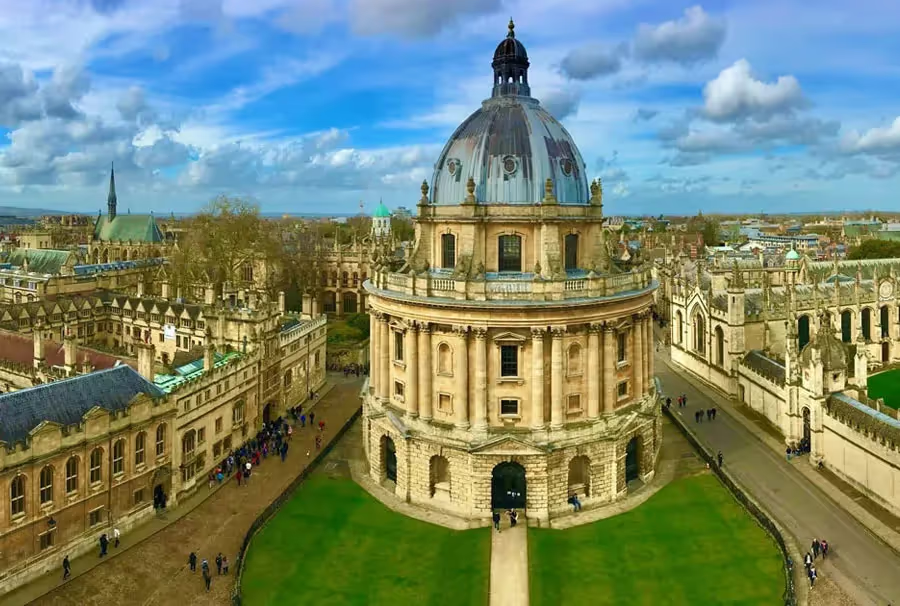
Location: Oxford, Cambridge, Boston, Tokyo, Singapore, and London
Cost: Varies; summer school scholarship available through their bursary programme
Acceptance rate/cohort size: Fairly selective; average of 7 participants per class
Dates: 2 weeks during the summer
Application Deadline: Multiple summer cohorts with rolling admissions.
Eligibility: Students worldwide aged 15-18 

The Mathematics Summer School by Immerse Education offers a focused introduction to university-level mathematical study. You will work through core topics like algebra, calculus, statistics, and linear systems using structured problem sets and guided discussions. Sessions emphasize reasoning through complex problems rather than memorizing formulas. You will collaborate with peers on mathematical challenges and apply theory to unfamiliar scenarios.

Instructors provide regular feedback and mentorship to help you refine your approach and identify areas of strength. The program is designed for students who want a clearer sense of advanced mathematics before choosing a university path. You can find more details about the application here.

Why it stands out: Its mix of rigorous math academics taught by esteemed faculty and provision of residential programs at campuses will help you gain an accurate picture of life as a math undergraduate student.

3. The University of Minnesota: IMA-MathCEP Math Modeling Camp

Location: On-campus at the University of Minnesota (Minneapolis), with limited remote slots for students in greater Minnesota who cannot commute
Cost/Stipend: Fully funded; students are responsible for daily commute and meals
Acceptance rate/cohort size: Not publicly disclosed
Dates: June 23-27
Application Deadline: May 31st
Eligibility: Open to high school students worldwide (including graduating seniors) who have completed a year-long course in single-variable calculus by the end of the school year

The IMA-MathCEP Math Modeling Camp is a one-week camp at the University of Minnesota. You will learn to use mathematical modelling, working in teams to solve real problems. You will be guided by faculty to analyze scenarios such as the flow of traffic, contamination of disease, or environmental changes, and develop practical solutions for them.

You’ll also learn to communicate complex ideas by presenting your findings to peers. The program is for you if you’ve completed a full year of single-variable calculus and are ready to transition to a collaborative, fast-paced setting. 

Why it stands out: The camp offers you the opportunity to analyze real-world problems and learn the applications of mathematics firsthand.

4. Texas State University: Honors Summer Math Camp 

Location: Texas State University, San Marcos, TX
Cost: $6,600. Need-based financial aid is available
Acceptance rate: Fairly selective
Dates: June 21st – August 1st
Application Deadline: Applications open December 1st; admissions are done on a rolling basis until the camp is full
Eligibility: Domestic and international high school students

The Honors Summer Math Camp at Texas State University’s College of Science and Engineering is a multi-year, structured summer camp for high school students. For the first summer, you will be guided by undergraduate mentors as you work on daily problem sets in small study groups. If you return as a second-year student, you will conduct original research under the guidance of Texas State faculty.

There are also ‘Honors Seminars’ helping you build inquiry skills. Past projects have included “Developing Fast Training Logistic Regression Models” and “Examining the Influence of Fairness Metrics on Clustering Algorithms”. You will conclude the program with a group presentation where you showcase your creative problem-solving skills.

Why it stands out: The multi-year structure accurately reflects university academics, helping you better prepare for university-level math education.

5. Illinois Institute of Technology’s Math in Action: Real-World Problem Solving

Location: Virtual
Cost: $300. Need-based scholarship is available
Acceptance rate: Fairly selective
Dates: June 15-19
Application Deadline: January
Eligibility: Rising 9th-12th graders from around the world

The Math in Action: Real-World Problem Solving is a virtual mathematics camp, hosted by the Elevate College Prep initiative at the Illinois Institute of Technology. The camp is designed for high school students interested in STEM careers.

You’ll participate in problem-solving sessions and interactive demonstrations, and learn to apply mathematical concepts to real-life problems. You’ll receive a Certificate of Completion from Illinois Tech and a $1000 Edge Award if you continue with undergraduate studies at the university itself. 

Why it stands out: Through the compactly structured camp, you’ll build practical skills as you explore relevant, technology-driven topics.

6. The University at Buffalo: National Grid Leadership Camp

Location: The University at Buffalo
Cost/Stipend: No cost
Acceptance rate/cohort size: Not specified
Dates: TBA
Application Deadline: May 30th
Eligibility: Western New York Students entering grades 10-12 

The UB/National Grid Camp is a residential program for high school students with strong interests in math and science who want early exposure to STEM careers. You’ll spend three nights on UB’s North Campus while working in teams to solve an engineering challenge that relies on mathematical reasoning, data analysis, and problem-solving.

The program includes engineering design activities, lab and computer exercises, and structured time in UB laboratories. You also visit National Grid, attend a business lunch with industry professionals, and take part in small-group discussions about STEM career paths. The experience emphasizes how mathematics underpins engineering decisions in real workplace settings.

Why it stands out: You will engage in team-based math and engineering problem-solving, with a sustained interaction with National Grid professionals.

7. University of Southern California: MASTERMIND Program

15 Math Summer Camps for High School Students 2

Location: University of Southern California
Cost/Stipend: Free
Acceptance rate/cohort size: Not specified
Dates: June 16th – July 11th
Application Deadline: May 30th
Eligibility: High school seniors/Graduating seniors from USC MESA, USC NAI, USC Trio Programs, USC Bovard Scholars, LA Metro MESA students preparing for advanced math and STEM fields

The Mathematics Applying Science, Technology, Engineering’s Relationships, Materials, Instruction, Numeracy, Delivery(MASTERMIND) Program at the University of Southern California is designed for high school students who want to strengthen their algebra and precalculus foundations before moving into calculus-level work.

You’ll use ALEKS for personalized practice, and MATLAB® labs to visualize equations and model real-world problems. By the end of the program, you are better prepared for calculus and math-intensive majors.

Why it stands out: You have access to adaptive learning software with MATLAB-based labs to learn and explore maths used in STEM fields.

8. Thomas Jefferson University: STEM Summer Camp Experience 

Location: Thomas Jefferson University, Philadelphia, PA
Cost: Free
Acceptance rate/cohort size: Highly selective
Dates: July 28th – August 14th
Application Deadline: Rolling deadlines
Eligibility: Rising grade 9 students in the Greater Philadelphia Area

STEM Summer Camp Experience is a three-week, in-person day program at Thomas Jefferson University that introduces high school students to how mathematics drives real engineering decisions. You will engage in projects to understand how concepts from data analysis, logical programming, and optimization show up in everyday systems.

You might work with data sets from local sports teams to analyze performance trends, use math-based design constraints in SolidWorks before producing parts with 3D printing, and model supply chain problems that involve planning, sequencing, and trade-offs. 

Why it stands out: The program grounds mathematics in practical engineering projects, from data analytics to supply chain modeling, helping you understand quantitative reasoning early on.

9. University at Buffalo: Experiential Learning in Emerging STEM Technologies 

Location: University at Buffalo, Buffalo, NY
Cost/Stipend: Stipend may be provided
Acceptance rate/cohort size: Highly selective
Dates: TBA
Application Deadline: Not specified
Eligibility: High school students enrolled in a high school in Buffalo or Western New York

The Experiential Learning in Emerging STEM Technologies introduces high school students to emerging STEM fields through hands-on, cohort-based learning. If selected, you’ll start with a core course in programming, where you learn Python fundamentals and basic logic before moving into web development and database concepts.

Mathematics shows up in structured problem-solving, logical reasoning, and understanding how data and algorithms behave. Further, you can choose electives in artificial intelligence, cybersecurity, IoT, or drone technology, all taught using UB’s research facilities. You may also receive stipends and have opportunities to present your work at science fairs or conferences. 

Why it stands out: The program highlights how mathematical thinking underpins AI, cybersecurity, and data-driven technologies.

10. Bridge to Enter Advanced Mathematics (BEAM): High School Programming

Location: BEAM Los Angeles and New York offices
Cost/Stipend: Free
Acceptance rate/cohort size: Highly selective
Dates: Year-round support
Application Deadline: Not specified
Eligibility: Students worldwide from underserved communities who show mathematical promise

The Bridge to Enter Advanced Mathematics is a long-term pathway program designed for high school students from underserved communities who wish to study advanced math. The program is built to support you all the way to graduation, with each stage designed to prepare you for the next. Beginning in grade 8, you will focus on two areas: completing Algebra 1 and selecting a high school that aligns with your academic goals.

You will receive advising, participate in enrichment classes, attend laboratory and career days, and receive guidance for internships and college applications. The program continues further into college, as you will receive guidance through the first year. If you’re majoring in STEM, you have the opportunity for consistent mentorship, including how to navigate prerequisites, secure an internships and get financial aid for college. 

Why it stands out: The camp gives underserved students both community and practical guidance to thrive in a STEM career, with support throughout high school, admissions, and the first year. 

11. George Mason University: FOCUS Academy

15 Math Summer Camps for High School Students 3

Location: George Mason University, Fairfax, VA
Cost: $500
Acceptance rate/cohort size: Not specified, but limited spots are available
Dates: July 14-18
Application Deadline: Rolling, until spots are filled
Eligibility: High school students from around the world

The FOCUS Academy is a five-day residential camp at George Mason University for high school students interested in STEM. Each day, you will explore the four STEM fields through varied workshops. The camp also includes other enhancement sessions such as college and SAT preparation, fitness classes, a farewell party, and more.

The camp is designed to be advanced and immersive, helping you get a glimpse of what living in dorms and studying in college might be like.

Why it stands out: The camp offers a combination of STEM workshops and college preparation for high school students.

12. AlphaStar Academy – Summer Math Camp

Location: St. Joseph of Cupertino School, Cupertino, CA
Cost: $875 – $3,250
Acceptance rate/cohort size: Open enrolment
Dates: Fundamental Courses Camp 1: June 9-27 | Camp 2: July 14th – August 1st. AMC 10 Booster Courses: July 21-25 (MC35B) | July 28th – August 1st (MC35B)
Application Deadline: Rolling deadlines
Eligibility: High school students all over the world

The Summer Math Camp by AlphaStar Academy is a rigorous, three- to four-week program for high school students willing to prepare for mathematics competitions like AMC 10/12, AIME, and USA(J)MO. You’ll be mentored by faculty with experience in top mathematics and science competitions like USAMO, IMO, and AIME.

Based on your level, you’ll choose from Fundamental Courses in Algebra, Counting, Geometry, and Number Theory, all offered at 8 levels. You can also look at Booster Courses for extra practice, since they focus solely on test-taking strategies and exam-level problems. 

Why it stands out: The camp offers high school students the opportunity to improve their fundamentals in mathematics and boost their exam performance during the summer.

13. √mathroots@MIT

Location: Massachusetts Institute of Technology, Cambridge, MA
Cost: Free
Acceptance rate: Highly competitive
Dates: Two weeks in early July
Application Deadline: March 3rd
Eligibility: U.S. high school students who are between the ages of 14 and 18 years 

√mathroots is a fully funded, two-week residential program for high school students interested in creative problem solving and advanced mathematics. The program is run by the MIT Program for Research in Mathematics, Engineering, and Science for High School Students (PRIMES), in association with MIT Admissions.

You’ll attend classes in mathematical proofs, engage in guest lectures from notable faculty in both research and competitive mathematics, and collaborate with your peers on problem-solving techniques.

Why it stands out: It focuses on deepening conceptual understanding and creative problem solving, helping you prepare for competitive mathematical paths and advanced coursework.

14. The University at Buffalo: CSExplore Camp

Location: University at Buffalo, Buffalo, NY
Cost/Stipend: No cost
Acceptance rate/cohort size: Not specified
Dates: TBA
Application Deadline: May 30th
Eligibility: Domestic and international high school students

CSExplore Camp is a three-day, in-person summer program at the University at Buffalo for high school students interested in computer science and engineering. You’ll work through core computing concepts, starting with circuits and hardware, then moving into logic, algorithms, and basic software design.

Mathematics is embedded throughout the program, especially in problem-solving, logical reasoning, and understanding how algorithms work. There are scheduled activities, including programming a robot and designing a simple video game, and visits to research labs

Why it stands out: The program helps you understand the role of mathematical thinking in computing, even at the introductory level.

15. University of Illinois Urbana-Champaign: Grainger Engineering Summer Camps

Location: University of Illinois Urbana-Champaign, Urbana, IL
Cost/Stipend: In-person, residential $1,000+ $25 deposit; In-person, commuter $600 per camper+ $25 deposit
Acceptance rate/cohort size: Fairly selective
Dates: Dates vary according to camp
Application Deadline: Applications open on February 1st
Eligibility: Varies based on camp

Grainger Engineering Summer Camps offer a one-week residential experience at the University of Illinois at Urbana-Champaign for students interested in exploring engineering in a university setting. You’ll be exposed to how engineers think, design, and solve problems. There are scheduled laboratory visits, team-based projects, and classroom-style sessions led by faculty and researchers from the Grainger College of Engineering.

Whether you are working on robotics, cybersecurity, video game design, aerospace concepts, or materials engineering, you will use mathematical reasoning to model systems, analyze constraints, interpret data, and make design decisions.

Why it stands out: Every camp reinforces mathematics as the common language behind engineering problem-solving, making its role clear across disciplines rather than treating it as a separate subject.

From Problem Sets to Mathematical Thinking

Mathematics begins to change when you stop racing toward answers and start questioning why solutions work. Summer study gives you time to slow down and think more deliberately.

In smaller groups and focused environments, you encounter unfamiliar problems that reward patience, creativity, and careful reasoning rather than speed alone.

The experiences offered by these math summer camps for high school students shift your perspective from memorising methods to developing mathematical judgement and confidence.

If you want to keep building that depth of understanding independently, explore our Mathematics Top Books Guide for texts that challenge assumptions and expand how you approach mathematics.