


 Русский (RU)
 Українська (UK)
 Türkçe (TR)
 Italiano (IT)
 Français (FR)
 Português (PT)
 中文 (中国) (ZH)
 Español (ES)
 日本語 (JA)
 ไทย (TH)
 Deutsch (DE)
 Ελληνικά (EL)
 Polski (PL)
 Bahasa Indonesia (ID)
 Nederlands (NL)
 العربية (AR)
 한국어 (KO)

If you’re a high school student who loves math, the subject can feel both exhilarating and intimidating. You might enjoy solving problems in class, but still wonder what mathematical research looks like beyond textbooks. Online math research programs for high school students open the door to asking deeper questions, discovering patterns, and exploring ideas that push boundaries.
Imagine spending your summer or school year working on open-ended problems, collaborating with peers online, and receiving guidance from instructors or mentors who work with mathematics every day. Picture diving into topics like number theory, combinatorics, topology, or applied math in contexts like cryptography and data science. These programs give you a deeper perspective on how mathematical research actually works, without requiring travel or relocation.
How do you choose the right online math research programs for high school students?
Some programs focus primarily on practice problems, while others introduce students to active research questions and collaborative exploration. That’s why careful selection matters: it helps you find programs that challenge you intellectually, build real research skills, and support your long-term academic growth.
Across universities, research organizations, and educational platforms, online math research programs bring students into communities of inquiry where they can explore advanced topics. You might work on original problems, contribute to ongoing studies, or learn frameworks for independent investigation.
You’ll learn from experienced instructors, take part in interactive discussions, and collaborate with motivated peers from around the world. Along the way, you’ll refine your logical reasoning, sharpen your analytical thinking, and gain a clearer sense of what mathematical research feels like at higher levels of study.
To help you get started, we’ve curated a list of 15 Online Math Research Programs for High School Students. They’ve been selected for their academic depth, research focus, and ability to provide meaningful, advanced exposure to the world of mathematics.
Additionally, if you’re also looking for in-person math programs, you can have a look at them here.
15 Online Math Research Programs for High School Students
1. University of Maryland: MathQuantum Fellowships
Location: Virtual
Cost/Stipend: Free
Acceptance rate/cohort size: Extremely selective, approximately 10 students accepted
Dates: 2 weeks in the summer. For 2025, the dates were July 14-25
Application Deadline: February 13th
Eligibility: High school students with a strong background in mathematics. International students can apply.
This fellowship introduces you to the mathematical foundations of quantum information science through virtual seminars, lectures, discussions, and a mini-project. You will work with faculty from the University of Maryland to explore topics such as linear algebra, probability, and quantum algorithms.
The program also includes professional development sessions designed to prepare you for future research careers. You will perform several hands-on quantum computing activities and demonstrate the extent of your learning by completing a mini-project by the end of the Fellowship.
Why it stands out: It provides early exposure to the highly specialized and growing field of quantum mathematical research.
2. Immerse Education’s Math Online Summer School

Location: Fully remote
Cost/Stipend: Varies from £2,995 – £4,994 depending on program type. Summer school scholarship available through their bursary programme
Acceptance rate/cohort size: Selective; an average of 7 participants per class
Dates: Flexible; multiple cohorts in a year.
Application Deadline: Rolling admissions; multiple dates throughout the year
Eligibility: Students worldwide aged 13-18 (accredited options require age 14+)
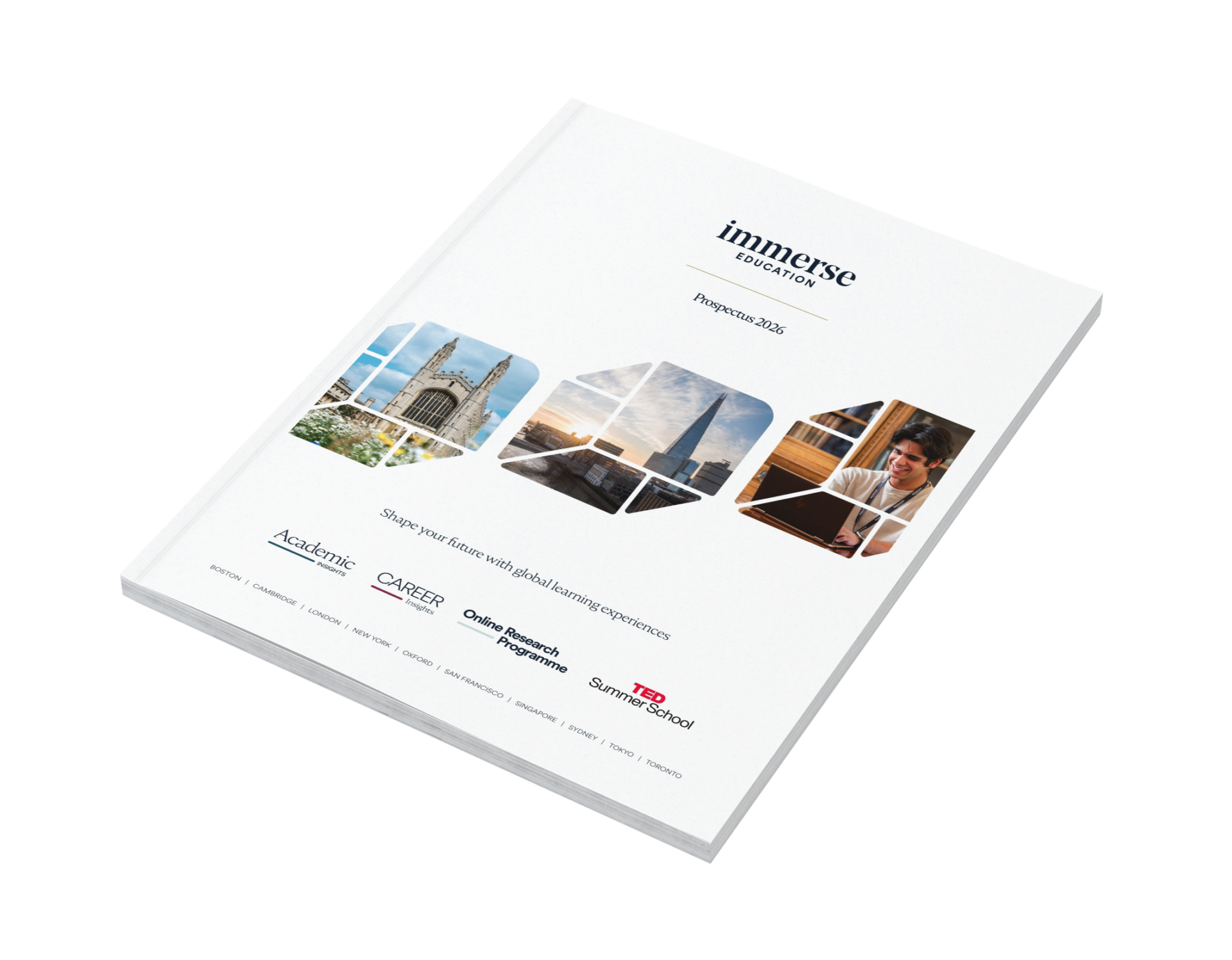
Immerse’s Online Research Program offers high school students the opportunity to conduct rigorous research with tutors from Oxford, Cambridge, and Ivy League universities. The Mathematics track provides you with 10 hours of 1:1 personalized tuition with an academic tutor on a specific mathematical topic of interest and has you work toward the completion of a university-level research project.
Throughout the two weeks, you receive guidance on academic writing, research methodology, and subject-specific analysis. The curriculum is designed to help you develop the independent study habits required for success at top-tier research institutions. You receive a participant evaluation and a certificate of achievement upon the successful submission of your paper. You can find examples of papers Immerse students have worked on here. You can find more details about the application here.
Why it stands out: You’ll be taught by faculty from leading universities and interact with global peers, so you’ll be in a global learning environment.
3. Stanford University Mathematics Camp (SUMaC)
Location: Online
Cost/Stipend: $3,750
Acceptance rate/cohort size: Highly selective, only 64 students chosen per batch
Dates: June 15th – July 3rd or July 6-24 for Abstract Algebra & Number Theory. June 15th – July 3rd for Algebraic Topology.
Application Deadline: February 2nd
Eligibility: Rising high school juniors and seniors with an exceptional interest in mathematics, aged 15-18. International students can apply.
SUMaC Online lets you explore advanced mathematical topics through daily online lectures and guided research seminars. You can choose between two tracks: Abstract Algebra and Number Theory, or Algebraic Topology.
The program is intensely focused on proofs and the fundamentals of mathematical theory, emphasizing conceptual understanding and the discovery of mathematical structures rather than rote computation. You will work with Stanford faculty and instructional assistants to solve challenging problems and asynchronously complete take-home assignments and research projects.
Why it stands out: The program focuses on pure mathematics at a highly advanced level, helping you build the fundamentals required for a career in mathematics research.
4. George Mason University: Aspiring Scientists Summer Internship Program (ASSIP)
Location: Varies by mentor; many are open to remote internships
Cost/Stipend: $1,299
Acceptance rate/cohort size: Highly selective
Dates: June 18th – August 12th
Application Deadline: February 15th
Eligibility: High school students aged 15 and older. International students can apply.
This program provides you with the opportunity to assist George Mason faculty with active research projects in mathematics and related STEM fields. You work within a professional lab or research group, gaining hands-on experience with modern research tools and methodologies. You can check for available projects and mentors here– the Mathematics track allows for remote interns and focuses primarily on mathematical modeling, computational mathematics, and mathematical biology.
Throughout the summer, you will also attend professional development seminars and career development sessions. Your work culminates in a research poster or paper that summarizes your contributions to the field, which may even be published independently by your mentor. This role offers a realistic view of the day-to-day responsibilities of a professional researcher.
Why it stands out: It is one of the few university-hosted internships that allows mentors to offer remote internships to their students.
5. Stanford AIMI Summer Research Internship
Location: Online
Cost/Stipend: $2,400. Full or partial need-based financial aid is available.
Acceptance rate/cohort size: Selective, around 50 students accepted
Dates: June 15-26 or July 6-17
Application Deadline: February 20th
Eligibility: U.S. high school students entering grades 9-12 aged 14+
This internship is hosted by the Stanford Center for Artificial Intelligence in Medicine and Imaging (AIMI), focusing on the intersection of mathematics, coding, and healthcare. You will participate in a two-week virtual program where you learn about the mathematical foundations of machine learning and how they are applied to medical data.
You will work with Stanford student leads and researchers on research projects, understanding how to use computational tools to analyze datasets and develop predictive models. The program includes technical lectures and career mentorship sessions with industry professionals. This experience provides you with a practical understanding of how mathematical research is utilized in modern medical technology.
Why it stands out: It offers a specialized focus on the application of advanced mathematics and AI within the medical field.
6. NASA SEES High School Internship
Location: Remote (with potential travel to Texas)
Cost/Stipend: Free
Acceptance rate/cohort size: Highly selective
Dates: Virtual internships vary by project, though they are generally between June and July 21st
Application Deadline: February 22nd
Eligibility: Current high school sophomores and juniors who are US citizens aged 16+
The STEM Enhancement in Earth Science (SEES) program is a rare opportunity to virtually assist NASA scientists in analyzing Earth science data. You will learn how to use mathematical modeling and statistical tools to study topics such as climate change, satellite imagery, or space weather.
The program requires the completion of distance learning modules before you begin your formal research phase. You will work in teams to solve real-world problems and present your findings at a virtual science symposium. This role is great for understanding how mathematics is applied to large-scale data sets within a government research agency.
Why it stands out: You contribute to active NASA research and missions while learning from professional aerospace scientists and engineers.
7. MIT PRIMES-USA
Location: Online
Cost/Stipend: Free
Acceptance rate/cohort size: Extremely selective, fewer than 50 students selected per batch
Dates: January 1st – December 31st
Application Deadline: December 31 of the previous year
Eligibility: High school sophomores and juniors residing in the United States. While not required, it’s preferred that you also be either a USAMO or USAJMO qualifier, have received a grade A for a college-level proof-based math course, participated in a summer math program, or have a letter of recommendation from a college professor of mathematics.
In this year-long program, you conduct original research in mathematics under the guidance of MIT faculty and graduate students. As one of the most prestigious online math research programs for high school students, you are expected to dedicate at least 10 hours per week to your research and attend weekly virtual meetings with your mentor. Projects focus on possible solutions to unsolved problems in mathematics and the application of advanced mathematical theory to computer science and computational biology.
You will draft a formal research paper by the end of the program, which can also be used for submission to professional research journals or national competitions. PRIMES also partners with faculty from premier institutes like Cornell, Stanford, Penn State, SUNY at Stony Brook, University of Michigan, and many more, providing valuable exposure to the brightest minds in the mathematics research community.
Why it stands out: It is a prestigious, year-round program that offers direct access to the MIT mathematics department’s research ecosystem.
8. Louisiana State University: Virtual Math Research Circle (VMRC)
Location: Online
Cost/Stipend: $1,200 per session. Limited financial assistance is available.
Acceptance rate/cohort size: Selective, small teams of 3-6 students per mentor
Dates: Summer (one of two 3-week intensives between July and August), Fall, or Spring (6-week distributed sessions)
Application Deadline: Rolling
Eligibility: High school students in grades 9–12. International students can apply.
The Virtual Math Research Circle (VMRC) at Louisiana State University lets you participate in authentic, mentored mathematical research alongside a small cohort of peers. You work under the guidance of a mathematician mentor to explore advanced topics such as graph theory, combinatorics, or probability theory that are typically not covered in high school.
Throughout the term, you engage with primary academic sources, formulate original conjectures, and write formal mathematical proofs using professional LaTeX typesetting. This research-first structure helps you build the technical writing and problem-solving skills required for undergraduate success. Your work culminates in a formal research report and a 30–45 minute colloquium-style presentation shared with a scholarly audience.
Why it stands out: It offers a structured pathway to authentic, potentially publishable mathematical research through direct collaboration with university faculty and graduate students.
9. Institute for Mathematics and Democracy (IMD): High School Summer Research Program
Location: Remote
Cost/Stipend: Free
Acceptance rate/cohort size: Selective
Dates: Six weeks in the summer
Application Deadline: March 6th
Eligibility: Current high school students, both domestic and international.
This unique program lets you engage in hands-on research that explores the intersection of mathematics and political science, specifically focusing on voting systems and fair representation. The program teaches you to apply mathematical tools like game theory and geometry to analyze real-world democratic structures.
You work under the supervision of mathematicians to develop new insights into how math can improve societal systems. The curriculum involves rigorous data analysis and the drafting of research reports that may be shared with the broader academic community. This interdisciplinary approach gives you a unique perspective on the utility of mathematics in a civic context.
Why it stands out: It is one of the few research programs focused specifically on the application of mathematics to social justice and democratic theory.
10. Polymath Jr.
Location: Online
Cost/Stipend: Free
Acceptance rate/cohort size: Extremely selective, each project only admits 15-25 students
Dates: June 15th – August 9th
Application Deadline: April 1st
Eligibility: Graduating high school seniors with proof-writing experience. International students can apply.
Polymath Jr. is a remote collaborative program where you work in groups on original research projects in various fields of mathematics. Each project is led by a research mathematician who guides you through the process of making conjectures and proving theorems.
You will participate in regular virtual meetings and contribute to a shared research paper using professional typesetting tools. The program simulates the collaborative nature of modern academic research, often leading to results suitable for publication. This experience builds the collaborative and technical skills necessary for a successful university trajectory in mathematics.
Why it stands out: The program is modeled after professional “Polymath” projects, allowing you to participate in large-scale, collaborative mathematical discovery.
11. MIT THINK Scholars Program
Location: Online
Cost/Stipend: No cost, scholars are provided up to $1,000 in funding
Acceptance rate/cohort size: Highly selective, 6 finalists and approximately 10 honorable mentions per year
Dates: February – June
Application Deadline: January 1st
Eligibility: Full-time high school students residing in the United States
The THINK Scholars Program is a research mentorship initiative that supports you in the early stages of a self-designed STEM research project, including theoretical or applied mathematics. You must submit a formal research proposal outlining a project you wish to conduct, and if selected, you are paired with MIT student mentors who provide weekly guidance on methodology and technical execution.
You will participate in regular virtual check-ins to troubleshoot challenges and refine your analysis, simulating the initial phases of a university research grant. This experience develops your project management skills and offers a practical introduction to the rigor expected in undergraduate inquiry.
Why it stands out: It is one of the few programs that provides direct financial support and MIT-level mentorship for research projects that you conceive independently.
12. The Coding School: National High School Research Program (NHSRP)
Location: Online
Cost/Stipend: While the tuition cost is $3,995, a number of students from several states receive a full scholarship. You can check the details here.
Acceptance rate/cohort size: Selective
Dates: June 29th – July 24th (Data Science Track) or June 29th – July 31st (Quantum/AI Tracks)
Application Deadline: February 1st (Priority); March 15th (Final)
Eligibility: Incoming 10th – 12th graders and recent graduates (9th graders eligible for Data Science). International students can apply.
This program, held in partnership with the Columbia University Data Science Institute, lets you understand how mathematics is applied to research in data science, artificial intelligence, and quantum computing. You will spend the first two weeks undergoing intensive technical training in R and statistical analysis before transitioning into three weeks of mentored research.
You’ll be matched with PhD researchers and university faculty to assist with active projects, focusing on data cleaning, visualization, and the application of mathematical algorithms to real-world datasets. The experience mirrors how a university research lab operates, ensuring you learn academic integrity, professional protocol, and technical writing. You conclude the program by presenting your scientific findings at the TCS National Research Symposium.
Why it stands out: It provides a direct pathway to assist with active university-level research projects at institutions like Columbia through a formalized, distance-learning framework.
13. Columbia University: Thinking and Problem Solving (Online Track)
Location: Online
Cost/Stipend: $2,867 for 1-week, $4,017 for 2-week tracks
Acceptance rate/cohort size: Selective
Dates: June 22-26 | July 6-17 | July 20-31
Application Deadline: February 2nd (Early); April 2nd (Final)
Eligibility: High school students in grades 9-12. International students can apply.
Hosted by Columbia University’s Pre-College Programs, this online track focuses on the application of mathematics to solve complex real-world problems. You will engage in rigorous study of topics such as graph theory, Nash equilibria, and probability models as they apply to economics, computer science, and biology.
The curriculum involves a combination of live lectures, individual problem-sets, and a self-directed research project on a mathematical topic of your choosing. You’ll receive direct feedback from Columbia instructors and work with a global cohort to find creative solutions to advanced mathematical challenges.
Why it stands out: It provides a university-credited research experience that bridges theoretical mathematics with its practical applications in modern industry and science.
14. New York Academy of Sciences: The Junior Academy

Location: Online
Cost/Stipend: Free
Acceptance rate/cohort size: Selective
Dates: Fall session (September – December) and Spring session (January – May)
Application Deadline: January 6th for the spring session
Eligibility: Students aged 13-17 worldwide
In this program, you join a global community of students to solve real-world challenges through research and mathematical modeling. You’ll be working in international teams on projects sponsored by industry leaders and academic institutions. The program provides a platform where you can access expert mentors who guide you through the research process.
You will learn to use data analysis and logical reasoning to develop innovative solutions to global issues like sustainability and health. This experience builds your collaborative skills and gives you a broader perspective on the global application of mathematics.
Why it stands out: It emphasizes international collaboration and the application of mathematical thinking to solve complex, global-scale problems.
15. IMSA: Research Inquiry Skills and Experimentation (RISE)
Location: Online
Cost/Stipend: $1,280
Acceptance rate/cohort size: Selective
Dates: September 15th – May 28th
Application Deadline: Registration opens August 18th and closes when full
Eligibility: High school students in grades 9-12 worldwide
The Research Inquiry Skills and Experimentation (RISE) program is an online, largely asynchronous academic-year initiative that focuses on the foundational methodologies required to conduct original scientific and mathematical inquiries. You will participate in modules that cover literature searches, data analysis, and the development of research questions.
Throughout the course, you work toward creating a formal research proposal or a preliminary study that can be used for future competitions or university applications. You will learn to utilize statistical software to interpret data sets and communicate your findings in a professional format. The program also includes a few live synchronous sessions with instructors from the Illinois Mathematics and Science Academy (IMSA) to guide your project development.
Why it stands out: It provides a structured, skill-based curriculum that prepares you for independent research by focusing on the specific mechanics of the inquiry process.
Online Mentors, Real Math Discovery
Online mentors make advanced math feel reachable, turning tough ideas into conversations. You learn to question, prove, and persevere with steady expert guidance today.
Through online math research programs for high school students, you collaborate across time zones, explore conjectures, and practice writing clear proofs that reflect real discovery.
Projects and seminars build more than solutions: they sharpen logic, creativity, and patience. Each revision strengthens your reasoning and prepares you for higher study ahead.
Don’t let that progress fade. Open our Mathematics Top Books Guide now, choose your next book in 60 seconds, and level up your proof skills today.