

 Русский (RU)
 Українська (UK)
 Türkçe (TR)
 Italiano (IT)
 Français (FR)
 Português (PT)
 中文 (中国) (ZH)
 Español (ES)
 日本語 (JA)
 ไทย (TH)
 Deutsch (DE)
 Ελληνικά (EL)
 Polski (PL)
 Bahasa Indonesia (ID)
 Nederlands (NL)
 العربية (AR)
 한국어 (KO)

If you are a high school student fascinated by math, the transition to advanced theory can feel both exhilarating and demanding. You might excel at your current coursework, but you may still wonder how to bridge the gap toward undergraduate-level thinking and a potential career in the field. One of the best ways to do so is by participating in pre-college math programs for high school students that offer you the opportunity to engage with concepts far beyond the standard curriculum.
Imagine accessing the academic excellence of premier universities by joining programs hosted on leading campuses that provide a foundational understanding of undergraduate-level rigor. These initiatives allow you to develop a technical skillset in specialized areas such as number theory, combinatorics, and professional mathematical research.
How do you choose the right pre-college math programs for high school students?
Selecting an appropriate program may be challenging. Without the right preparation and familiarity with advanced concepts, it can be difficult to find an environment that truly clarifies your long-term college trajectory. Guidance is necessary to help you evaluate various offerings and identify the program that aligns with your specific objectives in the mathematical sciences.
Various leading institutions offer math programs that are rigorous, analytical, and grounded in professional practice. You will explore subjects that push you past high school limits, allowing you to experience the reality of a math-heavy career before you even graduate. You will learn through deep immersion in technical topics and engagement with a community of like-minded peers.
Regardless of your current level, you will be required to maintain a high level of academic discipline once the program begins. To help you choose, we have compiled a list of the Best Pre-College Math Programs for High School Students. They have been selected for their academic depth, campus prestige, and ability to prepare you for the challenges of a mathematics degree.
If you’re looking for more options, you can check out math summer camps for high school students.
15 Pre-College Math Programs for High School Students
1. Stanford University Mathematics Camp (SUMaC)
Location: Stanford University or online
Cost/Stipend: $8,950 for residential, $3,750 for online
Acceptance rate/cohort size: Highly selective, only 40 students chosen for the residential program, and 64 students for the online program
Dates: June 15th – July 3rd or July 6-24 for the online tracks of Abstract Algebra & Number Theory. June 15th – July 3rd for the online track of Algebraic Topology. June 21st – July 17th for the residential tracks of both topics.
Application Deadline: February 2nd
Eligibility: Rising high school juniors and seniors with an exceptional interest in mathematics, aged 15-18; open to international students
At SUMaC, one of the most rigorous pre-college math programs for high school students, you will engage in intensive study of advanced mathematics through one of two subject paths: Program I covers Abstract Algebra and Number Theory, while Program II focuses on Algebraic Topology. The curriculum is delivered through daily lectures, guided research, and proof-based problem-solving sessions rather than computational math.
You will work closely with Stanford faculty and graduate students to explore mathematical structures. The program includes a research project where you investigate a specific topic and present your findings to peers. You can expect a rigorous academic schedule that mimics the pace of undergraduate mathematics.
Why it stands out: It focuses on pure mathematics and proof-based logic rather than contest preparation, providing a direct preview of upper-level university mathematics.
2. Immerse Education’s Mathematics Online Summer School

Location: Fully remote
Cost/Stipend: Varies from £2,995 – £4,994 depending on program type. Summer school scholarship available through our bursary programme
Acceptance rate/cohort size: Selective, 1:1 tutoring
Dates: Flexible; multiple cohorts in a year.
Application Deadline: Rolling admissions; multiple dates throughout the year
Eligibility: Students aged 13-18 (accredited options require age 14+); open to international students
Immerse’s Online Research Program gives high schoolers the opportunity to work on an independent, rigorous research project with tutors from Oxford, Cambridge, and Ivy League universities. They have over 20 tracks available, including a dedicated Mathematics track. It nets you 10 hours of 1:1 personalized instruction from an academic tutor on a specific mathematical research topic and has you complete a university-level research project.
Throughout the duration of the program, you receive mentorship on academic writing, research methodology, and subject-specific analysis. The curriculum will help you develop the independent study habits required for success at top-tier research institutions. When you successfully submit your final paper, you also receive an evaluation as well as a certificate of achievement. You can find examples of papers Immerse students have worked on here. You can find more details about the application here.
Why it stands out: You’ll be taught by faculty from leading universities and interact with global peers, so you’ll be in a global learning environment.
3. George Mason University Aspiring Scientists Summer Internship Program (ASSIP)
Location: Varies by mentor, can be fully remote, hybrid, or in-person at George Mason University or collaborating institutions
Cost/Stipend: $1,299
Acceptance rate/cohort size: Highly selective
Dates: June 18th – August 12th
Application Deadline: February 15th
Eligibility: High school students aged 15 and older; open to international students
You will work alongside George Mason University faculty and research scientists on original research projects across various disciplines, including applied mathematics and data science. Throughout the eight-week duration, you will gain hands-on experience in the scientific process, from literature review to data analysis.
The program culminates in a poster symposium where you present your research results to the academic community. You will also participate in professional development workshops and career-focused seminars to round out your education.
Why it stands out: It offers you the opportunity to be published in scientific journals as a high school student through genuine research mentorship.
4. University of Maryland MathQuantum High School Fellowship
Location: Virtual
Cost/Stipend: Free
Acceptance rate/cohort size: Extremely selective, approximately 10 students accepted
Dates: 2 weeks in the summer. For 2025, the dates were July 14-25
Application Deadline: February 13th
Eligibility: High school students with a strong background in mathematics; open to international students, though stipends are only available to US citizens
In the MathQuantum Fellowship, as the name suggests, you will participate in mentored research and interdisciplinary training focused on applying mathematics to Quantum Information Science (QIS) problems. The program provides access to coursework and seminars in both theoretical and applied mathematics related to quantum systems.
You will work within a community of researchers, including undergraduate students, to gain exposure to modern physics and math integration. Professional development sessions focus on scientific proposal writing and networking within the STEM field. The fellowship concludes with a mini-research project that ties together your learnings from the experience.
Why it stands out: It is a niche program at the intersection of advanced mathematics and quantum computing, providing significant technical exposure.
5. IMD High School Summer Research Program
Location: Remote
Cost/Stipend: Free
Acceptance rate/cohort size: Selective
Dates: Six weeks in the summer
Application Deadline: March 6th
Eligibility: Current high school students; open to international students
The Institute for Mathematics and Democracy offers this six-week online research intensive focused on the intersection of mathematics and social sciences, specifically democracy and voting systems. Under the guidance of the institute faculty, you will work in small groups to tackle open-ended research questions.
The program emphasizes the use of mathematical modeling, graph theory, and statistics to analyze political systems and fairness. You will attend weekly seminars and research meetings to discuss progress and methodology with peers. This experience allows you to see how abstract math applies to real-world policy and societal structures.
Why it stands out: It is one of the few programs focusing specifically on the application of mathematics to democratic systems and political science.
6. Program in Mathematics for Young Scientists (PROMYS)
Location: Boston University, Boston, MA
Cost/Stipend: Up to $8,000, depending on financial aid awarded based on family income
Acceptance rate/cohort size: Highly selective, approximately 80 students selected
Dates: June 28th – August 8th
Application Deadline: February 27th
Eligibility: Students at least 14 years old who have completed 9th grade, including international students
PROMYS is widely regarded as one of the most intellectually demanding pre-college math programs for high school students, helping you build outward from a strong foundation in Number Theory. The daily schedule revolves around a morning Number Theory lecture followed by hours of advanced seminars in subjects like Discrete Mathematics, Algebra, Primes, and Quivers.
The program also features special guest seminars and lectures in broader topics like the ethics and philosophy of science, the relationship between pure and applied science, and career options. Counselors, who are undergraduate math majors, provide feedback on your work and guide your explorations without giving away answers.
Why it stands out: It teaches you the process of mathematical discovery, requiring you to derive fundamental mathematical principles independently rather than learning them from a textbook.
7. Ross Mathematics Program
Location: Otterbein University (OH) or Rose-Hulman Institute of Technology (IN)
Cost/Stipend: $7,500
Acceptance rate/cohort size: Selective, approximately 60 students per site
Dates: June 14th – July 24th
Application Deadline: March 8th
Eligibility: Students aged 15-18 with a strong interest in math, including international students
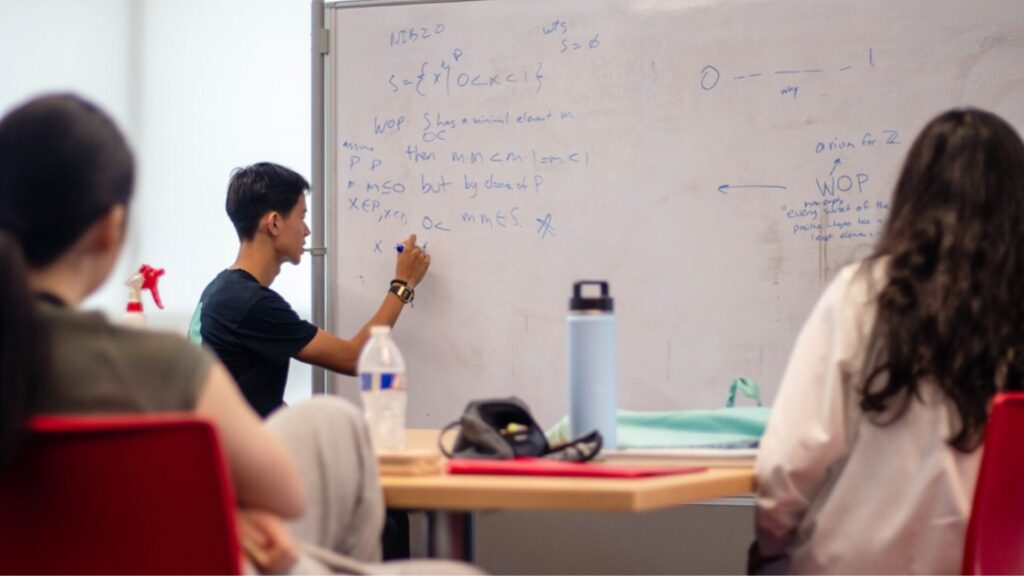
In the Ross Mathematics Program, you will focus almost exclusively on a single subject, Number Theory, to develop a deep understanding of mathematical proof and logic. The program demands a significant time commitment, as you spend most of your day working through complex problem sets that build upon each other.
Lectures provide the framework, but the core of the experience is your individual work on these problems. You will learn to state mathematical conjectures precisely and prove them using rigorous logic. The program serves as a preparation for the level of intellectual independence required in university-level STEM research.
Why it stands out: Through its heavy focus on a single core subject rather than a more spread-out education, it helps you develop the foundational proof-writing skills necessary for advanced theoretical mathematics.
8. MIT PRIMES-USA
Location: Online
Cost/Stipend: Free!
Acceptance rate/cohort size: Extremely selective, fewer than 50 students selected per batch
Dates: January 1st – December 31st
Application Deadline: December 31st of the previous year
Eligibility: High school sophomores and juniors residing in the United States. While not required, it’s preferred that you also be either a USAMO or USAJMO qualifier, have received a grade A for a college-level proof-based math course, participated in a summer math program, or have a letter of recommendation from a college professor of mathematics.
Among the most competitive pre-college math programs for high school students, MIT PRIMES-USA allows you to engage in a year-long research project in mathematics, computer science, or computational biology under the mentorship of MIT graduate students or faculty. The program begins with a reading phase to build the necessary background knowledge in your assigned research area.
From March to May, you work on your research project, which continues through the summer and into the fall. You will utilize advanced mathematical software and theoretical frameworks to investigate unsolved problems. The results of your work are written into a formal research paper and presented at the Fall PRIMES Conference. This program requires a high level of self-motivation and a significant weekly time commitment throughout the year.
Why it stands out: It is one of the only year-long research programs that allows high schoolers to work on unsolved mathematical problems under MIT mentorship.
9. Hampshire College Summer Studies in Mathematics (HCSSiM)
Location: Hampshire College, Amherst, MA
Cost/Stipend: While the tuition is $6,511, there is substantial financial aid with each student being charged on a sliding scale according to their family income.
Acceptance rate/cohort size: Highly selective, approximately 40-50 students
Dates: June 28th – August 8th
Application Deadline: Rolling
Eligibility: High school students, including international students
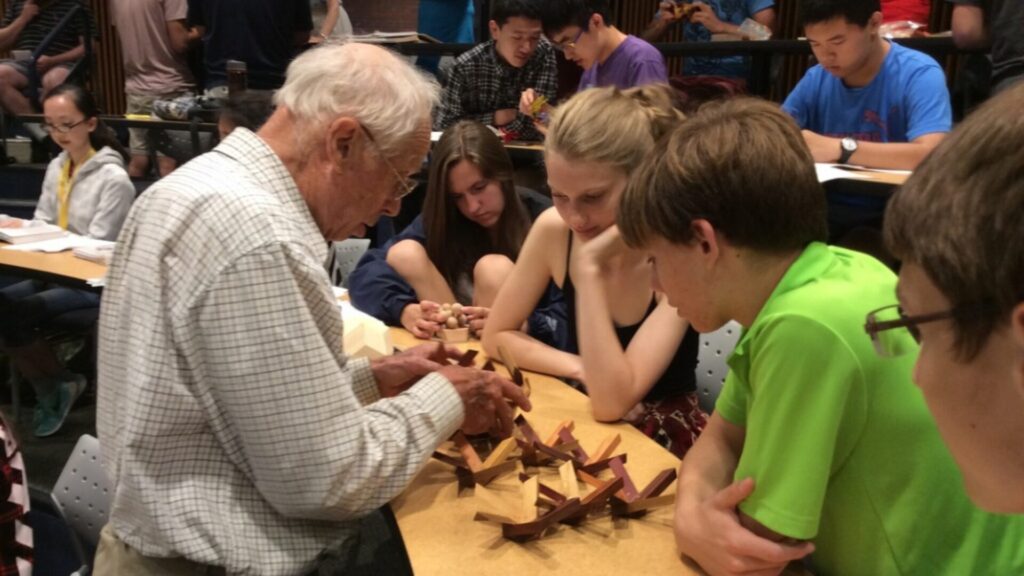
You will spend six weeks engaged in intensive, discovery-based mathematical inquiry through a structured daily schedule of workshops and courses. During the first three weeks, you are partitioned into workshops led by university professors where you actively investigate problems from multiple mathematical areas rather than listening to traditional lectures.
The final three weeks consist of specialized three-week Maxi-courses and one-week Mini-courses that allow you to explore specific mathematical themes and unifying concepts in depth. An average day involves four hours of morning classes, a daily Prime Time Theorem lecture on special topics, and a three-hour evening problem-solving session.
Why it stands out: It uses a unique workshop-based structure to transition from general mathematical problem-solving to specialized high-level research topics.
10. Honors Summer Math Camp (HSMC) at Texas State
Location: Texas State University, San Marcos, TX
Cost/Stipend: $6,600
Acceptance rate/cohort size: Highly selective
Dates: June 21st – August 1st
Application Deadline: Acceptance window opens December 1st and closes when full
Eligibility: High school students in grades 9-12, including international students
HSMC is a multi-summer, six-week residential program designed to develop your abilities in mathematical proof and research. First-year participants focus on Number Theory, learning to write rigorous proofs and build a foundation for higher-level math. Returning students engage in advanced courses such as Analysis or Combinatorics and work on a multi-year research project.
These projects are often submitted to national competitions like the Regeneron Science Talent Search. You will work closely with university faculty and undergraduate mentors to refine your problem-solving skills. The program also includes guest lectures on a variety of STEM careers and research opportunities.
Why it stands out: It is unique for its multi-summer structure, which allows you to progress from learning proofs to conducting competitive research over several years.
11. AwesomeMath Summer Program
Location: Online
Cost/Stipend: $1,275 – $1,575 per course, depending on how early you register
Acceptance rate/cohort size: Open enrolment
Dates: June 8-26 | June 29th – July 17th | July 20th – August 7th
Application Deadline: Early: January 31st | Regular: March 31st | Late: May 15th
Eligibility: High school and middle school students globally, who meet AwesomeMath’s Readiness Criteria.
AwesomeMath offers several courses focused on competition-style mathematics, including Algebra, Combinatorics, Geometry, and Number Theory. Each course is designed to sharpen your problem-solving techniques for exams like the AMC 10/12 and AIME. You will participate in live, instructor-led sessions where you analyze complex problems and learn various strategies for solving them.
Each course has 4 tiers of increasing difficulty, and AwesomeMath’s Readiness Criteria will help you measure your readiness for any given tier. You will interact with other high-achieving students through online forums and collaborative activities. While the focus is on competition, the curriculum also introduces concepts that are useful in advanced undergraduate courses.
Why it stands out: It is highly specialized for students looking to excel in national and international mathematics competitions.
12. PZ Math Camp (formerly Williams College Math Camp)
Location: Williams College, Williamstown, MA
Cost/Stipend: $3,100
Acceptance rate/cohort size: Extremely selective, only around 28–35 students chosen
Dates: June 29th – July 10th
Application Deadline: April 24th
Eligibility: Mathematically gifted high school students currently enrolled in Algebra 2 or its equivalent; international students can apply
PZMC, formerly the WCMC, is a two-week residential program that introduces you to Number Theory and mathematical thinking. The program focuses on small-group learning, pushing you to work on open-ended problems that do not have straightforward answers, encouraging you to develop your own mathematical intuition.
Faculty members lead sessions that bridge the gap between high school math and university-level research. You will also learn how to use LaTeX and other tools essential for writing formal mathematical papers. The program is designed to be highly interactive, with a strong emphasis on collaboration and communication.
Why it stands out: It is a highly selective program that provides a high-level introduction to the fundamentals of mathematical research at a top-tier liberal arts college.
13. Research Science Institute (RSI) – Math Track
Location: MIT, Cambridge, MA
Cost/Stipend: Free
Acceptance rate/cohort size: Extremely selective, only 100 students admitted
Dates: 6 weeks in the summer
Application Deadline: Early to mid-December
Eligibility: Current high school juniors who are at least 16 years old by July 1st; international applicants welcome
As one of the most prestigious pre-college math programs for high school students, RSI’s Math Track places you in a six-week intensive experience that combines on-campus coursework with off-campus research internships. During the first week, you attend seminars in advanced mathematics and scientific communication.
For the following five weeks, you work on an individual research project under the mentorship of experienced scientists and mathematicians. You will conduct original research using university facilities and libraries to address current scientific questions. The program culminates in the preparation of a formal research paper and a conference-style presentation. This experience provides a comprehensive overview of the research cycle, from hypothesis formulation to peer review.
Why it stands out: It is widely considered one of the most prestigious summer research programs in the world, with participants often going on to win major national awards.
14. MathILy (Mathematics Infused with Levity)
Location: Bryn Mawr College, Bryn Mawr, PA
Cost/Stipend: $6,175. Needs-based financial aid is available.
Acceptance rate/cohort size: Selective, approximately 45 students selected
Dates: June 28th – August 1st
Application Deadline: April 28th
Eligibility: High school students with strong mathematical talent; international students can apply
You will engage in five weeks of intensive inquiry-based learning centered around discrete mathematics. The Root class provides a foundation in various mathematical areas, followed by the Week of Chaos short courses on specialized topics, and concluding with a Branch class for deep study into a specific area.
You will spend most of your time in class working on problems in small groups, discovering definitions and theorems for yourself. You will explore topics such as topology, graph theory, and linear algebra through a lens of discovery. The program is held on a college campus, allowing you to experience residential life and academic rigor.
Why it stands out: It uses a unique program structure to provide both breadth and depth in advanced discrete mathematics.
15. University of Chicago Young Scholars Program
Location: University of Chicago, Chicago, IL
Cost/Stipend: $1,000 is the maximum cost, but the actual payment depends on family income
Acceptance rate/cohort size: Highly selective
Dates: June 30th – July 25th
Application Deadline: April 11th
Eligibility: Chicago area high schoolers entering grades 9-12
You will attend daily lectures and problem-solving sessions led by University of Chicago faculty and graduate students. The program focuses on a central theme each summer, such as Geometry for 2025, exploring the topic in significant depth. You will be challenged to think critically about mathematical structures and the logical foundations of the subject.
The curriculum introduces you to the style of thinking required for undergraduate math, with two lectures led by UChicago faculty and one group session led by an undergraduate mathematics major every day. You will also participate in computer labs where you use software to model mathematical concepts.
Why it stands out: It provides an accessible entry point for students to experience the academic environment of mathematical research focused in a specific area.
Expanding Your Mathematical Toolkit
True mathematical growth happens when you move beyond formulas and begin to think in structures, proofs, and patterns. That shift transforms how you approach every problem.
The pre-college math programs for high school students listed in this article push you into proof-based reasoning, abstract logic, and independent exploration that mirrors university mathematics. You begin to see connections between ideas rather than isolated techniques.
Through challenge and persistence, you build discipline, clarity, and confidence. You stop memorising methods and start understanding why mathematics works the way it does.
Ready to sharpen your edge even further? Explore our Mathematics Top Books Guide and discover the essential reads that top young mathematicians use to accelerate their growth.