

 Русский (RU)
 Українська (UK)
 Türkçe (TR)
 Italiano (IT)
 Français (FR)
 Português (PT)
 中文 (中国) (ZH)
 Español (ES)
 日本語 (JA)
 ไทย (TH)
 Deutsch (DE)
 Ελληνικά (EL)
 Polski (PL)
 Bahasa Indonesia (ID)
 Nederlands (NL)
 العربية (AR)
 한국어 (KO)

If you’re a high school student with a passionate interest in mathematics, you’ll know that the field can sometimes be quite overwhelming. One day, you could be breezing through your schoolwork, excelling on all fronts. Yet, the next day, you might find yourself wondering whether math summer programs in the US for high school students are the right way to explore mathematics more seriously after graduation.
After all, mathematics is more than numbers. It’s more than the problem sets that you solve in the classroom. Mathematics involves real-world applications, abstract thinking, and even collaborative research. This is why math summer programs are one of the best ways to thoroughly explore this interest.
Picture this: you’re engaging in heated discussions about number theory with your instructors, you’re exchanging geometric proofs with your peers, and you’re challenging yourself to think in new ways to solve mathematical problems. By spending your summer at a math program, you’ll gain insights into what an advanced mathematics career looks like, along with getting to engage with college-level mathematical topics.
How to pick the best math summer programs for high school students?
It’s true: there are numerous math summer programs to choose from, and that choice can be overwhelming. At first glance, some programs can seem like a tough sell: expensive, offering basic material, and disconnected from genuine mathematical thinking. This is why it’s important to know exactly what to look for: not all math programs are built equal in terms of rigor, structure, or even mentorship.
Across the globe, distinguished universities and institutions offer rigorous math programs, where you can find a variety of sub-disciplines: algebra, combinatorics, number theory, discrete math, and many more. Be it with the problem-solving workshops or with the guidance of mathematicians, you’re likely to sharpen your analytical skills by learning to approach complex problems with newfound clarity and creativity.
Even if you’re just starting out in your math journey, there’s no cause for concern: from introductory programs to advanced-research type programs, there’s something for everyone.
Now, regardless of your academic level, you’ll certainly need to put in your fair share of effort. But for now, we’ve made things a little easier for you. To help you choose, we’ve curated a list of the 15 Best Math Summer programs for High School Students, factoring in a mix of academic rigor, reputation, and valuable mentorship prospects.
15 Best Math Summer Programs for High School Students
1. Bryn Mawr College’s MathILy
Location: Bryn Mawr, Pennsylvania (near Philadelphia)
Acceptance rate/cohort size: Approximately 45
Application Deadline: April 29th
Dates: Six-week residential session during the summer
Eligibility: Open to rising juniors and seniors worldwide with a strong interest in mathematics.
Cost: $5,300 ($1,060/week); need-based financial aid is available
MathILy (Mathematics Infused with Levity) is a five-week, rigorous summer program at Bryn Mawr College for high school students interested in the advanced study of proof-based mathematics. Here, you’ll take part in inquiry-based learning to explore combinatorics, graph theory, and linear algebra, along with learning conjecture, proof, and mathematical writing.
During the program, you will attend classes on core instruction for two weeks, a “Week of Chaos” with short elective-style courses, and finally, two weeks of advanced classes. PhD mathematicians and graduate students living on campus will mentor you in and out of class. There are mathematics relays, field trips to Philadelphia, and group discussions on career and identity in the “Life Seminar” series.
Why it stands out: You’ll get access to a tight-knit mathematical community known for producing top-tier math graduates, which can help throughout your academic career.
2. Immerse’s Pre-University Mathematics Summer School

Location: London, Singapore, Tokyo, Boston, Oxford, and Cambridge
Acceptance rate/cohort size: Average of 7 students per class
Application Deadline: Multiple summer cohorts with rolling admissions.
Dates: 2 weeks during the summer
Eligibility: Students across the globe aged 15-18 currently enrolled in middle or high school
Cost: Varies; summer school scholarship available through their bursary programme.
The Academic Insights Mathematics summer school offers a rigorous introduction to university-level mathematics within world-leading academic environments. Taught by experienced mathematicians from institutions such as Oxford and Cambridge, the programme is delivered in small groups, allowing for close academic guidance and discussion. Participants study core mathematical concepts, including algebra, calculus, statistics, and problem-solving techniques, while developing the logical reasoning and analytical skills essential for advanced study.
Learning is structured around university-style lectures, interactive problem-solving sessions, and weekly one-to-one tutorials that provide personalised academic feedback. Throughout the programme, students work towards a personal mathematics project, applying theoretical ideas independently. At the end of the course, participants receive detailed written feedback and a certificate of completion, offering a clear reflection of their academic progress and readiness for further study in mathematics.
Why it stands out: It mirrors the depth and structure of undergraduate mathematics through expert-led teaching, personalised tutorials, and project-based learning in globally recognised university settings.
3. Stanford University Mathematics Camp (SUMaC)
Location: Virtual and residential sessions available
Acceptance rate/cohort size: Highly selective. Residential – 40 participants, Online – 64 participants
Application Deadline: February 3
Dates: Session One: Online June 16th – July 4th, Session One: Residential June 22nd – July 18th, Session Two: Online July 7th – 25th
Eligibility: Open to rising juniors and seniors across the globe with a strong interest in mathematics
Cost: Online: $3,580, Residential: $8,575; need-based financial aid is available
Stanford University Mathematics Camp (SUMaC) is a three- to four-week program for high school students interested in pursuing advanced study in mathematics and is widely regarded as one of the most rigorous math summer programs in the US for high school students. Here you’ll attend daily lectures, solve problem sets, and engage in group discussions, with a focus on proof-based thinking, which is not usually taught in high school.
You will choose either of the two tracks: Abstract Algebra and Number Theory, or Algebraic Topology. If you choose the residential option, you’ll also join co-curricular activities, go on weekend field trips, and connect with like-minded peers. If you go for the online track, you will follow a similar academic structure, supplemented by live sessions and virtual events with students from around the world.
Why it stands out: You’ll be exposed to the proof-based rigor associated with their graduate-level math, serving as an early exposure to methods that not many high school students have access to.
4. Carnegie Mellon’s Summer Academy for Math and Science (SAMS)
Location: Carnegie Mellon University, Pittsburgh, PA
Acceptance rate/cohort size: Highly selective
Application Deadline: February 1st
Dates: June 20th – August 1st
Eligibility: Students must be at least 16 years old by the program start date, a U.S. citizen or permanent resident, and in 11th grade in high school at the time of application submission
Cost: Fully-funded
The Summer Academy for Math and Science (SAMS) is a fully funded, six-week residential programme at Carnegie Mellon University and one of the most impactful math summer programs in the US for high school students from underrepresented STEM backgrounds. If selected, you’ll engage in advanced mathematics and science through classroom instruction, project-based learning, and continued participation with faculty and staff mentors.
The curriculum includes three parts: a virtual jumpstart before the program, the six-week-long in-person program, and career and personality enrichment sessions with faculty and current Carnegie Mellon community members. The program culminates in your research presentation at the final symposium.
Why it stands out: It offers long-term mentoring, helping you better craft competitive applications for selective STEM & math university programs.
5. Bridge to Enter Advanced Mathematics (BEAM): High School Programming
Location: BEAM Los Angeles and New York offices
Acceptance rate/cohort size: Highly selective
Application Deadline: Not specified
Dates: Year-round support
Eligibility: Students from underserved communities who show mathematical promise
Cost: Free
BEAM is a long-term pathway programme and one of the most comprehensive math summer programs in the US for high school students, supporting participants from early high school through college graduation. In 8th grade, the focus is on two key areas: helping you complete Algebra 1 and selecting a high school that aligns with your academic goals. You will continue to receive advising, participate in enrichment classes, attend lab visits and career days, and receive individualized guidance on STEM opportunities, internships, and college applications.
BEAM further continues into college as well, supporting you through the first year. As a STEM major, you are offered ongoing mentorship, from navigating prerequisites to securing internships and financial aid for college. The goal is to give underserved students the academic depth, community, and practical guidance to thrive in a STEM career.
Why it stands out: You’ll be provided support throughout high school, admissions, and the freshman year, something that is rare amongst summer programs.
6. Research Science Institute (RSI)
Location: Massachusetts Institute of Technology, Cambridge, MA
Acceptance rate/cohort size: Approx. 100 students globally; very selective
Application Deadline: December 10th
Dates: Six-week residential session during the summer
Eligibility: Students worldwide in their junior year of high school (11th grade)
Cost: Non-refundable application fee of $75; cost-free for all participants, all educational, housing, and dining expenses are covered
The Research Science Institute (RSI) offers a highly selective, six-week summer program at MIT. If chosen for the mathematics track (about 10 students in the past), you’ll begin with a week of seminars taught by MIT professors. Then, for the next five weeks, you will exclusively work with a graduate student mentor on an original research project.
Past mathematics projects have included topics like Braid Group Symmetries on Punctured Spheres and Poisson Geometry in Cluster Algebras. You’ll learn how to read academic papers, design your research plan from the start, and finally present your work through a written paper and a talk at the end of the program research symposium.
Why it stands out: You’ll be working with MIT researchers and joining an alumni community that includes MIT, Harvard, and Stanford alums, which could be influential in shaping your academic journey.
7. Research Mentorship Program at the University of California, Santa Barbara — Math Track
Location: University of California, Santa Barbara, CA
Acceptance rate/cohort size: Around 80
Application Deadline: March 9th
Dates: June 15th – July 31st. Mandatory Preparation Webinar: May 28th/May 30th
Eligibility: High school students across the globe in the 10th or 11th grade (outstanding 9th graders accepted on a case-by-case basis) with a minimum 3.80 academic weighted GPA
Cost: Commuter $5,675, Residential $13,274. Need-based scholarships are available. Priority given to California residents.
The Research Mentorship Program (RMP) at UC Santa Barbara is a six-week summer program for high school students to work full-time on an original research project. You will be guided by a UCSB faculty member, graduate student, or postdoc. Research Project areas include STEM, humanities, and social sciences, including fields like neuroscience, data science, public health, environmental policy, and media studies.
The program offers two university-level courses with eight college credits: one in formal research writing and one in presentation techniques. You’ll spend around 35 to 50 hours weekly in the lab and on the field, analyse data, and then write a research paper and present it at the Research Symposium. Previously done maths research as part of the program has included Mathematical Modeling of Optimized Signal Duplication in BiSQUID Superconducting Circuits.
Why it stands out: You’ll create a full research paper and present it at a symposium, getting a good idea of what college-level work in math looks like.
8. Hampshire College Summer Studies In Mathematics
Location: Hampshire College, Amherst, MA
Acceptance rate/cohort size: 51 students
Application Deadline: April end
Dates: June 29th – August 9th
Eligibility: Open to talented and highly motivated high school students from around the world
Cost: $6,511; free for domestic students with a family household income under $85,000
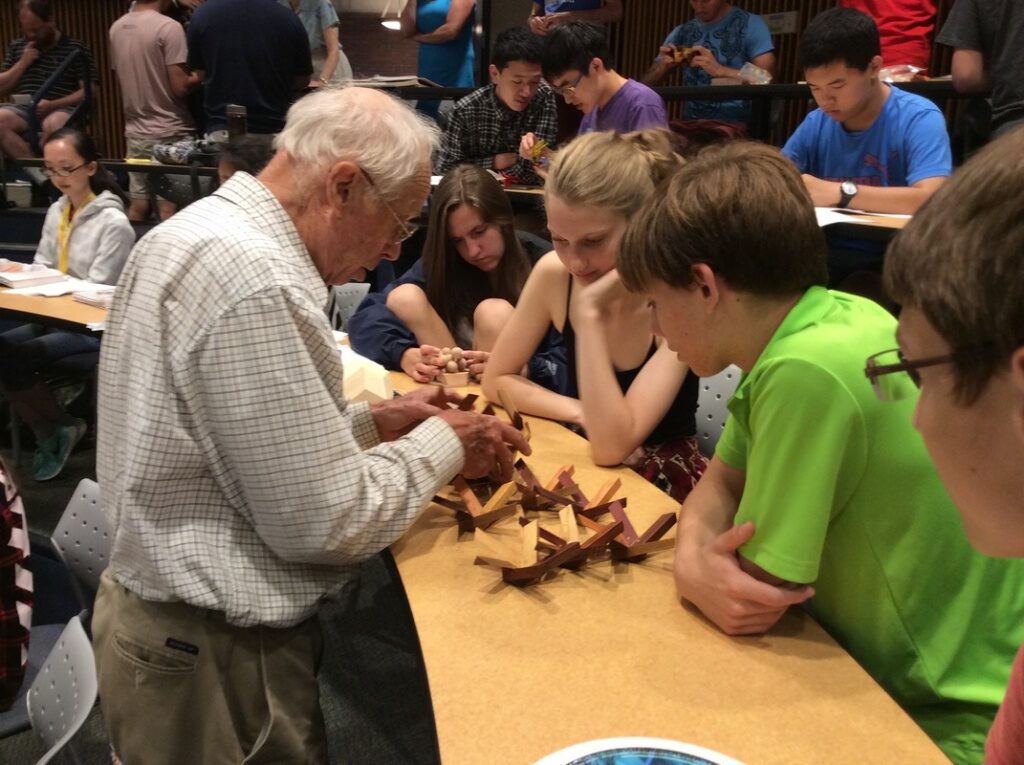
The Hampshire College Summer Studies in Mathematics (HCSSiM) is an intensive, six-week residential program designed for high school students willing to engage in college-level mathematics. The program structure includes four hours of morning classes, daily Prime Time Theorem series with visiting mathematicians, and evening problem-solving sessions.
In the first three weeks, you’ll join a workshop group taught by faculty and supported by math majors or graduate students, to explore a number theory or combinatorics course. You also choose one maxi-course, such as topology or hyperplane arrangements, along with two mini-courses for deeper study.
Why it stands out: Its teaching style emphasizes independent mathematical thinking and will help prepare you for high-level theoretical work.
9. Stony Brook University – Simons Summer Research Program
Location: Participants may elect to live on campus with other student researchers or to commute to Stony Brook University, Stony Brook, NY
Acceptance rate/cohort size: 5%
Application Deadline: February 7th
Dates: June 29th – August 7th
Eligibility: U.S. citizens or permanent residents currently in 11th grade; must be at least 16 by program start
Cost: Residential: $2,450 (Estimated summer program costs)
The Simons Summer Research Program is a six-week research program. Under the guidance of a Stony Brook University faculty mentor, you’re given responsibility for a specific project. If accepted, you’re expected to reach out to your mentor, review suggested pre-readings, and attend a required lab safety session in the first week.
During the program, you can expect to spend at least four hours each day on research, and finally, submit a formal abstract and a poster presentation by the end of the program. Past research projects in the Department of Applied Mathematics and Statistics have included developing algorithms in high-performance computing, machine learning, and multiscale modeling for medical simulations.
Why it stands out: You’ll work in labs connected to national research centers, helping you contribute to cutting-edge applied and computational math projects, something few high school students would have access to.
10. California State Summer School for Mathematics & Science (COSMOS)
Location: University of California’s 5 COSMOS campuses — UC Davis, UC Irvine, UC Los Angeles, UC San Diego, and UC Santa Cruz
Acceptance rate/cohort size: 20-25 students
Application Deadline: February 6th
Dates: July 5th – August 1st at UCD, UCLA, UCM, UCSC; July 5th – 31st at UCI, UCSD
Eligibility: California students entering grades 9 through 12
Cost: $5,518
The California State Summer School for Mathematics & Science (COSMOS) is a four-week residential summer program hosted across five University of California campuses. Each campus offers its own STEM “cluster” based on unique faculty research strengths. As a participant, you’ll attend two advanced STEM courses and a science communication course, combining academic content with lab and fieldwork.
You’ll be taught and mentored by UC faculty and researchers in clusters of around 25 students. You’ll live on campus, work in UC labs, and present your research alongside peers from across the state. Through the program, you’ll get a glimpse of college-level STEM coursework.
Why it stands out: You’ll be placed in groups built around active UC research, giving you exposure to major UC laboratories, tech partnerships, and undergraduate research pipelines.
11. MathQuantum High School Fellowship
Location: Virtual
Acceptance rate/cohort size: 10 students
Application Deadline: February 13th
Dates: TBA, Middle/end of July
Eligibility: High school students worldwide interested in Mathematics, Computer Science, Physics, and/or Quantum (Information) Science
Cost: Free, stipend not included
The High School Fellowship is a free, two-week online summer program offered by MathQuantum, a Research Training Group supported by the U.S. National Science Foundation focusing on applying advanced mathematical tools to problems in quantum information science (QIS). Here, you’ll join a small cohort of high school students to explore the foundations of QIS through interactive coding labs, mentor-led discussions, and a final mini-project.
You’ll explore topics like linear algebra, quantum mechanics, cryptography, and the ethics of QIS, and get an inside look at tools like ion traps and QLab. The program includes career development sessions and, if offered, participation in the Qubit by Qubit summer camp.
Why it stands out: You’ll be mentored by working researchers and PhD candidates, helping you gain deeper subject knowledge and learn from their expertise.
12. Ohio State University – Ross Mathematics Program
Location: Otterbein University, Columbus, OH, and Rose-Hulman Institute of Technology, Terre Haute, IN
Cohort size: 60 students
Dates: June 15th – July 25th
Application Deadline: March 15th
Eligibility: High school students from across the world aged 15-18 years who have not yet entered college
Cost: $7000. Need-based financial aid is available
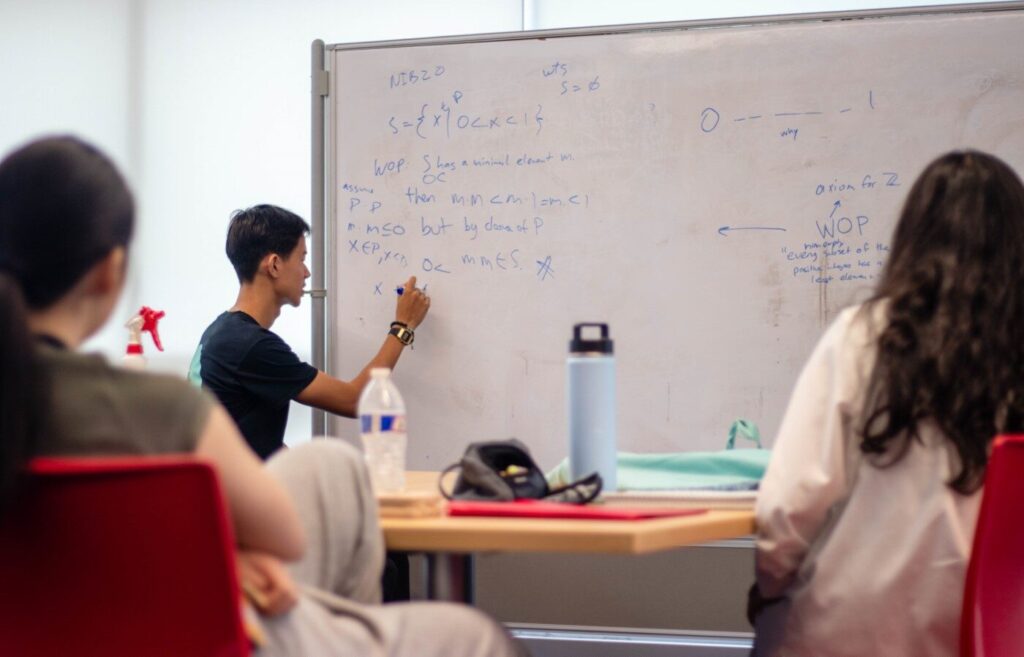
The Ross Mathematics Program is a six-week, residential summer course at Otterbein University and Rose-Hulman Institute of Technology for high school students interested in pursuing independent mathematical research. You will attend class for a minimum of three hours per day in small “family groups” led by a counselor.
Apart from classes, you will be responsible for structuring your own time to solve problem sets covered in class. The focus is on number theory. You’ll also attend electives and practice articulating mathematical arguments with your peers.
Why it stands out: It has a track record of helping students develop proof-based reasoning skills, so you’ll have a chance to do the same and excel in Olympiads and graduate study.
13. Texas State University – Honors Summer Math Camp
Location: Texas State University, San Marcos, TX
Acceptance rate: 15%
Dates: June 21st – August 1st
Application Deadline: Starting on January 1; rolling admissions
Eligibility: High school students worldwide
Cost: $6,600. Need-based financial aid available
The Honors Summer Math Camp at Texas State University is a multi-year summer residential program for high school students. For six weeks in your first year, you will be guided by undergraduate mentors in solving daily problem sets in small study groups. If you return as a second-year student, you will conduct original research with Texas State faculty.
The program includes Honors Seminar, modeled after Honors Programs offered at many colleges, an interdisciplinary course that prepares students to conduct their own research in the future. Past projects have included Examining the Influence of Fairness Metrics on Clustering Algorithms and Developing Fast Training Logistic Regression Models.
Why it stands out: The multi-year structure accurately reflects university academics, helping you better prepare for university-level math education.
14. Rutgers University–New Brunswick – Young Scholars Program in Discrete Mathematics
Location: Rutgers University, Piscataway, NJ
Acceptance rate: Moderately selective
Dates: July 7th – August 1st
Application Deadline: Rolling deadlines
Eligibility: High school students across the world
Cost: $4,600. Need-based financial aid available
The Young Scholars Program at the Rutgers School of Arts and Sciences is a four-week, residential program for high school students interested in learning the mathematical sciences. This intensive program introduces you to Discrete Mathematics and its applications through a weekly structure. You begin with foundations, including mathematical induction, basic logic, Combinatorics, and Probability I.
For week two, you will focus on Graph and Number Theory. In the third week, you are introduced to the practical applications of previously covered topics. And in week four, you will mathematically analyse games, as you continue to build on concepts from previous weeks. Throughout the program, you’ll meet professionals working in the field of discrete math and have discussions about future career paths.
Why it stands out: It’s backed by DIMACS (the discrete math community) and gives you early access to fields like data science, cryptography, and optimization.
15. Texas Tech University – Anson L. Clark Scholars Program
Location: Texas Tech University, Lubbock, TX
Acceptance rate/cohort size: Highly selective, 12 students
Dates: June 21st – August 6th
Application Deadline: February 16th
Eligibility: U.S. High school juniors and seniors who are at least 17 years of age
Stipend: $750, upon completion of a successful research project report
The Anson L. Clark Scholar Program at Texas Tech University introduces academically accomplished high school students to seven weeks of research. Research areas include Cellular and Microbiology, Cancer Biology, Chemistry, Computer Science, Electrical and Computer Engineering, History, Mechanical Engineering, Cancer Bioimaging, and Physics.
You’ll work both on the campus and in the Health Science Center under the guidance of Texas Tech faculty. You will attend seminars, participate in group discussions, and go on field trips. You’ll also receive a $750 stipend after completing your research project report.
Why it stands out: You’ll receive one-on-one mentorship from Texas Tech faculty, helping you deepen subject knowledge and improve your research project report.
Beyond Summer, Into Mathematics
Exploring mathematics in depth often begins with a single experience that changes how you see the subject. Summer programmes can be that turning point.
The programmes featured here show how math summer programs in the US for high school students offer more than academic enrichment. They introduce rigorous thinking, collaborative problem-solving, and exposure to university-level expectations.
Whether you explored proofs, research, or applied mathematics, each experience helps you clarify your interests and build confidence in tackling complex ideas.
If you’re ready to keep developing that momentum, our Mathematics Top Books Guide offers thoughtful reading recommendations to deepen your understanding and extend your learning beyond the summer.