
 Русский (RU)
 Українська (UK)
 Türkçe (TR)
 Italiano (IT)
 Français (FR)
 Português (PT)
 中文 (中国) (ZH)
 Español (ES)
 日本語 (JA)
 ไทย (TH)
 Deutsch (DE)
 Ελληνικά (EL)
 Polski (PL)
 Bahasa Indonesia (ID)
 Nederlands (NL)
 العربية (AR)
 한국어 (KO)

As a high school student considering a residential summer camp, the idea of spending several weeks away from home can feel both exciting and unfamiliar. You might wonder what residential camps truly offer beyond activities and social events. Residential summer camps provide a unique environment that blends independence, personal growth, structured learning, and community living.
Picture yourself living on a university campus or dedicated camp setting, sharing dorms with peers from around the world, participating in hands-on workshops, outdoor adventures, group challenges, or academic enrichment activities led by experienced instructors. By spending your summer in a residential program, you gain a taste of independent living while building friendships and learning to navigate new responsibilities.
How do you choose the right residential summer camps for high school students?
With so many options available, choosing the right camp can feel overwhelming. Some residential camps focus primarily on recreation and social bonding, while others emphasize academics, leadership, or career exploration. That’s why thoughtful guidance is essential to pick the programs best for you.
Today, universities, educational institutions, and specialized organizations offer residential summer camps that combine structured programming with community living. You may explore subjects like STEM, arts, leadership, sports, or cultural studies while developing independence, teamwork, and communication skills. These camps range from short immersive experiences to multi-week residential programs designed to prepare students for future academic and personal challenges.
No matter your interests, residential summer camps help you answer important questions: What kind of environment helps you thrive? How do you adapt to new routines and responsibilities? To help you explore your options, we’ve curated a list of 15 residential summer camps for high school students. They’ve been selected for their enriching experiences, supportive communities, and strong reputations.
15 Residential Summer Camps for High School Students
1. Business Opportunities Summer Session (BOSS)
Cost: $350 registration fee (paid only after acceptance); food, lodging, and program events are covered. Transportation to/from campus is not covered, and students must arrange their own travel.
Dates: June 14th – June 26th
Application Deadline: October 20th – March 20th
Location: Penn State University Park campus, State College, PA (residential; participants stay in a campus residence hall).
Eligibility: High school juniors from the U.S. and Puerto Rico who are entering 12th grade and are interested in pursuing business in college.
The Business Opportunities Summer Session (BOSS) is a two-week residential business camp that introduces students to undergraduate-level business study at Penn State’s Smeal College of Business. You take classes in core business areas such as management, marketing, finance, and business communication, taught by Smeal faculty.
The curriculum focuses on case discussions, group projects, and structured presentations to show how business ideas are taught and used in college. You take classes for your major and attend leadership and college prep sessions. Living on the University Park campus allows students to experience residence life, dining halls, and daily academic schedules similar to those of first-year undergraduates.
Why it stands out: It immerses you in the business school experience at Penn State’s Smeal College of Business, combining core classes in management, marketing, and finance with leadership training and real-world case studies, giving you an early understanding of what business study at a large university entails.
2. Immerse Education’s Pre-University Summer School

Cost: Varies; summer school scholarship available through their bursary programme
Dates: Two weeks during the summer
Application Deadline: Rolling admissions across multiple summer cohorts
Location: Boston, Cambridge, London, Oxford, Singapore, Sydney, Tokyo, and Toronto
Eligibility: Students around the world aged 13–18 currently enrolled in middle or high school
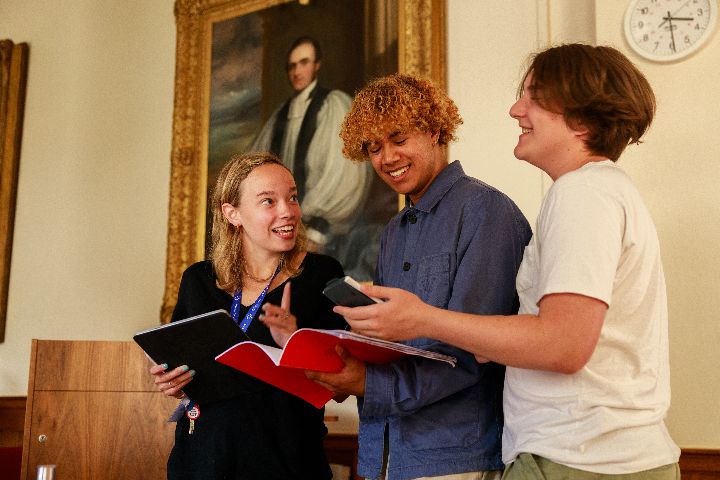
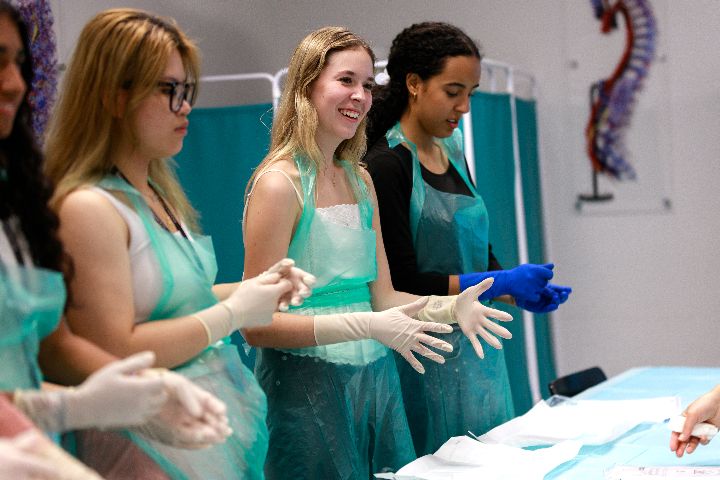
The Academic Insights Program is one of the most immersive residential summer camps for high school students, offering the opportunity to take undergraduate-level classes at universities around the world. You work with academics from universities like Oxford, Cambridge, and Harvard in small classes of 4–10 students. They attend university-style lectures and 1:1 weekly sessions with their tutor. The program includes practical experiences such as dissections in medicine, robotic arm building in engineering, or moot courts for law.
You can choose from over 20 subjects, including architecture, artificial intelligence, business management, computer science, economics, medicine, philosophy, and more. By the end of the program, you will complete a personal project and receive written feedback and a certificate of completion. You can find more details about the application here.
Why it stands out: You’ll get an early start at university life and academics because the program includes an independent project, discussion-based classes, and living at a college campus.
3. University of Michigan – Summer Engineering Exploration Camp
Cost: Tuition is typically around $700, covering instruction and program materials; housing, meals, and travel costs are separate.
Dates: July 5-11 (one-week residential camp).
Application Deadline: February 19th
Location: University of Michigan campus, Ann Arbor, MI (residential, in person).
Eligibility: High school students entering grades 10–11 interested in engineering and design thinking. International students are welcome to apply
The University of Michigan Summer Engineering Exploration Camp (SEE Camp) provides a hands-on, residential introduction to engineering and design through collaborative projects and workshops. The Society of Women Engineers hosts the camp on the University of Michigan campus. It teaches students about different fields of engineering, like mechanical, environmental, and electrical engineering.
You take part in design challenges, visit labs, and do interactive activities that show you how university engineers solve problems. You can learn about college engineering programs and the kinds of work engineers do by talking to current students and faculty. A week on campus helps you adjust to college life, including teamwork and time management.
Why it stands out: It offers a hands-on, residential introduction to various engineering disciplines through collaborative projects and workshops, letting you experience engineering problem-solving techniques and explore university-level engineering programs while building skills in teamwork and time management.
4. University of Maryland Shirley Povich Sports Journalism Summer Camp
Cost: $125 registration fee; covers instruction and materials for the week-long camp.
Dates: July 7-11.
Application Deadline: Registration opens in March and runs on a rolling basis.
Location: University of Maryland, College Park, MD – Knight Hall, Philip Merrill College of Journalism campus.
Eligibility: High school students entering grades 9-12; open to students across the U.S. interested in sports media.
The Shirley Povich Sports Journalism Summer Camp is a week-long programme designed to immerse high school students in the practice and craft of sports media reporting. You attend workshops and sessions led by professional journalists and teachers from the Philip Merrill College of Journalism. These cover topics such as writing about sports, broadcasting play-by-play, creating social media videos, and making eSports.
The daily schedules include both hands-on skill-building activities and panels featuring working sports reporters and media professionals discussing careers in the field. There are also activities at the camp, like tours of campus facilities and sessions on how to help students get into college, which give you a better idea of what life is like at a university.
Why it stands out: It immerses you in the world of sports media reporting with hands-on workshops, including writing, broadcasting, and creating content, while learning from professional journalists and gaining insights into sports media careers, all within a university environment.
5. Rice University – Tapia STEM Camps
Cost: Residential tuition typically ranges from $2,200–$2,500 per session, with early-bird pricing for early applicants. Scholarships may be available through program partners.
Dates: Multiple one-week sessions in July.
Application Deadline: May 1st
Location: Rice University campus, Houston, TX (residential, in person).
Eligibility: Rising 8th through 12th graders worldwide with an interest in STEM and readiness for immersive group projects.
Rice University’s Tapia STEM Camps offer a week-long, residential immersion in science, technology, engineering, and mathematics, built around project-based learning and interactive challenges. Campers live on Rice’s campus and work on applied STEM projects in small groups. These projects often end with presentations, which help you practice your communication and scientific reasoning skills.
University professors, graduate students, and current undergraduates assist in designing an engaging curriculum that inspires students to explore. There are many activities, such as conducting lab experiments, working on design problems, and going on field trips, that connect what you learn in school to the real world.
Why it stands out: It offers a week-long, project-based immersion in STEM at Rice University, where you work on applied challenges in small groups, gaining not just technical skills but also teamwork, problem-solving, and communication abilities through real-world, hands-on experiences.
6. Entrepreneurship & Innovation Bootcamp – Tufts University
Cost: ~$4,225 (commuter) or ~$5,750 (residential), including program activities and housing. Limited need-based financial aid is available.
Dates: July 5-17.
Application Deadline: May 1st (priority deadline).
Location: Tufts University Medford/Somerville campus, MA, with residential and commuter options.
Eligibility: Domestic and international high school students entering grades 10-12 or recent high school graduates.
The Entrepreneurship & Innovation Bootcamp at Tufts University is a two-week program that teaches students how to identify problems and develop business ideas that can be successful. You take part in workshops on business case development, market research, and go-to-market strategy. The program ends with a formal pitch to peers and advisors.
The lessons focus on practical business thinking, communication, and collaboration on projects. You can also use campus resources and get help from Tufts students, alumni, and faculty who work at the Gordon Entrepreneurship Center. Experiences on campus, such as living in residence halls, are similar to aspects of college learning and community.
Why it stands out: It immerses you in entrepreneurship through hands-on workshops on business case development and market strategy, guiding you to create and pitch a new business idea in just two weeks, while using Tufts’ campus resources and receiving mentorship from faculty and alumni.
7. Stanford University Mathematics Camp (SUMaC)
Cost: $3,750 (online) or $8,950 (residential).
Dates: Residential Session: June 21st – July 17th; Online Sessions: June 15th – July 3rd and July 6th – July 24th
Application Deadline: February 2nd.
Location: Stanford University campus, Stanford, CA (residential option); a parallel online option is also offered.
Eligibility: High school students from around the world in 10th or 11th grade at the time of application with a strong foundation in geometry, algebra, and proof-based mathematics.
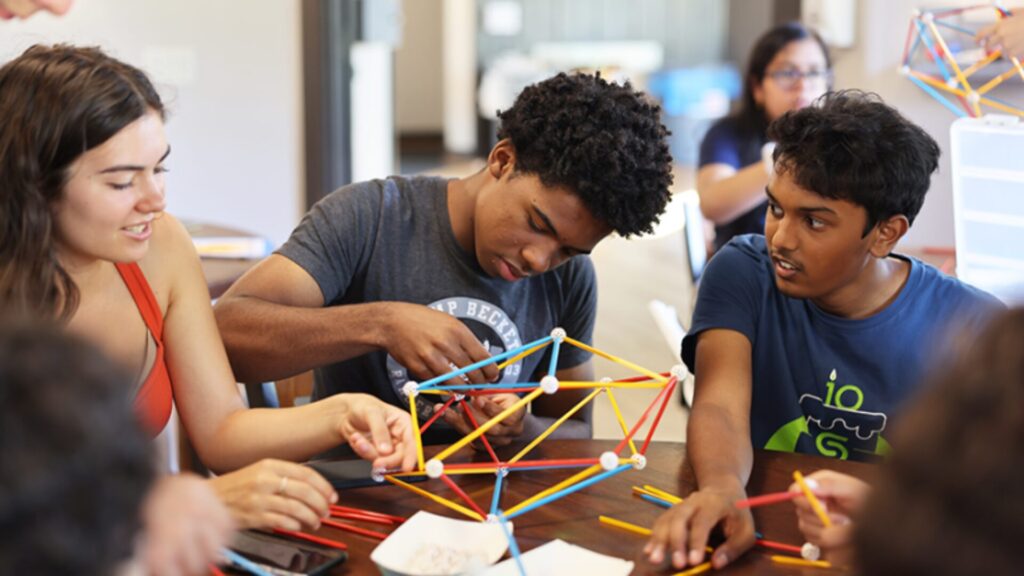
Stanford University Mathematics Camp (SUMaC) is one of the most academically rigorous residential summer camps for high school students, challenging you to engage with advanced mathematical thinking in a way that mirrors collegiate-level study. You participate in daily lectures, group problem-solving sessions, and guided research discussions while selecting between two intensive course tracks.
Instead of traditional classroom exercises, the program emphasizes exploring mathematical concepts through proof construction, inquiry, and group work, helping you develop deeper analytical reasoning. Living on Stanford’s campus in the residential format exposes you to college life, and organized social and academic events foster a community of like-minded peers. You learn how mathematicians approach problems and work together to find solutions through challenging assignments and faculty interaction.
Why it stands out: It challenges you with advanced, proof-based mathematics and fosters deep analytical reasoning through lectures, group problem-solving, and guided research on topics like abstract algebra and topology, all while experiencing college life on Stanford’s campus.
8. Young Leaders and Changemakers Summer Camp – Singapore
Cost: S$3,625 or S$2,900 with the early-bird rate (until May 4th). Fees include accommodation on the NUS campus, program-related transport in Singapore, learning materials, a welcome lunch (Day 1), a networking lunch (Day 5), and a t-shirt.
Dates: June 29th – July 3rd (5 days), 10:30 a.m. – 5:00 p.m. (Singapore Time).
Application Deadline: June 1st.
Location: Lee Kuan Yew School of Public Policy, National University of Singapore, 469C Bukit Timah Rd, Singapore 25977 (on-campus accommodation provided).
Eligibility: Participants must be at least 16 years old by the program start date. The camp is open to local post-secondary/tertiary students and high school/university students from Singapore and beyond.
The Young Leaders and Changemakers Summer Camp is a five-day program on campus that teaches you how public policy, leadership, and innovation affect real communities. You take part in interactive workshops and hands-on activities focused on key areas of public policy, especially governance and social impact.
The camp includes “experiential learning journeys,” trips that help you see how things work in the real world beyond school. Throughout the week, you engage in expert-led discussions and practical exercises that develop teamwork, critical thinking, and decision-making in applied policy contexts. The programme culminates in a capstone project where you pitch an idea and present solutions to a real-world issue, mirroring the project-and-presentation format common in university-level seminars.
Why it stands out: It combines public policy, leadership, and social impact with experiential learning, where you solve real-world problems through hands-on workshops, expert-led discussions, and a capstone project, providing you with skills and insights relevant to international policy work.
9. Camp Business – Drexel University, LeBow College of Business
Cost: ~$2,000 (residential session); ~$950 (commuter session).
Dates: Residential Blue: July 13-17; Commuter: July 20-24; Residential Gold: July 27-31
Application Deadline: Priority deadline in early May.
Location: Drexel University campus, Philadelphia, PA (residential and commuter options).
Eligibility: High school students worldwide entering their sophomore, junior, or senior year.
Drexel’s Camp Business is a fast-paced one-week residential summer camp for high school students that introduces you to key business areas, including accounting, marketing, finance, and management, through interactive lectures and applied workshops. You learn about both college business education and basic business skills through interactive lectures, team workshops, and strategy games.
There are also classes on leadership, business etiquette, financial documents, and the basics of the stock market. Students in residential sessions live in dorms with structured academic and social schedules. When you finish the program, you get a certificate of completion. By the end of the week, students develop foundational business knowledge and an understanding of how these concepts translate to college and career contexts.
Why it stands out: It offers a one-week immersive experience in key business areas, using interactive lectures, strategy games, and workshops to build foundational business skills and provide a glimpse into college business education, all while living on Drexel’s campus.
10. Summer Business Camp (NJ) – Rutgers Business School (NJ)
Cost: $2,600 for one week (includes room & board, meals, and field trips).
Dates: Three one-week sessions: July 5-11; July 12-18; July 19-25
Application Deadline: Registration is open.
Location: Livingston Apartments and Rutgers Business School, Livingston Campus, Piscataway, NJ.
Eligibility: Designed for high school students all around the globe.
This is a one-week, residential business camp that combines faculty-led introductions to core business areas with applied work like elevator pitches and a business plan competition. Campers switch between topics such as finance, accounting, management, marketing, and supply chain, then apply what they’ve learned in real-life situations.
The schedule includes visits to businesses and structured sessions that are similar to how college students develop and present business ideas. You live on Rutgers’ Livingston Campus, which is meant to be a shorter version of a college routine.
Why it stands out: It combines faculty-led business education with real-life application through business plan competitions and visits to local companies, giving you a practical understanding of core business concepts and the chance to experience a college-style routine on Rutgers’ campus.
11. U.S. Naval Academy Summer STEM Camp
Cost: Program fee typically around $750, covering instruction, materials, housing, and meals during the session.
Dates: One-week sessions held across June.
Application Deadline: March 31st.
Location: United States Naval Academy, Annapolis, MD (residential, in person).
Eligibility: Middle and high school students, typically rising 8th–11th graders, who meet academic and age requirements. Applicants must be U.S. citizens or permanent residents.
The U.S. Naval Academy STEM Camp introduces you to hands-on engineering and science through short, intensive projects conducted on a federal service academy campus. You work with Academy faculty and midshipmen in workshops that focus on robotics, aerospace engineering, cyber systems, materials science, and naval architecture, among other things.
Instead of lectures, the curriculum focuses on problem-solving under constraints, working together, and practical design. You also talk to current midshipmen who can tell you about life at the Naval Academy, leadership training, and STEM classes.
Why it stands out: It immerses you in hands-on engineering and science projects at a federal service academy, where you work on robotics, aerospace, and cyber systems while gaining exposure to the unique environment and expectations of military academy life.
12. Manhattan College Entrepreneurship Pre-College Camp (NY)
Cost: Tuition is $1,400 for three weeks, plus a $50 non-refundable registration fee.
Dates: July 6-23 (Monday – Thursday; no class on Fridays).
Application Deadline: Admissions open.
Location: Manhattan University campus, Riverdale, NY.
Eligibility: Domestic and international students ages 15-17.
This is a three-week entrepreneurship camp where you take a business idea from idea to MVP and pitch it, with weekly goals to help you stay on track. In the first week, you choose a specific product or service to focus on and create branding elements such as a logo, a definition of your target audience, and a marketing plan.
You look for suppliers, decide on prices, work on your MVP, and write your pitch in week two. You present your business in week three and talk about how to run it after the program. You end with a presentation to both an online and an in-person audience. You will work in groups to finish assignments and make changes between two daily check-ins with your instructor.
Why it stands out: It immerses you in hands-on engineering and science projects at a federal service academy, where you work on robotics, aerospace, and cyber systems while gaining exposure to the unique environment and expectations of military academy life.
13. FSU Entrepreneurship Summer Camp – Florida State University (FL)
Cost: $100 camp fee (covers field trips, a camp t-shirt, and daily lunches).
Dates: June 8-12; applications open mid-February.
Application Deadline: Applications open mid-February.
Location: Florida State University, Tallahassee, FL.
Eligibility: Domestic and international high school students.
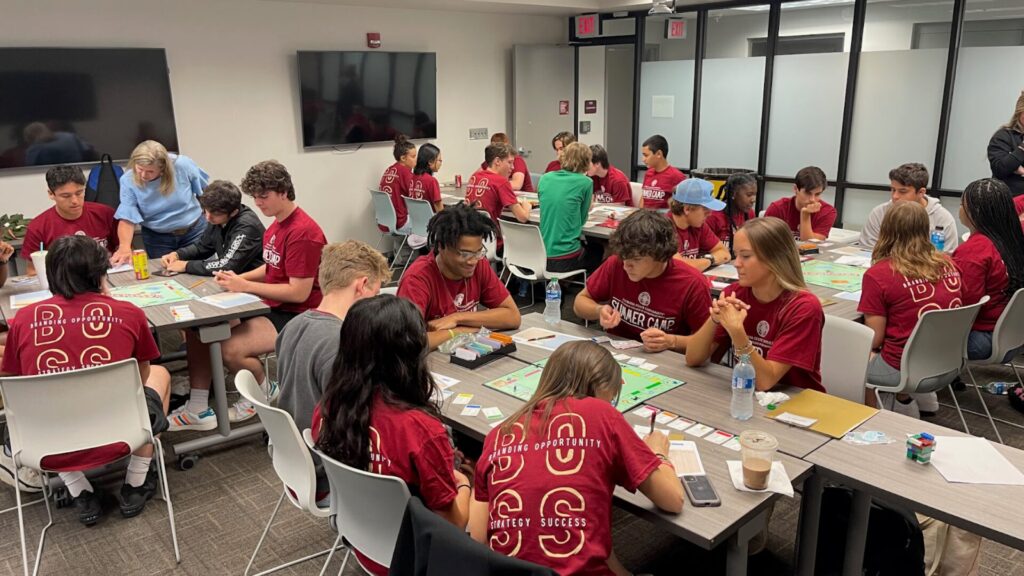
This is a weeklong entrepreneurship camp led by the Jim Moran College of Entrepreneurship, where you work in teams to build a business model and pitch it at the end of the program. The program frames the experience as a “small group” camp, which typically means more guided work time and tighter team collaboration.
You practice assembling and working in a balanced startup-style team while developing an idea into a viable model. The week culminates in teams pitching their businesses to family and friends, creating an audience-facing milestone akin to a demo day.
Why it stands out: It emphasizes tight-knit team collaboration, allowing you to develop a business model from scratch and pitch it in front of an audience, closely mimicking the startup environment and providing hands-on experience with entrepreneurial work.
14. Entrepreneurship Summer Camp – North Carolina Central University (NC)
Cost: $100; meals are included.
Dates: July 7-18 (Monday–Friday), 9 a.m. – 3 p.m.
Application Deadline: Registration is open.
Location: North Carolina Central University, Durham, NC.
Eligibility: Rising 10th-12th graders around the globe.
This is a two-week entrepreneurship camp where you learn the fundamentals of turning an idea into a presentable business concept through hands-on work. The curriculum explicitly includes developing a business idea, creating a brand, managing finances, and building presentation skills. The program also includes speaking with entrepreneurs who share their stories and offer advice.
This helps students connect what they learn in class to real-life paths to becoming a founder. It looks more like an intensive workshop than a residential experience as it runs on a weekday daytime schedule.
Why it stands out: It combines fundamental business education with real-world application, where you develop an idea, create a brand, and manage finances, while also learning directly from experienced entrepreneurs who guide you in turning your concept into a presentable business.
15. NYU Tandon’s Summer Camp for Machine Learning
Cost: $3,180.
Dates: Two-week sessions in June – July (specific dates vary by year).
Application Deadline: May 15th.
Location: NYU Tandon School of Engineering, Brooklyn, NY (in person; residential options may be available).
Eligibility: High school students worldwide (commonly grades 9–12) with an interest in computer science, machine learning, and data analysis. Prior programming experience and completion of Algebra 2 or an equivalent math course are recommended for full engagement.
NYU Tandon’s Summer Camp for Machine Learning gives you a focused, university-based introduction to the theoretical and applied foundations of machine learning and data analysis. You learn about the main ideas behind fields like image and speech recognition, autonomous systems, and real-time data interpretation through guided coursework and programming exercises.
The curriculum includes both theoretical and practical algorithm development. This helps you see how theoretical ideas can be used in the real world. By combining technical instruction with project work in a university setting, the camp helps you clarify your interest in computing and data science before you enter college.
Why it stands out: It offers a focused introduction to machine learning and data analysis at a prestigious engineering school, where you gain both theoretical knowledge and practical experience in building algorithms and solving real-world problems in computing and data science.
From Camp Routine to Campus Readiness
Living away from home during the summer helps you adapt to new routines, responsibilities, and environments that mirror the realities of student life beyond high school.
Residential summer camps for high school students offer structured days, shared living spaces, and guided independence, helping you learn how to balance academics, social life, and personal well-being.
Through these experiences, you build confidence, resilience, and self-awareness while learning how to navigate community living, manage time, and engage with diverse peers.
To continue preparing for life on campus, explore our Student Life and Cultural Immersion blogs for practical advice on academics, accommodation, social life, and making the most of new environments.