


 Русский (RU)
 Українська (UK)
 Türkçe (TR)
 Italiano (IT)
 Français (FR)
 Português (PT)
 中文 (中国) (ZH)
 Español (ES)
 日本語 (JA)
 ไทย (TH)
 Deutsch (DE)
 Ελληνικά (EL)
 Polski (PL)
 Bahasa Indonesia (ID)
 Nederlands (NL)
 العربية (AR)
 한국어 (KO)

Summers in high school don’t have to be a pause from learning; they can be a chance to engage with subjects at a deeper level. Mathematics summer programs in London for high school students offer a space where the subject moves beyond textbooks into proofs, competition-style problems, discussion, and collaborative problem-solving.
These programmes also introduce you to advanced areas such as proof-writing, applied statistics, computational problem-solving, and competition maths. You learn through lectures, problem sets, and collaborative sessions, gaining exposure to university-style academics where independent thinking and structured reasoning are key.
Now, place that experience in London. You might find yourself studying in lecture halls at leading universities, walking past historic institutions, and engaging with a city where academic tradition meets modern research and industry. The setting adds context to what you’re learning, showing mathematics not just as theory, but as a discipline connected to finance, technology, and scientific research.
What makes London an ideal destination for mathematics summer programs?
London offers a strong academic environment for mathematics, with access to globally recognized universities, research centers, and industries that rely heavily on quantitative skills. From finance to data science, the city connects mathematical theory to real-world applications in a way that few places can.
Beyond academics, the diversity of the city brings together students and ideas from across the world. This creates a learning environment where discussions are shaped by different perspectives, making the experience both intellectually and culturally engaging.
To help you explore your options, we’ve curated a list of 15 mathematics summer programs in London for high school students, selected for their academic rigor, problem-solving focus, and exposure to university-level learning.
For adjacent options, check out the online math programs and summer programs in London.
15 Mathematics Summer Programs in London for High School Students
1. UCL Year 12 Maths Summer School – Maths in Action
Location: UCL campus, central London
Cost/Stipend: None
Acceptance rate/cohort size: Highly Selective; typically ~40-50 students per session
Dates: July 20-24
Application Deadline: June 2nd
Eligibility: Current Year 12 students attending UK state-funded schools; check grades and other criteria here; not open to international students
The UCL Year 12 Maths Summer School – Maths in Action is one of the most applied mathematics summer programs in London for high school students, giving you a practical introduction to how mathematics is used to understand real-world systems. You will attend academic sessions that explore topics such as modelling blood flow with differential equations, studying how diseases spread, and understanding the basics of cryptography.
Rather than focusing only on techniques, the program emphasizes how mathematicians build models, make assumptions, and interpret results. Alongside academics, you will also gain insights into university life, including personal statement guidance, student finance, and studying at UCL. The experience is designed to help you evaluate whether mathematics at university aligns with your interests.
Why it stands out: It focuses on real-world mathematical modelling, showing how maths is applied to fields like biology, epidemiology, and cybersecurity.
2. Immerse Education’s London Mathematics Summer School

Location: University College London, London, UK
Cost/Stipend: Varies, summer school scholarship available through our bursary programme
Acceptance rate/cohort size: Selective; around 7 participants per class
Dates: 2 weeks during the summer
Application Deadline: Multiple summer cohorts; rolling admissions
Eligibility: Students aged 15-18; open to international students
The Immerse Education London Summer School offers an academically rigorous mathematics experience for students aged 15–18, set in a city known for its strong academic and research environment. You will explore core areas such as algebra, calculus, and statistics through small-group teaching and collaborative problem-solving sessions. The program goes beyond standard school curricula, encouraging you to engage with complex concepts and develop deeper analytical thinking.
A key component is a self-directed research project, where you investigate a topic of interest and apply university-style methods with guidance from expert tutors. Alongside this, personalised feedback and one-on-one support help refine your understanding and academic communication skills.
Why it stands out: It combines small-group teaching with a guided independent research project, mirroring university-style mathematical study.
3. Imperial College Year 12 Sutton Trust Summer School – Mathematics Track
Location: Imperial College London campus, London, UK
Cost/Stipend: None
Acceptance rate/cohort size: Highly selective; approximately 224 places across all subject streams
Dates: July 14-17; July 21-24
Application Deadline: March 5th
Eligibility: Year 12 in England or Wales, Year 13 in Northern Ireland, or S5 in Scotland (or equivalent) at the time of application; should be under 18 years old; attend, and have always attended, a state-funded school or college (non-fee paying) in the UK; check other requirements here; not open to international students
At the Imperial College Year 12 Sutton Trust Summer School in Mathematics, you will explore advanced undergraduate-level topics including number theory, abstract logic, and the mechanics of mathematical proof. You will spend your week attending formal academic lectures, participating in interactive problem-solving workshops, and collaborating on a final group presentation focused on a specific mathematical challenge.
Through these activities, you will develop high-level analytical skills, learn to communicate complex technical proofs, and gain the confidence to manage a university-level workload. This program effectively bridges the gap between high school study and the abstract reasoning required at a top-tier STEM institution.
Why it stands out: It is a completely free residential experience that grants high-achieving students from underrepresented backgrounds direct access to world-class faculty and specialized support for the most competitive university admissions tests.
4. King’s Maths School – Girls love Maths and Physics! Summer School
Location: King’s Maths School, Kennington Road, London
Cost/Stipend: None
Acceptance rate/cohort size: Selective; 160 students
Dates: July 13-16
Application Deadline: May 24th
Eligibility: Female, and female-identifying, students in year 10 in the UK; not open to international students
King’s Maths School’s Girls Love Maths and Physics! Summer School is a four-day program designed to introduce Year 10 students to advanced ideas in mathematics and physics beyond the school curriculum.You will explore new concepts through interactive sessions, problem-solving activities, and hands-on experiments that connect theory with real-world applications.
The program also includes talks from female professionals in STEM, offering insight into academic and career pathways in maths and physics. An educational trip and collaborative activities help build a sense of community among participants with shared interests. The program is fully funded, with meals provided and financial support available for travel if needed.
Why it stands out: It focuses on encouraging female participation in maths and physics through mentorship, exposure, and fully funded access.
5. Imperial College London Y10 Insights Summer School
Location: Imperial College, South Kensington campus, London
Cost/Stipend: None
Acceptance rate/cohort size: Highly Competitive; cohort size not disclosed
Dates: July 29th – August 1st
Application Deadline: March 11th
Eligibility: Students in Year 10, studying at least 8 GCSEs, on track for grades 7-9 in STEM, must attend a state-funded school; not open to international students
Imperial College London’s Y10 Insights Summer School is a four-day residential program designed to introduce you to STEM subjects through science and engineering streams.You will attend structured taster sessions that extend beyond GCSE-level content, including maths topics applied to physics, engineering, and real-world problem-solving.
The program combines lectures with hands-on practicals in undergraduate labs, allowing you to explore concepts through guided experimentation. You will also work in groups to develop and present a poster on a concept learned during the program, building your communication and collaboration skills. Alongside academics, you will experience university life through mentoring, campus accommodation, and structured activities.
Why it stands out: It integrates maths learning directly into science and engineering applications through university-level taster sessions.
6. King’s College London K+ Natural, Mathematical & Engineering Sciences (NMES) Summer School
Location: King’s College London campuses, London, UK
Cost/Stipend: None
Acceptance rate/cohort size: Highly competitive; approximately 50-60 students
Dates: Typically run during a multi-day block in July or August
Application Deadline: Late November/early December of Year 12
Eligibility: Current Year 12 students who attend a non-selective state school or college in London or surrounding areas; must meet specific widening participation criteria (e.g., first generation in their family to attend university, receipt of Free School Meals, care-experienced, or living in an area with low progression to higher education); not open to international students
The King’s College London K+ Natural, Mathematical & Engineering Sciences (NMES) Summer School is a free, widening participation program designed to help you prepare for university life. During the program, you will explore a comprehensive range of topics, specifically Chemistry, Computer Science, Engineering, Informatics, Mathematics, and Physics.
You will engage in academic taster lectures, participate in bespoke skills-based workshops, explore STEM career pathways, and network with academics and peers at a summer conference. Successful completion grants you a two-grade reduced offer for most undergraduate courses at King’s and a potential £1000 first-year bursary if you enroll.
Why it stands out: It directly translates a free summer academic experience into tangible, long-term university admission and financial advantages for underrepresented students.
7. King’s Maths School – Step up to A level (Maths, Physics, Further Maths) Summer School
Location: King’s Maths School, Kennington Road, London
Cost/Stipend: None
Acceptance rate/cohort size: Highly Selective; approximately 50-60 students
Dates: July 13-17
Application Deadline: May 24th
Eligibility: Year 11 students planning to study Maths and Physics in Year 12; not open to international students
The Step Up to A Level (Maths, Physics, Further Maths) Summer School is a short academic program designed to help you transition from GCSE-level study to the demands of sixth form. In this program, you will explore key “big ideas” in mathematics and physics, building a stronger conceptual foundation for A-level subjects.
Sessions include lectures, hands-on lab experiments, and collaborative problem-solving activities that mirror classroom and practical learning at the next level. You will also develop core academic skills such as logical reasoning, mathematical thinking, and scientific analysis while interacting with like-minded peers. The program is fully funded, with meals provided and financial support available for travel.
Why it stands out: It prepares you specifically for A-level rigor by combining theory, practical work, and skill-building in a structured setting.
8. Imperial Year 12 Work Experience Programme
Location: Imperial College, South Kensington campus, London
Cost/Stipend: None
Acceptance rate/cohort size: Highly Selective; cohort size varies by department
Dates: June 29th – July 3rd
Application Deadline: March 5th
Eligibility: Year 12 students (or equivalent) who attend a UK state-funded (non-fee-paying) school; at least 5 GCSEs at grades 7-9 and specific A-level subjects (e.g., Biology and Chemistry/Maths for Medicine); not open to international students
Among the 15 mathematics summer programs in London for high school students featured here, this programme gives you direct exposure to academic research and professional life within a university setting. In the mathematics stream, you will spend five days shadowing researchers and academics in the Department of Mathematics, observing how theoretical and applied work is conducted.
You will attend seminars and lectures, explore topics such as algebra, mathematical physics, or modelling, and assist with structured tasks like problem-solving exercises or data-related work. The program also includes group discussions, presentations on real-world applications like cryptography or fluid dynamics, and opportunities to interact with PhD students and researchers. The experience concludes with a student showcase, where you present your learning to faculty and peers.
Why it stands out: It provides direct exposure to real mathematical research environments through shadowing and academic immersion.
9. Imperial College Global Summer School – Physical Sciences
Location: Imperial College London, South Kensington Campus, London, UK
Cost/Stipend: £7,695
Acceptance rate/cohort size: Selective; cohort size not disclosed
Dates: Session 1: June 29th – July 10th; Session 2: August 3-14
Application Deadline: Rolling admissions
Eligibility: Must be 16 or 17 years old (cannot turn 18 before or during the program); requires high academic excellence, typically a majority of 9-7 (A*-A) grades at GCSE or international equivalent, with a minimum of 7 (A) in math and science subjects; English proficiency required; open to international students
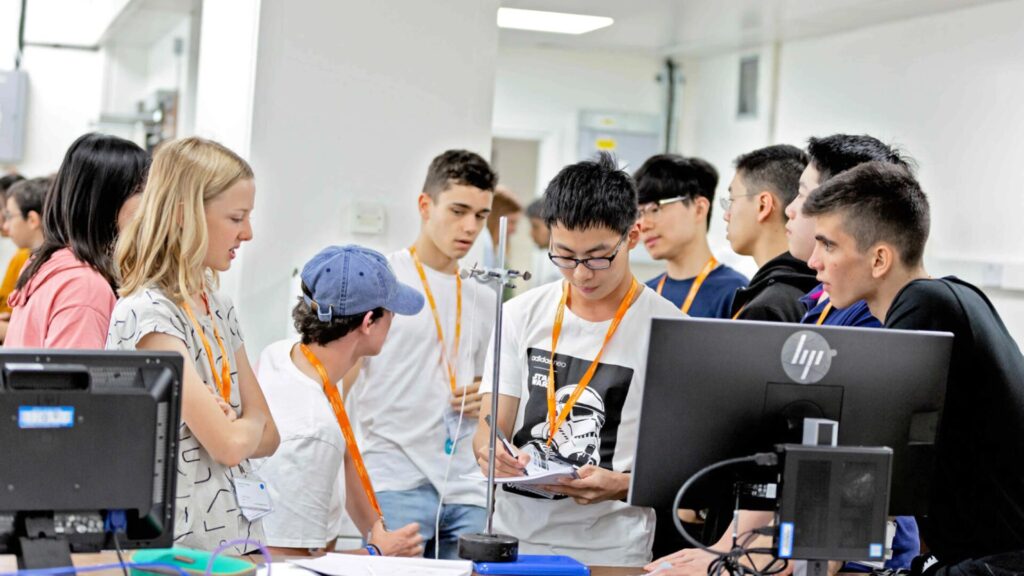
This program gives you a genuine taste of undergraduate applied mathematics and physics. During the course, you will explore core topics like statistical data analysis, algorithmic logic, and the mathematical mechanics of physical oscillations. You will conduct hands-on experiments to mathematically analyze real data, attend university-style lectures to master new theoretical techniques, and use Python to build dynamic computer simulations.
In the second week, you will apply these techniques by collaborating with international peers on a comprehensive team project to solve a complex real-world STEM challenge. The curriculum is taught directly by Imperial College’s Department of Mathematics, allowing you to experience authentic university-level rigor.
Why it stands out: It seamlessly bridges the gap between abstract mathematical theory and applied computer programming to solve tangible, real-world physical challenges.
10. King’s College London Pre-University Summer School – Computer Science
Location: London, UK (King’s College London Campuses)
Cost/Stipend: £3,195 (1 week); Residential (Tuition + Accommodation): £3,965 + Application Fee: £65
Acceptance rate/cohort size: Competitive; cohort size not disclosed
Dates: July 13-17
Application Deadline: April 10th
Eligibility: Academically motivated students aged 16 or 17 (must turn 16 before the start date); enrolled in the final three years of high school; minimum English proficiency of CEFR B2 (or equivalent) for non-native speakers; open to international students
The King’s College London Pre-University Computer Science program is an intensive summer course that uses mathematics as the foundation for computational problem-solving. During this week, you will study core topics including major programming principles, mathematical logic, algorithmic efficiency, and program design. You will attend university-level lectures with embedded tutorials, collaborate on small group coding projects, and engage in rigorous peer-assessment exercises.
By completing this coursework, you will develop strong practical skills in Python programming, critical analysis, and applying scientific reasoning to complex mathematical problems. The course is designed to replicate the exact academic rigor and teaching structure of a first-year undergraduate module at King’s.
Why it stands out: It treats high school students like true undergraduates, bypassing basic introductory camps to provide an authentic, fast-paced immersion into university-level computational mathematics and software design.
11. King’s College London Pre-University Summer School – Science, Technology and Engineering
Location: King’s College London, London, UK
Cost/Stipend: £3,195 (Tuition only) or £3,965 (Residential: Tuition + Accommodation), plus a £65 application fee per one-week session; limited scholarships are available
Acceptance rate/cohort size: Selective; over 1,500 students annually across the entire summer school
Dates: July 6-10
Application Deadline: April 10th
Eligibility: High school students aged 16 or 17 (must be enrolled in the final three years of high school); CEFR Level B2 English proficiency required; open to international students
This program offers you a rigorous immersion into how applied mathematics and computational logic solve modern societal challenges. You will explore heavily quantitative topics, including microprocessors, digital logic, robotics, artificial intelligence, and computer-aided design. You will engage in practical laboratory work, participate in team-based engineering problem-solving workshops, and conduct independent technical research to produce a group presentation.
A unique feature of this course is its direct instruction by faculty from King’s School of Biomedical Engineering, providing an authentic taste of undergraduate study rather than standard high school tuition.
Why it stands out: It empowers you to apply abstract mathematical principles directly to cutting-edge, real-world fields like medical imaging and robotics under the guidance of leading university biomedical experts.
12. Imperial College London Sutton Trust Summer School – Molecular Bioengineering
Location: Imperial College London, London, UK
Cost/Stipend: None
Acceptance rate/cohort size: Highly competitive; limited cohort sizes
Dates: July 14-17
Application Deadline: March 5th
Eligibility: UK Year 12 students attending a non-fee-paying (state-funded) school or college. Applicants must meet specific socio-economic criteria set by the Sutton Trust. Academic requirements include a minimum of eight GCSEs (with five at grades 7-9 including maths and all sciences, plus at least a 5 in English Language), and currently studying at least three A-levels (must include Mathematics and a relevant Science); not open to international students
In this program, you will discover how mathematics and computing are essential to improving complex biological systems. You will explore topics such as synthetic biology, tissue scaffolding, building DNA probes, and using mathematical models to track biological data.
To understand these concepts, you will attend academic taster lectures, conduct physical wet-lab chemistry experiments, use computational tools in dry-labs to analyse data, and collaborate on a team-based problem-solving project. A unique feature of this program is that it explicitly fuses the life sciences with quantitative engineering, challenging you to apply your A-level maths to solve tangible medical problems.
Why it stands out: It provides a fully funded, residential university experience that proves advanced mathematics is just as vital as biology for developing the future of healthcare.
13. Imperial College London Year 9 Girls Engineering Summer School
Location: Imperial College London (South Kensington Campus), London, UK
Cost/Stipend: None
Acceptance rate/cohort size: Competitive; cohort size not disclosed
Dates: August 4-7
Application Deadline: March 18th
Eligibility: Female students in Year 9. Applicants must be on track to achieve a minimum of five GCSEs at grades 7-9 (including maths and sciences) and a minimum grade 5 in English Language. Must be able to commute to the campus daily. Priority is given to students from under-represented backgrounds in higher education; not open to international students
The Imperial College London Year 9 Girls Engineering Summer School is a fully funded program that reveals how your classroom mathematics is practically applied to solve real-world engineering challenges. During the course, you will explore multiple disciplines by applying mathematical principles to hands-on physical experiments. You will also attend dynamic taster sessions led by university academics and collaborate on interactive team-building design challenges.
Finally, you will consolidate your mathematical and technical findings to create and present a formal academic poster to university staff. A standout feature of this initiative is its dedicated mission to empower young women by directly connecting early high school mathematics to tangible STEM career pathways.
Why it stands out: It provides an early, targeted, and free opportunity exclusively for young female students to experience how foundational mathematics translates into practical university-level engineering.
14. UCL Automating a Greener Planet Summer School

Location: UCL, Advanced Propulsion Lab, Marshgate, Stratford
Cost/Stipend: None
Acceptance rate/cohort size: Selective; cohort size not disclosed
Dates: July 20-22
Application Deadline: April 30th
Eligibility: Year 12 students in the UK; not open to international students
The UCL Automating a Greener Planet Summer School shows how mathematics summer programs in London for high school students can connect applied maths with cutting-edge environmental robotics. During this program, you will explore core topics like systems programming, algorithmic logic for automation, and the quantitative modelling of sustainable technologies.
You will program automated robotic systems, analyze environmental data to solve design challenges, tour the Advanced Propulsion Lab, and collaborate on a sustainability project. The course operates out of the highly specialized UCL East laboratories, giving you direct exposure to real-world engineering facilities. By the end, you will develop critical analytical skills, master the mathematical logic behind automated systems, and learn to apply quantitative problem-solving to ecological issues.
Why it stands out: It empowers you to directly apply abstract mathematical and programming concepts to solve urgent, real-world climate and sustainability challenges.
15. UCL Women In Mathematics Day
Location: UCL Main Campus (Bloomsbury), London
Cost/Stipend: None
Acceptance rate/cohort size: Competitive; approximately 60-80 students
Dates: June 30th
Application Deadline: Rolling basis until full
Eligibility: Year 12 female students (ages 16-17) studying A-level Mathematics (or equivalent) in the UK school system; not open to international students
At the UCL Women in Mathematics Day, you will explore advanced topics beyond the A-level syllabus and learn about cutting-edge research in modern mathematics. You will participate in academic taster lectures, join a Q&A panel with current female undergraduates, and take a guided tour of the university campus. Additionally, you will attend a tailored admissions session to help you navigate the university application process effectively.
This long-standing program is unique for its 25-year history of specifically empowering female mathematicians to bridge the gender gap in STEM. By attending, you will develop a broader mathematical perspective, enhance your problem-solving abilities, and gain confidence for your future university transition.
Why it stands out: It features a prestigious 25-year legacy of creating a dedicated, supportive space that specifically empowers female students to visualize themselves as successful university-level mathematicians.
Turn Problem-Solving Momentum Into Deeper Reading
After exploring the mathematics summer programs in London for high school students featured here, maths may feel closer to research, design, and real-world problem-solving.
From modelling blood flow and disease spread to studying cryptography, robotics, Python simulations, and statistical data, these programmes show maths in action.
They can also help you move from solving set questions to asking better ones, whether about algorithms, engineering, finance, sustainability, or scientific research.
Ready to keep solving? Explore our Mathematics Top Books Guide and find reads that challenge, inspire, and deepen the way you think about numbers, logic, and the world.