
 Русский (RU)
 Українська (UK)
 Türkçe (TR)
 Italiano (IT)
 Français (FR)
 Português (PT)
 中文 (中国) (ZH)
 Español (ES)
 日本語 (JA)
 ไทย (TH)
 Deutsch (DE)
 Ελληνικά (EL)
 Polski (PL)
 Bahasa Indonesia (ID)
 Nederlands (NL)
 العربية (AR)
 한국어 (KO)

If you’re a high school student interested in engineering, you may already enjoy building, designing, or solving technical problems. But beyond classroom learning, you might wonder what it actually looks like to apply those skills in a real-world setting. Engineering summer jobs for high school students can give you early exposure to how the field works, helping you develop practical skills, explore career paths, and strengthen your college applications.
Imagine spending your summer assisting in a workshop, supporting a research project, or working with a small tech startup. Picture learning how prototypes are built, how data is analysed, or how engineering teams collaborate to solve real problems. These opportunities often combine hands-on work with mentorship, giving you a realistic introduction to the field.
How do you find the right engineering summer jobs for high school students?
It’s important to know that traditional engineering jobs are rare for high schoolers, since most roles require advanced training. Instead, students typically find opportunities through internships, assistant roles, research programs, or entry-level technical work.
In some cases, engineering summer jobs can include working in maker spaces, repair shops, or local businesses where you help with design, fabrication, or maintenance tasks. Even roles that seem basic can give you valuable insight into engineering processes.
These experiences help you develop key skills such as problem-solving, teamwork, communication, and adaptability. They also give you a clearer sense of which areas of engineering interest you most, whether that’s mechanical, electrical, software, or environmental engineering.
You’ll learn from professionals, collaborate with peers, and gain hands-on exposure to real projects. Along the way, you’ll build confidence, strengthen your resume, and better understand what pursuing engineering at the university level might involve.
To help you get started, we’ve curated a list of 15 Engineering Summer Jobs for High School Students. They’ve been selected for their practical learning opportunities, accessibility, and ability to provide meaningful early exposure to the engineering field.
For more options, you can consider online engineering programs.
15 Engineering Summer Jobs for High School Students
1. Research Science Institute (RSI) – Massachusetts Institute of Technology (MIT)
Location: Massachusetts Institute of Technology, Cambridge, MA
Cost: Free
Application Deadline: Early to mid-December
Dates: Late June – Early August; 6 weeks
Eligibility: Rising high school juniors worldwide with exceptional academic and research potential in STEM fields; international students are welcome to apply
RSI is a summer program focused on advanced study in mathematics, science, and engineering through a structured research experience. Over six weeks, you begin with a short period of intensive coursework that introduces key theoretical concepts at a university level. After this, you move into an independent research project, working under the guidance of experienced scientists and engineers.
The program is residential and places a strong emphasis on academic discipline and consistent effort. You attend lectures, complete regular assignments, and document your progress through both written and oral presentations. By the end, you produce a research paper that reflects your work. The overall structure is intended to mirror the expectations and pace of higher-level academic research.
Why it stands out: It gives you the opportunity to work closely with researchers, receiving direct guidance as you develop and complete a structured research project.
2. Immerse Education’s Engineering Summer School

Location: London, Tokyo, Sydney, and Singapore
Cost: Varies; summer school scholarship available through our bursary programme
Application Deadline: Multiple summer cohorts with rolling admissions
Dates: 2 weeks during the summer
Eligibility: High school students worldwide aged 15-18
The Career Insights Program offers high school students an opportunity to explore different career paths in major global industry hubs. In the Engineering Summer track, you are introduced to how engineering work is carried out in professional settings. The program focuses on project-based learning, where you collaborate on practical tasks with established companies, alongside attending workshops and visiting workplaces such as offices and production facilities.
Throughout the program, you receive weekly one-on-one career guidance and detailed feedback on your resume and overall profile. At the end, you present your work and observations to professionals, allowing you to reflect on what you’ve learned and how it connects to potential future studies or careers. You can find more details about the application here.
Why it stands out: You’ll gain direct industry exposure, build a professional network, and receive a certificate you can include in your college applications and work profile.
3. AEOP High School Internship
Location: Multiple locations throughout the U.S. More info here
Cost/Stipend: Free to participate; educational stipend provided
Application deadline: Rolling basis
Dates: Typically 6-8 weeks during summer; dates TBA
Eligibility: High school students who are U.S. citizens or permanent residents; additional site-specific requirements may apply
As an AEOP High School Intern, you work with Department of Defence scientists or university researchers on ongoing, federally funded STEM projects, making it one of the more research-focused engineering summer jobs for high school students. At your laboratory site, your work may involve areas like molecular bioengineering, where you assist with lab-based research and experiments. Tasks can include learning techniques such as DNA cloning, protein expression in bacteria, and analysing results using tools like fluorescence microscopy and cell-free expression systems.
You also receive guidance from experienced mentors in the lab, with regular feedback on your work and progress. The program focuses on hands-on research and introduces you to the structure and pace of professional lab environments. In addition to your site-based experience, you connect with other AEOP interns across the country through virtual sessions, including office hours and career-focused webinars. The program also offers stipends, which can help make participation more accessible.
Why it stands out: You contribute to active research projects while learning standard laboratory techniques, giving you a clear view of how scientific work is carried out in professional settings.
4. University of Toronto’s Blueprint Engineering Program
Location: University of Toronto, St. George Campus, Toronto, ON
Cost: Free (accommodations and travel expenses are not included); need-based travel bursaries available (check the optional residential program here)
Application Deadline: March 29th
Dates: July 6-31, with biweekly events from October to February
Eligibility: Canadian citizens or permanent residents who self-identify as Black and are currently in grades 10 or 11
If you are a Black high school student in Canada currently in grade 10 or 11 with an interest in STEM, the University of Toronto’s Blueprint program offers a structured, year-long learning experience through its Faculty of Applied Science & Engineering. During the summer portion, you take part in two introductory engineering courses that combine core concepts with practical lab-based activities. The program also includes group outings and community-based events alongside academic work.
As the program continues, your experience depends on your grade level. If you are moving into grade 11, you take part in the Prepare stream, which focuses on building professional and leadership skills. If you are moving into grade 12, you join MAPS (My Academic Preparation Sessions), which supports your transition to university with guidance on applications and expectations. At the end of the program, you attend a graduation ceremony and receive a certificate of completion.
Why it stands out: The program combines academic preparation with ongoing support over an extended period, helping you build both subject knowledge and readiness for university.
5. Texas Tech University’s Anson L. Clark Scholars Program
Location: Texas Tech University, Lubbock, TX
Cost: No cost, $750 stipend
Application Deadline: February 16th
Dates: June 21st – August 6th
Eligibility: High school juniors and seniors who are at least 17 by the start date and are U.S. citizens/permanent residents
The Anson L. Clark Scholars Program places you in a university research environment over the course of a summer, where you work closely with a faculty mentor at Texas Tech. As one of the more academically rigorous engineering summer jobs for high school students, it assigns you an individual research project in a field such as artificial intelligence, computer science, engineering, or a related area, which you spend several weeks developing through hands-on work. The program focuses on helping you understand research methods, structure your analysis, and communicate your findings through academic writing.
Alongside your project, you take part in seminars, group discussions, and organised visits that provide context on how research connects to broader applications. As a residential program, you stay on campus and follow a schedule similar to university life, including managing your time between independent work and group activities. At the end of the program, you complete a written research report and present your work.
Why it stands out: You work directly with a faculty mentor while carrying out an individual project, giving you insight into how research is guided and evaluated at the undergraduate level.
6. Ontario Tech University Youth Program – Connected Engineering: Innovate and Accelerate
Location: Ontario Tech University, Oshawa, ON
Cost: Free
Application Deadline: Rolling until spots fill
Dates: June 29th – July 3rd
Eligibility: High school girls ages 14-17; international eligibility not disclosed
This youth program at Ontario Tech University is designed for high school girls who want to explore areas such as electrical, software, and mechanical engineering through practical activities. You take part in structured modules that introduce core engineering concepts in a clear and accessible way, with an emphasis on applying what you learn through hands-on work.
During the program, you collaborate with peers on a group project to design a functional engineering system. You also gain experience using programming tools to work with sensors and lighting systems, and create basic components using modelling software. The program highlights how coding and technology can be used to approach real-world problems, while helping you build skills in prototyping, programming, and 3D modelling.
Why it stands out: The program combines collaborative projects with introductory technical training, allowing you to explore multiple engineering fields in a guided setting.
7. Nuffield Research Placements
Location: Various settings across the UK (universities, research centres, laboratories, museums, field sites)
Cost: Fully funded
Application Deadline: Varies by region
Dates: Varies based on placement, during summer holidays
Eligibility: Must be over 16 and in Year 12 or S5, enrolled in full-time state-funded education in the UK, have at least five GCSEs at Level 5 or above (or Scottish Nationals at Level B or above) including maths, a science, and English (or another humanities subject), be studying relevant A-levels or Highers in STEM or related fields, and be available for 1-2 consecutive weeks in July or August
Nuffield Research Placements give you the opportunity to work with researchers over the summer on a project in areas such as science, computing, engineering, mathematics, or quantitative social science. You start with an online learning module that helps you build basic skills in research methods, data handling, and digital tools before moving on to a placement at a university, research institute, or similar organisation.
During the placement, you work on a defined research question alongside professionals, contributing to ongoing or structured projects. You then present your work through a written report and a research poster. Alongside the placement, you can also attend optional workshops and webinars, which may include topics like Python programming. There is also the option to submit your work for recognition, such as a CREST Award or participation in competitions like the Big Bang Fair.
Why it stands out: You take part in a guided research project within a professional setting, giving you experience of how research is structured, carried out, and communicated in academic and applied environments.
8. Imperial College London Y12 Work Experience Programme

Location: Imperial College London campus, South Kensington, London, UK
Cost: Free (fully funded; materials and lunch provided)
Application Deadline: Typically early March. Applications open in January, with closing dates dependent on the stream and year
Dates: 5 days in summer (stream dates vary by department)
Eligibility: Current Year 12 students at UK state schools who can commute daily to the London campus
The Work Experience Programme at Imperial College London introduces you to research environments across different STEM departments. Over five days, you join a selected area such as bioengineering, physics, mathematics, or climate science, where you take part in activities that may include lab visits, short workshops, and introductory experiments linked to ongoing academic work.
You also attend sessions that cover university applications, including guidance on UCAS forms and personal statements. Current students at Imperial College London support these sessions by sharing their own experiences of studying at university and adjusting to academic life. At the end of the programme, you present your work and reflections in a small academic-style session with other participants and mentors.
Why it stands out: You are introduced to university-level research and academic expectations in a structured setting, while also receiving practical guidance on the application process and student life at a STEM-focused institution.
9. British Airways Work Experience & School Programmes
Location: British Airways head office and operational sites across the UK, including London (Heathrow), Cardiff, and Glasgow
Cost: Free
Application Deadline: Rolling basis. Applications open three times a year (September, January, April). The deadline varies by location
Dates: Placements typically last 3-5 days in summer (exact scheduling varies by year; plus 1-day Insight Days)
Eligibility: Students from Year 10/S4 and above (typically aged 14-17+), UK residents with a valid passport able to travel to the placement location
The British Airways Work Experience programme introduces you to different roles within the aviation and business sectors, making it a practical option among the various engineering summer jobs for high school students who want to explore engineering in a real workplace. Over 3–5 days, you are placed in a department such as engineering, customer service, logistics, or business operations, where you take part in structured activities, workplace tours, and question-and-answer sessions with staff.
Depending on your placement, you may contribute to tasks like planning a customer service activity, working through a basic engineering-related problem, or participating in workshops focused on communication, teamwork, and problem-solving. You also receive guidance from a mentor and use British Airways’ Speedbird-Z platform to explore information about the aviation industry and career pathways.
Why it stands out: You are exposed to different operational areas within a large aviation company, helping you understand how various teams work together and what skills are used in everyday professional environments.
10. SPARK Summer Mentorship Program
Location: Hybrid format, available virtually and in-person in the Greater Seattle area
Cost: Free
Application Deadline: April
Dates: Approximately 6-8 weeks during the summer (typically June to August)
Eligibility: Available to high school students in grades 9-12 (current school year). Applicants must be U.S. citizens or permanent residents and must reside in the U.S.
In the SPARK Summer Mentorship Program, you work with mentors from universities, research labs, and industry on projects across areas such as computer science, engineering, biology, and data science. Your responsibilities depend on the project and may include designing simple experiments, writing code, developing basic prototypes, or working with datasets as part of ongoing research or applied work.
You also learn how to record and structure your work through research-style writing and how to present your progress and results in a clear format. In some cases, you may share your work in group presentations or formal sessions. Alongside the technical aspects, the program includes opportunities to develop teamwork, communication, and problem-solving skills, while helping you explore different STEM-related career paths.
Why it stands out: You work on real project-based tasks with guidance from mentors in academic and industry settings, giving you exposure to how STEM work is structured and communicated in practice.
11. MIT Introduction to Technology, Engineering & Science (MITES) Summer
Location: Massachusetts Institute of Technology (MIT), Cambridge, MA
Cost: Free
Application Deadline: February 1st
Dates: June – August
Eligibility: U.S. citizens or permanent residents, high school juniors
MIT’s Introduction to Technology, Engineering, and Science (MITES) is a six-week residential program that introduces you to college-level STEM subjects in a structured academic environment. During the program, you take courses in topics such as machine learning and genomics, along with elective options like robotics or architecture that include practical or project-based components.
You are supported by MIT students and instructors who provide academic guidance and share advice on preparing for higher education. Throughout the program, you also work with other participants on assignments and collaborative tasks. At the end, you present your work to peers and members of the MIT community, summarising what you have studied and produced during the program.
Why it stands out: You follow a structured college-style curriculum while working alongside instructors and peers, giving you a clear sense of how STEM subjects are taught and applied in a university setting.
12. ASPIRE Internship at the Johns Hopkins Applied Physics Laboratory (APL)
Location: Johns Hopkins Applied Physics Laboratory campus, Laurel, MD, and Virtual
Cost: Free
Application Deadline: February 15th
Dates: June 23rd – August 21dy
Eligibility: High school juniors or seniors who are U.S. citizens, minimum age: 15 years; minimum 2.8 GPA. More information available here
The ASPIRE Program is a summer experience at the Johns Hopkins Applied Physics Laboratory, where you are introduced to STEM fields such as engineering through structured, project-based activities. During the program, you are matched with mentors and take part in tasks that reflect the type of work done in research and development settings. The focus is on applying existing knowledge, working through technical challenges, and observing how teams approach problem-solving.
You typically spend around 30–40 hours per week on site, contributing to projects and seeing how day-to-day work is carried out in a professional environment. You also have opportunities to speak with staff about their roles, ask questions, and learn how different STEM career paths develop within a research-focused organisation.
Why it stands out: You gain exposure to a research and development workplace through guided, project-based work, helping you understand how technical teams operate and how problems are approached in applied STEM fields.
13. UChicago’s DSI Summer Lab
Location: John Crerar Library at the University of Chicago, Hyde Park campus, IL
Cost/Stipend: No cost; $5,600 stipend
Application Deadline: January 12th
Dates: June 15th – August 7th
Eligibility: High school students (freshmen through seniors) who live/attend school in the Chicago area
The DSI Summer Lab is an eight-week paid research program for high school students in the Chicago area. During the program, you are matched with a mentor working in data science–related areas such as public policy, climate science, materials science, or biomedical research. You contribute to a project that applies data science methods to investigate a real-world question.
Over the course of the program, you build skills in programming and data analysis while also learning how to plan and carry out a research project, including developing questions, working collaboratively, and communicating results. Alongside your project work, you attend guest speaker talks, professional development sessions, and group activities with other participants. At the end of the program, you present your work at a closing symposium.
Why it stands out: You take part in a mentored, data-focused research project with structured training and a final presentation, giving you experience in how data science is used to address practical questions across different fields.
14. Princeton University Laboratory Learning Program
Location: Princeton University, Princeton, NJ
Cost: Free
Application Deadline: March 15th
Dates: Five weeks during the summer
Eligibility: High school students; minimum age: 16 years; U.S. citizens or permanent residents attending a local NJ high school
The Princeton University Laboratory Learning Program is a full-time, in-person opportunity for high school students in the local area to participate in research activities at Princeton University. During the program, you work on ongoing projects under the supervision of faculty members and research staff, gaining exposure to how work is organised in a university laboratory setting.
Your placement depends on available mentors each year, so you may be assigned to different areas within science or engineering. In your role, you carry out assigned tasks and observe how research projects are planned, developed, and managed. At the end of the program, you submit a short report that summarises your contributions and what you learned.
Why it stands out: You gain direct experience of a university lab environment by contributing to active research projects under supervision, helping you understand how academic research is structured and carried out in practice.
15. NYU Tandon SPARC Summer Program
Location: NYU Tandon School of Engineering, Brooklyn, NY
Cost/Stipend: $3,300 total ($2,800 tuition + fees)
Application Deadline: To Be Announced
Dates: Two weeks, Monday – Friday
Eligibility: Students worldwide aged 15+ (current 9th-12th graders), AP Math/Algebra 2/Trigonometry; preference PreCalc/AP Calc/Stats
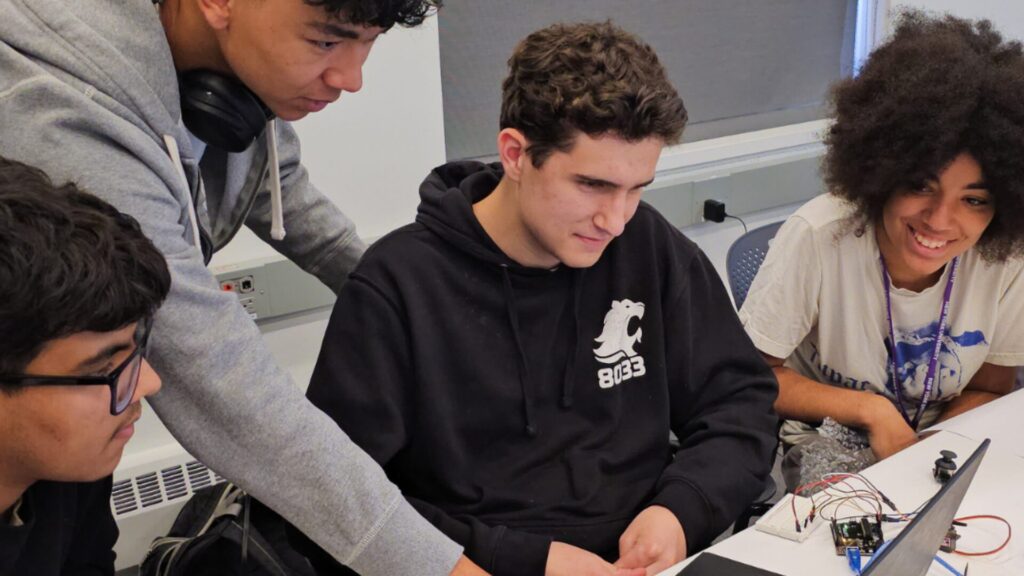
NYU Tandon’s SPARC or Summer Program in Automation, Robotics, and Coding introduces the basics of robotics, mechatronics, and programming over two weeks. Students assemble and program interactive robotic devices using microcontrollers, sensors, and actuators from provided kits. Coding covers variables, conditionals, loops, and binary to control robot functions.
Circuitry and electronic components build foundational electrical and mechanical engineering knowledge. Tournament-style challenges test robots in real-world scenarios. Hands-on manipulation emphasises applications for automation systems. Core concepts in robotics engineering emerge through iterative building and competitions.
Why it stands out: You’ll be placed at a cutting-edge engineering lab and do a final research presentation, giving you an experience of how academic research works.
Turn Engineering Experience Into Career Clarity
Maybe you already know you like building, coding, designing, or solving technical problems, but still need to see where those interests fit.
That’s where the 15 engineering summer jobs for high school students in this article can help, from MIT RSI and AEOP to Nuffield, Imperial, MITES, and NYU Tandon.
Each option gives you a different lens on engineering, whether through research labs, aviation work experience, robotics, data science, or mentor-led projects.
Still deciding which engineering path feels right? Visit our Career Exploration blogs to compare careers, skills, industries, and study routes before choosing your next step.