
 Русский (RU)
 Українська (UK)
 Türkçe (TR)
 Italiano (IT)
 Français (FR)
 Português (PT)
 中文 (中国) (ZH)
 Español (ES)
 日本語 (JA)
 ไทย (TH)
 Deutsch (DE)
 Ελληνικά (EL)
 Polski (PL)
 Bahasa Indonesia (ID)
 Nederlands (NL)
 العربية (AR)
 한국어 (KO)

Most students think of summer when searching for academic opportunities, but winter break can be equally valuable. Winter college programs for high school students let you explore a subject in a university setting, experience advanced coursework, and gain an early understanding of college-level learning.
You might spend your break discussing legal case studies, conducting laboratory experiments, building engineering projects, analysing business problems, or attending university seminars with students from different schools. Even a short programme can give you a clearer picture of what studying a particular subject at university involves.
How do you choose the right winter college program?
The first thing to consider is your reason for joining. Some programs are designed to help students explore a future major, while others focus on developing a particular academic skill or introducing students to university life. Choosing a program that matches your goals will make the experience much more meaningful.
It’s also worth paying attention to the curriculum rather than the program name alone. The strongest college programs include practical projects, discussions, workshops, or mentorship instead of relying entirely on lectures. They leave students with a better understanding of both the subject and the university environment.
To help you explore your options, we’ve compiled a list of 15 winter college programs for high school students!
For adjacent opportunities, consider summer programs for high school students.
Key takeaways
- UMBC’s Winter Session lets academically strong students take undergraduate courses during a three-week January term, with credits that may count toward a future UMBC degree.
- Immerse Education’s Online Research Programme runs multiple cohorts throughout the year, offering 1:1 or small-group mentorship from tutors at Oxford, Cambridge, or other leading universities, open to students aged 13 to 18 worldwide.
- MIT PRIMES is entirely free but restricted to high school students living in the Greater Boston area, running as a year-long research program in mathematics, computer science, or computational biology.
- Columbia University’s Academic Year Weekend Program costs $2,868 per session plus an $80 application fee, with live classes held only on Fridays, Saturdays, or Sundays to fit around a regular school schedule.
- Cornell University’s Winter Session lets high school students earn an official Cornell transcript by completing the same coursework and assessments as undergraduates during a January term running January 2 to 17.
- UC San Diego Research Scholars requires a minimum 3.0 GPA and offers winter sessions from January through March across disciplines including biomedical science, engineering, and marine science.
- Georgetown University’s Pre-College Online Program costs $1,895 for enrichment courses or $3,995 for college-credit courses, available year-round to students aged 13 and older.
- Program costs for winter college programs range from free options like MIT PRIMES to over $2,868 per session for Columbia University’s Academic Year Weekend Program.
15 Winter College Programs for High School Students
1. UMBC Winter Session
Location: University of Maryland, Baltimore County (UMBC), Baltimore, MD
Cost: Tuition-based (application fee: $50)
Acceptance Rate/Cohort Size: Not publicly available
Dates: January 4-22
Application Deadline: December 16th (for visiting students)
Eligibility: Academically strong rising high school juniors and seniors who meet UMBC’s concurrent enrollment requirements, submit a non-degree application, high school transcript, application fee, and a counselor recommendation with permission to enroll; international student eligibility not specified
Among winter college programs for high school students, UMBC’s Winter Session allows you to take undergraduate courses during the university’s three-week January term through its concurrent enrolment programme. If you meet the eligibility requirements, you’ll join regular college classes alongside undergraduates and complete an entire semester’s coursework in an accelerated format.
Credits earned may count toward a future degree at UMBC or transfer to another institution, depending on its policies. Since admission is limited to academically strong students and requires counselor approval, the program offers an early look at the pace, workload, and expectations of college academics before graduation.
Why it stands out: You complete the same accelerated winter courses as UMBC undergraduates, giving you an authentic college classroom experience during your high school winter break.
2. Immerse Education’s Online Summer School

Location: Fully remote
Cost: Varies; scholarship available through our bursary programme
Acceptance rate/cohort size: Selective; 1:1 learning
Application Deadline: Rolling admissions; multiple dates throughout the year
Program Dates: Flexible; multiple cohorts in a year.
Eligibility: Students around the world aged 13-18 (accredited options require age 14+)
The Online Research Program offers high school students the opportunity to conduct rigorous research with tutors from Oxford, Cambridge, and Ivy League universities. You will work with your tutor to explore a subject of your choice in depth and write an academic research paper. The program is offered in 1:1 and small group formats, and you can choose to receive college credit from universities in the US and the UK.
The virtual research program is offered in over 20 subjects, including artificial intelligence, chemistry, psychology, economics, computer science, creative writing, philosophy, and more. At the end of the program, you’ll receive a written evaluation from your tutor, an opportunity to publish your research, and an invitation to present at the Immerse Online Symposium. You can find examples of papers Immerse students have worked on here. You can find more details about the application here.
Why it stands out: You’ll get access to 1:1 Oxbridge- or Ivy-style research supervision culminating in a publishable academic paper.
3. MIT PRIMES
Location: Massachusetts Institute of Technology, Cambridge, MA
Cost: Free
Acceptance Rate/Cohort Size: Highly selective
Dates: January – December/January
Application Deadline: Typically late November
Eligibility: High school students living in the Greater Boston area; international student eligibility not specified
MIT PRIMES is a year-long research program that introduces you to original research in mathematics, theoretical computer science, or computational biology. The program begins with advanced reading assignments before you transition to solving open research problems under the supervision of MIT graduate students and researchers.
Throughout the year, you’ll attend meetings, submit research reports, and gradually develop the skills needed for independent investigation. You’ll explore questions that may not yet have established solutions. Many projects conclude with a formal research paper that is presented at the PRIMES conference and may later be submitted to journals or research competitions.
Why it stands out: Few high school programs allow you to investigate unsolved mathematical problems and present your work in the same research conference as other MIT PRIMES scholars.
4. Columbia University Academic Year Weekend
Location: Online
Cost: $2,868 per session (plus $80 app fee)
Acceptance Rate/Cohort Size: Not publicly available
Dates: January 23rd – March 29th
Application Deadline: Varies by session
Eligibility: High school students (see program website for complete eligibility requirements); not open to international students
Columbia University’s Academic Year Weekend Programme stands out among the many winter college programs for high school students by offering online college-level courses that fit around your regular school schedule. You can enrol in up to four courses, with live classes held on Fridays, Saturdays, or Sundays.
Courses follow Columbia’s seminar-style teaching approach, encouraging discussion, participation, and critical analysis throughout the term. Alongside academics, you’ll join virtual student activities, attend college readiness workshops, and receive guidance from instructors as you experience the expectations of an Ivy League classroom.
Why it stands out: The weekend-only schedule makes it possible to take live Columbia courses throughout the winter without stepping away from your regular high school classes.
5. Penn State College of Medicine Research Internships and Observation
Location: Penn State College of Medicine, Hershey, PA
Cost: Free; some internships may offer a stipend
Acceptance Rate/Cohort Size: Not publicly available
Dates: Flexible (determined by the research mentor)
Application Deadline: Rolling; no fixed deadline specified
Eligibility: U.S. high school students who secure sponsorship from a Penn State College of Medicine faculty member and complete the required approval process; not open to international students
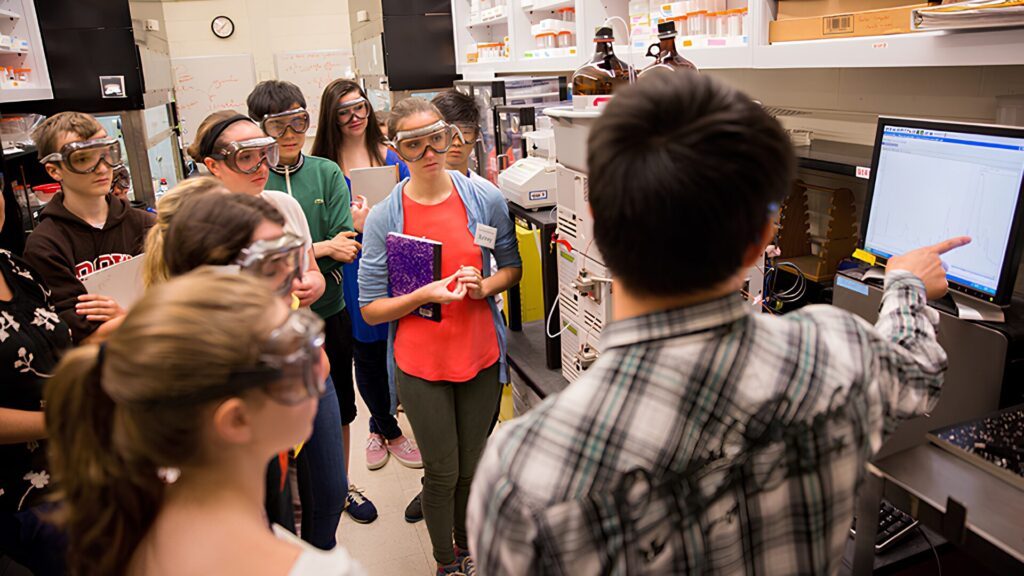
Penn State College of Medicine’s Research Internships and Observation Program gives you the flexibility to explore biomedical research in a way that matches your interests and schedule. After identifying a faculty member through the Penn State Research Database, you’ll contact them directly to arrange either a short research observation or a longer laboratory internship.
Depending on your mentor’s research, you may observe experimental techniques, assist with data collection, learn how studies are designed, and see how researchers analyze and interpret scientific results. Since each placement is built around an individual faculty member’s work, the experience can vary widely across fields such as neuroscience, cancer biology, genetics, immunology, and other areas of biomedical science.
Why it stands out: Instead of assigning you to a predefined project, the program lets you build your own experience by choosing a faculty mentor whose research matches your interests.
6. Johns Hopkins Center for Talented Youth (CTY) Winter Courses
Location: Online and In-Person
Cost: Varies by course
Acceptance Rate/Cohort Size: Eligibility-based admission
Dates: Multiple start dates throughout the year
Application Deadline: Varies by course
Eligibility: Academically advanced students meeting CTY qualification requirements; open to international students
Johns Hopkins CTY Courses allow academically advanced learners to study subjects that are rarely available in a traditional high school classroom. Depending on your interests, you can choose from topics such as anatomy, astrophysics, cryptography, competitive mathematics, forensic science, creative writing, and many others through instructor-led or self-paced formats.
Lessons emphasize discussion, problem-solving, and deeper exploration, encouraging you to think beyond memorizing facts. Online courses also connect you with other high-achieving students from around the world, creating a collaborative environment where you can exchange ideas while working through challenging material.
Why it stands out: With dozens of specialized winter courses available, CTY lets you explore niche academic subjects that many high schools simply don’t offer.
7. Cornell University Winter Session
Location: Online
Cost: Tuition varies by course
Acceptance Rate/Cohort Size: Open enrollment for qualified students; course sizes vary
Dates: January 2-17
Application Deadline: Registration opens in October; deadline December 1st
Eligibility: High school students and visiting pre-college students; international student eligibility not specified
Cornell University’s Winter Session is one of the winter college programs for high school students that lets you enrol in undergraduate courses and earn official Cornell credit during an accelerated January term. You’ll study alongside college students while completing the same readings, discussions, projects, and assessments.
Subjects span areas such as business, architecture, health sciences, veterinary medicine, international relations, engineering, and the humanities, allowing you to choose a course that fits your interests. Since credits appear on an official Cornell transcript, the program offers both academic challenge and the opportunity to begin earning college credit before graduating from high school.
Why it stands out: You earn an official Cornell transcript by completing the same undergraduate courses and assessments taken by university students during the winter term.
8. UC San Diego Research Scholars
Location: Virtual and In-Person Options
Cost: Varies by program; scholarships available for select tracks
Acceptance Rate/Cohort Size: Selective
Dates: Winter sessions typically run January – March; dates vary by track
Application Deadline: Varies by program
Eligibility: High school students aged 15+ in grades 9-12 with a minimum 3.0 GPA; international student eligibility not specified
UC San Diego Research Scholars introduces you to university-level research through faculty-led projects offered in online, hybrid, and in-person formats. Depending on your chosen track, you may investigate biomedical science, engineering, marine science, business, or other disciplines while learning how research questions are developed and tested.
Activities can include laboratory work, data analysis, literature reviews, field observations, and the use of technical tools such as Python or MATLAB. Throughout the program, you’ll strengthen your research skills while working toward a final research poster, presentation, or written report that reflects the work completed during your project.
Why it stands out: The program offers research tracks across several disciplines, allowing you to choose a project that closely matches your academic interests instead of following a single curriculum.
9. University of Rochester Pre-College Online Medicine Courses
Location: Online
Cost: $1,595 per course
Acceptance Rate/Cohort Size: Not publicly available
Dates: Multiple 2- and 4-week sessions in the winter
Application Deadline: Rolling admissions
Eligibility: Students aged 13 and above; international student eligibility not specified
The University of Rochester’s Pre-College Online Medicine Courses let you explore specialized areas of medicine through flexible online classes that can be completed during the winter. You can choose from topics such as personalized medicine, orthopedic surgery, biomedical engineering, genetics, and other healthcare fields, with each course requiring roughly 20–30 hours of study.
Lessons are delivered through faculty-created videos that you complete at your own pace, while a dedicated mentor provides guidance and feedback throughout the program. Each course concludes with a capstone project in which you’ll present what you’ve learned in a format of your choice before receiving a University of Rochester Certificate of Completion.
Why it stands out: Instead of following a general medicine curriculum, you can select a focused course in a specific medical specialty and finish it with a mentor-guided capstone project.
10. Rice University Pre-College Program

Location: Virtual
Cost: Varies by course length
Acceptance Rate/Cohort Size: Not selective
Dates: Multiple 2-, 4-, 8-, and 12-week courses offered between January and May
Application Deadline: Rolling admissions
Eligibility: Students aged 13+; open to international students
Rice University’s Pre-College Program lets you study university-level subjects through flexible online courses that run alongside the school year. You can choose from STEM, business, social sciences, law, and healthcare topics, including aerospace engineering, genome engineering, medicine, physiology, psychology, entrepreneurship, economics, and international relations.
Rather than offering broad introductions, each course focuses on a specific field through case studies, project-based assignments, and real-world applications. Since courses are available in 2-, 4-, 8-, and 12-week formats, you can select an option that fits your schedule while learning from university-designed content and, in some courses, industry professionals.
Why it stands out: With multiple course lengths and dozens of specialized subjects available, you can tailor your learning experience around both your interests and your academic schedule.
11. Susquehanna University Summer & Winter Online Courses
Location: Online
Cost: Tuition-based (varies by course)
Acceptance Rate/Cohort Size: Open enrollment for eligible students
Dates: Summer (4- and 7-week sessions) and Winter online sessions
Application Deadline: Rolling registration until courses fill
Eligibility: High school students, current Susquehanna students, and visiting college students (credit transfer subject to home institution approval); international student eligibility not specified
Susquehanna University’s Summer & Winter Online Courses allow you to earn college credit through accelerated online classes offered during both academic breaks. Courses are available in 4- and 7-week formats across subjects such as biology, business, computer science, mathematics, physics, political science, Spanish, and more.
Classes are taught by university faculty and combine flexible online learning with structured assignments, making it possible to stay on track while balancing your regular schoolwork. The program also includes online laboratory science courses, giving you the opportunity to complete lab requirements remotely while earning credits that may transfer to other colleges and universities.
Why it stands out: It is one of the few programs that offers accelerated online lab science courses during both the summer and winter terms, making it easier to earn transferable STEM credits from home.
12. Pratt Institute Winter PreCollege
Location: Pratt Institute, Brooklyn, NY (Online and In-Person)
Cost: Credit courses: $1,294 | Noncredit courses: $675
Acceptance Rate/Cohort Size: Open enrollment; space varies by course
Dates: Varies by courses, check here!
Application Deadline: Varies by course and semester
Eligibility: High school students in grades 9-12 (ages 14-18); international student eligibility not specified
Pratt Institute’s Winter PreCollege is one of the more creative winter college programs for high school students, offering online and in-person college-level courses in art, design, and architecture. Depending on your class, you may explore drawing, digital media, design thinking, portfolio development, or other creative disciplines taught by Pratt faculty and alumni.
Coursework includes studio projects completed both during and outside class, reflecting the workload and expectations of Pratt’s undergraduate programs. If you enroll in a credit-bearing course, you’ll earn college credit that is recognized by Pratt and accepted by many other institutions.
Why it stands out: Unlike most pre-college art programs that only run in summer, Pratt lets you build portfolio pieces and even earn college credit during the regular school year.
13. Tufts University Professional & Continuing Education
Location: Tufts University, Medford, MA; Virtual options available
Cost: Varies by course
Acceptance Rate/Cohort Size: Not specified
Dates: Varies by course
Application Deadline: Varies by course
Eligibility: Students entering grades 10-12; international student eligibility not specified
Tufts University’s Professional & Continuing Education Program allows qualified high school students to enroll in selected university courses alongside adult learners. Depending on the term, you can study subjects such as public health, nutrition, project management, social sciences, and other interdisciplinary fields through online or in-person classes.
You’ll complete the same assignments, discussions, and assessments as other students, giving you firsthand experience with the pace and expectations of college academics. Credits earned may also transfer to another institution, depending on its policies.
Why it stands out: You aren’t placed in a separate high school cohort, but you join actual Tufts continuing education classes and are evaluated by the same standards as other university students.
14. Georgetown University Pre-College Online Program
Location: Online
Cost: Enrichment Courses: $1,895 | College Credit Courses: $3,995
Acceptance Rate/Cohort Size: Open enrollment for eligible students
Dates: Courses offered year-round
Application Deadline: Rolling enrollment
Eligibility: High school students aged 13 and older; open to international students
Georgetown University’s Pre-College Online Program is one of the most flexible winter college programs for high school students, offering year-round access to university-level subjects from anywhere. You can choose between shorter enrichment courses and more rigorous college-credit options in medicine, biology, psychology, cybersecurity, business, law, international relations, and creative writing.
Lessons combine recorded lectures, assignments, discussions, and instructor feedback, allowing you to progress through the course within a structured schedule. If you choose a college-credit course, your work is recorded on an official Georgetown transcript after successful completion.
Why it stands out: The program gives you the flexibility to either sample a new subject through an enrichment course or earn official Georgetown College credit without changing platforms or providers.
15. Ecampus at Oregon State University
Location: Virtual
Cost: $384 per credit, along with a $30 nonrefundable application fee and extra costs for books and supplies
Application Deadline: Vary by session
Dates: Winter session runs from January to March
Eligibility: High school students with a minimum 3.0 GPA; international student eligibility not specified
Oregon State University’s Ecampus gives you the option to take online college courses and earn credit while still in high school. You’ll apply as a nondegree-seeking student, which lets you take up to eight credits per term during the school year. You will be in classes alongside both high school and college students, choosing from over 100 courses in fields like computer science, psychology, anthropology, business, biology, and environmental sciences.
These credits may later count toward a degree if you continue at Oregon State or transfer to another university. It’s also a chance to study subjects your high school might not offer. Most classes are asynchronous, so you can work on them when it fits your schedule.
Frequently asked questions: Winter college programs for high school students
Are winter college programs open to international students?
Eligibility is mixed. MIT PRIMES and Rice University’s Pre-College Program have geographic or eligibility restrictions tied to specific requirements, while programs like Immerse Education’s Online Research Programme and Johns Hopkins CTY Winter Courses are explicitly open internationally. UMBC’s Winter Session and Cornell’s Winter Session don’t specify international restrictions but require meeting specific concurrent enrollment criteria, so it’s worth confirming directly with each program.
Do winter college programs award college credit?
Many do, since several are structured as actual undergraduate courses rather than standalone high school programs. UMBC’s Winter Session, Cornell University’s Winter Session, and Susquehanna University’s Winter Online Courses all offer credits that may transfer to other institutions. Others, like Immerse Education’s Online Research Programme, offer credit only through specific accredited pathways. Confirm transfer policies directly with your target college, since credit acceptance varies by institution.
How much do winter college programs cost?
Costs range from free to several thousand dollars. MIT PRIMES and Penn State’s Research Internships and Observation Program are free, while Columbia’s Academic Year Weekend Program costs $2,868 per session and Georgetown’s college-credit courses cost $3,995. Many programs, including UMBC’s Winter Session and Cornell’s Winter Session, charge standard university tuition rates since you’re enrolling in actual undergraduate courses.
What is the difference between an online and in-person winter college program?
Online programs, like Rice University’s Pre-College Program or Georgetown’s Pre-College Online Program, let you study from home on a flexible schedule, often asynchronously. In-person programs, like UMBC’s Winter Session or Cornell’s Winter Session, require you to attend classes on campus alongside undergraduates, giving you a more immersive college experience but requiring travel and housing logistics. If flexibility matters more than campus immersion, an online option is the better fit.
How selective are winter college programs?
Selectivity varies by program structure. MIT PRIMES is highly selective, and UMBC’s Winter Session requires counselor approval and strong academic standing. Other programs, like Johns Hopkins CTY Winter Courses and Susquehanna University’s Online Courses, use eligibility-based or open admission rather than a competitive review process. Regardless of selectivity, meeting GPA and prerequisite coursework requirements matters significantly for university-affiliated programs like UC San Diego Research Scholars.
Is Immerse Education a good option for winter break research?
Immerse Education’s Online Research Programme is a strong choice if you want individualized mentorship without needing to travel during winter break. Working with a tutor from Oxford, Cambridge, or another leading university, you’ll refine a research question, evaluate sources, and develop an argument across more than 20 available disciplines. The program concludes with a completed paper, a written evaluation, and the option to present at the Immerse Online Symposium, with accredited pathways available for university credit.
Take the Next Step Toward University Life
Winter break can become a testing ground for college through accelerated January courses, official transcripts, research projects, weekend seminars, and portfolio-building studio work before graduation.
These 15 winter college programs for high school students include UMBC and Cornell credit courses, MIT PRIMES research, Columbia weekend classes, and Pratt design courses during winter.
These options help you compare campus and online formats, test demanding workloads, explore specialised subjects, and collect evidence for applications and interviews with greater confidence.
Which next step will best prepare you for university? Browse our University Preparation blogs for guidance on course choices, applications, study skills, and campus life.