
 Русский (RU)
 Українська (UK)
 Türkçe (TR)
 Italiano (IT)
 Français (FR)
 Português (PT)
 中文 (中国) (ZH)
 Español (ES)
 日本語 (JA)
 ไทย (TH)
 Deutsch (DE)
 Ελληνικά (EL)
 Polski (PL)
 Bahasa Indonesia (ID)
 Nederlands (NL)
 العربية (AR)
 한국어 (KO)

Lab coats rustle, pipettes click into place, and whiteboards fill with half-finished equations as the South Kensington skyline glows gold outside. This is what a typical afternoon looks like on the Imperial summer school in London.
If you’re researching an Imperial summer school because you’re aiming for a STEM degree, you’re probably wondering whether it’s worth the investment. The short answer is yes for students looking for an authentic university-style laboratory experience, though it’s far from the only high-quality option available in London.
Imperial College London’s Global Summer School is a two-week residential programme for 16 and 17 year olds, pairing lab-based teaching in Chemistry, Physics, Engineering, Medicine, or Data Science with a cross-disciplinary Innovation Challenge on the South Kensington campus.
Unlike many general summer schools, every subject is built around practical projects and collaborative problem-solving rather than classroom lectures alone, giving you a realistic preview of STEM study at university.
In this guide, we’ll cover course tracks, entry requirements, fees, dates, and how Imperial compares with UCL, LSE, and Immerse Education programmes.
Let’s start with what happens on campus.
Key Takeaways
- Imperial’s Global Summer School is a two-week residential STEM programme for 16 and 17 year olds, running in 2026 across two sessions: 29 June to 10 July, or 3 August to 14 August.
- The 2026 fee is £7,695, a non-negotiable price that includes tuition, accommodation at Prince’s Gardens, three meals a day, social activities, and a certificate of participation awarded by Imperial.
- Five subject tracks are on offer, though not all run in both sessions: Engineering and Medicine and Life Sciences run in July and August, Chemistry and Physics run in July only, and Data Science and AI runs in August only.
- Admissions require a majority of grades 9–7 (A*–A) at GCSE or the international equivalent, a personal statement, and a teacher reference, assessed on a first-come, first-served basis once applications open in early January.
- Unlike Imperial’s own summer offering, UCL and LSE’s official summer schools are built for current university students rather than high schoolers, so they aren’t like-for-like alternatives for a 16 or 17 year old.
- Immerse Education’s own London Summer School, based on the UCL campus for ages 15–18, offers broader subject variety across STEM, law, business, and the arts for students not ready to commit to a single university’s specialism.
What Is the Imperial College London Summer School?
Imperial College London is ranked second in the world in the QS World University Rankings 2026, and it’s based in South Kensington, London, specialising exclusively in science, engineering, medicine, and business.
Each year, it runs six separate summer schools for high school students. Most of these, including the Year 9 Girls Engineering Summer School, the Year 10 Insights Summer School, and the Year 12 Sutton Trust Summer School, are UK-student outreach programmes with free or low-cost places.
Alongside these, Imperial also offers its flagship pre-university programme for international students: the Global Summer School. This two-week residential programme is built for 16 and 17 year olds and runs for £7,695 across two 2026 sessions, 29th June to 10th July or 3rd August to 14th August, in Prince’s Gardens, South Kensington.
That South Kensington postcode is no small detail, placing you in one of the world’s great academic neighbourhoods. If you want to see what makes it so distinctive, explore our ultimate guide to studying in London as an international student.
Law
In-person
Explore Law in London and build necessary skills...

Banking and Finance
In-person
Dive into global finance in London, one of...

Course Tracks: Hands-On Academic Innovation
The fortnight splits into two distinct phases: week one immerses you entirely in your chosen subject through lectures, labs, and workshops led by Imperial faculty, while week two shifts you into cross-disciplinary teams for the Innovation Challenge, tackling a real-world problem alongside students from other tracks.
Here’s what each track actually looks like.
Engineering and Physical Sciences
Forget picking a single engineering discipline before you’ve even tried it. This track throws you into the deep end of six different fields, from designing bridges to firing hydrogen cannons, so you discover what genuinely excites you before you ever have to commit to a degree.
Here’s what that rotation covers:
- Aeronautical Engineering puts you inside supersonic and hypersonic wind tunnels and a flight simulator, guided by researchers working in high-speed aerodynamics.
- Chemical Engineering opens with a hydrogen cannon firing a ping-pong ball into the air, before you head into the Carbon Capture Pilot Plant, the most advanced of its kind at any university.
- Civil Engineering has you designing a railway bridge for HS2 in the July session, or drafting a government bid for a new sea crossing between Portpatrick and Larne in August.
- Mechanical Engineering challenges you to build something in teams, then watch it get tested to failure while competing for the “heaviest lifter” award.
- Design Engineering takes a hands-on approach from hour one, moving straight into rapid prototyping and a real-world design challenge.
- Materials Science is an additional session exclusive to the July cohort, run through live demonstrations from the Department of Materials.
You’ll be split into one of two scheduling streams on arrival, but both cover identical content, so nobody misses out on any discipline.
Medicine and Life Sciences
Instead of one narrow specialism, this track puts you through three strands of modern medicine, from real clinical procedures to genetics experiments most students won’t touch until university. Here’s what each strand covers:
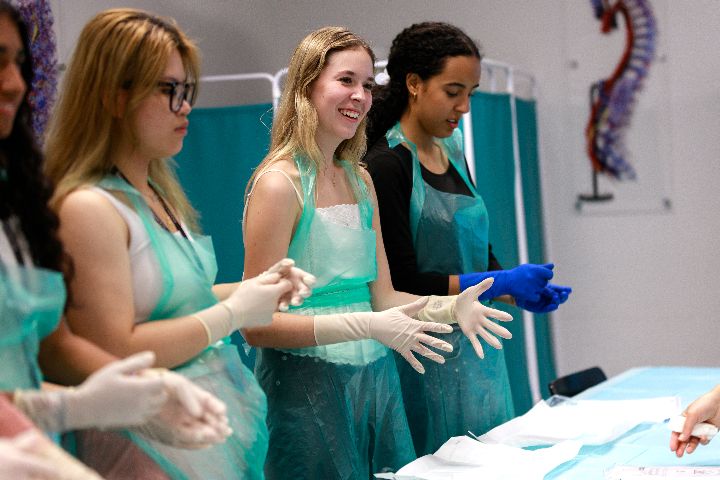
- Clinical skills: Inside a simulation lab at St Mary’s Hospital, you’ll learn to take a blood pressure reading, draw blood, and stitch a wound under expert supervision.
- Medicine sessions: Depending on when you attend, you’ll dive into a different side of medicine: July students study the kidneys, testing real urine samples for signs of illness, while August students explore how the heart and lungs keep us alive. Every student also learns how doctors use a patient’s genes to choose the right cancer treatment for them.
- Life Sciences: Pipettes in hand, you’ll spend two full days at the bench, tracking down which genes make a fruit fly’s eyes glow green, using the same core techniques real geneticists rely on, from extracting DNA to reading the results on a gel.
By the end of week one, you’ll have handled real lab equipment and real patient-style scenarios, not just watched a demonstration.
Physics, Chemistry, and Advanced Tech
The remaining three tracks land on different sessions, so which one you can join depends on when you attend. Here’s what each involves:
- Physics: You’ll leave this track knowing how to code in Python from scratch, and how to use it to analyse your own experimental data. The subject tackles the science of oscillations through three lenses: calculus, hands-on experiments, and computer simulation, before you present your findings to the group.
- Chemistry: Somewhere between the lab and the kitchen, this track turns cooking into a science lesson. You’ll synthesise your own molecule, build a working spectrometer out of Lego to measure light, and finish with a session split between medicinal chemistry and Imperial’s own Chemical Kitchen.
- Data Science and Artificial Intelligence: Where Chemistry has you in a lab and a kitchen, this track keeps you behind a screen, taking you from Python basics through computer vision and image classification to natural language processing in just four days, led by Imperial’s Data Science Institute.
Join the Immerse Education 2025 Essay Competition
Follow the instructions to write and submit your best essay for a chance to be awarded a 100% scholarship.
Admissions: Selection Criteria and How to Apply
If you’re wondering how to get into the Imperial summer school, admissions come down to strong grades and genuine motivation, assessed on a first-come, first-served basis once applications open in early January.
Before you get to proving that motivation, though, it’s worth confirming you meet the basic eligibility requirements first.
Eligibility and Language Requirements
Before your grades even come into play, Imperial checks a set of core boxes covering age, academic performance, English ability, and genuine motivation. Here’s what each requires:
- Age: 16 or older before your programme starts, and not turning 18 before or during it.
- Academic ability: A majority of grades 9-7 (A*-A) at GCSE or the international equivalent, with at least a 7 (A) in maths and relevant science subjects. No formal exams yet? Predicted grades or your latest end-of-term results work instead.
- English language: Native speakers and students taught mostly in English are exempt, confirmed by their teacher’s reference. Everyone else needs proof of an English qualification, such as IELTS.
- Motivation: A genuine enthusiasm for STEM and a clear reason for applying, shown through your personal statement.
Logistics: Fees, Accommodation, and Dates
Now that you’ve prepared your statement and secured your place, the next question is what it actually costs, and what you get for it.
A primary concern for families planning is how much the Imperial summer school costs. For the 2026 residential programme, the fee is £7,695 per two-week session, and Imperial states this fee is non-negotiable, with no option to reduce costs by living off campus instead.
Here’s what that fee actually covers, and what it doesn’t:
- Included: All tuition, course materials, accommodation, three meals a day, campus facilities, social activities, a certificate of participation, and a meet-and-greet transfer at Heathrow on your first and last day.
- Not included: Travel to and from London, spending money, laundry, stationery, and medical or dental insurance.
You’ll stay in Prince’s Gardens, Imperial’s own accommodation in South Kensington, a two-minute walk from your lessons. Staying on campus for the full two weeks is compulsory.
Evenings still bring a packed social calendar, from a West End musical to a Thames boat cruise, run alongside current undergraduates as pastoral mentors.
If you want to see what else a summer in the capital has to offer beyond campus, our guide on living and studying in London covers it in full.
Comparing London’s Elite Summer Schools
London has no shortage of elite summer schools, so if you’re wondering which is more prestigious, UCL or Imperial, Imperial holds the edge as a global top-two university specialising entirely in STEM, while UCL takes a broader, multi-disciplinary approach spanning the arts, humanities, and social sciences alongside its sciences.
With that in mind, in the next sections, we’ll compare Imperial against other elite London summer schools.
UCL vs. Imperial Summer Pathways
Imperial’s Global Summer School is a pre-university programme built specifically for 16 and 17 year olds. UCL’s own Summer School, by contrast, is designed for current undergraduates and postgraduates from around the world, so it isn’t a like-for-like alternative for a high school student.
Here’s how the two compare on paper:
| Imperial Global Summer School | UCL Summer School | |
| Subject variety | STEM only: Engineering, Medicine, Physics, Chemistry, Data Science and AI | Wide range across humanities, social sciences, business, and sciences |
| Age and location flexibility | Strictly 16–17, one campus in South Kensington | Typically 18 and above, with courses on UCL’s Bloomsbury campus |
| Admissions | Grades 9–7 (A*–A) at GCSE, personal statement, teacher reference | Minimum one year of undergraduate study, roughly a 2:1 average or equivalent |
| Duration and structure | Two weeks, residential, fixed cohort | Three or six weeks, non-residential by default, choice of modules |
| 2026 fee | £7,695, accommodation included | £2,995 per session, or £4,995 for both, accommodation extra |
If you’re a high school student after a residential, pre-university experience in London, Imperial is the closer match. For later on, our guide on whether a UCL summer school is worth it covers that in full.
LSE vs. Imperial Summer Pathways
Like UCL, LSE’s own Summer School is built for current university students and young professionals, not high schoolers. The average participant is 21 years old, and it’s the largest programme of its kind in Europe, pairing degree-level social sciences courses in economics, finance, law, and international relations with a professional skills programme called Spark.
A side-by-side makes the differences easy to spot:
| Imperial Global Summer School | LSE Summer School | |
| Subject variety | STEM only: Engineering, Medicine, Physics, Chemistry, Data Science and AI | Social sciences only: economics, finance, law, international relations, and more |
| Age and location flexibility | Strictly 16–17, one campus in South Kensington | Average age 21, courses on LSE’s central London campus |
| Admissions | Grades 9–7 (A*–A) at GCSE, personal statement, teacher reference | Enrolled at a university or college anywhere in the world, minimum GPA requirements apply |
| Duration and structure | Two weeks, residential, fixed cohort | Three-week sessions, up to nine weeks across all three, non-residential by default |
| 2026 fee | £7,695, accommodation included | £3,350 per session at the student rate, accommodation extra |
If your ambitions lean toward business, economics, or politics rather than STEM, and you’re not yet at university, LSE’s own Summer School isn’t the right fit just yet. If you want to learn more about it for later, our LSE summer programme overview covers everything you need to know.
Imperial vs. Immerse Education
Where Imperial locks you into one campus and five STEM subjects, Immerse Education opens the door far wider. Our London Summer School runs on the UCL campus for ages 15–18, spanning subjects from Law and Engineering to Business Management and Psychology, with additional locations across Cambridge, Oxford, and beyond.
Here’s how the two stack up:
| Imperial Global Summer School | Immerse Education | |
| Subject variety | STEM only: five fixed subject tracks | Wide range across STEM, law, business, humanities, and the arts |
| Age and location flexibility | Strictly 16–17, one campus in South Kensington | Ages 13–18, with locations across London, Cambridge, Oxford, and more |
| Admissions | Highly competitive: grades 9–7 (A*–A), first-come first-served | Places available across a broader range of academic profiles, recommended at a B2 (upper-intermediate) level of English |
| Duration and structure | Two weeks, fixed cohort, one subject specialism | Two weeks, with a choice between Academic Insights and Career Insights pathways |
| Fees | £7,695, accommodation included | £5,995 non-residential, £7,495 residential |
For many students, the deciding factor isn’t prestige but flexibility. If you’re already certain that engineering, medicine, physics, or AI is your future, Imperial offers remarkable depth.
If you’re still exploring different academic paths, a broader programme can provide valuable exposure before committing to a university specialism.
FAQs
Can I Choose Which Session I Attend, July Or August?
Not entirely, since your subject often decides it for you. Physics and Chemistry run in the July session only, with Physics currently operating an August waitlist.
Data Science and AI runs in August only. Engineering and Medicine and Life Sciences are available in both sessions, so if you want a genuine choice of dates, one of those two subjects is your best bet.
What Happens If I Don’t Get Accepted?
Imperial doesn’t disclose acceptance rates or provide individual feedback on unsuccessful applications. That’s because places are allocated on a rolling, first-come, first-served basis, rather than through a fixed cutoff.
There’s no waiting list either. If you’re unsuccessful, your best option is to apply again the following year, ideally as early as possible once applications open in January.
Do I Need A Visa To Attend The Imperial Summer School?
It depends on your nationality. Some international students will need a Standard Visitor visa to enter the UK for the programme, while others won’t.
Imperial directs applicants to the UK government’s official visitor visa guidance to check individual requirements, and can provide supporting documentation once you’ve accepted your place, so it’s worth checking this early rather than close to your travel date.
How Do I Decide If Imperial Is Right For Me?
Imperial’s programme is best suited to students who already know they want to study STEM at university and are excited by intensive laboratory work. If you’re hoping to explore multiple subjects, compare different career paths, or experience a wider range of academic disciplines before specialising, a broader summer school may be a better fit.
Matching the programme to your goals will always matter more than choosing the highest-ranked institution alone.
Will I Be Assessed Or Graded During The Programme?
There are no formal grades or exams. Instead, you’re evaluated through practical work in week one. Then, week two ends with a group presentation during the Innovation Challenge. Mentors and course leaders judge it, awarding a prize to the winning team.
Will I Receive A Certificate At The End?
Yes. Every participant who completes the programme receives a certificate of participation awarded directly by Imperial College London, included as part of your programme fee, alongside a finale celebration to mark the end of the two weeks.
Conclusion: Is the Imperial Summer School Worth It?
The Imperial summer school delivers genuine access to a world top-two university, hands-on lab work, and a personal statement talking point most applicants can’t claim.
That access comes with trade-offs: one subject track, one campus, and a highly competitive, first-come-first-served admissions process that leaves little flexibility.
If STEM is your fixed path and you can move fast on applications, it’s a strong choice. Ultimately, the best Imperial summer school experience isn’t simply about spending two weeks at a world-renowned university. It’s about developing the confidence, curiosity, and practical skills that will continue to strengthen your university applications long after the programme ends.
Ready to build the skills and confidence to excel at university? Explore our London Summer School and start planning your next step today.