
 Русский (RU)
 Українська (UK)
 Türkçe (TR)
 Italiano (IT)
 Français (FR)
 Português (PT)
 中文 (中国) (ZH)
 Español (ES)
 日本語 (JA)
 ไทย (TH)
 Deutsch (DE)
 Ελληνικά (EL)
 Polski (PL)
 Bahasa Indonesia (ID)
 Nederlands (NL)
 العربية (AR)
 한국어 (KO)

Few degrees are backed by three departments ranked in the UK’s top five at once. Warwick’s Philosophy, Politics, and Economics departments each hold that ranking, according to The Times and Sunday Times Good University Guide, so before you apply for a PPE degree, it’s worth getting the entry requirements right from the start.
Warwick’s typical offer for PPE is A*AA at A-level, alongside a GCSE Mathematics grade 7 or A and GCSE English Language grade 6 or B, with a lower contextual offer available for eligible applicants.
In this guide, we’ll cover every accepted qualification route, the contextual offer, whether you need to sit the TMUA, how competitive the course really is, and whether PPE lives up to its reputation.
Let’s start with the numbers that matter most.
Key Takeaways
- Warwick’s typical PPE offer is A*AA at A-level, plus GCSE Mathematics at grade 7 or A and GCSE English Language at grade 6 or B. These GCSE conditions apply regardless of your A-level subjects.
- Alternative qualification routes exist beyond A-levels, including a 38-point IB offer and Scottish Highers, which require AA in two Advanced Highers plus AAA in three Highers. Other routes include the Welsh Baccalaureate, BTECs, and Access to HE Diplomas.
- Warwick’s typical contextual offer for PPE is AAB at A-level, or 34 points for the IB. That’s one grade or four points below the standard offer, though GCSE Maths at grade 7 or A still applies either way.
- PPE applicants don’t need to sit the TMUA, which only applies to Warwick’s standalone Economics-related courses (L100, LLD2, LN12), not PPE (L0V0).
- Warwick doesn’t interview PPE applicants, so your personal statement and school reference carry the full weight of your application alongside your grades.
- There’s no official published acceptance rate for Warwick PPE. Philosophy, Politics, and Economics at Warwick each rank in the UK’s top five, according to the Times and Sunday Times Good University Guide.
Warwick PPE A-Level Requirements
Warwick’s entry requirements for PPE start with a typical A-level offer of A*AA, excluding General Studies and Critical Thinking.
Warwick doesn’t set compulsory subjects for PPE, but names Economics, History, and Mathematics as ones that support your application. The strongest combinations pair an essay-based subject, such as History, with a quantitative one, such as Maths or Economics, to cover both strands of the degree.
Philosophy Politics and Economics
In-person
Examine society’s foundational systems in Cambridge, where these...

Philosophy Politics and Economics
In-person
Analyse society’s core systems in Oxford, where interdisciplinary...
Warwick PPE GCSE Requirements
When it comes to Warwick’s entry requirements, the most commonly missed condition for PPE isn’t an A-level grade at all, it’s GCSE Mathematics at grade 7 or A.
This applies regardless of which A-levels you’re studying. It sits alongside your A-level offer as a separate, named condition, not a general footnote.
You’ll also need GCSE English Language at grade 6 or B. If you hold grade 6 or B in English Literature instead, Warwick accepts English Language at grade 4 or C alongside it.
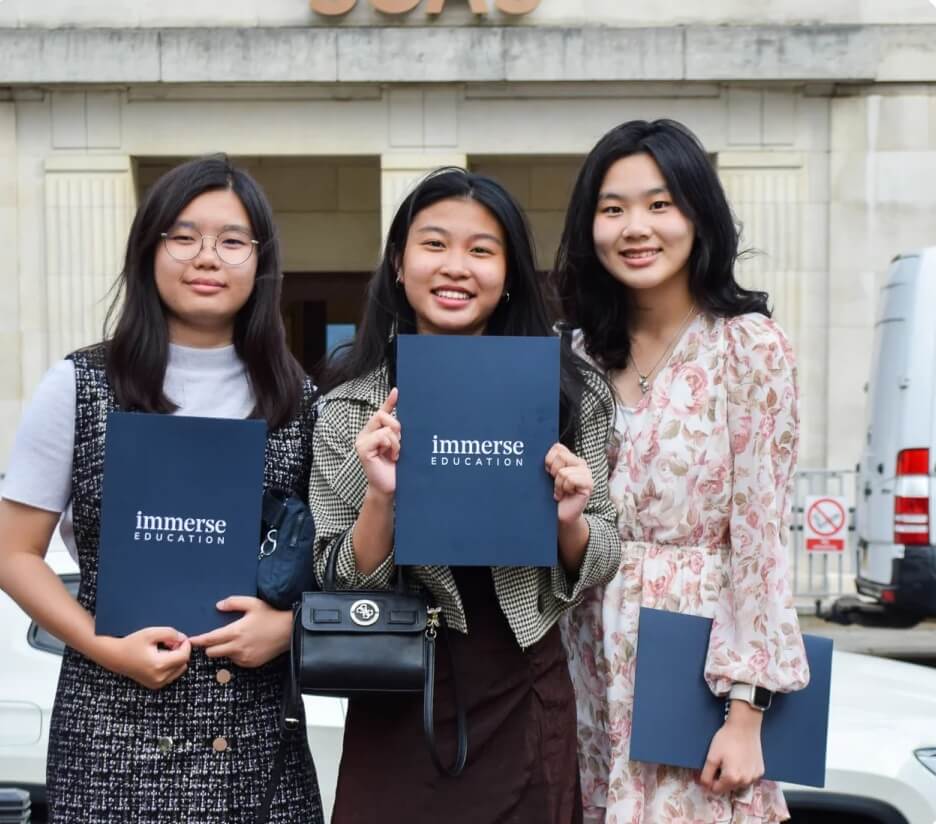
Join the Immerse Education 2025 Essay Competition
Follow the instructions to write and submit your best essay for a chance to be awarded a 100% scholarship.
Alternative Qualification Routes
If A-levels and GCSEs aren’t the path you’re taking, Warwick still offers several other recognised routes into PPE, each with its own specific grade and subject conditions.
Here are the alternative qualifications Warwick accepts.
1. International Baccalaureate (IB)
Warwick’s typical IB offer for PPE is 38 points overall, including 4 at Higher Level or 5 at Standard Level in Maths or Maths Studies.
Both accepted syllabuses count equally: Mathematics: Analysis and Approaches and Mathematics: Applications and Interpretations. This trips up IB students who assume only one syllabus qualifies.
You’ll also need GCSE English Language at grade 6 or B, or an equivalent IB English result. That means grade 5 in English A at either level, grade 5 in English B Higher Level, or grade 6 in English B Standard Level.
2. BTEC and Access to Higher Education Diplomas
Warwick welcomes BTEC applicants for PPE as long as the Mathematics requirements are still met, since BTEC alone doesn’t typically cover the GCSE or equivalent Maths condition on its own.
Access to Higher Education Diploma applicants are assessed case-by-case. They typically need 45 credits at Level 3, made up of Distinction in 33 credits and Merit in 12 credits. Warwick may also ask for subject-specific credits, or an A-level studied alongside the Access Diploma, to cover PPE’s essential subject requirements.
3. Scottish Highers and Welsh Baccalaureate
If you’re taking Scottish qualifications, Warwick’s typical offer is AA in two Advanced Highers plus AAA in three further Highers, alongside grade A in National 5 Mathematics.
If you’re taking the Welsh Baccalaureate, Warwick asks for AAA across three A-levels, plus grade C in the Advanced Skills Baccalaureate Wales. Grade A or 7 in GCSE Mathematics also applies.
4. International Qualifications
Beyond A-levels, the IB, and the UK-specific routes above, Warwick also accepts a range of internationally recognised qualifications. These are often combined with two or three A-levels, rather than used as a full standalone replacement.
Requirements vary significantly by country and qualification type. For example, the Greek Apolytirion is accepted only in combination with additional A-levels, not on its own.
Because of this variation, check Warwick’s country-specific entry requirements page directly rather than assuming a general international qualification automatically transfers to PPE.
Warwick PPE Contextual Offer
If your grades don’t stack up to the standard A*AA offer, don’t count yourself out of PPE yet, since Warwick’s entry requirements include a contextual offer for eligible applicants. It’s worth understanding exactly what changes and what doesn’t before you assume it applies to you.
Here’s how the contextual offer works for PPE:
- A-level contextual offer: the typical contextual offer is AAB. That’s one grade below the standard A*AA offer. GCSE Mathematics at grade 7 or A still applies.
- IB contextual offer: the typical contextual offer is 34 points, including 4 at Higher Level or 5 at Standard Level in Maths, four points below the standard 38-point offer.
Eligibility isn’t based on your grades. Warwick looks at factors such as your school’s exam performance, the proportion of pupils at your school entitled to Free School Meals, and the level of deprivation linked to your home postcode. It’s assessed through Warwick’s own criteria rather than a form you fill in yourself.
Check your eligibility directly through Warwick’s contextual offer eligibility checker before assuming a contextual offer applies to your application.
Do You Need the TMUA for Warwick PPE?
No, PPE applicants don’t need to sit the TMUA.
The Test of Mathematics for University Admission (TMUA) is required only for Warwick’s standalone Economics-related UCAS codes: BSc Economics (L100), BSc/BA Economics, Politics and International Studies (LLD2), and BSc Economics and Management (LN12). PPE, under UCAS code L0V0, isn’t on that list.
This resolves a question many PPE applicants naturally have, since Economics is one of the three subjects in the degree.
Is Warwick PPE Prestigious?
Quick answer: yes, Warwick PPE is widely considered a prestigious degree, backed by three departments that each rank in the UK’s top five.
Let’s break down what “prestigious” really means here.
Is PPE a Prestigious Degree Generally?
PPE originated at the University of Oxford in 1920, replacing the classical “Greats” degree with a course built for training future public servants and government leaders.
That history still shapes its reputation today. Harold Wilson and Edward Heath both became UK Prime Ministers after completing Oxford PPE. Bill Clinton also began PPE there as a Rhodes Scholar before switching courses.
That said, “prestigious” isn’t fixed to one university. Reputation depends on what you want from the degree, whether that’s a research-led curriculum, a specific city, or a particular teaching style. Several UK universities now offer PPE with genuine academic strength.
If you’re still deciding whether the subject itself is the right fit, our guide to what PPE stands for and why students choose it breaks down what the degree actually involves.
Which University Is Best for PPE in the UK?
There isn’t a single “best” PPE university, since each takes a genuinely different approach to teaching it.
Oxford offers the original PPE degree, taught through one-to-one and small-group tutorials rather than large lectures. Warwick teaches PPE within a large campus setting. Its departments rank 1st for Economics and 2nd for Philosophy in the Times and Sunday Times Good University Guide 2026.
LSE, based in central London, integrates all three subjects throughout the degree rather than allowing specialisation. UCL, by contrast, lets students narrow their focus after the first year, choosing between politics and philosophy, or politics and economics.
The right choice depends on your preferred teaching style, city, and how much subject specialisation you want. Our guide to the best universities for PPE in the UK breaks each option down in more depth.
How Hard Is It to Get Into Warwick PPE?
There’s no official published acceptance rate for Warwick PPE. That doesn’t mean the course is easy to get into, it means the exact odds aren’t public.
What you can control is more useful anyway: your grades, your GCSE Maths result, and your personal statement.
Meeting the A*AA offer and GCSE Maths grade 7 or A is the baseline, not a guarantee. With no interview and no admissions test for PPE, Warwick makes its decision on your predicted or achieved grades, your personal statement, and your school reference alone.
Beyond the Grades: The Application Process
Now that you know what Warwick expects for PPE entry, it’s time to learn about the requirements around the application process itself.
Every application goes through UCAS, and for 2027 entry, the equal consideration deadline is 13th January 2027 at 18:00 UK time. Warwick decides based on your predicted or achieved grades, personal statement, and school reference, since PPE applicants aren’t typically interviewed.
That makes your personal statement carry more weight than it would elsewhere. Here’s how you can create a personal statement that makes the most of that opportunity.
Why Your Personal Statement Matters More Without an Interview
Since Warwick doesn’t interview PPE applicants, there’s no follow-up conversation to explain a flat or generic personal statement, so it has to carry the full weight of your case on its own.
A weak approach reads like this:
“I have always been interested in philosophy, politics, and economics. I enjoy debating current events and reading the news, and I believe PPE would let me explore these interests further.”
It lists interests without showing how you actually think through a problem, and admissions readers see hundreds of statements that sound exactly like this one.
A stronger approach reads like this instead:
“Analysing the UK’s 2022 mini-budget through three lenses, its ethical implications for intergenerational fairness, its political feasibility given parliamentary opposition, and its measurable effect on gilt yields, showed me how philosophy, politics, and economics answer different parts of the same question.”
It picks one real-world issue and analyses it through all three PPE disciplines at once. That’s exactly the cross-disciplinary thinking the degree demands from day one.
The difference isn’t really about vocabulary or ambition, it’s about demonstration. Warwick wants evidence that you can already think like a PPE student, not just that you’d like to become one. For a full breakdown of how to structure that evidence, see our guide on how to write a personal statement.
How to Strengthen Your PPE Application
With no interview to set you apart, your personal statement and your supercurricular activity have to do that job instead, showing Warwick you’ve engaged with PPE beyond the classroom.
Strong applications build that evidence well before the personal statement deadline, not in the summer before applying. Here are a few options worth starting in Year 12:
- An EPQ on a political, philosophical, or economic question, giving you a real research project to discuss.
- Subject-specific reading, beyond your syllabus, that you can reference and critique in your statement.
- Model UN or debate, building the argumentation skills PPE assesses directly.
- A subject-focused summer school, giving you structured, hands-on exposure to all three disciplines at once, rather than reading about them in isolation.
Simply mentioning these in your personal statement is useless on its own. What matters is taking what you learned and turning it into something specific. That could be an argument, a formed opinion, an unresolved question, or a new connection between disciplines.
Explore PPE With Immerse Education
If you’d like to build genuine subject depth before you apply, Immerse Education’s PPE Summer School runs in Oxford, where PPE itself originated, for participants aged 16 to 18.
Across the programme, you’ll work through political theory, ethical debates, and economic principles through seminars and case studies, alongside a personal research project. Through this immersive experience, you gain first-hand knowledge and specific examples that genuinely strengthen your personal statement. That’s far more useful than generic interest you’d otherwise struggle to back up.
It’s not a shortcut to an offer. It’s a genuine way to test whether PPE’s three disciplines suit how you think, before you commit to studying them for three years.
FAQs
Is Warwick or UCL Better for PPE?
Neither is objectively better, since they teach the degree differently. Warwick draws on departments ranked 1st in the UK for Economics and 2nd for Philosophy, and requires all three subjects throughout. UCL lets you specialise after Year 1, choosing between politics and philosophy, or politics and economics, alongside a research methods focus.
If you want breadth across all three disciplines, Warwick suits that better. If you’d rather narrow your focus earlier and build deeper research skills, UCL’s structure may fit you better instead.
Is It Difficult to Get Into Warwick?
Warwick doesn’t publish an overall acceptance rate, and PPE specifically has no published figure either. What’s clear is the entry bar: A*AA at A-level plus GCSE Maths at grade 7 or A, alongside a personal statement that carries extra weight since Warwick doesn’t interview PPE applicants.
Difficulty depends more on how competitive your subject and grades are relative to other applicants that year than on a fixed number. Meeting the published requirements is the baseline, not a guarantee of an offer.
Can International Students Apply to Warwick PPE?
Yes, Warwick accepts international applicants for PPE through UCAS, alongside a range of recognised international qualifications beyond A-levels and the IB.
Requirements vary by country and qualification type, so check Warwick’s country-specific entry pages directly before applying. International applicants also need to meet Warwick’s English Language requirements, which sit at Band C for this course.
Is Warwick a Top-Tier University Globally?
“Tier 1” isn’t an official global classification, but Warwick’s actual rankings place it firmly among the world’s leading universities. Warwick ranks 68th in the QS World University Rankings 2027 and sits in the UK’s top 10 across most major league tables.
Individual departments rank even higher: Economics is 1st in the UK, and Philosophy is 2nd, according to the Times and Sunday Times Good University Guide 2026. Warwick is also a founding-era member of the Russell Group.
Is Warwick Uni Leaving Russell Group?
No, Warwick is not leaving the Russell Group. This claim traces back to an April Fools’ joke published by student newspaper The Tab in April 2024. The joke falsely claimed Warwick would be replaced by Coventry University.
It was confirmed as satire shortly after publication, but the claim still circulates online. Warwick remains a founding-era member of the Russell Group, as confirmed directly on the Russell Group’s own website.
Conclusion: Is Warwick PPE Right for You?
Warwick’s PPE entry requirements come down to a clear bar: A*AA, GCSE Maths at grade 7 or A, and a personal statement that has to work harder without an interview to back it up.
Alternative routes exist if A-levels aren’t your path, and grades are only part of the picture Warwick actually weighs.
If Warwick PPE’s blend of philosophy, politics, and economics has you curious about the subject itself, that’s worth exploring before results day arrives.
Explore the subject and build the concrete, specific examples your personal statement needs with Immerse Education’s PPE Summer School in Oxford, where PPE began.