



 Русский (RU)
 Українська (UK)
 Türkçe (TR)
 Italiano (IT)
 Français (FR)
 Português (PT)
 中文 (中国) (ZH)
 Español (ES)
 日本語 (JA)
 ไทย (TH)
 Deutsch (DE)
 Ελληνικά (EL)
 Polski (PL)
 Bahasa Indonesia (ID)
 Nederlands (NL)
 العربية (AR)
 한국어 (KO)

With an acceptance rate of around 14%, Oxford is one of the world’s most competitive university destinations, but with focused preparation, you can understand the entrance requirements and take clear steps towards joining its ambitious academic community.
Oxford is not looking for a perfect student. It looks for academic alignment across grades, subject choices, tests, written work, and interviews – and if you prepare well, that’s well within reach.
In this guide, we’ll break down GCSEs, A-levels, admissions tests, personal statements, and interview expectations so you can prepare with focus and confidence.
Let’s unpack the requirements clearly.
Decoding the Baseline: Academic Qualifications and Grades
Oxford’s academic requirements are demanding because tutors need clear evidence of readiness. In particular, they look for depth, pace, and independent thinking.
With that said, here are the main qualification areas you need to understand before judging whether your profile is competitive.
A-Levels and Advanced Highers Requirements
For A-level applicants, Oxford conditional offers usually range from A*A*A to AAA, depending on the course, and the university bases its entrance requirements on specific exam grades rather than UCAS tariff points. Each course page confirms the exact grades and subjects required. Therefore, check your chosen degree before building your application strategy.
You don’t need four A-levels for Oxford in most cases. Taking a fourth subject can show that you manage a demanding workload, but standard conditional offers are usually based on three A-levels. It’s better to protect your strongest grades in required subjects. This is especially important for Mathematics, Chemistry, Physics, Biology, English, History, or similar essentials.
This is where ambitious students sometimes make mistakes. Taking four A-levels can look impressive, but it can also stretch your time across too many subjects. If that causes you to drop from an A* to an A in a required subject, the extra qualification may weaken rather than strengthen your application.
The same principle applies to the Extended Project Qualification (EPQ): it can add depth, but it cannot compensate for weaker core grades. An EPQ gives you a structured way to show independent research, academic curiosity, and subject-specific reading in your personal statement. However, you should treat it as supporting evidence, not as a shortcut to a reduced Oxford offer.
STEM vs. Humanities Grade Profiles
STEM and humanities courses both demand excellence, but they prove readiness through different evidence: subject precision for scientific degrees, and analytical depth for essay-led courses. Specific requirements still depend on the course page, so treat this as a guide, not a shortcut.
Here’s the difference between the two profiles:
- STEM subjects: Computer Science, Mathematics, Physics, and Chemistry commonly require A*AA or A*A*A, with exact subjects enforced; Mathematics and Further Mathematics often carry the highest expectations, while Chemistry usually expects top grades in science subjects or Mathematics.
- Humanities & Social Sciences: PPE, History, and English Literature often sit around AAA, but tutors still expect sharp argument, wide reading, admissions test strength, and genuine subject curiosity rather than safe memorised responses alone.
Regional and Early-Shedding Variations
Scottish applicants are usually assessed through Advanced Highers, with competitive offers often framed around AA or AAB, depending on the course and supporting Highers.
Early A-level completion can also affect how your profile is read. If you complete A-level Maths in Year 12, Oxford will still usually expect three strong, distinct subjects across sixth form.
Finishing early matters less than sustained academic strength. Over time, Oxford wants evidence in the subjects most relevant to your chosen degree.
The International Baccalaureate (IB) Framework
For IB applicants, Oxford University offers usually sit between 38 and 40 points overall, including core points, with specific Higher Level entrance requirements set by each course. The total score matters, but the HL profile often matters more because it proves subject readiness.
Many competitive courses ask for 6s and 7s at Higher Level, especially in subjects directly linked to the degree. For science, Mathematics, Medicine, or Economics-related courses, top HL results in the right subjects are essential.
A 45 overall may still fall short if you receive a 5 in an essential HL subject. Oxford expects both an excellent overall score and the correct HL subjects at the required level.
The Truth About GCSE Profiles
Oxford does not use one universal GCSE cutoff, so you do not automatically need straight 9s to apply. Strong GCSEs still help, especially when it comes to differentiating several applicants who have similar A-level predictions, admissions test scores, and written work.
Tutors look at GCSE performance in context. That means they consider how your results compare with the typical performance of your school, not just how they look on paper. If you achieved mostly 8s and 9s at a school where that is uncommon, your profile may show strong academic potential.
The key is consistency. A competitive applicant usually has high grades across subjects, with particular strength in areas linked to their chosen course. For Medicine, science and Mathematics grades matter. For English, essay-based subjects carry more weight.
So, do you need straight 9s at GCSE for Oxford? No, but you do need evidence that you can perform at a high academic level within your educational context.
Beyond the Classroom: Subject Choices and Facilitating Content
Top grades only help if they sit in the right subjects for your chosen Oxford course. Tutors want evidence that your academic preparation matches the demands of the degree, so subject choice becomes a crucial first metric when evaluating how hard it is to get into Oxford.
Oxford course pages usually separate subjects into essential, recommended, and helpful categories. Essential means non-negotiable. Medicine requires Chemistry, alongside at least one from Biology, Physics, Mathematics, or Further Mathematics. Engineering Science expects Mathematics and Physics, while English usually requires English Literature or combined English Language and Literature.
Recommended or helpful subjects can strengthen your preparation but may not be compulsory. For PPE, Mathematics can support the economics element, while History can help with political context and essay reasoning.
Don’t be afraid of taking subjects that don’t seem to overlap. You don’t need to manufacture a perfectly matching “themed” package to prove you are ready for a specific course. In fact, Oxford tutors highly value diverse thinking. If you love Chemistry or a modern language, keeping it alongside your essay subjects demonstrates massive academic range and intellectual curiosity.
Choose subjects that genuinely stretch your mind and build deep analytical skills, rather than trying to curate a timetable that looks like a pre-packaged box-ticking exercise.
Chemistry
In-person
Delve into molecular mysteries in Oxford, where Nobel...

Philosophy Politics and Economics
In-person
Analyse society’s core systems in Oxford, where interdisciplinary...

The Gatekeepers: Admissions Tests and Written Work
Strong grades may get your application taken seriously, but Oxford also uses admissions tests and written work as part of its university entrance requirements to see how you think before you ever reach an interview.
Here are the admissions tests and written work requirements you need to understand before the autumn application stage.
Subject-Specific Admissions Tests (UCAT, TSA, MAT, HAT, LAT)
Oxford admissions tests are not general intelligence tests or memory checks. They are designed to assess how you approach unfamiliar academic problems, often before tutors decide who to invite to interview.
Here are the main tests and equivalents to understand:
- UCAT: Used for Medicine, the University Clinical Aptitude Test helps assess cognitive skills alongside GCSE performance during shortlisting.
- LNAT: Used for Law, this tests reading comprehension, argument analysis, and written reasoning through an essay component.
- TSA: Historically used for subjects such as PPE and Experimental Psychology, the Thinking Skills Assessment measured critical thinking and problem-solving, though Oxford’s current test arrangements now use newer tests for some courses.
- MAT: Historically used for Mathematics, Computer Science, and related joint schools, the Mathematics Admissions Test assessed deep mathematical understanding rather than broad syllabus recall; from 2026, Oxford says these applicants will take the TMUA instead.
- HAT: Historically used for History-related courses, the History Aptitude Test assessed close reading, historical reasoning, and the ability to interpret unfamiliar material.
- LAT: Used for Classics and related language courses, the Language Aptitude Test assesses how quickly you can recognise patterns and reason through unfamiliar linguistic information.
Submitting Written Work and Essays
For many humanities and social science courses, Oxford may ask for marked schoolwork. This usually means one or two existing pieces, not a new essay.
These submissions show how you think on paper before the interview. Tutors look for analytical flair, essay structure, and independent thought rather than a perfectly safe, regurgitated response that has been shaped by too much external help.
A strong piece of written work should usually be:
- Authentic: it should come from normal school or college work and reflect your own thinking.
- Marked by a teacher: it should include teacher comments or evidence that it has been assessed.
- Relevant to the course: History applicants should submit historical analysis, English applicants should submit literary work, and Theology or Philosophy applicants should choose writing that shows close reasoning.
- Within the word guidance: many courses ask for work of no more than 2,000 words, though you should always check the exact course instructions.
- Submitted with verification: your school or college may need to confirm that the work is genuinely yours.
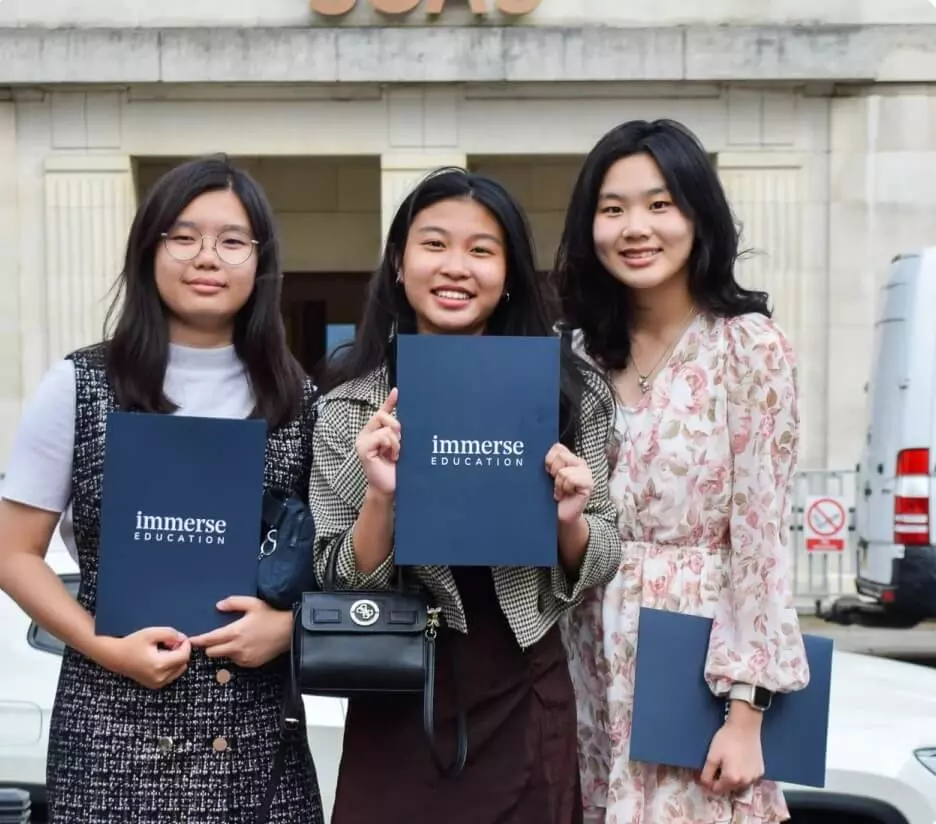
Join the Immerse Education 2025 Essay Competition
Follow the instructions to write and submit your best essay for a chance to be awarded a 100% scholarship.
The UCAS Component: Personal Statements and Academic References
Your UCAS materials should make one clear argument: you are ready to study your chosen subject at Oxford, not simply interested in university life.
For Oxbridge, a useful balance is around 80% supercurricular analysis and 20% extracurricular context. That means most of your personal statement should focus on subject reading, academic programmes, lectures, essay competitions, research, or ideas you have explored beyond the syllabus.
Unlike many US universities, Oxford cares almost exclusively about supercurriculars. Unrelated sports, music, volunteering, or societies will not carry much weight unless you connect them directly to your academic readiness, thinking skills, discipline, or subject motivation.
Because Oxford values academic depth so highly, your examples need to show thinking rather than simple enthusiasm. A weak Law sentence might say, “I have wanted to study Law since reading a book about it last year,” because it tells the tutor very little about your reasoning.
A stronger version would explain how a specific legal idea changed your understanding, such as: “My analysis of the tension between parliamentary sovereignty and judicial review led me to examine Lord Bingham’s judgments on constitutional principle.”
Your academic reference should then support the same message by highlighting intellectual independence, written ability, classroom contribution, and resilience when working through challenging material.
Navigating the Oxford Interview Process
Once your academic requirements, admissions test performance, written work, and UCAS materials have carried you through shortlisting, the interview becomes one of the final stages of the Oxford admissions process.
The Oxford interview is best understood as a short academic tutorial, not an interrogation. Tutors want to see how you think when you meet unfamiliar material, respond to hints, and adjust your reasoning under pressure.
In Biology, you might be shown an unusual bone, plant sample, or diagram and asked to infer its function, origin, or adaptation using principles such as evolution, anatomy, and ecology. English applicants may analyse an unseen poem, while Law applicants may respond to a hypothetical case.
Strong preparation means practising aloud, reading beyond your syllabus, and becoming comfortable with challenge. A tutor pushing back is not always a bad sign; they may be testing how flexibly you can think.
If you’re ready to start practising, why not check out our list of 60 examples of Oxford University Interview Questions?
Conclusion: Meeting and Exceeding Expectations
Meeting Oxford’s expectations is not about one perfect credential; it is about showing consistent academic strength, subject fit, curiosity, and thoughtful preparation over time.
The Oxford University entrance requirements can feel demanding, but each stage has a purpose: grades show readiness, while tests and interviews reveal how you think.
From GCSE context to written work, every detail should support one message: you are prepared to engage deeply with your chosen subject at university level.
Ready to experience Oxford-style learning? Explore our Oxford Summer School for small-group teaching, university-level subject insight, and life in historic Oxford colleges with peers worldwide.