

 Русский (RU)
 Українська (UK)
 Türkçe (TR)
 Italiano (IT)
 Français (FR)
 Português (PT)
 中文 (中国) (ZH)
 Español (ES)
 日本語 (JA)
 ไทย (TH)
 Deutsch (DE)
 Ελληνικά (EL)
 Polski (PL)
 Bahasa Indonesia (ID)
 Nederlands (NL)
 العربية (AR)
 한국어 (KO)

Ever heard your teen mention FBLA and thought, wait, what is that exactly? You’re not alone.
FBLA, short for Future Business Leaders of America, is a school-based organisation that helps high school participants build business skills through leadership roles, competitive events, and conferences that reward real-world thinking.
In this article, we’ll guide you through how FBLA works in high school, what FBLA competitive events look like, how conferences run, and how to tell if it’s the right fit for your child.
Let’s get into it.
What is FBLA?
FBLA stands for Future Business Leaders of America, and its mission is simple: to prepare young people for careers in business and leadership through practical experience and structured competition. According to the official organisation, it focuses on education, leadership, and career readiness for middle and high school members.
In high school, FBLA operates through local chapters led by a faculty adviser, with elected participant officers running meetings and projects. Those chapters connect to state organisations and a national leadership team, creating a clear pathway from school-level involvement to state and national conferences.
For ambitious families, this structure matters. If your teen is interested in leadership roles, confident communication, or standing out in university applications, FBLA offers a recognised platform to practise those skills in a real, competitive environment rather than just learning about them in theory.
It also matters because it helps you plan ahead for opportunities that may involve travel. As students progress through the organisation, they can qualify for state and national conferences, which are often hosted in different cities and bring together competitors from across the country.
What Does FBLA Do in High School?
FBLA is a structured way for your teen to practise leadership and business skills in real settings, not just talk about them.
With that said, here are the three core pillars that shape what FBLA does in high school.
1. Leadership Development
FBLA builds leadership by giving your teen real responsibility inside a chapter, with roles and projects that need follow-through.
In most schools, that looks like participant-led meetings, elected officer positions, and teams organising activities with an adviser in the background. FBLA also frames leadership as a core part of its high school experience, alongside competitions and educational programmes.
From a parent’s point of view, the win is how quickly this grows confidence. When your teen has to run an agenda, speak up, and represent a group, their communication stops being theoretical and starts becoming a skill you can see.
2. Academic Competition
FBLA brings academic competition to life by turning business concepts into events your teen can train for, perform under pressure, and improve through feedback.
These competitions sit inside FBLA’s National Awards Program, which the organisation describes as its competitive events programme recognising excellence across business and career-related areas.
For parents, this is where you often see the clearest “return”. Your teen learns how to revise with purpose, practise with deadlines, and present with confidence, because the format is real and the standards are public.
3. Career Readiness
In an article by Melinda Knight titled The Communication Skills Employers Value, she notes that communication skills repeatedly sit at or near the top of what employers look for when assessing candidates.
FBLA supports career readiness by helping your teen practise the exact skills they will need for university interviews, internships, and early work experiences. Many events and chapter activities push participants to write professionally, speak clearly, manage time, and handle questions on the spot.
The tricky part is that most teens do not get many low-stakes chances to rehearse these moments. They might understand the content, but still rush, freeze, or lose structure when they are being judged.
If your goal is to help your teen feel genuinely prepared for FBLA presentations and interviews, Immerse Education’s TED Summer School, created in partnership with TED, helps participants learn how to shape ideas with clarity, structure arguments with purpose, and tell stories that truly resonate, all guided by tutors trained by the TED team, making it a powerful way to build confidence before competition season starts.
Communication & Public Speaking
In-person
Find your voice and build on your public...

Communication & Public Speaking
In-person
Develop ideas with impact in New York, a...

Understanding FBLA Competitive Events
FBLA competitive events sit inside what the organisation calls the National Awards Program, designed to recognise excellence in business knowledge, leadership, and career skills at regional, state, and national levels.
For your teen, this means choosing an event, preparing over months, and competing first locally, then potentially progressing to state and national conferences. The structure is clear, the criteria are published, and the standards are high.
Here are the five main categories you and your teen should understand:
- Objective tests: Timed knowledge tests make up a large portion of the high school event list, covering a wide range of business and career topics.
- Role play events: Built around real business scenarios, role plays ask participants to respond to a prompt and present a solution to judges, rewarding quick thinking under pressure.
- Presentation events: Prepared speeches and business presentations delivered to judges, where structure, persuasion, and confident presence matter as much as the content.
- Production events: A skills-focused category where participants create a specific output, with judging centred on accuracy, execution, and professional standards.
- Chapter events: Chapter-level projects that showcase teamwork, planning, and measurable impact, rather than individual performance alone.
If your teen is drawn to presentation-based FBLA competitive events, it helps to know this: judges are listening for more than “good information”. They reward a clear message, confident delivery, and the kind of persuasive structure that makes a room pay attention.
That is exactly what participants build in our TED summer school over two weeks in London, New York, Singapore, or online, where they learn to turn an idea into a talk people remember, and step up with real stage confidence.
Join the Immerse Education 2025 Essay Competition
Follow the instructions to write and submit your best essay for a chance to be awarded a 100% scholarship.
What Are Four Individual Competitive Events a Student May Enter in FBLA?
FBLA offers many individual events, so your teen can choose what suits them, from analytical to creative to speaking.
With that said, here are four individual events that help them stand out.
1. Accounting
Accounting is a strong choice if your teen likes clear rules, logical problem-solving, and working with numbers under time pressure.
In FBLA, Accounting is an objective test covering fundamentals like financial statements, journal entries, and the accounting cycle, while Advanced Accounting goes further into areas like managerial accounting and financial analysis.
2. Business Communication
Picture your teen’s texts turned into a workplace email, would it still land well?
Business Communication tests professional writing and speaking, digital correspondence, and workplace etiquette through a structured objective test. It also covers how messages change when you are writing to a client, a manager, or a wider organisation.
3. Public Speaking
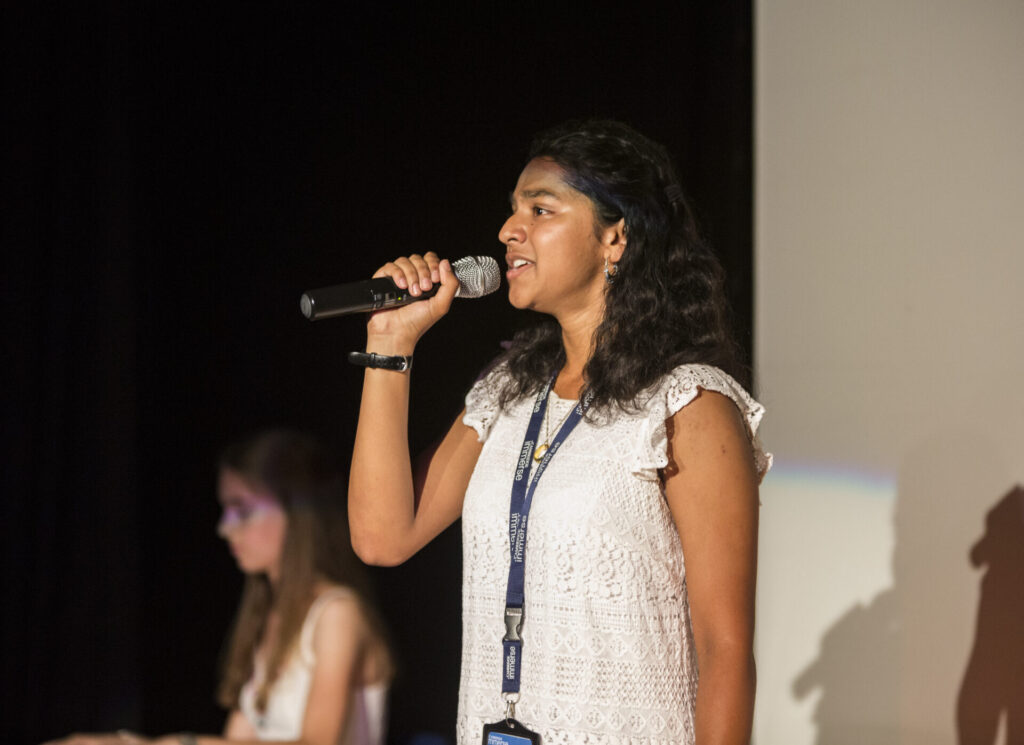
Public Speaking is for teens who want to sound confident, clear, and persuasive when eyes are on them. In this event, participants deliver a live presentation to a panel of judges, where structure, delivery, and presence all count. It is a powerful way to build stage confidence fast, especially for university interviews and leadership roles.
If your teen wants a specialised programme to train those exact skills before competition season, our Public Speaking Summer School helps them build a stronger voice, sharper structure, and calmer delivery under pressure.
4. Job Interview
Job Interview is one of the most practical FBLA events because it mirrors a real interview experience, with judges assessing how well your teen presents themselves, answers questions, and stays composed under pressure.
It rewards preparation, self-awareness, and clear communication, which matters when university and internship interviews start feeling serious.
How FBLA Conferences Work
Most teens start locally, compete regionally, then advance to state level if they place high enough. From there, top performers typically earn the right to represent their state at the National Leadership Conference, which is where FBLA brings together its strongest competitors and participant leaders.
Two key conferences parents hear about most are the National Fall Leadership Conference and the National Leadership Conference. The National Fall Leadership Conference focuses on leadership training, business learning, and networking, while the National Leadership Conference is the major end-of-year gathering where members compete, attend workshops and exhibits, and share ideas with peers from across the country.
At conferences, your teen can expect competitions, skills workshops, networking, big-session speakers, and the buzz of awards ceremonies. When your child is in a presentation event, the atmosphere can feel surprisingly like a live TED-style experience: time limits, stage nerves, bright lights, and the challenge of making a message land.
Is FBLA Better Than DECA?
You do not need to treat this like a rivalry. In most schools, FBLA and DECA are simply two different ways to practise business skills, compete, and build confidence, and the “best” choice depends on how your teen likes to learn and perform.
Here is the simplest way to see the difference at a glance.
| Focus | FBLA | DECA |
| Core focus | Broad business and leadership, with many pathways to compete | Business careers with a strong emphasis on marketing, finance, hospitality, and management |
| Competitive event structure | Five main categories: objective tests, role plays, presentations, production, and chapter events | Three broad categories: role-plays and case studies, prepared events, and online simulations |
| Best fit for teens who… | Like having lots of event formats to choose from, including testing and structured presentations | Enjoy fast-paced case studies, pitch-style role plays, and real-world scenarios |
| What parents often notice | Clear skill-building in communication, leadership, and professional readiness through chapters and conferences | Strong confidence gains in business thinking and presenting under time limits |
| If your teen loves speaking | Presentation events can be a strong match, especially for structured speeches | Role plays also build speaking confidence, but often in shorter, improvised formats |
How to Join FBLA and Prepare Strategically
If you want your child to build real leadership experience, compete in business events, and grow in confidence, FBLA can be a strong fit, and the good news is that joining is usually straightforward once you know where to look.
Here are the key steps to get your teen enrolled in FBLA:
- Find your school’s FBLA chapter and adviser: Ask your school counsellor or a business teacher who runs FBLA on campus.
- Get registered through FBLA CONNECT: Chapters typically add members and manage enrolment through FBLA CONNECT.
- Pay membership dues: National dues are $10 for high school members, plus any state dues required in your area.
- Know the membership year: FBLA’s membership year runs from August 1 to July 31, which can affect conference and competition eligibility.
- If your school does not have a chapter: You can submit an official request to start or reactivate a chapter through FBLA’s form process.
In terms of time commitment, FBLA is flexible, but it is not “set and forget”. Chapters often meet weekly or biweekly, and prep increases as competitions approach. Objective tests mean revision and timed practice, while presentation events require rehearsal, feedback, and refinements.
If your teen is aiming for Nationals in San Antonio, Texas (June 29 to July 2), our Public Speaking Summer School helps them practise like it is the real stage before competition season even begins.
Conclusion
FBLA is what helps ambitious teens turn business skills into real confidence through leadership, competition, and conferences.
Over time, the biggest win is often communication. Your child learns to think clearly, speak with purpose, and handle pressure.
The next step is learning how to shape those thoughts into a clear message people remember, especially when judges are watching.
Help your teen go from “good content” to a talk that lands, with our TED Summer School building structure, storytelling, and stage confidence in just two weeks.