

 Русский (RU)
 Українська (UK)
 Türkçe (TR)
 Italiano (IT)
 Français (FR)
 Português (PT)
 中文 (中国) (ZH)
 Español (ES)
 日本語 (JA)
 ไทย (TH)
 Deutsch (DE)
 Ελληνικά (EL)
 Polski (PL)
 Bahasa Indonesia (ID)
 Nederlands (NL)
 العربية (AR)
 한국어 (KO)
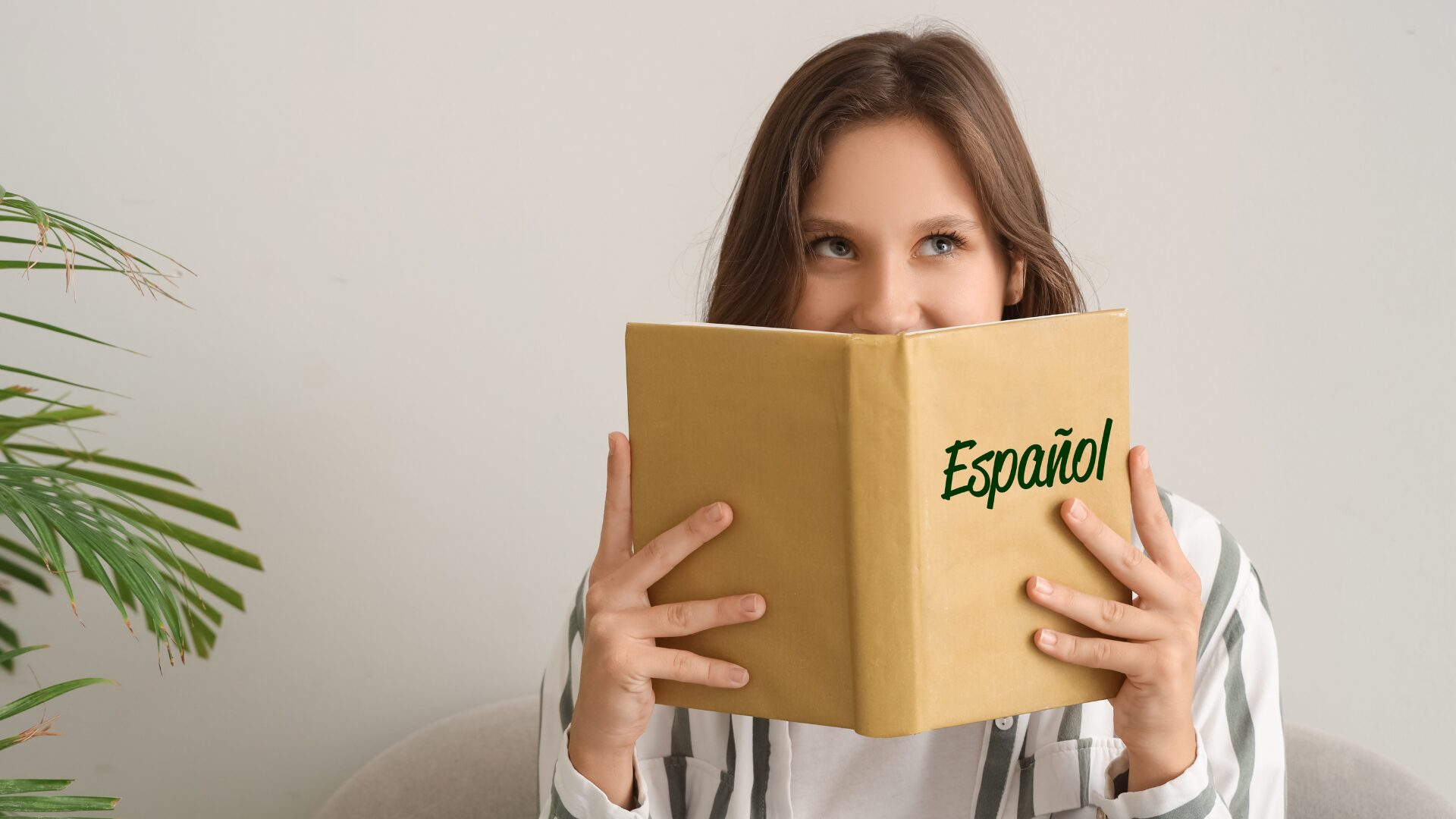
The secret to securing your Spanish GCSE isn’t mindless repetition or using Duolingo aimlessly, but knowing how to revise for exams using high-performance cognitive techniques.
You can master your exams by integrating scientific active recall methods with targeted practice across the specific listening, reading, writing, and speaking papers used by all major UK exam boards.
In this guide, we’ll explore proven strategies to ace each exam section and follow a comprehensive eight-week revision timetable designed to boost your confidence on exam day.
Let’s start building your path to a Grade 9 now.
Why GCSE Spanish Feels Difficult (And How to Fix It)
You likely find Spanish daunting because you treat it as a collection of individual words, not a logical system.
Your main challenge is juggling irregular verb endings and gender agreement while translating complex thoughts under exam pressure. This often leads you to think in English and convert word for word, which results in clunky phrasing and frequent grammatical errors that cap your potential grade.
To fix this, you must pivot from passive memorisation to mastering high-leverage frameworks.
Instead of learning isolated nouns, you should focus on versatile sentence starters like “si tuviera la oportunidad” (if I had the opportunity) that work across any exam topic you encounter.
By automating these sophisticated structures, you free up mental bandwidth to focus on your accuracy and pronunciation. Consistency is key, as just five minutes of daily audio practice is far more effective than a long Sunday cramming.
If you want to know how best to revise effectively for your Spanish GCSE, shifting your focus to these functional patterns transforms the subject from a series of hurdles into a fluid and manageable skill.
Understand Your Framework: AQA vs Edexcel Specifics
Before we begin discussing specific tips on how to revise for Spanish GCSE, it is crucial to first know the structure of your exam because this directly affects how you should prioritise your study time.
With that said, here is a deeper look between the two formats.
AQA
The AQA specification (8692) follows a linear structure, with all four papers taken at the course end, each worth 25%. This means you need to balance your revision across all four skills equally to secure a top grade.
Subject Content
- Theme 1: People and lifestyle (Identity, relationships, healthy living, and daily routines).
- Theme 2: Popular culture (Free-time activities, customs, festivals, and celebrity culture).
- Theme 3: Communication and the world around us (Travel, social issues, and environmental projects).
Paper 1: Listening
- Duration & Marks: 35m / 40 marks (Foundation) or 45m / 50 marks (Higher).
- Understanding and Dictation: You must answer questions in both English and Spanish to show comprehension. A specific section requires you to transcribe short Spanish sentences accurately to prove you understand “Sound-Symbol Correspondences.”
Paper 2: Speaking
- Duration & Marks: 7–9m (Foundation) or 10–12m (Higher) + 15m prep / 50 marks.
- Role-play: You have 15 minutes of preparation to draft responses to five specific prompts, including one “surprise” question marked with an exclamation mark.
- Reading aloud: You must read a short Spanish text with correct pronunciation, followed by a brief, unprepared conversation based on that text.
- Photo card: You are required to describe an image and answer three follow-up questions, testing your ability to speak spontaneously.
Paper 3: Reading
- Duration & Marks: 45m (Foundation) or 1h (Higher) / 50 marks.
- Comprehension and Translation: This paper tests your ability to understand diverse texts and includes a translation task from Spanish into English.
Paper 4: Writing
- Duration & Marks: 1h 10m (Foundation) or 1h 15m (Higher) / 50 marks.
- Structured Writing: You are required to write either 90 words (Foundation/Higher) or 150 words (Higher only) using a variety of tenses and complex justifications, alongside a translation from English into Spanish.
You can learn more about the specific exam format and the grammar requirements for the 2026 exams from AQA’s website.
Edexcel
The Edexcel specification (1SP1) is a linear course with all exams taken at the end of the year. Similar to AQA, each of the four papers is weighted at 25%, but Edexcel organises its content into six broad thematic contexts to ensure a wide range of cultural and personal discussion.
Subject Content
- Theme 1: My personal world (Family, friends, and relationships).
- Theme 2: Lifestyle and wellbeing (Physical/mental health, food, and sport).
- Theme 3: My neighbourhood (Town life, shopping, and environmental issues).
- Theme 4: Media and technology (Social media, gaming, music, and film).
- Theme 5: Studying and my future (School life and career aspirations).
- Theme 6: Travel and tourism (Holidays, accommodation, and transport).
Paper 1: Listening and Understanding
- Duration & Marks: 35m / 40 marks (Foundation) or 45m / 50 marks (Higher).
- Understanding and Dictation: Includes a compulsory Dictation section where you must transcribe spoken Spanish sentences accurately to test your grasp of “sound-symbol” correspondences.
Paper 2: Speaking
- Duration & Marks: 7–9m (Foundation) or 10–12m (Higher) + 15m prep / 50 marks.
- Read Aloud: You read a short text with correct pronunciation, followed by a brief, unprepared interaction.
- Role-play: A transactional task (e.g., in a shop or hotel) based on a prompt.
- Picture Task: You describe a visual stimulus and engage in a follow-up conversation on one of the broad thematic contexts.
Paper 3: Reading and Understanding
- Duration & Marks: 45m (Foundation) or 1h (Higher) / 50 marks.
- Comprehension and Translation: Features questions in English and a specific task where you translate a short passage from Spanish into English (minimum 35 words for Foundation, 50 for Higher).
Paper 4: Writing
- Duration & Marks: 1h 10m (Foundation) or 1h 15m (Higher) / 50 marks.
- Written Responses and Translation: You produce responses of varying lengths (e.g., 80–90 words or 130–150 words) to express ideas and opinions, plus a translation from English into Spanish.
You can also find the full breakdown of the thematic contexts and sample assessment materials from Edexcel’s website.
Communication & Public Speaking
In-person
Develop ideas with impact in New York, a...

Creative Writing
In-person
Hone your writing craft in Cambridge, following in...

Mastering the Four Assessment Pillars
Despite the different formats across exam boards, the four sections of listening, reading, speaking, and writing exist at both AQA and Edexcel and are weighted equally at 25% each.
Here are some practical strategies to help you excel in each section.
1. Listening: Sharpening Your Ear
To master the listening paper, you must move beyond just hearing words to identifying the specific “traps” examiners use to differentiate between grades. Since the 2026 specification includes a dictation element, your focus should be on the relationship between spoken sounds and written Spanish.
Here are some practical steps you can implement to sharpen your ear and maximise your marks in this section:
- Practice with Synonyms and Distractors: Listen for “but” (pero) or “however” (sin embargo), as these often signal a change in the answer. Remember that the correct option rarely uses the same word you hear in the audio; for example, if you hear “soy un gran aficionado al fútbol,” look for “deportes” in the question.
- Dictation and Accent Accuracy: Focus on “Sound-Symbol Correspondence” by practicing short transcriptions. Pay critical attention to accents, as missing one on a verb (e.g., hablo vs. habló) changes the tense and can lose you both the communication and accuracy marks.
- The 5-Second Rule: Use the time before the track starts to underline key question words (Who, Where, When) so you know exactly what information to filter for.
- Vocalise the Vocab: When learning new words, always say them out loud; if you can’t pronounce a word correctly, you are much less likely to recognise it when a native speaker says it at speed.
2. Reading: Decoding the Text
The reading paper is less about translating every single word and more about identifying clues and intent. A vital part of knowing how to revise for the reading section of your Spanish GCSE is preparing for “inference” questions where the answer isn’t explicitly written but must be “guessed” based on the context.
Here are some practical steps you can use to navigate the text and avoid common pitfalls:
- Hunt for “Time Markers”: Before answering, look for words like ayer (yesterday), ahora (now), or mañana (tomorrow). A common trap is a text that discusses a past hobby (e.g., jugaba al tenis) while the question asks what the person does currently.
- The “Inference” Strategy: If you encounter a word you don’t know, look at the words around it. If the sentence is “El hombre estaba ____ porque perdió su trabajo,” and you know perdió su trabajo means “lost his job,” you can infer the missing word means something like “sad” or “stressed.”
- Translation Precision: In the translation section (Spanish to English), do not paraphrase. If the text says mi hermana pequeña, write “my little sister” or “my younger sister.” Writing just “my sister” could lose you a mark for ignoring the adjective.
- Ignore the “Noise”: You will encounter “filler” words designed to distract you. Focus on the verbs and nouns first to get the “skeleton” of the sentence, then add the adjectives to find the specific detail required for the mark.
3. Speaking: Communicating with Confidence
While many students find the speaking exam nerve-wracking, it serves as your best opportunity to showcase personality and fluency. When looking at how to revise for the Spanish GCSE speaking test, remember that the focus is on natural interaction, meaning your success depends on your ability to keep a conversation flowing spontaneously.
Here are some practical steps you can implement to boost your confidence and your marks:
- Master the “Three-Tense Rule”: To hit the higher mark bands (Grade 7+), you must use at least three tenses (Past, Present, and Future) in every extended answer. For example, if asked about your school, say what you did yesterday (ayer estudié…), what you do now (ahora estudio…), and what you will do next year (el año que viene estudiaré…).
- The “P.E.E.L.” Method for Opinions: Don’t just give a one-word answer. Use Point (I like…), Evidence (because it’s fun), Elaboration (and I go every week), and Linking (but my brother hates it). This naturally extends your speaking time and demonstrates complex structures.
- Narrate the Photo Card: For the photo description, use the acronym PALMS (People, Action, Location, Mood, Setting). This ensures you cover all the “hidden” requirements of the task without freezing up.
- Strategic Fillers: Learn “thinking” phrases like “Es una pregunta interesante” (That’s an interesting question) or “Déjame pensar” (Let me think). These buy you 3–5 seconds to process your grammar without the awkward silence that drops your “fluency” score.
- Listen to the Question’s Tense: The examiner’s question usually hands you the verb you need. If they ask “¿Qué hiciste ayer?” (What did you do yesterday?), you know your answer must start with a past tense verb ending in -é or -í.
4. Writing: Building a Strong Foundation
The writing exam is your chance to demonstrate total control over the language by taking your time to construct accurate and sophisticated sentences. If you want to know how to best revise for the Spanish GCSE writing paper, prioritise mastering complex grammar over simply repeating basic vocabulary.
Here are some practical steps you can implement to ensure your writing reaches the top mark bands:
- The “Checklist of 5”: Before finishing any task, scan your work specifically for five elements: a past tense, a present tense, a future intent, a justified opinion, and an idiomatic expression (like costar un ojo de la cara). Including all five is often the “hidden” requirement for a Grade 8 or 9.
- Avoid the “Repetition Trap”: If you use porque in your first sentence, switch to ya que or puesto que in your second. Replacing basic words like bueno with genial or estupendo instantly elevates the perceived quality of your vocabulary.
- Perfect Your Verb Endings: Most marks in the writing paper are lost on simple conjugation errors. Take ten seconds to double-check that your “I” forms (hablo) and “they” forms (hablan) are correct, and ensure you haven’t forgotten the “h” in hay or he.
- Plan Your Structures: Spend the first five minutes of the exam jotting down “high-level” phrases you’ve memorised, such as “Si tuviera más dinero, me gustaría…” (If I had more money, I would like…). Using the conditional tense like this shows a level of sophistication that smaller, simple sentences cannot match.
- The Translation “Sense Check”: When completing the translation into Spanish, read your final sentence back to yourself. If it sounds like “Spanglish” or follows English word order too closely (e.g., “I am 15” should be Tengo 15 años, not Soy 15), pause and correct the idiom.
Join the Immerse Education 2025 Essay Competition
Follow the instructions to write and submit your best essay for a chance to be awarded a 100% scholarship.
GCSE Spanish: The 8-Week “Excel” Roadmap
Weeks 1-2: The Foundation (Core Verbs & Tenses)
- Focus: Mastering the “Big Five” (Ser, Estar, Tener, Ir, Hacer) in Present, Preterite, and Future.
- Action: Create “Three-Tense” drills. Practice saying/writing a basic sentence (e.g., “I go to school”) and immediately shifting it into the past and future.
- Goal: Eliminate conjugation errors in your “Checklist of 5.”
Weeks 3-4: The Ear & The Eye (Listening & Reading)
- Focus: Identifying “Tense Traps” and Synonyms.
- Action: A great way to revise for Spanish GCSE is how you use past papers to specifically hunt for Time Markers (antes, ahora, el año que viene).
- Dictation Drill: Listen to Spanish audio and write exactly what you hear to master Sound-Symbol Correspondence.
Weeks 5-6: The Art of Elaboration (Speaking)
- Focus: Developing fluency and spontaneous response.
- Action: Use the PALMS method on random photos from your phone. Practice the P.E.E.L. technique for every opinion (e.g., “I like X… because… for example… however…”).
- Goal: Internalise “Strategic Fillers” so you never have “dead air” during the exam.
Weeks 7-8: The “Final Polish” (Writing & Full Mocks)
- Focus: Sophistication and Accuracy.
- Action: Memorise three “High-Level Phrases” (like Si tuviera más tiempo…) and practice dropping them into every writing task.
- Exam Simulation: Complete full papers under timed conditions to practice “Double Check” habits (agreements and accents).
Conclusion
Consistent daily practice turns exam pressure into calm, confident performance by strengthening your vocabulary, grammar accuracy, timing, and ability to respond clearly across every paper.
For GCSE Spanish, success comes from understanding how each skill connects, allowing you to revise with purpose, improve weak areas, and apply stronger answers under pressure.
This eight-week roadmap builds fluency through repetition, structure, and timed practice, helping your listening, speaking, reading, and writing develop together in a clear, manageable way.
Next, join our Academic Insights summer school to prepare for A-level study, where you’ll develop university-level study skills, deepen your academic confidence, and gain a meaningful head start.