
 Русский (RU)
 Українська (UK)
 Türkçe (TR)
 Italiano (IT)
 Français (FR)
 Português (PT)
 中文 (中国) (ZH)
 Español (ES)
 日本語 (JA)
 ไทย (TH)
 Deutsch (DE)
 Ελληνικά (EL)
 Polski (PL)
 Bahasa Indonesia (ID)
 Nederlands (NL)
 العربية (AR)
 한국어 (KO)

If you’re a high school student who enjoys mathematics beyond the classroom, summer schools in Japan for high school students can offer the kind of challenge you may not always find at school. You might solve Olympiad-style problems, explore advanced concepts, or learn alongside students who share your enthusiasm for mathematical thinking.
Imagine spending your mornings studying number theory, combinatorics, or mathematical modelling with university instructors, then exploring Tokyo’s neighbourhoods, visiting historic temples in Kyoto, or experiencing traditional Japanese festivals and cultural workshops with fellow students from around the world. These programmes combine rigorous academic exploration with the chance to immerse yourself in one of the world’s most fascinating cultures.
How to select the best Mathematics summer schools in Japan for high school students?
These programs go far beyond memorising formulas or preparing for exams. Some focus on pure mathematics and competition training, while others connect mathematics to fields like computer science, engineering, robotics, economics, or data science.
Of course, not all math summer programs offer the same level of rigour, mentorship, or cultural engagement. Some focus primarily on lectures, while others emphasise interactive workshops, research projects, and close collaboration with faculty and peers. Finding the right fit can shape both your mathematical growth and your broader academic perspective.
Across Japan, universities and educational organisations offer outstanding mathematics summer opportunities designed specifically for ambitious high school students. Along the way, you’ll strengthen your analytical thinking, deepen your understanding of advanced mathematical concepts, and build friendships with students who share your curiosity and passion for learning.
To help you explore the best options, we’ve compiled a list of 15 Mathematics Summer Schools in Japan for High School Students. They’ve been selected for their academic rigour, immersive learning environments, and cultural experiences.
For more opportunities, consider the online math program and summer programs in Japan.
15 Mathematics Summer Schools in Japan for High School Students
1. JMO Summer Seminar
Location: Villa Chigadaki, Hokuto City, Yamanashi Prefecture (residential, in-person)
Cost: Free. Accommodation and meals are fully covered. Travel subsidies apply for students travelling over 500 km, up to ¥30,000
Dates: August 2nd (Sun) to August 8th (Sat). Assembly at Kiyosato Station at 3:30 PM on August 2nd
Application Deadline: June 9th (Tue), by post. Applications open May 5th (Tue)
Eligibility: Year 2 of high school or below. JMO selection camp qualifiers and 1st JGMO prize-winners are guaranteed a place. All others must submit an original mathematics paper by post. International students: not confirmed; the application requires a Japanese postal address and the paper must be sent to a Tokyo address, making participation from overseas logistically difficult
The JMO Summer Seminar gathers around 30 mathematics-passionate students each summer. Students read advanced texts in small groups. They present mathematical findings and discuss ideas with tutors. Tutors are primarily former Japanese IMO representatives.
General applicants must submit an original mathematics paper. It can cover any self-driven mathematical exploration. One submission per person; typed or handwritten on A4. You can apply here.
Why it stands out: Entirely free and mentored by former IMO representatives, admission is earned through original mathematical thinking, not exam scores.
2. Immerse Education’s Tokyo Mathematics Summer School
Location: Tokyo, Japan
Cost: Varies; summer school scholarship available through our bursary programme
Dates: Multiple summer cohorts
Application Deadline: Rolling admissions. Contact Immerse Education directly for current availability
Eligibility: Students aged 15 to 18. Open to international students from around the world
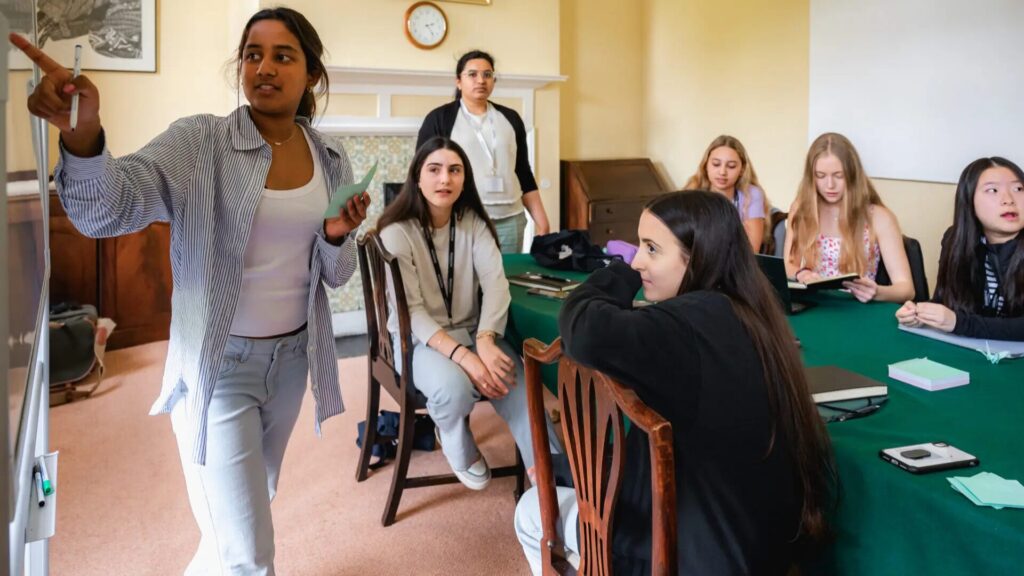
Designed as one of the more internationally focused mathematics summer schools in Japan for high school students, Immerse Education brings together students from around the world in Tokyo. They study mathematics at the university level in small groups of 7 to 10, with tutors drawn from leading universities including Oxford and Cambridge. The curriculum covers logic, proof, algebra, and calculus, while sessions combine theory with practical problem-solving and collaborative projects.
Students explore Tokyo through cultural workshops and evening activities. The programme ends with a graduation ceremony, dinner, and personalised tutor evaluation. You can start applying here.
Why it stands out: One of the only international residential mathematics programmes held in Tokyo, combining rigorous university-style learning with direct access to Japan’s technology and innovation landscape.
3. Japan Mathematical Olympiad (JMO)
Location: Japan
Cost: Examination fee 4,000 yen
Dates: Registration opens in July and closes in September
Application Deadline: June 8th
Eligibility: High school students and below. Middle school students may alternatively enter the Junior JMO. Individual and school block registration are both available. The competition is run through Japanese school networks and exam venues located in Japan, making remote or overseas participation practically unavailable
The JMO selects Japan’s six-member team for the International Mathematical Olympiad. The preliminary round has 12 answer-only problems.
Problem areas are algebra, combinatorics, geometry, and number theory. Top scorers (around 200) advance to the final round. The final round has five proof-based essay problems. Top performers receive medals and prizes in March. You can register here.
Why it stands out: The JMO is the only pathway to representing Japan at the International Mathematical Olympiad.
4. Nihon University Mathematics Summer School
Location: Nihon University, Sakurajosui Campus, Setagaya, Tokyo (Centre Hall, B1F). About 10 minutes’ walk from Sakurajosui or Shimotakaido stations on the Keio Line
Cost: Free
Dates: August
Application Deadline: Not specified
Eligibility: Primarily designed for high school students, though open to middle school students, university students, teachers, and the general public. No advanced mathematics required. International students are not confirmed; all official materials are in Japanese, and the event is held in Japanese, which may limit participation for non-Japanese speakers
Three Nihon University faculty deliver talks on modern mathematics. Topics are accessible with high school knowledge. Past talks covered RSA cryptography, probabilistic modelling, and knot topology.
Each session runs approximately 90 minutes. You can register here once this year’s edition is announced.
Why it stands out: No selection, no fee, and no prerequisites; any curious student can attend and encounter genuine university-level mathematics.
5. RIMS Introductory Mathematics Public Lecture
Location: Hybrid: in-person at the RIMS 4th Floor Lecture Hall, Kyoto University; and online via Zoom. The optional office hour on the final day is in-person only
Cost: Free
Dates: Early August each year
Application Deadline: Not specified
Eligibility: Open to the general public, with high school students explicitly welcome. Not exclusively a high school program. International students are not confirmed; all lectures and materials are in Japanese, which may limit participation for non-Japanese speakers
The Research Institute for Mathematical Sciences at Kyoto University has hosted this series since 1976. Three or four researchers deliver four days of lectures. All content is accessible with high school knowledge.
Past editions covered enumerative geometry, fluid dynamics, representation theory, and web mathematics. Lecture notes are published freely after each edition. Register and access past notes here.
Why it stands out: Nearly 50 years of tradition, frontier researchers as lecturers, and free lecture notes, all with no cost to attendees.
6. Tokyo Metropolitan University Mathematics Summer School
Location: Tokyo Metropolitan University, Minamiosawa Campus, Building 12, Room 101, Hachioji, Tokyo. Accessible from Minamiosawa Station on the Keio Sagamihara Line
Cost: Free
Dates: Not specified
Application Deadline: Online registration via Google Form, usually until around July or until full
Eligibility: Principally designed for high school students of any year level, though open to the general public. No prior university mathematics required. International students not confirmed; all lectures and registration materials are in Japanese, which may limit participation for non-Japanese speakers
Three faculty members each deliver a 90-minute mathematics lecture. Topics are accessible with high school knowledge. Past talks covered RSA cryptography, probabilistic modelling, and knot topology.
Students can speak with lecturers between sessions. The day ends with a short graduation ceremony. No selection process or fee required. Registration for 2026 has not started yet.
Why it stands out: A 30-year tradition with zero barriers to entry; one full day of university mathematics, completely free.
7. Japan Mathematics Contest
Location: Online (problem submission via the contest website)
Cost: Free
Dates: From June 30th
Application Deadline: Not specified
Eligibility: Open to primary, middle, and high school students. Not exclusively a high school program. International students are not confirmed; the contest website and all materials are in Japanese, which may limit participation for non-Japanese speakers
This free online contest is co-hosted by Osaka Metropolitan University and Nagoya University. It rewards open-ended thinking over speed or technique. Questions have no single correct answer.
Students generalise, explore, and construct their own reasoning. Submissions are evaluated for originality and depth. A prize is awarded for outstanding entries. Past questions are freely available on the website. Access this year’s questions here from June 30.
Why it stands out: One of the only contests in Japan where original reasoning matters more than memorised technique.
8. Suuri no Tsubasa Summer Seminar (46th Edition)
Location: Fukuoka Prefecture (specific venue TBC); 4-night, 5-day residential camp
Cost: Free
Dates: August 13th to August 17th
Application Deadline: May 10th
Eligibility: Exclusively for currently enrolled high school students born April 2, 2008, to April 1, 2011. Around 40 students were selected based on written essays. International students are not confirmed; the application, essays, and all seminar activities are conducted entirely in Japanese
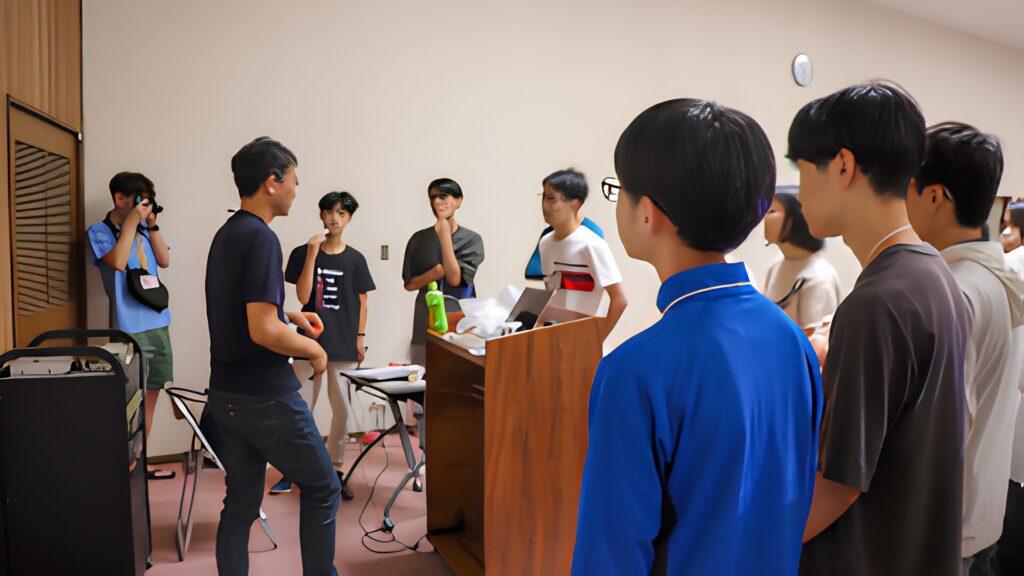
Founded by Fields Medal winner Heisuke Hironaka, this seminar has run every summer since 1980. Around 40 students gather from across Japan. Leading researchers lecture across mathematics and related sciences. Students discuss, collaborate, and learn alongside motivated peers.
The application requires two written essays. One covers the applicant’s passion for mathematical sciences. The other addresses a topic of personal interest. You can apply here.
Why it stands out: Founded by a Fields Medal winner and running for over 40 years, this is one of Japan’s most celebrated and selective science camps for high school students.
9. STELLA Program (Next-Generation Science and Technology Challenge Program)
Location: Hiroshima University, Higashihiroshima Campus, and partner institutions across the Chugoku and Shikoku regions (on-site and hybrid components)
Cost: Free
Dates: Not specified
Application Deadline: Not specified
Eligibility: The Senior Course is open to high school students and Year 3 middle school students, or those who have completed the Junior Course. International students are not confirmed; the program is delivered entirely in Japanese and is structured around the Japanese school system
The STELLA Program is Hiroshima University’s flagship science and technology talent development initiative, built on the foundations of the former GSC Hiroshima program. It operates across three progressive tiers. The Senior Course (for high school students) begins with Stage 0 pre-education, covering science literacy, research ethics, scientific lectures, and entrepreneurship seminars.
Selected students then advance to Stage 1, where they develop a research plan under university faculty guidance, attend specialist seminars, and present a research poster. Top graduates are selected for the Advanced Course, where they conduct original research under university faculty supervision, participate in joint seminars with peers, and aim to present findings at academic conferences and submit papers in English.
Why it stands out: The STELLA Program offers one of the most structured and sustained science development pathways available to high school students in western Japan, taking students from foundational research literacy all the way to conducting and publishing original university-level research.
10. Stanford University Mathematics Camp (SUMaC)
Location: Online (two 3-week sessions) and residential at Stanford University, Palo Alto, California (one 4-week session)
Cost: USD $3,750 for online; USD $8,950 for residential. Financial aid available based on demonstrated need; open to both domestic and international applicants
Dates: Online Session 1: June 15th to July 3rd. Online Session 2: July 6th to 24th
Application Deadline: Applications for the current cycle closed on February 2nd. Check the SUMaC website for the next cycle’s deadline in late 2026
Eligibility: Students currently in Grade 10 or 11, at least 15 years old during the program. Students aged 18 or older during the program are eligible for the online program only. International students are eligible to apply
SUMaC has offered advanced mathematics to high school students since 1995. Students choose between two courses: Program I covers abstract algebra and number theory; Program II covers algebraic topology. Each course runs at the college level, with daily lectures, problem sets, and guided group work.
The online program serves 64 students; the residential program serves 40 students on Stanford’s campus. Admission requires a take-home proof-based exam, a teacher recommendation, essays, and strong prior engagement with mathematics.
Why it stands out: One of the most prestigious mathematics summer programs in the world, SUMaC offers students direct access to abstract algebra and topology at the level of a genuine college course, taught on or near the Stanford campus.
11. AwesomeMath Summer Program

Location: Fully online (live classes via Zoom)
Cost: USD $1,275 to $1,575 per course, depending on enrollment round. Price includes all teaching materials; no additional books required. No financial aid offered; early enrollment gives the best rate
Dates: Session 1: June 8th to 26th. Session 2: June 29th to July 17th. Session 3: July 20th to August 7th. Students enrol in one, two, or all three sessions
Application Deadline: Five application rounds, from early January through late May. The late round 2 deadline is May 26th
Eligibility: Students aged 12 to 18. International students can apply too
AwesomeMath Summer Program is a three-week intensive online math camp featured on MIT’s “Preparing for MIT” page. Each course runs Monday to Friday, with a 90-minute lecture followed by a 60-minute problem-solving session.
Courses cover algebra, combinatorics, geometry, and number theory across four difficulty levels. Students are assessed on two Saturdays per session. Daily homework is assigned, graded, and returned with feedback. You can begin applying here.
Why it stands out: With three flexible sessions, four subject areas, and four difficulty levels, AwesomeMath is one of the most structured and accessible online olympiad training programs available to high school students worldwide.
12. LSU Virtual Math Research Circle (VMRC)
Location: Fully online
Cost: USD $1,200 per session. A USD $300 deposit is due at registration
Dates: Session 1: June 8-27; Session 2: July 13th – August 1st
Application Deadline: Registration is currently open. Rolling admissions based on first-come, first-served basis
Eligibility: High school students in Grades 9 to 12. Teams of 3 to 6 students work together on a shared research project. International students are not confirmed on the official page
VMRC is an advanced mathematics research program where high school students collaborate with professional mathematicians from LSU and partner universities. Each team of 3 to 6 students works on an authentic, publishable research project over the session. Projects span a range of pure mathematics topics, chosen each cycle.
Teams present their results in a colloquium-style lecture at the end of the program. Students who complete a research extension and pass a final presentation are eligible for 1 hour of LSU university credit (MATH 1999). You can start applying here.
Why it stands out: One of the very few programs where high school students work on genuinely publishable mathematics research under university faculty supervision, with the option to earn real university credit upon completion.
13. MIT PRIMES-USA
Location: Fully remote (year-long distance mentoring program; no travel required)
Cost: Free
Dates: Year-long program. The 2026 cycle application closed on December 1st
Application Deadline: Applications for the 2027 cycle open in September 2026. Check the program page from September onwards
Eligibility: High school sophomores and juniors (Grades 10 and 11) residing in the United States, at least 50 miles from Boston. Home-school students of the same age are eligible. Seniors and students outside the US are not eligible for PRIMES-USA. International students are not allowed
PRIMES-USA is a free year-long mathematics research program run by the MIT Mathematics Department. Students work individually or in small groups on original, unsolved problems in mathematics, mentored by MIT graduate students and faculty via video call.
The program runs in four phases: a winter reading period, a spring research phase, a summer independent work period, and a fall write-up. Students present findings at the annual PRIMES conference in October and submit a final paper, which may be sent to professional journals or national science competitions. You can start applying here from September 2026.
Why it stands out: As a fully free, year-long research program run by MIT, PRIMES-USA gives high school students a genuine experience of independent mathematical research, with results regularly published in peer-reviewed journals and recognised at national competitions.
14. MathWOOT (Math Worldwide Online Olympiad Training)
Location: Fully online (live classes via AoPS online classroom)
Cost: $895 for MathWOOT Level 1 and 2. Early bird pricing to end on August 18th
Dates: September 8th start date for Level 1 and 2
Application Deadline: September 22nd for Level 1 and 2
Eligibility: High school students from around the world preparing for national and international mathematics olympiads. No formal age restriction stated; the course targets high school olympiad competitors. International students can apply
MathWOOT is a 7-month online olympiad training course taught by former olympiad medalists, including 5-time IMO Gold winner Alex Song. The course runs at two levels: Level 1 for students working toward AIME and USAMO qualification, and Level 2 for olympiad qualifiers aiming for top scores at the national and international level.
Level 2 content alternates across two versions, so students can take it for two consecutive years without repeating material. Each 2-hour class includes advanced problem-solving instruction, with direct written feedback on submitted solutions. Practice exams include AIME and USA(J)MO/IMO simulations. You can begin applying here.
Why it stands out: Taught by a 5-time IMO Gold medallist and used by students who have gone on to represent their countries at the IMO, MathWOOT is one of the most rigorous and internationally recognised online olympiad training programs available to high school students.
15. Euler Circle
Location: Online (live classes) and in-person in the San Francisco Bay Area, California
Cost: USD $850 to $1,100 per 10-week class, depending on the course. Financial aid available after admission for students unable to pay
Dates: Spring classes run from March to June. Summer classes include an Independent Research and Paper Writing course (June 8th to 10th) and two further courses (July 13th to August 14th)
Application Deadline: Applications for summer classes closed on April 12, but it’s a rolling admission process
Eligibility: High school students who have not yet graduated. Exceptional middle school students are also considered. International students can apply too
Euler Circle offers college-level mathematics courses to advanced high school students who have moved beyond competition math. Each course is equivalent to a full university mathematics class. Spring courses include transition to proofs, fundamentals of higher mathematics, and p-adic analysis. Summer courses include independent research and paper writing, mathematics in Lean, and Markov chains.
Students submit weekly problem sets for TA feedback, attend lectures, and in advanced courses write an expository paper. Students who demonstrate strong work are offered access to small-group research meetings on open mathematical problems. You can begin the application process here.
Why it stands out: Euler Circle is one of the only programs globally that takes high school students beyond olympiad mathematics into genuine university-level pure mathematics, including access to unsolved research problems, at a fraction of the cost of a university course.
From Mathematical Curiosity to Global Study
Numbers can open unexpected doors. A summer spent tackling proofs, patterns, and advanced problems can reveal how far mathematical curiosity can travel.
In Japan, mathematics summer schools for high school students can introduce you to Olympiad thinking, university lectures, research tasks, and collaborative challenges.
That experience can shape more than your subject knowledge. It can help you decide whether your future belongs in pure maths, engineering, economics, or computer science.
Take that next decision seriously. Visit our Study Abroad blogs for destination guides, subject advice, and application tips that could change your university shortlist.