




 Русский (RU)
 Українська (UK)
 Türkçe (TR)
 Italiano (IT)
 Français (FR)
 Português (PT)
 中文 (中国) (ZH)
 Español (ES)
 日本語 (JA)
 ไทย (TH)
 Deutsch (DE)
 Ελληνικά (EL)
 Polski (PL)
 Bahasa Indonesia (ID)
 Nederlands (NL)
 العربية (AR)
 한국어 (KO)
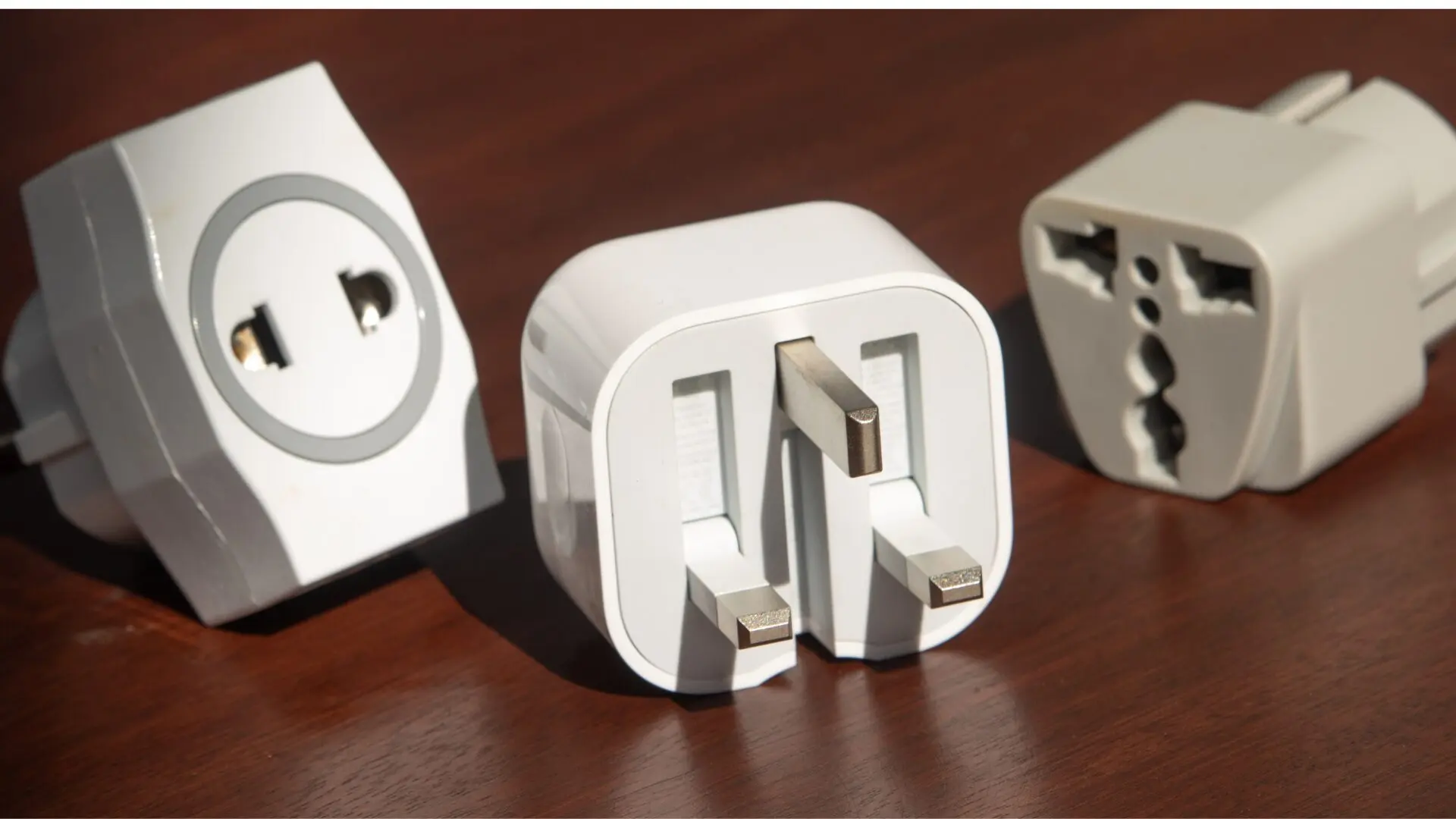
You’ve packed your passport, clothes, and enrolment documents, only to arrive and realise your phone won’t charge because the socket doesn’t fit your plug. One small detail can cause unnecessary stress. That’s why travel plug adapters matter more than most people expect.
This guide answers a simple question: which adapter should you bring for each Immerse Education destination?
You’ll find clear plug types, voltages, and practical advice to stay powered in every city, helping you feel prepared and confident.
Let’s explore what you need for Cambridge, Oxford, London, Sydney, New York, Toronto, San Francisco, Singapore, Boston, and Tokyo.
Understanding Global Plug Types
You’ll usually encounter fifteen major plug types, labelled A to O. These letters help you match your travel plug adapter to each destination. There are many plug types worldwide, but we’ll focus only on the ones you’ll actually use during your Immerse Education journey.
Examples of well-known plug shapes:
- Type A with two flat pins used widely in the US and Japan.
- Type B with two flat pins and a round grounding pin used in the US, Canada and Japan.
- Type C with two round pins used across Europe.
- Type G with three rectangular pins found in the UK and Singapore.
- Type I with angled flat pins used in Australia.
Voltage also shifts across regions.
- Many countries use 230 V.
- The US and Canada use 120 V.
- Japan uses 100 V.
This matters because plug shape and voltage are two separate things, and getting either wrong can damage your devices. Even if your adapter fits the socket, a different voltage can affect how safely your electronics run, which is why students need to understand both before they travel. We go into more detail later on whether you’ll need a voltage adapter or just a plug adapter, depending on where you’re heading and what you’re bringing.
So, What Travel Plug Adapter Do You Need for Each Immerse Education City?
Each Immerse Education city uses its own plug type and voltage. This means your travel plug adapter may change depending on where you go.
Most destinations use four plug types: Type G, Type I, Type A and Type B. These cover every city in our programmes.
Here is a simple table to help you prepare:
| Location | Plug Type | Voltage |
| Cambridge | Type G | 230 V |
| Oxford | Type G | 230 V |
| London | Type G | 230 V |
| Sydney | Type I | 230 V |
| New York | Type A and B* | 120 V |
| Toronto | Type A and B* | 120 V |
| San Francisco | Type A and B* | 120 V |
| Singapore | Type G | 230 V |
| Boston | Type A and B* | 120 V |
| Tokyo | Type A and B* | 100 V |
*Type A plugs have two flat pins and no grounding, which makes them suitable only for small, low-power devices. Type B plugs add a third pin for grounding, which is essential for higher-power electronics like laptops and anything with a metal casing. Because Type B sockets can also accept Type A plugs, international students should choose a Type B adapter, as it’s safer and works for all common devices they’re likely to bring.
A note on finding the right plug
The above table is a great place to start – based on your Immerse city, work out which “Type” you’re after.
However, once you start looking for your adapter, you’ll find that they are often referred to by more familiar or local names rather than the lettered “Type” system.
- Type G is commonly called the UK plug, British plug, or BS 1363, and you’ll also hear it described as the three-pin square plug used in the UK, Ireland, Singapore, and parts of the former Commonwealth.
- Type I is usually known as the Australian plug or Australian–New Zealand plug, sometimes called the angled flat-pin plug.
- Type A and B are typically called US plugs, North American plugs, or by their technical names NEMA 1 (Type A) and NEMA 5 (Type B), with Type B often described as the grounded US plug.
- Voltage is sometimes labelled as “UK voltage” or “European voltage” for 230 volts, and “US voltage” or “North American voltage” for 120 volts, especially in student or travel guides.
Artificial Intelligence
In-person
Explore Artificial Intelligence in Singapore, from technical specifics...

Natural Sciences
In-person
Explore the wonders of science in Cambridge, where...

Universal vs Single-Region Adapters
A universal adapter works in many regions, while a single-region adapter supports one plug type. Your choice depends on how many Immerse Education cities you plan to visit.
If you’re likely to only use your adapter in one place, a basic single-region adapter will be the cheaper option. For example, at Currys, this item is listed from £2.99.
If you have the budget for it, buy the universal one. The universal option usually gives better value, includes more features, often supports USB charging and works in every Immerse destination. A universal travel adapter from The Range costs around £11.99, and it covers several plug types you may need across continents.
You can also use it when you and your family travel, which makes it a practical choice beyond your programme.
Join the Immerse Education 2025 Essay Competition
Follow the instructions to write and submit your best essay for a chance to be awarded a 100% scholarship.

Do You Need a Voltage Converter?
It depends. You only need a voltage converter if your device is not dual-voltage. Most modern phones, tablets and laptops already support dual voltage, so they work safely in every Immerse Education city.
You can confirm this by checking the label on your charger. It usually shows a range such as 100–240 V, which means it adapts automatically when used abroad.
Some devices do not offer this flexibility. Hairdryers, curling tools and older chargers may only support one voltage, so they can overheat or stop working without a converter.
To stay safe, check your device details before you travel. Our pre-arrival guidance also helps you prepare with confidence.
FAQs
Do airports sell travel plug adapters?
Yes. Most major airports sell single-region and universal adapters, but prices are often higher than those in UK retailers, so buying before your trip is usually better.
Can I charge multiple devices with one adapter?
Yes, if your adapter includes USB ports. This lets you charge several devices at once, although you should check power limits to avoid overheating during travel.
Will my adapter work on trains or in shared accommodation?
Most adapters work anywhere with standard wall sockets. Trains and shared rooms may have limited outlets, so bringing a compact power bank helps significantly.
Do travel adapters expire or wear out?
Adapters can weaken over time through loose pins or heat damage. Checking for cracks, wobbly parts, or burnt marks ensures safer charging throughout your journey.
Conclusion
Travelling abroad feels exciting, and it’s often the small details that make your first days feel smooth and stress-free because a charged phone becomes your best companion.
You now know the plug types and voltages used in every Immerse Education city, which makes choosing the right travel plug adapter feel like one less thing to worry about as you prepare.
This preparation helps you settle in quickly and enjoy the freedom to navigate new streets with Google Maps, search for great cafés nearby and capture every moment without low-battery stress.
For more tips that make your journey easier, take a look at our blogs and explore guidance designed for you.