The Summer Science Program (SSP) is one of the most prestigious pre-university STEM experiences worldwide. Since 1959, it has welcomed motivated high school students into immersive, faculty-led research projects across top university campuses.

Unlike many summer schools, SSP focuses on doing real science. Over five weeks, participants join small teams to tackle authentic research challenges, using professional instruments and producing work recognised by the wider scientific community. 

With need-blind admissions and generous financial aid, SSP stands out as a highly selective but accessible pathway for academically driven students.

Here’s a detailed guide to SSP in 2026.

Course Breakdown

Programme TrackWho’s it for?DurationSubjects CoveredOutcomesCost (2026 based from 2025)
AstrophysicsHigh-school juniors with physics + precalculus5 weeks (Jun–Aug, multiple campuses)Celestial mechanics, Python programming, asteroid orbit determinationTeam research project; orbital data submitted to Minor Planet CenterMax family fee $9,800 (≈£7,500)
Bacterial GenomicsJuniors with biology + Algebra II5 weeksBacterial evolution, genome sequencing, bioinformaticsPoster/manuscript; hands-on lab skillsMax family fee $9,800 (≈£7,500)
BiochemistryJuniors with biology + chemistry5 weeksEnzyme characterisation, molecular modelling, inhibitor designPoster/report; research collaborationMax family fee $9,800 (≈£7,500)
Synthetic ChemistryJuniors with chemistry coursework5 weeksMacrocyclic catalyst synthesis, lab techniques, applications in energy/materialsPoster/manuscript; wet-lab masteryMax family fee $9,800 (≈£7,500)
Cell BiologyJuniors with biology coursework5 weeksCRISPR editing, yeast genetics, cancer biology linksPoster/report; gene-editing experimentsMax family fee $9,800 (≈£7,500)

Note: Check their official website for their current pricing.

Why Choose SSP?

The Summer Science Program gives ambitious high-school students the chance to contribute to authentic scientific research with outcomes recognised beyond the classroom. 

Astrophysics teams calculate asteroid orbits submitted to the International Astronomical Union’s Minor Planet Center, while at the same time, life sciences participants generate genome sequences, molecular models, or experimental manuscripts presented in poster form.

Each five-week session is designed to replicate the pace of professional science. Students commit around sixty hours per week to laboratory experiments, computational analysis, faculty lectures, and collaborative problem-solving. 

They live in supervised campus accommodation at universities such as UNC Chapel Hill, Purdue, CU Boulder, New Mexico State, and the University of Guelph, enjoying shared meals, field trips, and guest lectures. With around 36 participants per site, strong friendships and a supportive community culture quickly take root.

Ultimately, what makes SSP stand out is its rare combination of rigour, authenticity, and accessibility, reinforced by its need-blind admissions model.

Like SSP, Immerse Education values authentic research and hands-on exploration. However, where SSP focuses solely on STEM, we offer a broader choice of programmes across STEM, humanities, and social sciences.

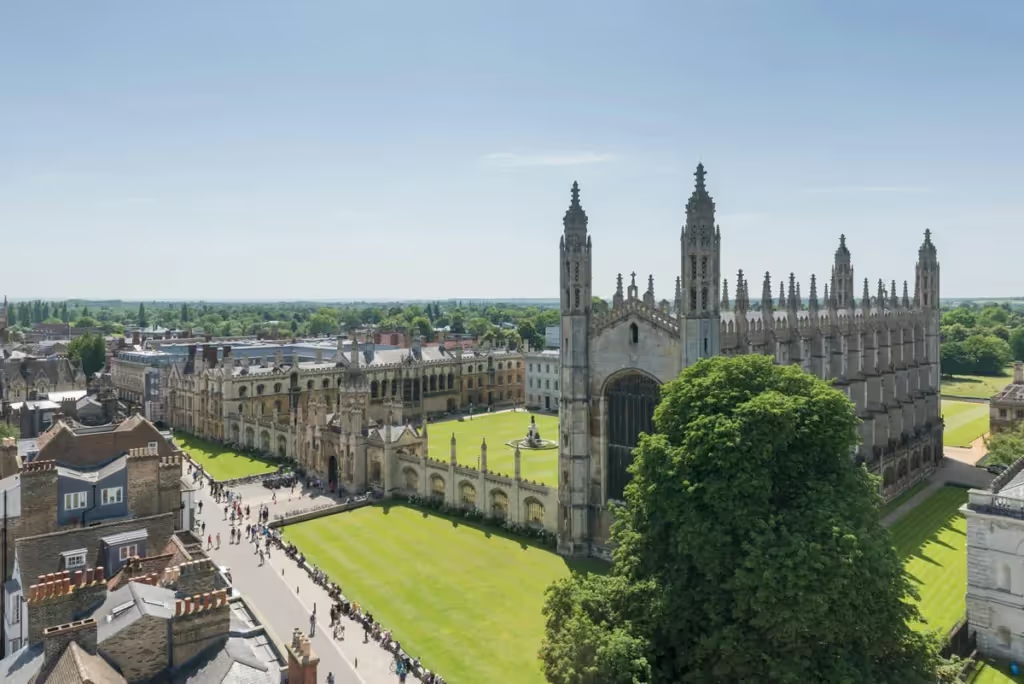
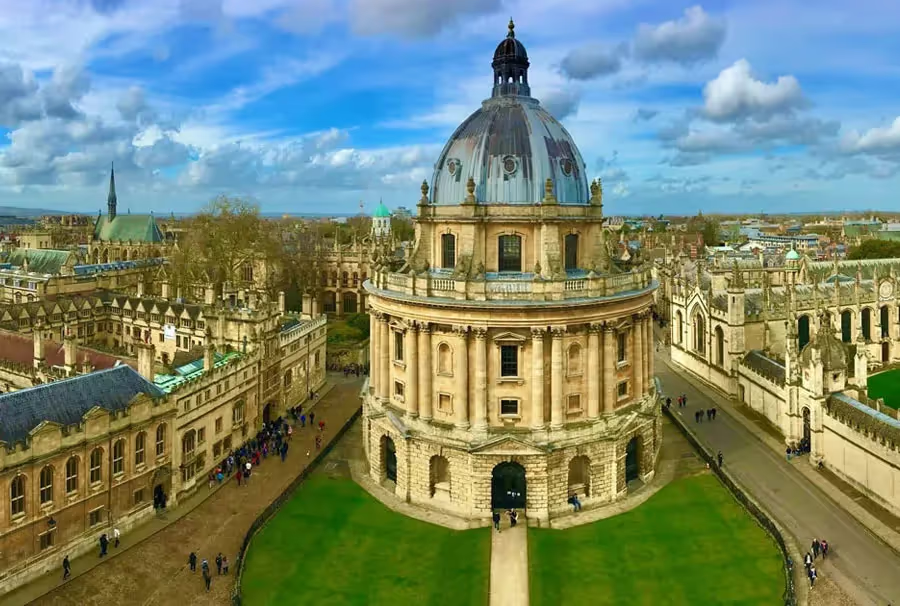
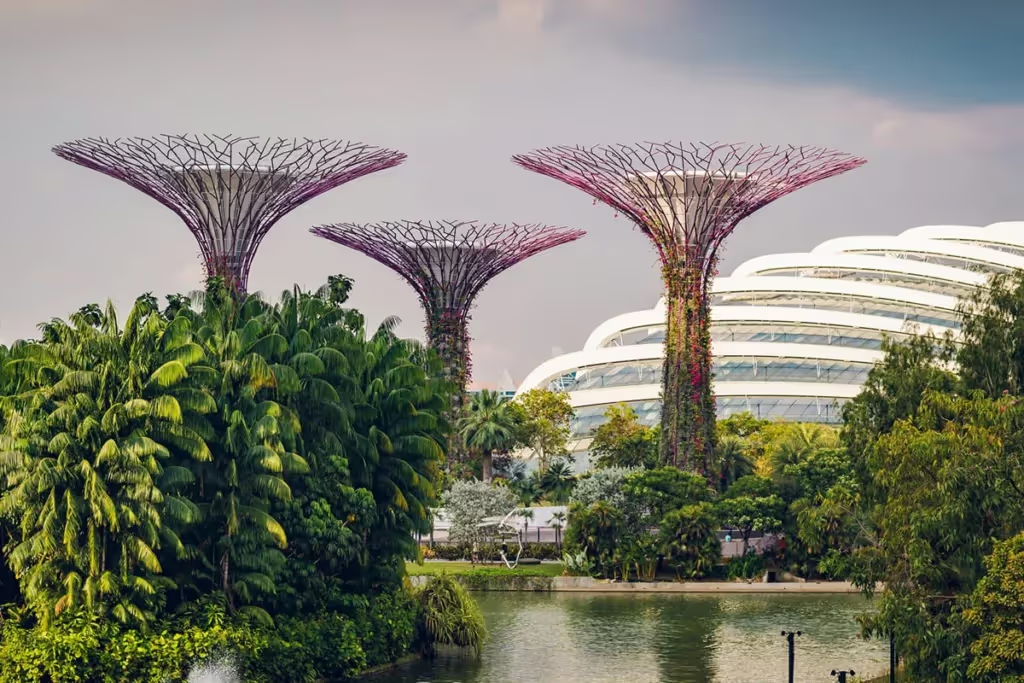
Our programmes are shorter at two weeks, making them more flexible, and run in multiple global locations from Oxford and Cambridge to London, New York, Sydney, Singapore, and Boston, plus 3 more locations. We also provide more affordable options, with residential fees for 2026 ranging from £5,995 to £7,495, while still delivering intensive, world-class academic experiences.

Key Features of SSP

The Summer Science Program runs for five weeks each summer, with students dedicating around sixty hours per week to authentic research. 

Each track combines laboratory work, computational analysis, and faculty-led seminars, guided by academic staff, PhD researchers, and guest lecturers from leading universities and industries.

Participants live in supervised university accommodation, share meals with peers and faculty, and take part in field trips, recreation, and social events that build a close-knit international community. Safeguarding and pastoral care ensure a supportive environment for ages fifteen to eighteen.

What sets SSP apart is its authenticity and accessibility: students produce real scientific outputs recognised by professionals, from asteroid orbital calculations to research posters. 

With highly selective admissions and a need-blind funding model, SSP remains one of the most rigorous and rewarding STEM experiences available to pre-university learners.

Advantages

  • Authentic research: Students use professional-grade equipment and produce outputs recognised by scientific bodies or suitable for publication.
  • Close mentorship: Small research teams receive direct supervision from university scientists and PhD researchers.
  • Prestige and history: Founded in 1959 with a respected alumni network in academia, technology, and industry.
  • University immersion: Residential life on campus with access to labs, libraries, and shared dining.
  • Collaborative community: Team-based projects emphasise cooperation and build lasting friendships.
  • Need-blind admissions: Admission is merit-based, with aid ensuring many attend free or at reduced cost.

Disadvantages

  • Highly selective: With only 500–600 places worldwide, admission is extremely competitive.
  • Intensive workload: Up to 60 hours per week of research and study can feel overwhelming.
  • Limited subject range: SSP focuses exclusively on five STEM tracks, with no humanities or interdisciplinary options.
  • Strict eligibility: Only current juniors with specific coursework can apply, excluding younger students.
  • Fixed duration: A single five-week block offers little flexibility compared to shorter or multiple-session programmes.
  • Geographic limits: All sites are in North America, requiring significant travel for international participants.

SSP vs Immerse Education

Immerse Education offers three core pathways: Academic Insights, Career Insights, and the Online Research Programme (ORP), combining university-style learning, real-world experience, and one-to-one research mentorship across global locations.

FeatureSummer Science ProgramImmerse Education
Age Range & AudienceHigh-school juniors (15–18); STEM-focused students seeking research immersionAges 13–18; students exploring university subjects or career pathways
AdmissionsFree application; need-blind; holistic review of ~500–600 places annuallyOnline application with places offered based on academic readiness, programme fit, and a B2+ English proficiency level.
Teaching & MentorshipResearch faculty and PhD mentors; small team-based projects; ~60 hours/week engagementTutors from Oxford, Cambridge & Ivy League; small tutorials; one-to-one support in research programme; over 20 hours of learning per week
Class Size~36 students per campus; research conducted in pairs or small teamsSmall tutorials (average of 7 students); one-to-one mentorship in research pathway
Academic DepthIntensive five-week research projects in five STEM tracksTwo-week academic tasters or online research projects, offering broader subjects and 40 hours of intensive, tutorial-style learning with assessed outputs.
Career Pathways & OutcomesProfessional research outputs (database submissions, posters, manuscripts); focus on STEM careersAcademic enrichment + career exploration; project-based learning in Career Insights; research outputs in Online Research Programme
Credit / RecognitionDocumentation of research participation and findings; no formal academic creditCertificate; research outputs can support university applications, with 8 UCAS points, 3 U.S. college credits for ORP, and potential tutor references for exceptional work.
DeliverablesResearch calculations, genome sequences, molecular designs, posters, or manuscriptsEssays, presentations, or supervised research projects with written evaluation
Learning EnvironmentFully residential on North American university campuses (US and Canada)Residential in Cambridge, Oxford, London, Boston, New York, San Francisco, Toronto, Singapore, Sydney, and Tokyo + online research option
Cultural & Industry ExposureField trips, guest lectures, campus life, STEM-focused cohortExcursions, guest speakers, industry visits in Career Insights, global cohort
Online OptionsIn-person only; no distance-learning formatDedicated Online Research Programme with both one-to-one PhD mentorship and group research programmes
Best ForSTEM students ready for intensive research; seeking authentic laboratory experience and professional outputsStudents exploring subjects broadly; wanting Oxbridge-style teaching or flexible online research mentorship

Is SSP Worth It?

For ambitious juniors passionate about STEM, the Summer Science Program is one of the most rigorous pre-university experiences. Its five-week format combines authentic laboratory work, professional-grade equipment, and close mentorship from faculty and PhD researchers. 

Participants produce genuine outputs, from asteroid orbit calculations submitted to international databases to research posters and manuscripts suitable for academic recognition. Opportunities of this depth are rarely available before university.

SSP also stands out for its need-blind admissions model. Families are assessed on merit alone, with generous financial aid allowing many to attend at reduced cost or free. 

However, places are highly competitive, with only 500–600 available worldwide. The programme is limited to five STEM tracks, requires prerequisite coursework, and demands around 60 hours of study each week.

For students seeking broader subjects, shorter commitments, and global flexibility, Immerse Education provides an excellent alternative. 

With Oxbridge-style tutorials, small-group teaching, and more than 20 subjects across STEM and humanities, Immerse delivers world-class academic preparation. Participants can choose from two-week residential programmes in Oxford, Cambridge, London, New York, Sydney, Singapore, and Boston, or opt for one-to-one and group online research mentorship

Fees for 2026 range from £5,995 to £7,495, making Immerse both prestigious and more accessible.

Alternatives to SSP

  • Immerse Education – Academic Summer School: Oxbridge-style subject exploration across humanities and sciences in Oxford, Cambridge, and Sydney.
  • Immerse Education – Career Insights: Project-based, industry-linked programmes in London, Boston, and Singapore.
  • Immerse Education – Online Research Programme: One-to-one research mentorship with PhD tutors, across disciplines from medicine to international relations.
  • Stanford Institutes of Medicine Summer Research Program (ages 16–18): Eight-week biomedical research internship at Stanford with lab placements and faculty mentorship.
  • UCSF Summer Student Research Program (ages 16–18): Biomedical and life-science research in San Francisco with lab and clinical projects led by UCSF mentors.

How to Apply for SSP

  1. Check Eligibility – Be a high-school junior (age 15–18) with required coursework completed by June (Astrophysics: physics + precalculus (or if you don’t have physics, calculus), Biochemistry: biology + chemistry + strong algebra skills; Bacterial Genomics: biology + algebra II, Synthetic Chemistry: chemistry + strong algebra skills)
  2. Choose Track & Campus – Select one of the five STEM tracks and indicate campus preferences in your application.
  3. Apply Online – The free application opens in December. Deadlines typically fall in late January for international applicants and late February for domestic applicants.
  4. Submit Materials & Await Decision – Provide transcripts and teacher recommendations; no test scores required. Decisions arrive March–April.
  5. Confirm Place & Prepare – If admitted, complete financial aid forms, medical and travel details, then attend orientation before beginning the five-week immersion.

Final Thoughts

The Summer Science Program delivers an intensive, five-week research experience on North American campuses, blending real lab investigation, faculty mentorship, and team projects. 

With need-blind admissions, generous aid, and professional outputs, it’s excellent preparation for STEM careers.

For broader subject choice, shorter programmes, and personalised guidance, Immerse Education is the stronger alternative. 

With STEM and humanities options, residential and online formats, and small-group or one-to-one mentorship, Immerse combines academic rigour with world-leading university settings to inspire lasting growth.