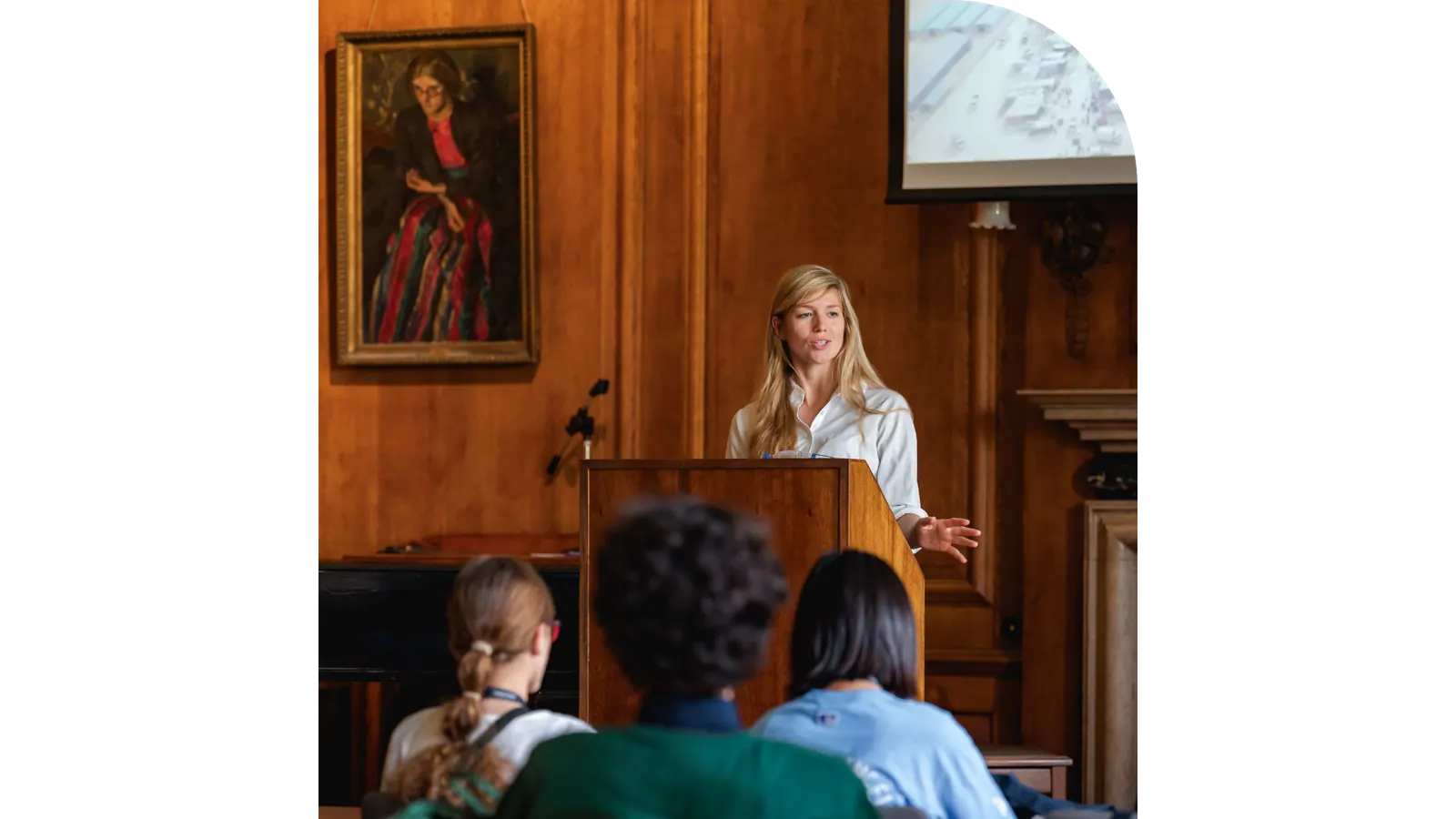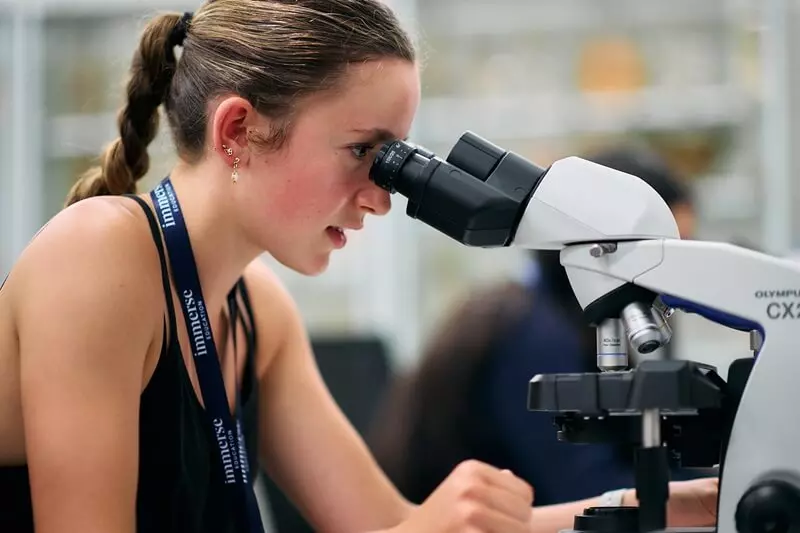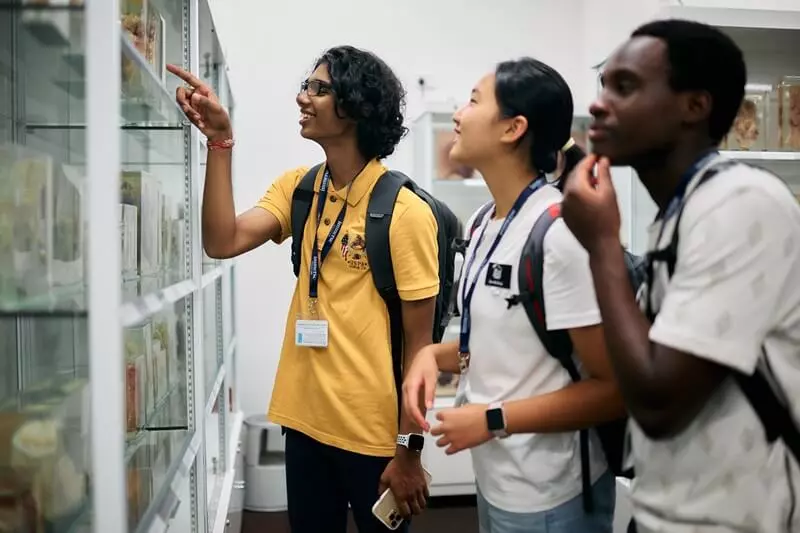
As a high school student interested in physics, you’ve probably felt both the thrill and the challenges of the subject. The equations might make sense on paper, but you may still wonder what physics really looks like beyond problem sets and whether a physics summer school could help you explore it more deeply. What does it mean to study physics the way university students do? And how can you find out before committing to it as a major, especially if you hope to study abroad?
These programmes offer one way to answer those questions. Imagine spending your summer in a university lab in Oxford or Toronto, working through experimental data with a mentor, debating quantum theory with classmates in Singapore, or tackling advanced mechanics problems in a classroom in Boston. In just a few weeks, you move from school-level familiarity to focused, in-depth exploration guided by instructors who treat you like a serious student of the field.
What physics summer schools are available for high school students?
Some physics summer schools focus on theoretical coursework, while others prioritize lab work or small-group research mentorship. You might join a university-hosted pre-college course, a physics research internship, or a subject-specific camp that pushes you into topics rarely covered in high school.
Importantly, not every program offers the same depth. Some stay introductory, while others expect you to grapple with university-level material and sustained project work. Choosing well is essential for a realistic sense of what a physics major demands.
To make that decision easier, we’ve put together a list of the 15 Physics Summer Schools for High School Students. They’ve been selected for their academic depth, research exposure, and serious engagement with the field of physics.
For more options, you can check out online STEM programs. To test your physics & science skills in a professional setting, have a look at STEM internship opportunities.
15 Physics Summer Schools for High School Students
1. Immerse Education’s Physics Summer School

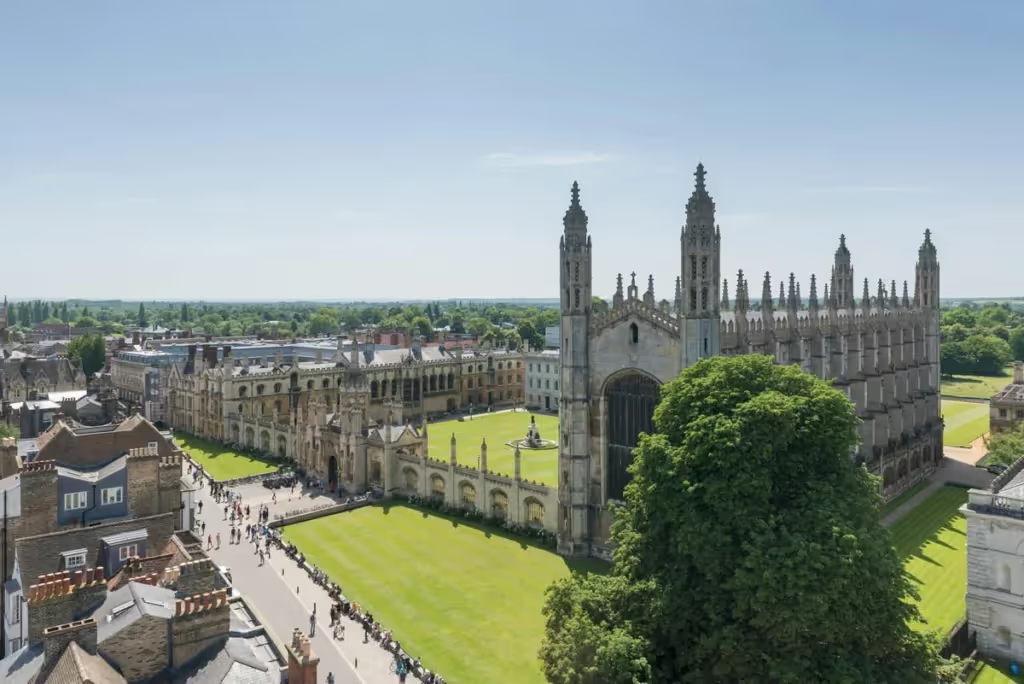
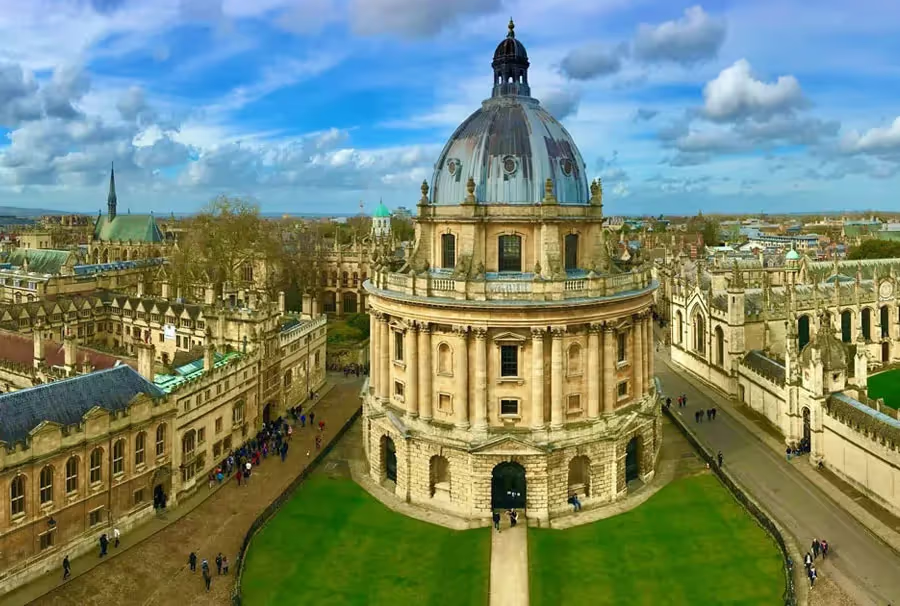
Location: Oxford, Cambridge, and Online
Cost/Stipend: Varies; summer school scholarship available through their bursary programme
Acceptance rate/cohort size: Selective, an average of 7 participants in a cohort
Dates: 2 weeks during the summer
Application Deadline: Multiple summer cohorts; rolling admissions.
Eligibility: Students worldwide aged 13-18 currently enrolled in middle or high school
Immerse Education’s Physics Summer School lets you experience university-level physics while living on campus. You’ll study core topics such as classical mechanics, quantum physics, and thermodynamics.
You’ll learn to apply theory to practical scientific questions through lab experiments, problem sets, and collaborative projects. Experienced tutors guide discussions and provide detailed academic feedback. By the end of the program, you will complete a personal project and receive a certificate of completion.
Why it stands out: You’ll gain exposure to academic life in a leading university, along with experience in physics.
2. Fermilab Program for Research in STEM Mentorship (PRISM)
Location: On-site and off-site work schedule
Cost/Stipend: $500 weekly stipend offered
Acceptance rate/cohort size: Highly competitive
Dates: July 13th – August 7th
Application Deadline: March 1st
Eligibility: High school seniors or recent graduates; must be a U.S. citizen; have proof of medical insurance; and have an Illinois high school enrollment
The Fermilab Program for Research in STEM Mentorship is a four-week summer program for high school seniors and recent graduates interested in advanced STEM fields. Each week centers on a different theme, including particle physics, quantum science, engineering design, and artificial intelligence.
You participate in hands-on activities, attend lectures led by Fermilab scientists, and tour active research facilities. You’ll work on a research project and receive mentorship from STEM professionals. By the end, you will submit a research abstract, create a poster, and deliver a final presentation.
Why it stands out: It places you in cutting-edge physics and engineering research environments, helping you gain hands-on experience with real experiments and advanced instrumentation.
3. CERN-Solvay Student Camp
Location: CERN campus, Geneva, Switzerland
Cost/Stipend: Free participation
Acceptance rate/cohort size: ~30 students per camp, selected from all over the world
Dates: April 19-25
Application Deadline: Not specified
Eligibility: High school students worldwide, aged 16+, with a good knowledge of English
The CERN–Solvay Student Camps are one-week residential experiences designed for high school students interested in experimental science. You live on CERN’s campus and observe how particle physics research operates inside one of the world’s leading laboratories.
During the week, you take part in interactive experiments at the Science Gateway, join small group lab activities, and visit working research sites. The schedule also includes lectures and open discussions with CERN and Solvay researchers about current discoveries and pathways into scientific careers.
Why it stands out: You’ll have rare access to CERN scientists and real particle-physics learning environments.
4. JHU CTY’s Advanced Topics in Physics: Special Relativity
Location: Johns Hopkins University, Baltimore, MD
Cost/Stipend: Residential $7,801/ Commuter $6,969 + $55 joining fee(if you are not a member of CTY yet) + in-person registration fee $75; Tuition and fees will be waived or reduced for students who qualify for financial aid
Acceptance rate/cohort size: Open enrolment
Dates: June 21st – July 10th, July 12-31
Application Deadline: May 11th for session 1, June 8th for session 2
Eligibility: Students worldwide in grades 9-12 who have completed Physics/ Trigonometry/ Algebra II/ Honors Algebra II
The Advanced Topics in Physics: Special Relativity course at Johns Hopkins University examines Einstein’s Special Theory of Relativity and its role in reshaping modern physics.
You’ll begin by studying the limits of Newtonian mechanics, then move into core ideas such as the principle of relativity, the constancy of the speed of light, time dilation, length contraction, and mass-energy equivalence. You will work through relativistic kinematics and dynamics, light cones, k-calculus, and Minkowski space.
Why it stands out: You’ll be introduced to advanced topics in physics that are rarely accessible to high school students and could serve as a foundation for future physics, engineering, or related studies.
5. University of Oxford Department of Physics: Year 12 Physics Summer School
Location: Varies based on placement
Cost/Stipend: Not specified
Acceptance rate/cohort size: Selective
Dates: TBA, typically take place in the last week of July
Application Deadline: Applications open in the Spring
Eligibility: Students who are currently in Y12, attending a non-fee-paying school, and living in Oxfordshire, Berkshire, or Buckinghamshire
The Year 12 Physics Summer School is a week-long, full-time placement designed to give A-level or equivalent students a realistic introduction to life in a university physics department. During the program, you are assigned a specific physics theme, such as particle physics or laser physics, and work on a focused project within that area.
Apart from project work, you’ll participate in departmental tours, sample lectures, and career talks that introduce research and professional pathways in physics. Placements also highlight technical, outreach, enterprise, and communications roles within the department, offering you a broader view of how a physics department operates.
Why it stands out: Direct involvement with the department’s technical, research, and operational teams gives you a rare view of how research at major universities operates.
6. Johns Hopkins University: ASPIRE High School Internship Program

Location: Virtual options available + mandatory in-person onboarding at APL, Laurel, MD
Cost/Stipend: No stipend
Acceptance rate/cohort size: Highly competitive
Dates: June 23rd – August 21st
Application Deadline: February 15th
Eligibility: Rising juniors or seniors; at least 15 years of age by June 1st; U.S. citizenship (green card holders are not eligible); Minimum 2.8 GPA; Permanent residence in one of the following Maryland counties: Anne Arundel, Baltimore (County or City), Calvert, Carroll, Charles, Frederick, Howard, Montgomery, Prince George’s; one of the following Virginia counties/cities: Alexandria, Arlington, or Fairfax; or the District of Columbia; Students in Calvert or Charles Counties are only eligible for virtual ASPIRE internship placements
The ASPIRE program at the Johns Hopkins Applied Physics Laboratory places high school juniors and seniors into research roles before college. You work closely with an APL mentor on applied math, data analysis, and physics projects that use statistics, modeling, and machine learning. Across at least 190 summer hours, you handle real datasets, test computational models, and interpret technical results.
Project options in the physical sciences have included building an Arduino-based tool to measure electromagnetic wavelengths, refining quantum algorithms using nuclear magnetic resonance methods, and developing an electric field sensor with web-based mapping software. The program concludes with a digital research poster where you present your process and findings.
Why it stands out: It gives you exposure to applied physics and engineering projects, helping you bridge classroom learning with real technical problem-solving.
7. Los Alamos National Laboratory Summer Physics Camp
Location: New Mexico School for the Arts, Santa Fe, NM
Cost/Stipend: Free for participants; a $350 stipend is provided upon completing the full program
Acceptance rate/cohort size: Competitive selection
Dates: June 8-19
Application Deadline: April 1st
Eligibility: High school students residing in New Mexico, tribal communities in New Mexico, or East Hawaii who have completed Algebra I or a higher-level math course
The Summer Physics Camp is a free, two-week residential program centered on STEM and energy security. Hosted at the New Mexico School for the Arts, scientists and engineers from Sandia National Laboratories and Los Alamos National Laboratory lead sessions and mentor students. You’ll work through projects in physics, engineering, bioengineering, chemistry, programming, and cybersecurity, with a focus on practical problem solving.
Past themes include electricity, gravitational waves, quantum systems, and microscopic biological processes. Alongside lab work, you receive guidance on résumé writing, interviewing, and education pathways connected to local colleges and U.S. Department of Energy national labs.
Why it stands out: You’ll learn how physics research translates into real-world projects, which can be valuable for future studies.
8. Northeastern University: Exploring Modern Physics
Location: Northeastern University, Boston, MA
Cost/Stipend: $7,095 (program tuition, course materials, housing, meals, and social activities). Need-based aid in the form of scholarships or program discounts is available
Acceptance rate/cohort size: Selective
Dates: July 26th – August 7th
Application Deadline: January 15th, February 27th, March 15th (priority, regular, late)
Eligibility: High school rising juniors and seniors from around the world who understand the basic concepts of physics, such as the topics of linear momentum and its conservation, and the conservation of energy in collisions. Students should also be aware of the basics of trigonometry, but calculus is not required
Exploring Modern Physics is a short academic program for high school students interested in advanced physics. You will directly detect cosmic rays using a cloud chamber and record particle data with an electronic muon counter. Topics covered in the classroom include special relativity, quantum mechanics, particle physics, and cosmology.
Core topics include antimatter, big bang nucleosynthesis, and radiation. By the end of the program, you can clearly explain modern physics concepts and connect them to your academic interests.
Why it stands out: You’ll examine key physics ideas through experiments and problem-solving, helping you experience how scientific thinking works beyond the high school level.
9. Quantum Systems Accelerator: QCamp
Location: Bay Area, CA, and Albuquerque, NM
Cost/Stipend: No cost/stipend offered
Acceptance rate/cohort size: Selective
Dates: June 29th – July 24th
Application Deadline: April 3rd
Eligibility: High school students who are 16 years or older by the beginning of the camp, live somewhat near Berkeley, CA, or Albuquerque, NM, and know basic algebra
The Quantum Computing, Mathematics, & Physics (QCaMP) is one of the most hands-on physics summer school options for high school students in the Bay Area, California, and Albuquerque, New Mexico. You begin with computing basics, including classical bits, logic gates, and core ideas from probability and statistics. In early lab sessions, you recreate the double slit and polarization experiments to ground quantum theory in direct observation.
In midweek lessons, the focus shifts to superposition and entanglement, with guided problem-solving that connects theory to computation. In the final stretch, you apply these concepts to an IBM Q research project, using quantum computing tools to test and refine your ideas.
Why it stands out: It provides immersive quantum science and research experiences, helping you explore cutting-edge physics and quantum computing concepts.
10. University of Chicago Neubauer Phoenix STEM Scholars
Location: University of Chicago, Chicago, IL
Cost/Stipend: $2,500
Acceptance rate/cohort size: Not specified
Dates: July 26th – July 31st
Application Deadline: Priority and regular deadlines vary annually
Eligibility: Open to current 11th-grade students in high school who are at least 15 years old; U.S. high school enrollment is required
Neubauer Phoenix STEM Summer Scholars begins with a virtual mathematics course, followed by a one-week residential experience in Chicago. After completing the online coursework, you live on campus and attend classes, faculty sessions, and guided tours of university facilities.
During the week, you’ll attend talks by professors and alumni in fields such as molecular engineering, mathematics, and computer science. You’ll go on site visits to Argonne National Laboratory, Fermilab, the Pritzker School of Molecular Engineering, and the Polsky Center for Entrepreneurship and Innovation.
Why it stands out: You’ll gain early exposure to cutting-edge research facilities and faculty that are at the heart of modern physics and STEM innovation.Source: University of Pennsylvania
11. University of Pennsylvania: Experimental Physics Research Academy

Location: University of Pennsylvania, Philadelphia, PA
Cost/Stipend: $10,050
Acceptance rate/cohort size: Highly competitive
Dates: July 11th – August 1st
Application Deadline: Rolling
Eligibility: Current high school students typically in grades 9-11; open to students from the United States and international students worldwide
The Experimental Physics Research Academy is a three-week residential program for high school students interested in mechanics, electromagnetism, quantum dynamics, and astrophysics. You attend daily lectures that move from kinematics and electricity to nuclear and modern physics, alongside sessions on experimental design, philosophy of science, and scientific ethics.
Most days include two or three lectures, one or two lab activities, and time for discussion or extra help. Faculty research talks introduce you to active projects at Penn, with Q and A sessions built in.
Why it stands out: It introduces you to advanced physics concepts, preparing you well for competitive STEM applications.
12. Research Science Institute (RSI)
Location: Massachusetts Institute of Technology, Cambridge, MA
Cost: Non-refundable application fee of $75; cost-free for all participants, all educational, housing, and dining expenses are covered
Acceptance rate/cohort size: Approx. 100 students globally; very selective
Application Deadline: December 10th
Dates: June 28th – August 8th
Eligibility: Students in their junior year of high school (11th grade), open to international students
The Research Science Institute is an intensive six-week summer program hosted at the Massachusetts Institute of Technology. The first week is devoted to advanced STEM seminars taught by MIT faculty. After that, you spend five weeks conducting an independent research project with close guidance from a graduate student mentor.
During this period, you practice reading technical journal articles, shape a research question, and develop a formal proposal. The program concludes with a written research paper and an oral presentation at a closing symposium.
Why it stands out: RSI gives you an immersive, university-level research experience where you contribute to original science at MIT with mentorship from active researchers.
13. Harvard-Smithsonian Science Research Mentoring Program (SRMP)
Location: Virtual or in person at the Center for Astrophysics | Harvard & Smithsonian (CfA) in Cambridge, MA
Cost: Paid
Acceptance rate/cohort size: 10-16 students
Application Deadline: May 10th
Dates: September – May
Eligibility: High school students in grades 10-12 attending Cambridge Rindge and Latin School
The Science Research Mentoring Program is hosted by the Center for Astrophysics, Harvard & Smithsonian, and is open to students from Cambridge Rindge & Latin School. Over the course of the academic year from September to May, you work on an independent astrophysics research project with direct guidance from a CfA scientist.
Each mentor supports a small team of two or three students, with a total cohort of about 10 to 16 participants annually. You meet weekly for research discussions and attend monthly advisory sessions with the SRMP team. The program concludes with a public symposium where you present your findings, and students receive stipends funded by the City of Cambridge.
Why it stands out: It pairs you with astrophysics researchers, helping you contribute to authentic astronomical research and data analysis.
14. Stanford Program for Next Generation Women in Physics (SPINWIP)
Location: Virtual
Cost: None
Acceptance rate/cohort size: Highly selective
Application Deadline: TBA
Dates: July 6-24
Eligibility: High school students in 9th-11th grade. Open to international students
The Stanford Program for Inspiring the Next Generation of Women in Physics is a three-week summer initiative designed for high school students, with a focus on girls from historically underrepresented groups. The Stanford Physics Department and the Kavli Institute for Particle Astrophysics and Cosmology run the program.
During the program, you explore topics such as quantum mechanics, quantum computing, astrophysics, and cosmology. You collaborate in small teams mentored by Stanford undergraduates, using coding to complete applied physics projects. The experience also includes faculty lectures and workshops on college and careers in physics.
Why it stands out: It prioritizes young women and gender-expansive students, giving them direct access to Stanford physicists and hands-on physics experiences in a highly supportive environment.
15. Science Program (SSP) – Astrophysics
Location: Hosted at multiple universities, check here
Cost: Free for participants with a family income of $75,000 or less; for more details, check here
Acceptance rate/cohort size: Highly selective
Application Deadline: TBA
Dates: Dates vary depending on the campus; check here
Eligibility: Students in their junior year (or international equivalent) who will be 15 to 18 for the full programme
The Summer Science Program in Astrophysics places you in a small research cohort focused on tracking near-Earth asteroids through direct observation and computation. During the latest project on Asteroid Orbit Determination, you’ll select a target object, draft an observing proposal, and collect telescope images with your team.
You measure the asteroid’s position against background stars, then write Python code to calculate its velocity and orbital elements using calculus and celestial mechanics. You work with tools such as JupyterLab, Astropy, and Matplotlib to process data and model trajectories. Your final calculations are submitted to the Minor Planet Center, contributing to ongoing efforts to refine predictions of asteroid paths.
Why it stands out: It involves a gradual progression to advanced courses, mirroring undergraduate studies.
Discover the Books Behind Great Physics Thinking
A summer spent studying physics can change how you see the subject, turning abstract ideas into real questions, experiments, and possibilities for future study.
The right physics summer school gives you direct insight into how physicists test evidence, solve problems, and approach the subject with depth, focus, and curiosity.
That kind of experience often leads to deeper academic ambition, helping you understand what advanced physics involves and why the subject remains compelling beyond summer.
Read our Physics Top Books Guide now before your summer momentum slips, and discover the titles that can sharpen your thinking, deepen your understanding, and push your physics further.