
 Русский (RU)
 Українська (UK)
 Türkçe (TR)
 Italiano (IT)
 Français (FR)
 Português (PT)
 中文 (中国) (ZH)
 Español (ES)
 日本語 (JA)
 ไทย (TH)
 Deutsch (DE)
 Ελληνικά (EL)
 Polski (PL)
 Bahasa Indonesia (ID)
 Nederlands (NL)
 العربية (AR)
 한국어 (KO)

Mathematics is often associated with equations and classroom problem sets, but higher-level study goes far beyond finding the right answer. Math summer programs in Singapore for high school students can show how mathematicians approach complex problems, construct rigorous proofs, analyse patterns, build statistical models, and apply computational methods to real-world questions.
Many programmes introduce topics rarely covered in high school, such as number theory, combinatorics, game theory, mathematical modelling, and data science, while strengthening logical reasoning and quantitative analysis. Beyond academics, these experiences can help you learn from university faculty, collaborate with like-minded peers, and understand the pace of higher education through lectures, workshops, research projects, and enrichment activities.
Why Singapore?
Singapore has established itself as one of Asia’s leading hubs for mathematics, science, and technology education. Home to globally recognized institutions such as the National University of Singapore (NUS) and Nanyang Technological University (NTU), the country offers students access to strong academic departments, research facilities, and enrichment opportunities that emphasize analytical thinking and problem-solving.
Singapore’s education system is also known for its emphasis on mathematical rigor, making it a natural destination for students interested in advancing beyond the standard high school curriculum.
Whether through Olympiad training, research mentorship, data science workshops, or university-led mathematics enrichment programs, you gain exposure to both theoretical and applied aspects of the field. Combined with its international student community, modern infrastructure, and strong connections to industries such as finance, technology, and engineering,
So, to help you find the right fit, we’ve put together a list of 15 math summer programs in Singapore for high school students.
For adjacent opportunities, consider the online math program.
Key Takeaways
- Costs range from free, as with the NTU Nanyang Research Programme and Microsoft GitHub Copilot Bootcamp, to about SGD 5,450 for NUS College Summer School’s international rate.
- Several free programs are restricted to Singapore students, including the Microsoft GitHub Copilot Bootcamp and Goldman Sachs AI Illuminator Coding Workshop.
- Programs increasingly frame math through applied lenses, including FinTech and quantum science at NTU’s Future Exploration Programme and business analytics at NUS SCALE.
- SIMOC requires students to have already earned a Bronze, Silver, or Gold medal in a recognized math competition, making it one of the more selective options on this list.
- Program length ranges from a single week, as with most NUS and NTU short courses, to multi-month commitments such as the NTU Nanyang Research Programme.
- Several NUS SCALE courses, including Data Analytics and Mathematical Statistics, are offered in blended online or on-campus formats running from June through August.
- Immerse Education’s Math Summer School is one of the few options open to students worldwide aged 15 to 18, combining small classes of around 7 participants with one-on-one tutoring across algebra, calculus, and statistics.
15 Math Summer Programs in Singapore for High School Students
1. NUS SCALE Youth Programme – AI & Machine Learning Fundamentals
Location: National University of Singapore (NUS), Singapore (online and on-campus options available)
Cost: ~SGD 2,680
Acceptance rate/cohort size: Selective; typically up to 30-40 students per class
Dates: June 29th – July 3rd
Application Deadline: Rolling admissions
Eligibility: Pre-university and high school students in grades 10-12; must be at least 15 years old at the start of the program; English proficiency is required; open to international students
In this program, you explore what artificial intelligence and machine learning are, how their basic principles work, and how they are being applied in modern businesses. For students comparing math summer programs in Singapore for high school students with an applied technology focus, this option connects quantitative reasoning to patterns, models, data interpretation, and machine-learning decisions.
You attend five on-campus classroom sessions, use Orange on your laptop, review material outside class, prepare a presentation, and complete a team project. You build basic AI awareness, data-handling confidence, analytical thinking, teamwork, and presentation skills.
Why it stands out: It gives high school students a no-prior-coding-required introduction to AI and machine learning at NUS, with project-based assessment and an NUS SCALE e-Certificate for successful participants.
2. Immerse Education’s Math Summer School

Location: London, Cambridge, Oxford, and Tokyo
Cost/Stipend: Varies; summer school scholarship available through our bursary programme
Acceptance rate/cohort size: Selective; an average of 7 participants per class
Dates: 2 weeks during the summer
Application Deadline: Multiple summer cohorts; rolling admissions.
Eligibility: Students from all countries aged 15-18 currently enrolled in middle or high school
Immerse Education’s Mathematics Summer School allows you to dive deep into mathematical theories over two weeks. You will spend your time learning and solving problems in algebra, calculus, and statistics. In addition to solving problems, you will also analyze different math theories and work on group projects.
Other components of the program include attending seminars conducted by experts, one-on-one tutoring sessions, group workshops, research projects, and more, all of which aim to help you build a strong foundation in mathematics.
Why it stands out: Its mix of rigorous math academics taught by esteemed faculty and provision of residential programs at campuses will help you gain an accurate picture of life as a math undergraduate student.
3. NUS Science Summer Camp
Location: NUS Kent Ridge Campus, Singapore
Cost: SGD 2,950
Acceptance rate/cohort size: Selective; cohort size not disclosed
Dates: June 29th – July 3rd
Application Deadline: Rolling admissions
Eligibility: Students in grades 10-12 with good English proficiency and an interest in science and mathematics; open to international students
This program introduces students to university-level STEM learning through a combination of lectures, demonstrations, and hands-on workshops. While the curriculum spans multiple scientific disciplines, mathematical thinking plays an important role in areas such as data analysis, scientific modelling, and machine learning concepts.
You attend sessions led by university professors and engage in laboratory activities that encourage experimentation and problem-solving. Beyond academics, students stay in campus accommodation, participate in field trips, and collaborate with peers from across Asia. The programme provides a broad perspective on how mathematics supports scientific discovery and innovation. It also offers valuable exposure to life at a major research university.
Why it stands out: It blends residential campus life with hands-on STEM learning, allowing students to explore how mathematics is applied across different scientific disciplines.
4. NTU Academy for Professional and Continuing Education – GenAI Bootcamp: AI Skills for the Digital Future
Location: Nanyang Technological University, Singapore
Cost: S$3,106.50 standard fee (S$2,943 per person for group registration of two or more students registering together)
Acceptance rate/cohort size: Open-enrollment; cohort size is not specified
Dates: June run: June 20th – July 3rd | August run: August 3-7
Application Deadline: June run: May 11th | August run: June 15th
Eligibility: All high school students; open to international students
This program introduces generative AI through foundational models, prompting, AI co-pilots, and agentic systems. You engage with the quantitative foundations behind these tools by examining how models like GPT and diffusion systems work and by using AI co-pilots for data analysis and structured problem-solving.
You practise with ChatGPT, GitHub Copilot, Midjourney, and Canva AI, then collaborate in teams on a Group Presentation Challenge that applies AI concepts to real-world scenarios. You also visit NTU research labs and an industry site, and attend an admissions talk. You leave with practical AI fluency and analytical reasoning skills for academic and future career projects.
Why it stands out: It pairs hands-on training in today’s leading AI co-pilots with direct access to NTU’s research labs, faculty from the College of Computing and Data Science, and a team-based challenge that applies AI to real-world problems.
5. NTU – Inspiring NTU: Future Exploration Programme
Location: Nanyang Technological University main campus, Singapore
Cost: June run S$3,542.50 standard fee (S$3,379 group rate for two or more registering together); July run S$3,106.50 standard fee (S$2,943 group rate)
Acceptance rate/cohort size: Open-enrollment; cohort size not specified
Dates: June Run: June 22-26; July Run: July 20-24
Application Deadline: June run: March 25th; July Run: May 25th
Eligibility: Currently enrolled high school, junior college, or pre-university student; aged 16 and above with a good command of English; open to international students
In this program, you explore how mathematical principles drive quantum science, work through the modelling logic behind FinTech topics such as digital payments, blockchain, and cryptocurrencies, and examine the machine-learning ideas shaping AI and society. Through faculty-led seminars, guided visits to NTU’s research facilities such as the Robotics Research Centre and Singapore Centre for 3D Printing, and a campus tour with student ambassadors, you connect abstract reasoning to real engineering and finance applications.
You also attend an admissions talk from the NTU Office of Admissions and sharpen your analytical, problem-solving, and research literacy skills. The experience strengthens quantitative reasoning while exposing you to NTU’s interdisciplinary research culture.
Why it stands out: It pairs faculty-led seminars in quantum science, FinTech, and AI with hands-on visits to NTU’s advanced research labs, letting you see how mathematical and computational reasoning powers real-world innovation at one of the world’s top young universities.
6. SMU Young Leaders Summer Programme
Location: Singapore Management University (SMU), Singapore
Cost: SGD 3,500
Acceptance rate/cohort size: Competitive; limited number of spaces available
Dates: July 13-18
Application Deadline: May 17th
Eligibility: Students graduating from high school in program year + 1 year or + 2 year (typically ages 16-18); open to international students
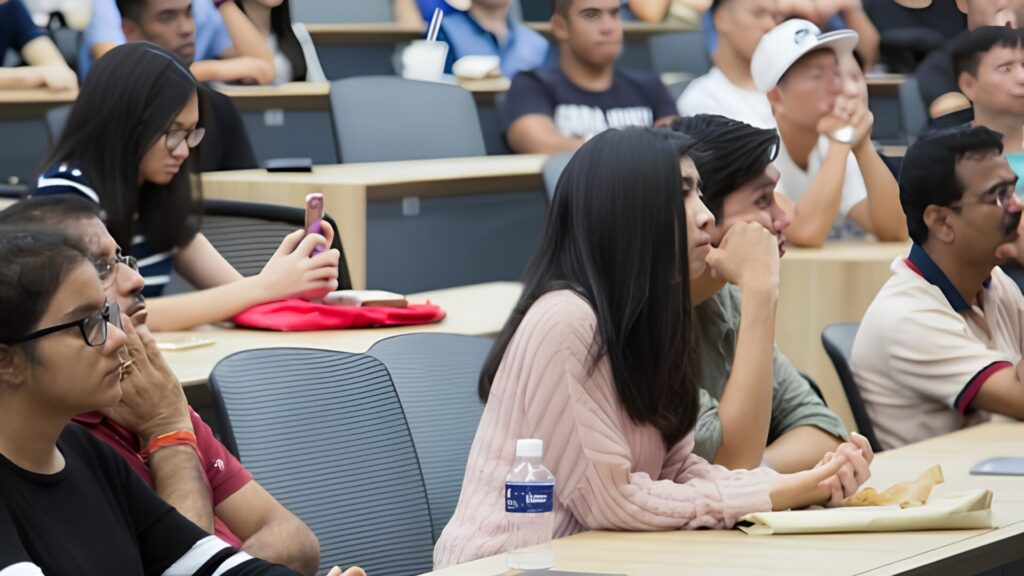
This week-long residential programme explores how analytical thinking, leadership, and technology intersect in today’s world. Through workshops, discussions, and group projects, you will examine topics such as digital transformation, smart cities, and data-driven decision-making. The programme places a strong emphasis on collaboration, requiring students to work in teams to develop and present solutions to contemporary challenges.
Alongside academic sessions, you’ll experience life on an urban university campus and interact with peers from dozens of cities worldwide. For students considering mathematics, data science, economics, or technology-related majors, the programme offers insight into how quantitative skills are applied beyond the classroom. You also complete a final presentation to develop communication and problem-solving skills.
Why it stands out: It combines leadership training with exposure to analytics, technology, and university life, helping students understand how quantitative skills are used in real-world decision-making.
7. NUS SCALE / NUS College – NUS Youth Programme: Data Analytics and Mathematical Statistics
Location: National University of Singapore, Singapore; offered as a blended online programme or as an on-campus programme
Cost: Fees provided upon enquiry
Acceptance rate/cohort size: Open enrollment; cohort size not specified
Dates: June – August
Application Deadline: Rolling admissions
Eligibility: High school and pre-university students; at least 15 years old at the start of the programme; comfortable communicating in English; open to international students
In this program, data analytics becomes a practical entry point into mathematical statistics and quantitative reasoning. Among math summer programs in Singapore for high school students, it is especially useful if you want to learn how to extract insights from data, test hypotheses, and use evidence to support or challenge arguments.
You apply these statistical reasoning methods in a group project, then deliver a final project presentation assessed alongside a quiz. The course helps you become a more critical consumer of data. You finish with an NUS SCALE e-Certificate of Completion and Assessment Report, with a commendation letter for the top-scoring project team.
Why it stands out: It frames data analytics as a discipline of mathematical statistics and quantitative reasoning, pairing logic-driven analysis with a graded group project and a credentialed NUS SCALE certificate and assessment report.
8. NTU Nanyang Research Programme (NRP)
Location: Nanyang Technological University, Singapore
Cost: None
Acceptance rate/cohort size: Selective; cohort size not specified
Dates: April 13th – March 5th
Application Deadline: February 24th
Eligibility: Junior College 1 students and Year 5 Integrated Programme students; open to international students
The Nanyang Research Programme offers a long-term research experience that closely mirrors undergraduate academic work. Participants are paired with NTU faculty members and spend several months conducting research within their chosen discipline. Depending on the project, students may apply mathematical modelling, statistical analysis, computational techniques, or quantitative reasoning to investigate a research question.
Along the way, you’ll learn how to review academic literature, analyse data, document findings, and communicate results effectively. The programme culminates in a research paper and oral presentation, providing experience with processes commonly encountered at university. For students interested in mathematics, data science, engineering, or research careers, it offers substantial exposure to academic inquiry.
Why it stands out: Students work directly with university researchers on sustained projects, producing outputs that resemble undergraduate-level research rather than short-term summer assignments.
9. Singapore International Mathematics Olympiad Challenge (SIMOC)
Location: Singapore
Cost/Stipend: Varies by participation package; scholarships available
Acceptance rate/cohort size: Selective; approximately 1,600-2,500 participants
Dates: July 17-21
Application Deadline: Mid-to-late May
Eligibility: Students in grades 1-12; must have previously achieved a Bronze, Silver, or Gold medal in the AMO or SASMO, or a Silver or Gold in the SMGF; open to international students
SIMOC brings together mathematically talented students from around the world for several days of competition, collaboration, and enrichment. Participants tackle challenging problems across algebra, geometry, combinatorics, number theory, and logical reasoning while competing individually and in teams. Beyond the contest component, students take part in puzzles, strategy challenges, and collaborative activities that encourage communication and creative problem-solving.
The international nature of the event creates opportunities to meet peers who share a strong interest in mathematics and Olympiad-level thinking. Awards, medals, and certificates are presented based on performance, providing formal recognition of achievement. Students interested in advanced mathematics will find exposure to a wide range of problem-solving approaches and perspectives.
Why it stands out: It combines rigorous mathematical competition with international teamwork, creating an environment where students can challenge themselves academically while building a global network of peers.
10. NUS SCALE / NUS School of Computing – Introduction to Business Analytics
Location: National University of Singapore campus, Singapore
Cost: Confirmed through individual enquiry or school/company group booking
Acceptance rate/cohort size: Open enrollment; class size is not publicly specified
Dates: June – August
Application Deadline: Rolling admissions
Eligibility: High school students in Grade 10-12 and pre-university students with an interest in business analytics; at least 15 years old at the start of the programme; open to international students
In this program, you explore business analytics through the lens of structured, data-driven problem-solving, learning how organisations define needs and recommend solutions that deliver value. Guided by a Senior Lecturer from the NUS School of Computing whose expertise spans data analytics, data visualisation, and predictive analytics, you examine what business analysis is and the role of a business analyst in organisational problem solving.
You work through the Business Analysis Body of Knowledge, the business analysis process, and the skillsets a business analyst must have. Through a group project presentation, you analyse data and information and apply analytical reasoning to justify practical recommendations. You complete the on-campus course with an NUS-issued e-Certificate.
Why it stands out: It rewards successful participants with an e-Certificate of Completion and Assessment Report issued by NUS SCALE, while the project team with the highest score also receives a commendation letter.
11. NUS SCALE / Saw Swee Hock School of Public Health – Introduction to Artificial Intelligence and Generative AI in Healthcare
Location: NUS campus, Singapore; delivered on campus across five 3-hour in-classroom sessions
Cost: Confirmed through individual enquiry or school/company group booking
Acceptance rate/cohort size: Open-enrollment; small, team-based group setting
Dates: June – August
Application Deadline: Rolling admissions
Eligibility: Pre-university and high school students in grades 10-12; minimum age 15 at the start of the programme; open to international students
This program introduces how artificial intelligence and generative AI work and reshape healthcare. Across foundations of AI, machine learning and deep learning, and AI ethics, you examine the conceptual mathematics behind how neural networks, large language models, and generative models operate.
Through interactive lessons and real-life healthcare case studies, you trace how data and model-based reasoning support tasks like medical imaging and personalised medicine. You then work in a team to develop, coach, and present a project proposing an innovative AI solution to a health problem. A complimentary campus tour and industrial learning journey round out the experience, and no coding background is required.
Why it stands out: It is an on-campus NUS programme that lets pre-university students explore the AI and generative-AI models behind modern healthcare with no prior coding required, culminating in a team project and an NUS-issued e-Certificate of Completion.
12. Microsoft GitHub Copilot Bootcamp – Secondary School / Junior College
Location: St. Patrick’s School, 490 East Coast Road, Singapore 429058
Cost: None
Acceptance rate/cohort size: Selective; cohort size not specified
Dates: June 3rd, 4th, 5th, and 8th
Application Deadline: May 20th
Eligibility: Students enrolled in a Singapore MOE secondary school or junior college; priority given to Infocomm Media Club members when response is heavy; not open to international students
In this program, you build games and web apps using Microsoft’s GitHub Copilot and Visual Studio Code, choosing either the Unity and C# game track or the HTML, CSS, and JavaScript web track. Quantitative and spatial reasoning surfaces most in the game track, where you work with Unity’s coordinate space, vectors, and a physics engine to build projects such as 2D platformers, 3D physics-based games, and first-person shooters.
You translate game logic and movement into code, using Copilot to scaffold features and debug while reasoning through the numerical relationships involved. You also apply design principles, problem-solving, and an industry-standard development workflow across both tracks.
Why it stands out: It is a free, IMDA-funded bootcamp that lets Singapore secondary school and junior college students build real games and web applications with GitHub Copilot and Visual Studio Code under Tinkercademy, a Microsoft Global Training partner.
13. NUS College Summer School

Location: NUS College, University Town, Singapore
Cost/Stipend: SGD 2,725 (Singaporeans/PRs); SGD 3,978.50 (ASEAN); SGD 5,450 (International)
Acceptance rate/cohort size: Selective; small-group sizes
Dates: June 21-27
Application Deadline: Rolling admissions
Eligibility: Students aged 16-18; open to international students
NUS College Summer School offers a residential academic experience that mirrors the interdisciplinary approach of an undergraduate honours program. As one of the broader math summer programs in Singapore for high school students, it shows how mathematical and analytical reasoning can support work in artificial intelligence, sustainability, urban systems, and other complex challenges that require evidence-based solutions.
A major component of the program is the Synthesis Lab, where teams collaborate to develop and present solutions to real-world problems. Living on campus allows students to experience university life while working closely with peers from different academic backgrounds. The program helps students understand how mathematics interacts with fields such as technology, economics, and social sciences.
Why it stands out: Its interdisciplinary curriculum shows how mathematical thinking can be applied across multiple fields while providing a residential university experience.
14. Singapore Thailand Science Immersion Programme
Location: National University of Singapore (NUS), Singapore
Cost: Approximately SGD 2,850
Acceptance rate/cohort size: Selective; 40 students
Dates: May 5-10
Application Deadline: February 28th (Rolling admissions)
Eligibility: Thai high school students (Mathayom 3-6); open to international students
The Singapore Thailand Science Immersion Programme introduces students to university-level STEM learning through lectures, workshops, and collaborative activities. Mathematics serves as a foundation throughout the program, supporting scientific inquiry, experimentation, and analytical problem-solving. You engage with NUS faculty and gain exposure to academic approaches that extend beyond the standard high school curriculum.
The program also incorporates excursions that showcase Singapore’s scientific and technological landscape. A concluding science challenge encourages students to apply concepts learned throughout the week in a team-based setting. By combining academic enrichment with cultural exchange, the program offers a compact introduction to STEM education in Singapore.
Why it stands out: It combines mathematics-based scientific learning with international academic exchange, giving students exposure to university-level STEM in a short-term format.
15. Goldman Sachs AI Illuminator Coding Workshop – Secondary School
Location: Singapore
Cost: None
Acceptance rate/cohort size: Selective; cohort size not specified
Dates: June 4-5
Application Deadline: Application closing date is not publicly specified for the current cycle
Eligibility: Secondary school students; requires a Google or Gmail account; not open to international students
In this program, you learn basic Python and core artificial intelligence concepts while programming Raspberry Pi microcontrollers. You wire and code components such as sensors and LEDs, then build Telegram bots that come together in a sustainability-themed project. Working with sensor inputs and the conditional logic that controls them gives you practical exposure to the computational and logical reasoning that underpins programming.
You also interact with Goldman Sachs professionals, who connect the technical work to real applications of technology in finance. Throughout, you practice structured problem-solving, debugging, and step-by-step logical thinking. The result is an accessible first step into coding, AI, and computational reasoning.
Why it stands out: It pairs an introductory, project-based path into Python and AI on real Raspberry Pi hardware with direct access to Goldman Sachs professionals who link the coding to how technology is used in finance.
Frequently Asked Questions: Math Summer Programs in Singapore for High School Students
What is a math summer program for high school students?
A math summer program introduces students to mathematical topics and ways of thinking that go beyond the standard school curriculum, such as data science, mathematical modelling, or competition style problem solving. Programs typically combine lectures, workshops, and group projects, often hosted at universities like NUS and NTU. Most run between one week and several months. Many conclude with a presentation, certificate, or formal research paper.
Do I need to be exceptionally advanced in math to apply?
It depends on the program. SIMOC requires students to have already earned a Bronze, Silver, or Gold medal in a recognized math competition, making it one of the more selective options here. Immerse Education’s Math Summer School is built to be accessible to students with a genuine interest in math, focusing on building a strong foundation in algebra, calculus, and statistics through small classes and tutoring.
How much do math programs in Singapore cost?
Costs range from free to about SGD 5,450 for NUS College Summer School’s international rate. Free options include the NTU Nanyang Research Programme and Microsoft GitHub Copilot Bootcamp, while mid-range programs like NUS Science Summer Camp run around SGD 2,950 to SGD 3,500. Immerse Education’s Math Summer School offers bursary support for eligible students.
Can international students attend these programs?
Most NUS and NTU programs, including NUS SCALE’s courses and NTU’s GenAI Bootcamp, are open to international students. A smaller set of free, government funded programs, like the Microsoft GitHub Copilot Bootcamp and Goldman Sachs AI Illuminator Workshop, are restricted to Singapore students. Immerse Education’s Math Summer School is open to students worldwide aged 15 to 18.
How is math applied beyond pure theory in these programs?
Several programs frame mathematics through real world applications rather than abstract theory alone. NTU’s Future Exploration Programme connects mathematical principles to quantum science and FinTech topics like blockchain and digital payments, while NUS SCALE’s Introduction to Business Analytics applies quantitative reasoning to organizational decision making. Immerse Education’s Math Summer School balances this by combining theoretical study in algebra, calculus, and statistics with group projects and research work.
What age do I need to be to apply?
Age requirements generally fall between 15 and 18, though some programs set narrower ranges. NUS SCALE programs typically require students to be at least 15, while SMU’s Young Leaders Summer Programme targets students closer to 16 to 18. Immerse Education’s Math Summer School accepts students aged 15 to 18 from anywhere in the world.
How do these programs help with college applications?
Participating in a math program demonstrates intellectual curiosity and a willingness to engage with material beyond the school curriculum. SIMOC provides formal recognition through medals and certificates based on competition performance, while Immerse Education’s Math Summer School offers seminars, research projects, and detailed feedback that students can reference in personal statements. Both give students concrete experiences to discuss in interviews.
What’s the difference between competition-focused and enrichment-focused programs?
Competition-focused programs, like SIMOC, require prior achievement and center on solving challenging problems under contest conditions. Enrichment-focused programs, such as Immerse Education’s Math Summer School and most NUS SCALE courses, are designed to introduce new topics and build foundational skills regardless of competition background. The right choice depends on whether you’re looking to test existing skills against peers or build new ones in a supportive setting.
Go Beyond Programmes With Great Maths Books
Strong mathematics starts with curiosity, but it grows through repeated challenges that teach you to reason, test ideas, and communicate clearly.
Math summer programs in Singapore for high school students can introduce you to mathematical modelling, statistics, AI, data analytics, Olympiad reasoning, and research methods.
Those experiences can show whether pure maths, data science, analytics, computing, finance, or scientific research feels most aligned with your future.
Want to keep that momentum going? Visit our Mathematics Top Books Guide for carefully chosen reads that strengthen skills beyond summer.