
 Русский (RU)
 Українська (UK)
 Türkçe (TR)
 Italiano (IT)
 Français (FR)
 Português (PT)
 中文 (中国) (ZH)
 Español (ES)
 日本語 (JA)
 ไทย (TH)
 Deutsch (DE)
 Ελληνικά (EL)
 Polski (PL)
 Bahasa Indonesia (ID)
 Nederlands (NL)
 العربية (AR)
 한국어 (KO)

If you’ve been wondering what studying a subject at university is really like, or what campus life feels like before you apply, pre-college programs in Japan for high school students can be a strong way to find out. They let you step beyond your regular school classes and experience university-level learning in subjects you may not usually explore at school.
Imagine spending your summer on a Japanese university campus, attending classes in subjects like engineering, business, psychology, design, or international relations, while building friendships with students from different parts of the world. The experience goes well beyond academics, helping you develop independence, a broader worldview, and a clearer sense of what international study can involve.
Japan makes that experience particularly compelling by combining world-class academics, cutting-edge technology, and a cultural environment unlike anywhere else. Depending on the programme, you may explore Japanese society, language, history, technology, or innovation while gaining a wider international perspective.
What kinds of pre-college programs in Japan are there for high school students?
The range is genuinely wide. STEM-focused programs cover areas like artificial intelligence, robotics, computer science, and scientific research. Others explore business, economics, law, psychology, entrepreneurship, or the humanities. Most programs hosted by Japanese universities involve lectures, workshops, seminars, and collaborative projects that give you a real feel for undergraduate academic life and expectations.
Many programs also incorporate cultural learning alongside academics. You might explore Japanese society, language, history, or innovation, depending on the program, which adds an international dimension to the experience that purely academic programs rarely offer. Taken together, these experiences help you build confidence, refine your academic interests, and add something genuinely meaningful to your college applications.
To simplify your research, we compiled a guide to 15 pre-college programs in Japan for high school students!
For related options, consider pre-college programs in Singapore.
Key Takeaways
- Costs range from free, as with Kyoto University’s ELCAS and Osaka University’s SEEDS Program, to about 340,000 JPY for Temple University Japan’s High School Summer Program.
- Many free or low-cost programs are conducted in Japanese and restricted to students based in Japan, including Ritsumeikan University’s Entrepreneurship Camp and the University of Tokyo’s GSC-Next.
- Program length ranges from a single day, as with Hokkaido University’s gummy candy materials science workshop, to a full half-year commitment, as with Osaka University’s SEEDS Program.
- Several programs run entirely online, including Stanford e-Japan, Stanford e-Entrepreneurship Japan, and the APU Academic and Cultural Experience Program, making them accessible without travel to Japan.
- A few programs are restricted to specific affiliated schools, including Keio Summer Bio College, which only accepts students from Keio’s own affiliated high schools.
- International students have a smaller set of accessible options, including TUJ’s High School Summer Program, NIC Summer Camp, and the APU Academic and Cultural Experience Program, all open to students worldwide.
- Immerse Education’s Academic Insights Programme is one of the few options open to international students worldwide aged 13 to 18, combining small group instruction across more than 20 subjects with a personal project and certificate of completion.
15 Pre-College Programs in Japan for High School Students
1. Ritsumeikan University Entrepreneurship Camp
Location: Ritsumeikan University, Osaka Ibaraki Campus, Ibaraki City, Osaka, Japan (residential)
Cost: Free
Acceptance rate/cohort size: About 50 students, chosen by lottery from over 150 applicants
Dates: Four days from late July into early August
Application Deadline: Not specified
Eligibility: High school students across Japan, mainly in the Kansai region and including those from non-Ritsumeikan schools; the program runs in Japanese, so it suits Japanese-speaking students rather than international applicants
Ritsumeikan University runs this four-day residential camp to develop entrepreneurship among high schoolers during their summer break. You arrive with a social issue you care about, form a team on the first day, and learn from lectures, guest entrepreneurs, and university-student mentors between hands-on workshops.
Over the four days, you research real users, shape a business model, and pitch your team’s venture to judges, so you walk away having turned a vague ambition into a concrete proposal you developed with others. Many teams keep going afterwards, carrying their ideas into external business plan contests across Japan.
Why it stands out: It gives Japanese high schoolers a genuine startup experience in just four days, from forming a team to pitching judges, with university mentors and guest founders guiding every step.
2. Immerse Education’s Tokyo Summer School
Location: Tokyo, Japan
Cost: Varies; summer school scholarship available through our bursary programme
Acceptance rate/cohort size: Selective; an average of 7 participants per class
Dates: 2 weeks during the summer
Application Deadline: Rolling admissions until seats are full
Eligibility: Ages 13-18; open to international students worldwide
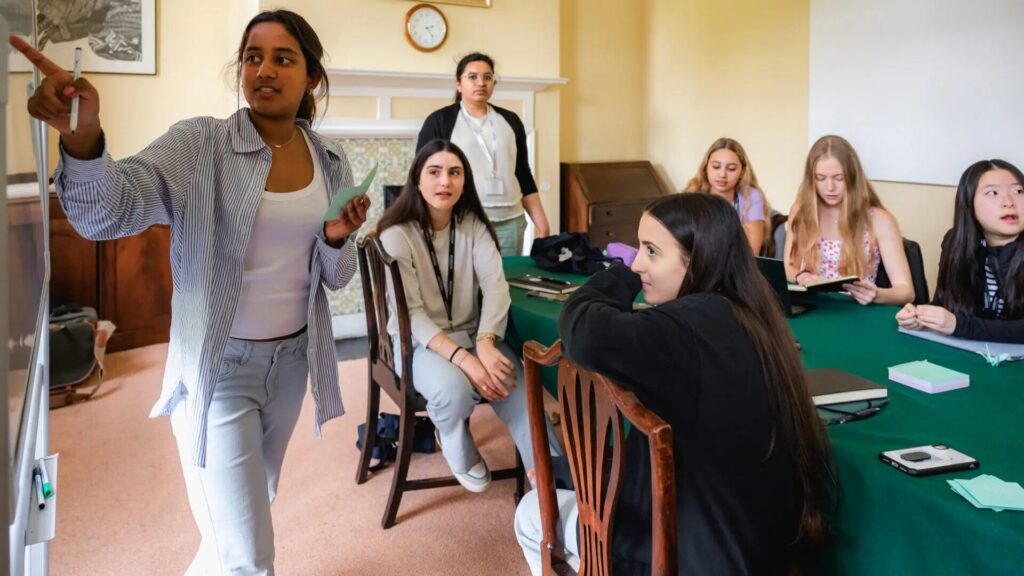
As one of the most immersive pre-college programs in Japan for high school students, the Tokyo Summer School lets students aged 15 to 18 explore university-level study and career pathways in one of the world’s most innovative cities. You will study with expert tutors in carefully sized cohorts, building your knowledge through academic sessions, practical workshops, collaborative projects, and guided feedback. Depending on your chosen programme, you can explore subjects such as Medicine, Mathematics, Business Management, Engineering, Environment & Sustainability, and Film & Animation.
The experience extends beyond the classroom, with opportunities to engage with Tokyo’s culture, industries, and landmarks, from traditional workshops to visits connected to animation, finance, manufacturing, and science. By the end of the programme, you’ll complete a personal or portfolio-worthy project, receive tutor feedback, and receive a certificate of participation. You can begin enrolment here.
Why it stands out: You’ll get an early start at university life and academics because the program includes an independent project, discussion-based classes, and living at a college campus.
3. TUJ High School Summer Program
Location: Temple University Japan Campus, Setagaya-ku, Tokyo, with Nikko and Tokyo excursions
Cost: 340,000 JPY, plus a 20,000 JPY registration fee
Acceptance rate/cohort size: Not disclosed
Dates: July 29th – August 6th
Application Deadline: Payment due May 1st (April 1st for students needing a visa); registration within one week of acceptance
Eligibility: High school students entering grades 9-12; open to international students worldwide
Temple University Japan’s summer programme combines Japanese language learning with elective courses inspired by the university’s undergraduate curriculum. You’ll spend your mornings and afternoons in class, but learning continues well beyond the classroom.
The schedule includes an overnight trip to Nikko, excursions around Tokyo, and opportunities to interact with Japanese high school students. No Japanese language experience is required, so beginners are welcome. Living on a university campus also gives you a feel for what student life in Tokyo is actually like.
Why it stands out: You study on the campus of the oldest American university in Japan, earning a real taste of US-style undergraduate classes while living in Tokyo for the summer.
4. NIC Summer Camp (NUCB International College)
Location: NUCB International College, Nisshin, Aichi, Japan
Cost: JPY 275,000 all-inclusive
Acceptance rate/cohort size: Not disclosed
Dates: July 20-28
Application Deadline: Rolling admission until seats are full
Eligibility: Students aged 13-15 with at least conversational English; open to international students worldwide
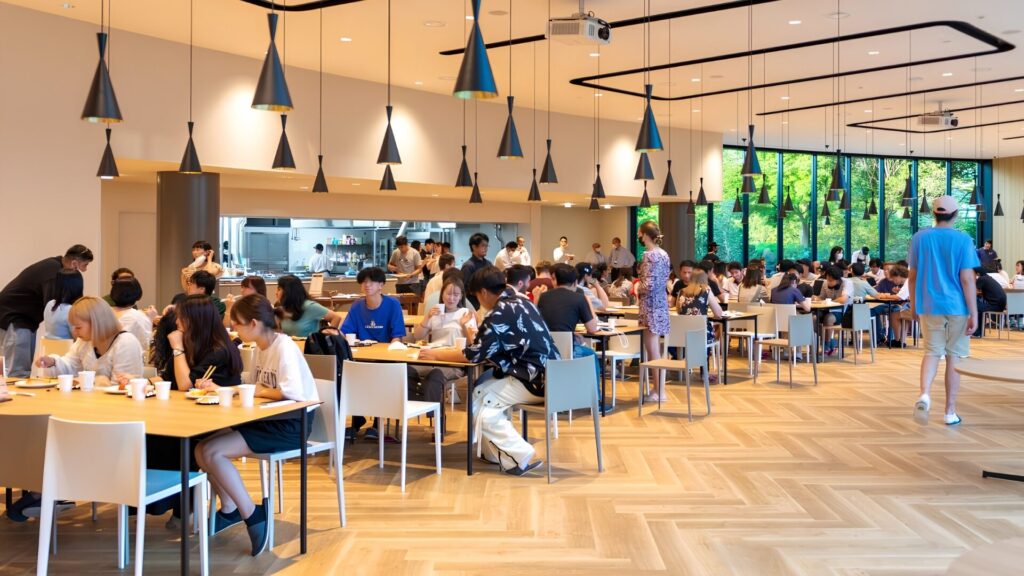
NIC Summer Camp takes place at an international boarding school campus in Aichi and focuses on leadership, teamwork, and problem-solving. You’ll experience classes inspired by the Harvard Case Method, where discussions revolve around real-world situations rather than lectures. Group challenges and collaborative projects run throughout the week, encouraging you to think through problems with students from different backgrounds.
You’ll also get a glimpse of the International Baccalaureate learning style through sample classes and workshops. Living on campus adds another layer to the experience, as you’re sharing meals, activities, and discussions with other participants. You can apply here.
Why it stands out: It puts you inside a dual-accredited IB boarding school for a week, letting you test case method learning and campus life.
5. Keio Summer Bio College (KSBC)
Location: Keio University Tsuruoka Town Campus, Tsuruoka City, Yamagata, Japan (residential)
Cost: About 30,000 yen (planned), covering lodging, meals, the excursion, and accident insurance; you pay your own transport to Tsuruoka, though the organizer covers the airport and station shuttle
Acceptance rate/cohort size: 18 students
Dates: July 27th to 29th (three days, two nights)
Application Deadline: Extended to June 29th
Eligibility: Students of Keio’s affiliated high schools only (Keio Senior High, Shiki, Girls, SFC, and the Keio Academy of New York), grades 1 to 3; not open to the general public or international applicants, and conducted in Japanese
Keio University’s Institute for Advanced Biosciences opens its Tsuruoka research campus each summer for a three-day taste of frontier life science. You work alongside Keio faculty and students through real laboratory sessions and lectures in a setting surrounded by nature.
You run hands-on experiments like proteome analysis and dosing cultured cells with anticancer drugs, tour advanced research facilities, and hear from the institute’s director, so you experience genuine biotech research long before university. A local excursion to the Kamo Aquarium and time with fellow students make the short stay both rigorous and social.
Why it stands out: It hands students of Keio’s affiliated schools real wet-lab experience at a leading bioscience institute, from mass spectrometry to cell-based drug testing, in just three days.
6. Hokkaido University Hands-on Summer School: Learn Science with Gummy Candy!
Location: Creative Research Institution (CRIS) Building, Hokkaido University, Sapporo, Japan
Cost: 1,500 yen (covers lunch and insurance)
Acceptance rate/cohort size: 20 participants (selected by lottery if applications exceed capacity)
Dates: August 4th (one day, 10 AM to 4 PM)
Application Deadline: June 30th
Eligibility: High school students interested in Hokkaido University and scientific research; the page sets no citizenship restriction, though it runs in person in Sapporo
Hokkaido University’s C³-SMART research center turns gummy candy into a one-day window into real materials science. You begin with a short lecture on the science of soft materials, then head into the lab.
You make your own gummies and measure their material properties using actual research methods, then talk through your results with faculty and students, so you taste how real research works through something completely familiar. For 1,500 yen, lunch included, it packs a genuine university research experience into a single afternoon. You can register here.
Why it stands out: It makes research approachable, letting high schoolers run genuine material-property experiments at a top university for just 1,500 yen in a single day.
7. APU Academic and Cultural Experience (ACE) Program
Location: Online (Zoom), hosted by Ritsumeikan Asia Pacific University (APU), Beppu, Japan
Cost: Free
Acceptance rate/cohort size: 200 students from around the world
Dates: August 1st & 2nd
Application Deadline: June 1st
Eligibility: High school students in grade 10 or above, or recent graduates within the past three years not yet in higher education; open to students worldwide; conducted in English, with recommended proficiency around IELTS 6.0 or TOEFL iBT 75
APU runs this free two-day online program for internationally-minded high schoolers from every corner of the world. Across two evenings on Zoom, you join university-level workshops and group work on culture, cultural intelligence, and global citizenship.
You collaborate with peers from many countries on real intercultural challenges and earn a Certificate of Completion, so you sharpen the communication skills that global study and work demand while previewing what APU offers. A Japanese cultural experience session and plenty of mingling time make the two days as social as they are academic.
Why it stands out: It opens a Japanese university experience to high schoolers anywhere with an internet connection, free of charge, and sends each finisher home with a certificate and a global peer network.
8. Stanford e-Japan
Location: Online (run by Stanford SPICE)
Cost: Free
Acceptance rate/cohort size: Not disclosed
Dates: 2-week camp to a semester-long distance-learning course with Saturday afternoon virtual classes
Application Deadline: Fall applications open from July 1st
Eligibility: Exceptionally high school students enrolled in Japan; not open to students outside Japan
Stanford e-Japan is an online programme for students in Japan who want to explore American society, culture, and U.S.-Japan relations through Stanford-designed coursework. Classes are taught in English and combine live discussions with independent research. Throughout the programme, you’ll examine topics such as education, politics, history, and international relations while developing your own research project.
You will be encouraged to connect what they’re learning to issues within their own communities. The programme runs over several months, giving you time to think deeply about your topic rather than rushing through it. By the end, you’ll present your research and receive feedback from instructors and peers.
Why it stands out: It’s a free, Stanford-run course focused on U.S.–Japan relations, giving students in Japan direct access to Stanford instruction and a research project from home.
9. Stanford e-Entrepreneurship Japan
Location: Online (Stanford SPICE with NPO e-Entrepreneurship)
Cost: No tuition fee; donor-supported
Acceptance rate/cohort size: Around 20 students
Dates: July 31st – September 6th
Application Deadline: Fall applications will open from July 31st (spring round closed)
Eligibility: First- and second-year high school students in and from Japan, capable in English; international students are not allowed
This small-cohort online programme explores entrepreneurship through the lens of design thinking. You’ll spend the semester looking at challenges in areas such as education, healthcare, technology, and the environment, then work through structured methods for developing solutions. Classes are interactive and emphasize brainstorming, collaboration, and problem-solving.
Alongside a group project, you’ll also complete your own individual research work. Because the cohort is intentionally small, discussions tend to be highly personal, and students get regular opportunities to contribute. The programme offers a thoughtful introduction to innovation without requiring any prior business experience.
Why it stands out: It offers a free, small-cohort Stanford course centred on design thinking and entrepreneurship, with both individual and team work over a full semester.
10. Kyushu University Faculty of Agriculture Trial Lesson Program
Location: Kyushu University, Ito Campus and field sites, Fukuoka, Japan
Cost: Free; you buy your own lunch and accident insurance
Acceptance rate/cohort size: Not disclosed
Dates: Varies; four short courses across late July and early August (one to two days each)
Application Deadline: Applications run from July 3rd to 13th
Eligibility: High school students; three courses run in Japanese and one (“Be Experimental in Kyudai!”) runs in English, so one option suits non-Japanese speakers; held in person in Fukuoka
Kyushu University’s School of Agriculture invites high schoolers onto campus for short trial lessons that mirror its real teaching and research. You pick from four courses spanning environmental entomology with field study, food and agriculture science, forest science, and a hands-on experimental class taught in English.
You spend a day or two doing the actual work of agricultural science, from field surveys to lab experiments, so you find out whether university-level agriculture fits you before you ever apply. Each course meets at a campus building or nearby station and runs with faculty guidance in the field. You can register here, but currently the form isn’t accepting responses.
Why it stands out: It lets high schoolers test-drive university agricultural science across four hands-on courses, including one in English, at one of Japan’s leading national universities.
11. University of Tokyo Philosophy Camp for High School Students
Location: Online (Zoom), hosted by the University of Tokyo Center for Philosophy (UTCP)
Cost: Free
Acceptance rate/cohort size: Not specified
Dates: Condensed into a 1-day online marathon block (usually running from afternoon to late night JST); exact dates not specified
Application Deadline: Not disclosed
Eligibility: High school students who enjoy philosophy; the camp runs in Japanese, so it suits Japanese-speaking students rather than international applicants
The University of Tokyo Center for Philosophy holds this recurring camp for high schoolers who love to think deeply, planned by Professor Shinji Kajitani. Across roughly two days online, you join structured philosophical dialogue rather than lectures.
You work through big questions together with other students and a facilitator, so you practice reasoning, listening, and articulating your own ideas in a way ordinary school rarely allows. The center has run the camp in summer, winter, and spring editions over the years, drawing students who want more philosophy than the classroom offers.
Why it stands out: It gives philosophically-minded high schoolers a rare space for real Socratic dialogue with University of Tokyo philosophers, recurring throughout the year.
12. TUJ Academic English Program
Location: Temple University Japan Campus, Setagaya-ku, Tokyo, with hybrid and online options
Cost: Early-bird fee is JPY 131,750/General fee is JPY 155,000 per semester (plus JPY 11,000 first-time student fee)
Acceptance rate/cohort size: Not disclosed
Dates: Varies
Application Deadline: Early Bird: August 30th and General: September 6th
Eligibility: All high school students, regardless of English level; in-person classes in Tokyo plus an online option, so it suits students in Japan and is available for remote international participants
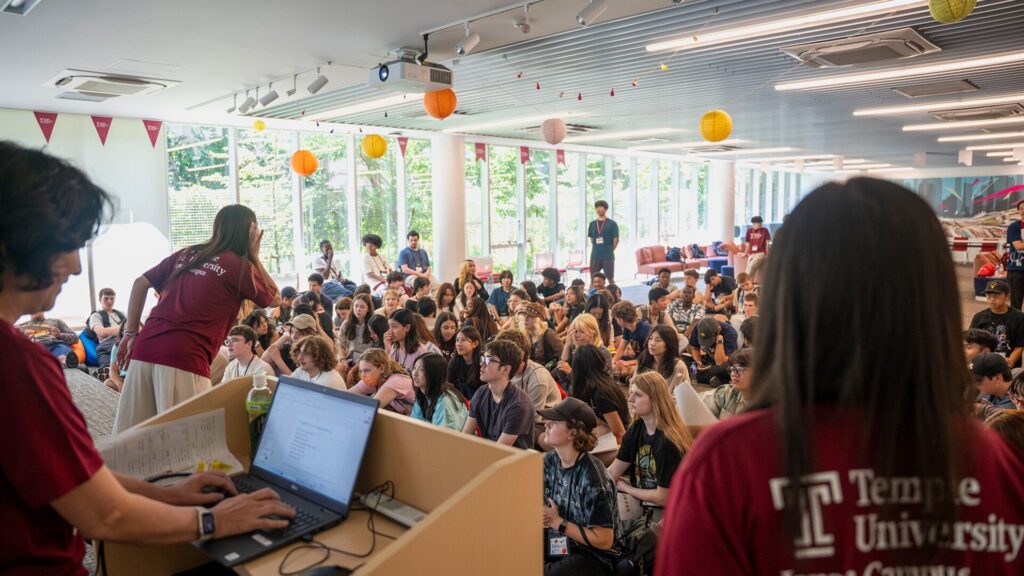
Temple University Japan’s Academic English Program is designed for students preparing to study in English at the university level. Classes focus on skills you’ll actually need in college, including academic writing, reading complex texts, participating in discussions, and presenting ideas clearly.
The programme runs alongside the school year, making it easier to fit into an existing schedule. Students can attend in person in Tokyo or join online from elsewhere. There are also optional conversation sessions with Temple University students, which provide extra opportunities to practice spoken English. You can apply here.
Why it stands out: It’s a university-run English course you take alongside high school, with an online option that opens it to students preparing for study abroad from anywhere.
13. Kyoto University ELCAS
Location: Kyoto University, Yoshida and Katsura campuses, Kyoto, Japan; the lecture sessions run online
Cost: Free; you cover your own transport, any lodging, and internet or equipment costs
Acceptance rate/cohort size: Cap enforces a maximum of 100 students per designated lecture course (selected via a randomized lottery if submissions exceed capacity)
Dates: The online Lecture track runs July 29th and July 30th; the closed Seminar track runs on-campus from August 19th to August 21st
Application Deadline: The online Lecture track remains actively open until July 8th. The intensive Seminar track closed on June 10th.
Eligibility: High school first- and second-year students (and equivalent) at schools across Japan; conducted in Japanese, so it suits Japanese-speaking students rather than international applicants
Kyoto University runs ELCAS, one of the more academically focused pre-college programs in Japan for high school students, its experience-based course that hands academically driven high schoolers the resources of a top research university. You choose from more than 20 fields across the sciences, social sciences, and humanities, joining live lectures online before moving onto campus for hands-on seminars.
You work in small groups directly with Kyoto University professors and young researchers, running experiments and debating ideas you would never meet in high school, so you find out what advanced study in your field actually asks of you. Many participants describe those few summer days as the moment a vague interest turned into a real academic direction.
Why it stands out: It opens one of Japan’s most prestigious research universities to high schoolers across more than 20 disciplines, free of charge, with real professors guiding small-group work.
14. Osaka University SEEDS Program
Location: Osaka University (The University of Osaka), Suita Campus, Osaka, Japan
Cost: Free
Acceptance rate/cohort size: 130 students
Dates: Monthly weekend sessions launching with an opening ceremony on August 1st and concluding on February 13th
Application Deadline: May 27th
Eligibility: High school students across Japan with a strong interest in science and technology; conducted in Japanese with some English exchange, so it suits Japanese-speaking students rather than international applicants
Osaka University designed SEEDS to find and grow promising young scientists, and it gives high schoolers the run of one of Japan’s leading research universities. Once a month, you attend university-level lectures across fields like materials, life sciences, and information science, then break into the small discussion rounds the program calls “Mebae-dojo.”
You tour advanced research labs, debate research with faculty, and practice English with international students, so you stretch both your scientific thinking and your global outlook far past what high school offers. Students who thrive in the first course move on to genuine lab research with a university mentor in the second year.
Why it stands out: It selects 130 high schoolers a year for a free, half-year immersion in research at a top national university, complete with lab tours, faculty discussion, and a route into real lab work.
15. University of Tokyo GSC-Next
Location: University of Tokyo, Institute of Industrial Science, Tokyo, Japan
Cost: Free; you cover transport to campus, with partial support possible for those traveling from far away
Acceptance rate/cohort size: About 70 students in the high school stage, with around 20 advancing to the research stage
Dates: The high school phase (Stage 2) runs from July 23rd through November 26th; Stage 3 lab placements deploy in March next year
Application Deadline: May 15th
Eligibility: High school first- and second-year students (and equivalent) enrolled in Japan; overseas applications are not accepted, and the program runs in Japanese
The University of Tokyo’s Global Science Campus, GSC-Next, sets out to grow the kind of researchers who could reshape society, run through its Institute of Industrial Science. As a high school participant, you move through STEAM-style lectures and workshops that sharpen the broad skills real research calls for, then shape a research plan of your own.
You design and pursue an original project, and the roughly 20 students who advance carry theirs into an actual University of Tokyo laboratory, so you experience the full arc of research long before university. Free to join and selective, it treats high schoolers as apprentice researchers rather than visitors.
Why it stands out: It takes 70 high schoolers from research-skills workshops to an original project inside the University of Tokyo labs, free of charge, treating them as researchers in training rather than guests.
Frequently Asked Questions: Pre-College Programs in Japan for High School Students
What is a pre-college program in Japan for high school students?
A pre-college program gives high school students an early look at university-level academics in Japan, often through lectures, workshops, or hands-on research. Programs span subjects ranging from entrepreneurship and biosciences to philosophy and agricultural science. Most run between one day and several months, with some conducted entirely online. Many conclude with a presentation, certificate, or research project.
Do I need to speak Japanese to apply?
It depends on the program. Several options, including Ritsumeikan University’s Entrepreneurship Camp and Kyoto University’s ELCAS, run entirely in Japanese and suit Japanese-speaking students. Others, like TUJ’s High School Summer Program and the APU Academic and Cultural Experience Program, require no Japanese language ability and are conducted in English. Immerse Education’s Academic Insights Programme is also conducted in English, open to international students worldwide.
How much do pre-college programs in Japan cost?
Costs range from free to about 340,000 JPY for Temple University Japan’s residential summer program. Free options include Kyoto University’s ELCAS and Osaka University’s SEEDS Program, both restricted to students based in Japan. Immerse Education’s Academic Insights Programme offers financial aid that can help reduce costs for eligible students.
Can international students attend these programs?
A smaller set of programs are open internationally, including TUJ’s High School Summer Program, NIC Summer Camp, and the APU Academic and Cultural Experience Program. Many free, university-run programs, including Osaka University’s SEEDS Program and the University of Tokyo’s GSC-Next, are restricted to students enrolled in Japan. Immerse Education’s Academic Insights Programme is open to students worldwide aged 13 to 18.
What age do I need to be to apply?
Age requirements vary by program, generally falling between 13 and 18. NIC Summer Camp accepts students aged 13 to 15, while most university-run Japanese programs target Year 1 to Year 2 high school students. Immerse Education’s Academic Insights Programme accepts students aged 13 to 18 from anywhere in the world.
Will I get hands-on research experience?
Yes, several programs include direct laboratory or research components. Keio Summer Bio College has students run hands-on experiments like proteome analysis, and the University of Tokyo’s GSC-Next has top students advance into an actual university laboratory. Immerse Education’s Academic Insights Programme takes a similarly hands-on approach, with students completing a personal project and conducting activities like dissections or robotic arm design depending on their subject.
How do these programs help with college applications?
Participating in a pre-college program in Japan demonstrates initiative and an international academic perspective. Programs like Osaka University’s SEEDS Program can lead to genuine lab research with a university mentor, giving students a strong academic credential. Immerse Education’s Academic Insights Programme provides a completed personal project and written feedback that students can reference directly in personal statements and interviews.
Explore Japan, Then Think Even Bigger
Studying in Japan can give you an early sense of university life, from academic expectations to cultural learning and independent decision-making.
The 15 pre-college programs in Japan for high school students listed here show options across Tokyo summer study, Stanford online learning, Kyoto lectures, and Osaka research.
Each programme offers a different route into international education, whether through hands-on labs, entrepreneurship camps, language learning, personal projects, or global peer collaboration.
Ready to look beyond Japan? Explore our Study Abroad blogs for destination guides, application advice, and practical next steps for studying internationally.