




 Русский (RU)
 Українська (UK)
 Türkçe (TR)
 Italiano (IT)
 Français (FR)
 Português (PT)
 中文 (中国) (ZH)
 Español (ES)
 日本語 (JA)
 ไทย (TH)
 Deutsch (DE)
 Ελληνικά (EL)
 Polski (PL)
 Bahasa Indonesia (ID)
 Nederlands (NL)
 العربية (AR)
 한국어 (KO)

From Merton to St Catherine’s, Oxford’s 39 colleges raise a common question for first-time visitors: which one is the main campus of the university?
Oxford University does not have a single main campus. Instead, its colleges, departments, libraries, and student spaces are spread throughout Oxford, so the whole city effectively is the campus.
In this article, we’ll explore how that city-wide structure works, where you can walk, which colleges are most worth seeing, and how to find reliable tours and maps.
Let’s step into Oxford and see how it all connects.
The Anatomy of a City-Wide Campus
Oxford’s structure can seem unusual at first. Instead of one central lawn, the university stretches across colleges, departments, libraries, and student spaces woven through the city.
Here’s how Oxford University works as a city-wide campus, and why understanding its different parts makes the whole place far easier to explore.
The Matrix of Colleges, Departments, and Libraries
Oxford University works through 39 colleges and four smaller Permanent Private Halls. These include Merton, St Catherine’s, Christ Church, Magdalen, New College, and Regent’s Park College. Alongside them are departments such as the Mathematical Institute and Faculty of History. Others include the Department of Engineering Science and Medical Sciences Division.
A participant might sleep and eat in a college, then attend academic sessions near a faculty building. Later, they might study in the Bodleian Library or a college library. They may then cross Broad Street, Catte Street, or the High Street to reach the next part of their day. This is why the campus feels like a living academic map for students and visitors.
How the Colleges Work
Oxford’s colleges are the communities students belong to within the wider university. Each has its own dining hall, common rooms, accommodation, library, tutors, traditions, and social spaces.
A student at Merton, for example, may live in college rooms, eat in hall, meet friends in the Junior Common Room, and receive tutorial support within that college community, while still attending university-wide lectures, labs, or seminars elsewhere in Oxford.
Because these colleges shape so much of daily life, our guide to how many colleges in Oxford helps explain how they fit into the wider university structure. The colleges are not separate universities, but they do shape daily life, identity, and belonging, which is one reason Oxford feels so personal even though it is world-renowned.
The Faculty Departments
While colleges shape a student’s day-to-day community, Oxford’s departments and faculties organise subject teaching and research. They also manage lectures, laboratories, and examinations.
For example, science students may spend time around the Science Area near Parks Road. There, buildings such as the Department of Chemistry, Department of Physics, and Department of Earth Sciences sit close together. Meanwhile, humanities students may move between faculty spaces such as the Faculty of History on George Street or the English Faculty on St Cross Road.
This means a student’s routine often stretches beyond their college walls. They might start the morning with breakfast in a college dining hall, attend a lecture in a faculty building, visit a specialist library in the afternoon, then return to college for a tutorial or evening event. That movement is part of what makes the university of Oxford campus feel so distinctive: academic life is not contained in one place, but carried through the city.
The Oxford Library System
Oxford’s library system is spread across the city. The Bodleian Library sits at its historic centre, while specialist libraries support different subjects. These include the Radcliffe Science Library, the Social Science Library, and the Sackler Library.
Colleges also have their own libraries. A student might use a central university library for rare books or research materials, then return to a quieter college library for everyday reading and essay preparation.
This is why exploring the historic Oxford libraries helps reveal how academic life works beyond the college gates. These spaces sit within the same scholarly environment that supported figures such as Stephen Hawking, who studied Physics at University College, and J.R.R. Tolkien, whose Oxford career and archives remain closely connected with the Bodleian and college collections.
Can You Walk Around the Oxford University Campus?
Yes, you can walk around much of the Oxford University campus. This is because the university is woven into public streets, squares, lanes, and green spaces across the city. However, individual college grounds, chapels, dining halls, gardens, and quads often have set visiting hours. Some also have entry fees, private events, or restricted access. So, walking through Oxford is easy, but entering every historic space is not always possible.
In the next sections, we’ll discuss how to follow a self-guided walking route through central Oxford. We’ll also show where to see famous college fronts without going inside. Finally, we’ll explain how our Oxford summer programme can help you experience more of the university from within.
The Ultimate Self-Guided Walking Route
The easiest way to understand Oxford is to walk through it. The streets connect colleges, libraries, theatres, chapels, shops, cafés, and green spaces into one academic landscape.
This route helps you see some of Oxford’s best architecture from the outside. You can enjoy the views without paying entry fees, while still understanding how the university fits into the city.
Here’s a step-by-step route through central Oxford:
- Start at Carfax Tower: Stand at the historic centre of Oxford, where Cornmarket Street, Queen Street, St Aldate’s, and the High Street meet, then use it as your starting point for understanding how compact the city centre is.
- Walk along the High Street: Head east to see the grand fronts of The Queen’s College and University College, with their formal entrances, stone façades, and sense of academic tradition built directly into one of Oxford’s busiest streets.
- Continue towards Magdalen College: Keep walking towards the eastern end of the High Street, where Magdalen College sits beside Magdalen Bridge, close to the River Cherwell and the entrance towards the college’s famous tower and grounds.
- Turn back towards Catte Street: Walk into one of Oxford’s most recognisable academic areas, where the Radcliffe Camera, Bodleian Library, Bridge of Sighs, and All Souls College sit within a few minutes of each other.
- Stroll past the Sheldonian Theatre: From Catte Street, move towards the Sheldonian Theatre, designed by Christopher Wren, where university ceremonies and formal events still take place.
- Finish on Broad Street: End near Balliol College, Trinity College, and the historic bookshops around Broad Street, where the city feels especially alive with students, visitors, cyclists, and academic buildings side by side.
Green Spaces Along the Way
This walking route also brings you close to some of Oxford’s most beautiful green spaces, so you can break up the college views with places where students relax, read, and meet friends. From Carfax Tower, you can walk down St Aldate’s towards Christ Church Meadow. This wide riverside space sits beside Christ Church and connects the city centre with the River Thames and the River Cherwell.
After seeing Magdalen College from the High Street, you are also near Magdalen Bridge. From there, you can find riverside walks around the Cherwell. If you extend the route beyond Broad Street, University Parks is another worthwhile stop, especially because it sits close to the Science Area and shows how green spaces fit into everyday academic life.
For a longer pause during your walk, our guide to the best parks in Oxford can help you choose the right place to rest, whether you want open lawns, riverside paths, or a quieter view of the city-wide campus.
The Inside Access Shortcut
You can read tons of guides or look at the most breathtaking pictures, but nothing will replace actually experiencing Oxford from the inside.
While tourists look from the outside, joining our Oxford Summer School allows you to live, dine, and study inside these historic walls rather than only admire them from the pavement. You take part in academically rigorous sessions that encourage critical thinking, subject exploration, and confidence beyond the school curriculum.
That experience continues outside the academic sessions too. Depending on your programme schedule, you may go punting on the River Cherwell, explore Oxford’s historic colleges, join extracurricular activities, and meet peers from around the world.
With mentors guiding the way, the city becomes a living academic environment, not just a beautiful place to visit.
English Literature
In-person
Hone advanced English Literature skills in Oxford

Economics
In-person
Hone advanced skills in Oxford, where academic excellence...

Which Oxford Campus is the Best? Exploring Top Colleges
The best college in Oxford depends on what you want to experience. You might prefer grand architecture, riverside beauty, academic history, famous alumni, or the atmosphere of one of the world’s most prestigious university settings.
With that said, here are three of the most prestigious and visually stunning colleges in Oxford to look for as you explore the city-wide campus.
1. Christ Church: For The Grandeur
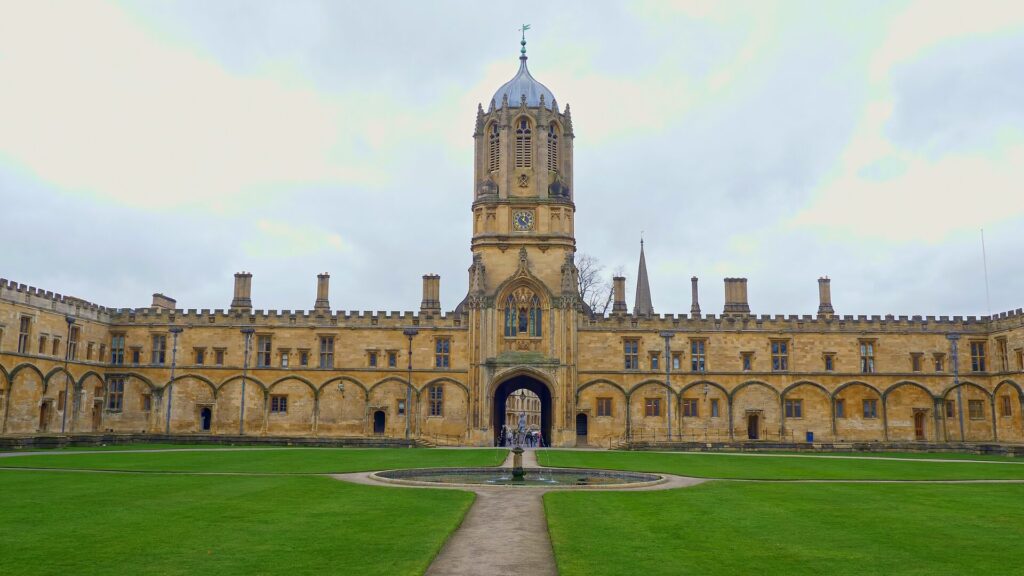
Christ Church is Oxford at its most theatrical. Tom Quad opens like a vast stone courtyard, while the Great Hall glows with long tables, portraits, and vaulted grandeur.
The famous 16th-century Grand Staircase, which leads up to the Great Hall, is where Professor McGonagall first greets Harry, Ron, and Hermione when they arrive at Hogwarts in the Harry Potter films.
Its prestige reaches beyond cinema. Lewis Carroll, author of Alice’s Adventures in Wonderland, studied here, as did William Gladstone, the four-time UK prime minister. Together, they help make Christ Church one of the most iconic stops on the Oxford University campus.
2. Magdalen College: The Riverside Beauty
For students drawn to both intellectual tradition and natural beauty, few places capture Oxford’s appeal as vividly as Magdalen.
The college has strong associations with English, History, Philosophy, Politics, Economics, and the sciences, shaping minds such as Oscar Wilde, who studied Classics at Magdalen, while later becoming an academic home for C.S. Lewis, who taught English there as a Fellow and Tutor. This gives Magdalen a reputation that reaches well beyond its postcard views.
Its bell tower rises above the High Street. Addison’s Walk curves through trees and meadows, while the deer park gives the grounds a rare sense of space inside the city.
3. New College: The Historic Giant
Despite its name, New College is one of Oxford’s great medieval foundations. It was founded in 1379 by William of Wykeham, the Bishop of Winchester.
Its high stone walls, peaceful gardens, grand chapel, and atmospheric cloisters create the feeling of stepping into a complete medieval world hidden within the city. The college is especially admired for its scale and architectural unity, which make it one of Oxford’s most impressive historic spaces.
It also appears in modern screen culture, with New College Hall featured in Mamma Mia! Here We Go Again, adding cinematic charm to its academic prestige.
Join the Immerse Education 2025 Essay Competition
Follow the instructions to write and submit your best essay for a chance to be awarded a 100% scholarship.

How to Experience Oxford: Tours and Navigation
With a total estate of around 537 hectares, Oxford can be difficult to navigate at first because its colleges, departments, libraries, museums, and green spaces are spread across the city rather than arranged around one central campus.
With that said, here are three different ways you can experience Oxford.
1. The DIY Method
If you want a DIY tour of Oxford, it’s best to use an Oxford University map because Oxford’s entrances are not always obvious from the street.
A building may appear close on GPS, yet the actual visitor gate, college lodge, or department entrance could sit around the corner, behind a courtyard, or down a narrow lane.
The benefit is freedom: you control your time, choose your stops, and pause wherever interests you most. Still, this is often the hardest method for first timers, as you have to work out which buildings are colleges, departments, libraries, museums, or public streets without a guide.
2. Taking an Oxford University Tour
If you want a more structured tour around Oxford, taking an Oxford University tour can help. Instead of simply walking past famous buildings, you can actually understand what you are seeing.
A strong guide can explain why the Bodleian Library matters and how the Sheldonian Theatre is used. They can also show which colleges shaped famous writers, scientists, and leaders.
Be careful with low-quality tourist traps that rush you past landmarks, rely on vague stories, or promise access they cannot guarantee. For a more reliable experience, choose official visitor information, reputable student-led tours, or university alumni tours.
3. The Mentor Advantage
The most immersive way to understand Oxford is not to follow it from the pavement. Instead, it’s to live within its rhythm.
At our Oxford Summer School, you do not just visit the city-campus; you study in academic surroundings, dine with peers, use programme facilities, and begin to understand how Oxford’s colleges, libraries, streets, and social spaces connect in daily life.
Our student mentors, who actually study at the university, are the ones who give you insider tours of Oxford. They share real-life experiences of navigating the city-campus, point out details a standard tour may miss, and show how academic and social life naturally overlap in the city.
Conclusion
Oxford is not a place you understand from one gate, map, or viewpoint. Instead, its identity comes from movement, discovery, and connection.
That connected identity exists because there is not just one Oxford campus, but various colleges, libraries, departments, streets, and gardens that create the university itself.
Together, these spaces make walking routes, maps, and tours useful, though they still only reveal one layer of life beyond the college gates.
To go beyond sightseeing, explore our Oxford Summer School and discover what it feels like to live, dine, study, and grow inside one of the world’s most inspiring academic cities.