

 Русский (RU)
 Українська (UK)
 Türkçe (TR)
 Italiano (IT)
 Français (FR)
 Português (PT)
 中文 (中国) (ZH)
 Español (ES)
 日本語 (JA)
 ไทย (TH)
 Deutsch (DE)
 Ελληνικά (EL)
 Polski (PL)
 Bahasa Indonesia (ID)
 Nederlands (NL)
 العربية (AR)
 한국어 (KO)

As one of the world’s most respected universities, Oxford has shaped thinkers, leaders, and innovators for centuries, and our Oxford University summer school lets you step into that tradition while exploring subjects at a true university level.
But with over 22 subjects available, ranging from science and medicine to law, business, and creative fields, how do you choose which subject to study?
In this article, we’ll explain how to choose a subject at our Oxford University summer school that aligns with your interests, strengths, and future goals.
Let’s get straight into it.
Step 1: Start With the Big Choice: Go Deeper or Branch Out?
Perhaps the hardest part of choosing what to study is deciding where to focus your attention in the first place.
With so many options available, it’s easy to feel unsure about which subject will make the most of your time at our Oxford summer school. But before looking at individual programmes, it helps to step back and think about what you want this experience to give you.
Do you want to strengthen a subject you already enjoy and feel confident studying, or would you rather use the summer to explore something new?
This early decision plays a big role in shaping your academic experience and what you take away from it. You might find yourself leaning towards one of these approaches:
- Build on a subject you already enjoy, allowing you to move beyond the school syllabus and engage with ideas at a more advanced, university-style level.
- Explore a subject you’ve never studied before, using the summer as a low-pressure opportunity to test new academic interests and discover what excites you.
Once you’re clear on which direction suits you best, choosing from the subjects available at Oxford becomes far more straightforward.
Step 2: Explore the Subjects You Can Study at Oxford
Once you’ve chosen your direction, the next step is to explore the subjects available at our Oxford summer programme, spanning science, humanities, creative fields, and business.
Below, you’ll find the different subjects available across our Oxford programmes, grouped by age and academic focus.
Ages 13–15: Building Foundations and Exploring Interests
For participants aged 13–15, our Oxford programmes focus on introducing key ideas, building confidence, and encouraging curiosity through accessible, engaging academic study.
STEM subjects
- Computer Science
- Engineering
- Medicine
Humanities and social sciences
- Law
Creative subjects
- Architecture
- Creative Writing
Business and economics
- Business Management
- Economics
Ages 16–18: Going Further in Your Chosen Subject
Less overview, more depth. Our Oxford programmes for ages 16–18 prioritise focused study, higher-level discussion, and the kind of independent thinking you’ll use at university.
STEM subjects
- Artificial Intelligence
- Biology
- Chemistry
- Computer Science
- Engineering
- Mathematics
- Medicine
- Nanotechnology
- Physics
- Psychology
Humanities and social sciences
- Criminology
- English Literature
- History
- International Relations
- Law
- Philosophy
- Philosophy, Politics & Economics (PPE)
Creative subjects
- Architecture
- Creative Writing
- Film Studies
Business and economics
- Business Management
- Economics
Law
In-person
Explore legal intricacies in Oxford, where centuries of...

Computer Science
In-person
Delve into molecular mysteries in Oxford, where Nobel...

Step 3: Check the Programme Details That Matter
Once you’ve selected a subject that interests you, you’ve already done the hardest part. Now it’s simply a matter of checking the programme details, so you know what the experience will actually be like.
Here are the key details you should look at before you decide.
Tutors
Studying in Oxford, you can feel confident that the tutors leading our programmes are not only highly knowledgeable, but also experienced at supporting young learners through challenging, university-style ideas.
To give you a sense of the calibre and variety of our teaching team, here are a few examples of tutors you could learn from.
Computer Science
- Younesse is a PhD candidate at the University of Oxford, with academic roots at the University of Cambridge and Paris-Saclay.
- Yasmin is a Research Fellow in Cambridge’s Engineering Department and a Fellow of the UK Higher Education Academy, bringing strong teaching credentials.
Law
- Laura is a PhD candidate in Criminology at the University of Oxford’s Faculty of Law, focused on rigorous, research-led legal thinking.
- Michael is a PhD candidate in the University of Cambridge’s Law Faculty and Trinity Hall, combining deep scholarship with collegiate academic support.
Architecture
- Michaela founded the Oxford School of Architecture (OSA) and is pursuing a PhD in Architecture and Neuroscience at Cambridge University.
- Konrad is a Norwegian architect with an MArch I from Harvard GSD (2020) and a BSc in Architecture from UCL (2014).
Economics
- Lesego completed an MBA at Cambridge Judge Business School before joining Bloomberg in London, with further experience at McKinsey across global offices.
- Itzhak is a DPhil candidate in Economics at Oxford, where he also earned his master’s and undergraduate degrees, and tutors microeconomics at St Hugh’s.
Syllabus
When you’re checking syllabuses, look for Oxford summer school providers that tailor content by age group, rather than combining different ages into one generic plan for convenience.
Our Oxford programmes use different syllabuses for different age groups, so the pace, depth, and expectations match your stage of learning.
Computer Science
- 13-15: Build foundations in Python, algorithms basics, web (HTML/CSS/JS), binary and computer architecture, intro databases and big data, plus Raspberry Pi robotics and AI, practical problem-solving.
- 16-18: Go deeper into computability and complexity, P vs NP, OOP Python, algorithm analysis, internet protocols, neural networks, NoSQL databases, and game-playing algorithms, research-style thinking.
Law
- 13-15: Explore what law is, UK constitution basics, criminal law essentials, human rights, EU and international law, legal careers, advocacy skills, and a supportive mock trial.
- 16-18: Study the legal system, constitutional principles, negligence and debates, criminal law, human rights enforcement, EU law and Brexit, advocacy, and public international law, and casework practice.
Architecture
- 13-15: Explore history and theory, sketch city streetscapes, practise foundations and elevations, draw plans to scale, sections, axonometric and isometric views, survey sites, design A1 boards.
- 16-18: Work like an applicant: develop concepts into designs, study structures and materials, refine plans, sections and elevations, practise axonometrics, explore typologies, programming, modelling, and workflows.
Economics
- 13-15: Cover micro basics: supply, demand, elasticity, firms and market structures; plus macro introductions to GDP, inflation and growth, and policy tools, behavioural and game theory.
- 16-18: Go deeper into micro and market failures, macro policy and crises, trade and exchange rates, development and financial economics, auctions, econometrics basics, and economic history case-studies.
Join the Immerse Education 2025 Essay Competition
Follow the instructions to write and submit your best essay for a chance to be awarded a 100% scholarship.
Step 4: Reviews and Testimonials
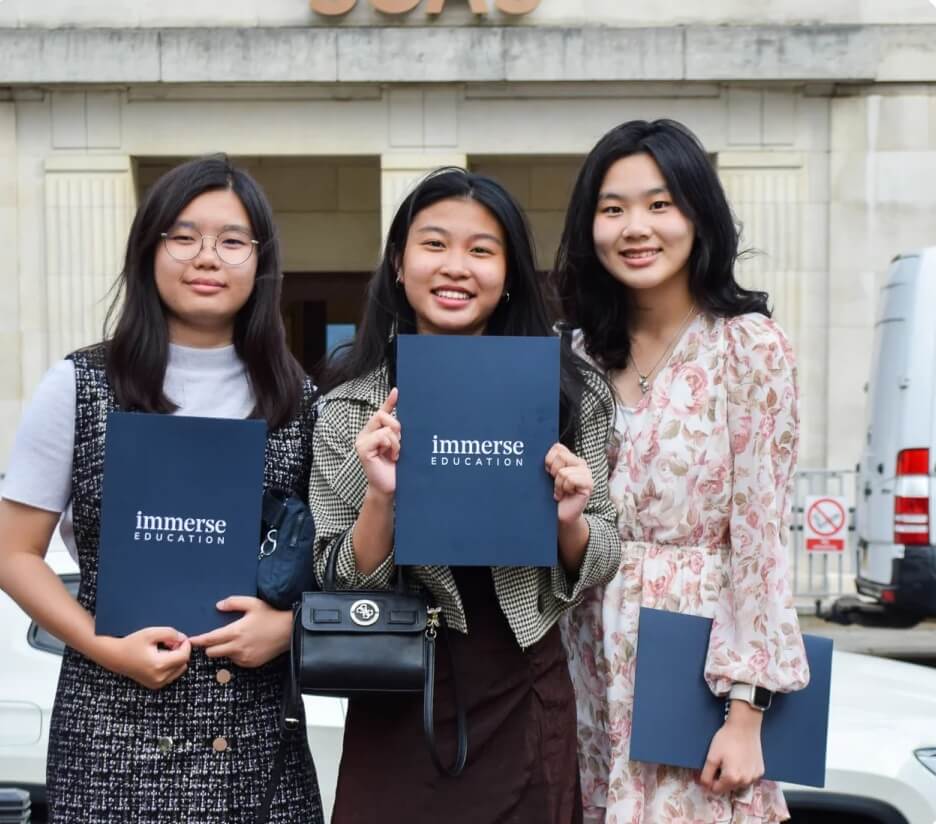
Aside from programme details, reviews and testimonials from past participants can be the most reassuring place to look.
They often share what the experience feels like day to day, including how approachable tutors are, how much personalised feedback you receive, and how quickly your confidence grows when you’re learning in small groups.
It’s also helpful to look for proof that the experience is consistently strong, not just for a handful of people. Over 20,000+ alumni have graduated globally, and 97% of participants say they would recommend Immerse, which speaks to both quality and support across our programmes.
For added peace of mind, we’re accredited by the British Accreditation Council (BAC). Many participants also go on to study and work with leading institutions, including Oxford, Harvard, Google, Amazon, and many more, showing how this kind of focused academic experience can open doors.
Step 5: Practical Things to Think About
Now that you’ve honed in on what subject you want to study, the final step is to check the key programme details that will shape your experience.
Here’s some helpful information about our Oxford summer programmes.
- Dates and age groups: Choose the session that suits you best: 5th Jul – 18th Jul, 19th Jul – 1st Aug, and 2nd Aug – 15th Aug
- Fees and study options: Residential: £7,495 or Non-residential: £5,995.
- Studying in Oxford: Your programme takes place across Oxford colleges, including University College, St Edmund Hall, Balliol College, and Oriel College.
FAQs
Can I choose more than one subject at the Oxford University summer school?
Yes. You can study one subject per session, and enrol in different sessions if you want to explore more than one subject.
Do I need prior experience in a subject to join?
No. Many programmes welcome beginners, and tutors adapt teaching to your level within each age group.
Will this help with university applications?
Yes. You’ll gain subject clarity and academic examples you can reference in personal statements and interviews.
Are the 13–15 and 16–18 programmes taught differently?
Yes. Our Oxford programmes use different syllabuses and depth levels for each age group.
Conclusion
Choosing what to study can feel like a big decision, but the process is simpler than it seems. Start by deciding whether you want depth in a familiar subject or a fresh academic direction.
Next, narrow your choices by age group and focus on what genuinely interests you. The right subject should keep you curious for two weeks.
Then check the details that shape your experience, from tutors and syllabus content to what past participants say. Those small signals build real confidence.
Ready to make Oxford your summer story? Browse our Oxford summer courses and secure a place on the programme that feels made for you.