
 Русский (RU)
 Українська (UK)
 Türkçe (TR)
 Italiano (IT)
 Français (FR)
 Português (PT)
 中文 (中国) (ZH)
 Español (ES)
 日本語 (JA)
 ไทย (TH)
 Deutsch (DE)
 Ελληνικά (EL)
 Polski (PL)
 Bahasa Indonesia (ID)
 Nederlands (NL)
 العربية (AR)
 한국어 (KO)

As a high school student, summer can be more than a break from classes; it can be a chance to experience the independence, structure, and community that come with living away from home. Overnight summer camps for high school students combine academics, activities, and residential life in one setting, helping students build confidence while exploring interests beyond the standard school curriculum.
You might spend your mornings in a laboratory, studio, or seminar room, then your evenings participating in campus events, team activities, or conversations with peers from around the world. These programs help students develop practical skills such as time management, communication, collaboration, and self-direction while giving them an early taste of college life.
They can also act as a foundation for your college journey, giving you a taste of what university life is like at a top institution, in person.
How do you choose the right overnight summer camp for high school students?
Choosing the right overnight summer camp for a teenager really comes down to matching their current interests with an environment that allows them to gain independence and grow. You will want to look closely at the camp’s daily schedule to see if it strikes a healthy balance between structured, focused activities and enough free time to relax and build friendships.
Beyond the activities, it is crucial to consider practical factors like the distance from home, the staff-to-camper ratio to ensure they will be well-supported, and the overall culture the camp promotes. Ultimately, the best choice is a place where your high schooler feels genuinely excited to spend their summer, and you feel completely comfortable sending them.
Below, we have listed 15 overnight summer camps for high school students. They have been selected based on their academic rigor, residential experience, and institutional credibility.
For adjacent opportunities, check out online summer programs.
15 Overnight Summer Camps for High School Students
1. Los Alamos National Laboratory Summer Physics Camp
Location: Los Alamos National Laboratory, Los Alamos, NM (in person)
Cost/Stipend: No cost / $350 stipend
Acceptance Rate/Cohort Size: Selective; approximately 20-40 students
Dates: June 8-19
Application Deadline: April 1st
Eligibility: High school students who have completed Algebra I and reside in New Mexico, New Mexico Tribal Communities, or East Hawai’i Island; not open to international students
The Los Alamos National Laboratory Summer Physics Camp allows you to explore physics inside one of the most recognized research laboratories in the U.S. Across two weeks, you engage in hands-on experiments, problem-solving activities, and demonstrations that introduce areas such as nuclear science, materials research, energy systems, and computational physics.
Researchers and scientists lead sessions that show how theoretical concepts are translated into practical scientific work. You also interact directly with professionals who discuss career pathways, current projects, and the role physics plays in large-scale national research initiatives. By the end of the camp, you gain a clearer understanding of how physics is studied, applied, and advanced beyond the high school classroom.
Why it stands out: It places you inside a major national laboratory, where you learn physics through real experiments, researcher mentorship, and exposure to large-scale scientific work rarely accessible to high school students.
2. Immerse Education’s Pre-University Summer School
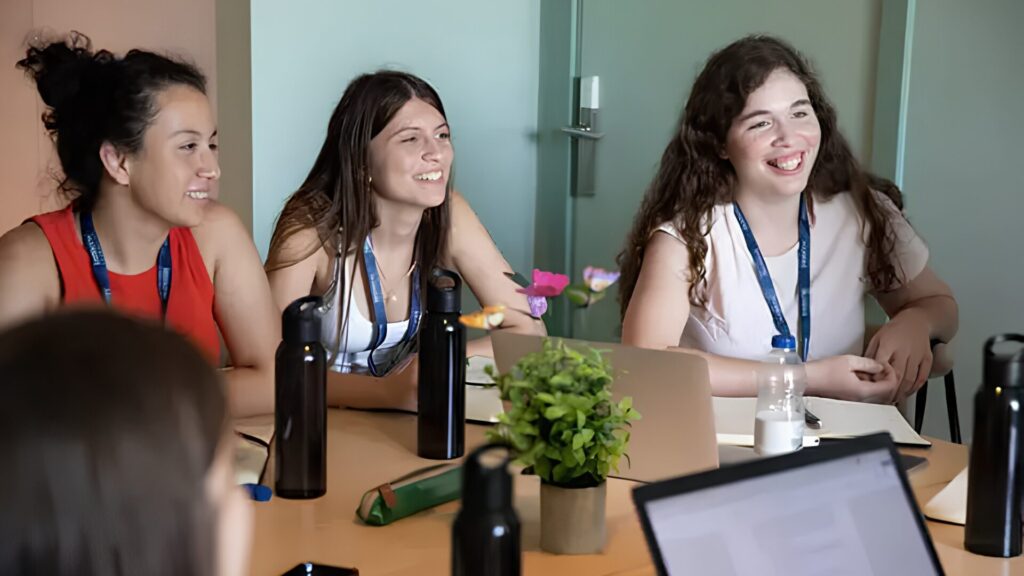
Location: Cambridge, London, Oxford, Singapore, Sydney, Tokyo, and Toronto
Cost: Varies; summer school scholarship available through our bursary programme
Acceptance Rate/Cohort Size: Selective; an average of 7 participants per class
Dates: 2 weeks during the summer
Application Deadline: Multiple summer cohorts; rolling admissions
Eligibility: Students aged 13-18 currently enrolled in middle or high school; open to international students
The Academic Insights Program allows high school students to experience university life firsthand. You will live on campus and study in small groups of 7–10, learning from tutors from top universities like Oxford and Cambridge. Participants can explore over 20 subjects, including Architecture, AI, Business Management, Computer Science, Economics, Medicine, Philosophy, and more.
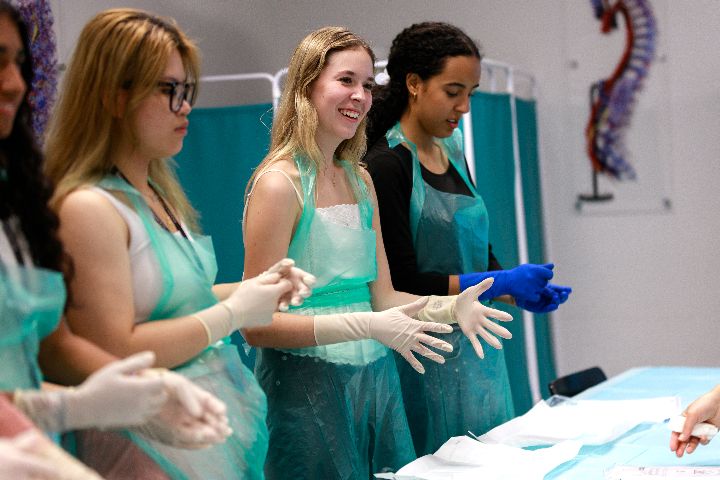
The courses are experiential and hands-on: you may find yourself conducting dissections in medicine, designing a robotic arm in engineering, participating in a moot court for law, or building creative writing portfolios and business case studies. By the end of the program, you’ll complete a personal project, receive written feedback, and receive a certificate of completion. You can find more details about the application here.
Why it stands out: You’ll study under expert academics, be guided daily by a university student mentor, complete a project you can show in future applications, and experience genuine university college life — with other campuses worldwide as alternatives.
3. Camp Rising Sun (Louis August Jonas Foundation)
Location: Upstate New York, USA
Cost: None
Acceptance Rate/Cohort Size: Highly selective; approximately 60 students
Dates: Girls & Non-Binary: June 28th – July 25th; Boys & Non-Binary: July 31st – August 27th
Application Deadline: Varies by region; typically December-February
Eligibility: Students aged 15-16 by the time camp begins; proficient in English; open to international students
In this camp, you attend seminars, collaborative projects, outdoor activities, cultural exchange, and shared community responsibilities that help you build maturity and independence. You participate in discussions on ethics, leadership, global issues, and communication while learning directly from peers with different backgrounds and perspectives. Because students live together and help shape the community, the program develops practical skills such as teamwork, adaptability, initiative, and thoughtful leadership.
The structured overnight setting also gives you an early sense of managing routines, responsibilities, and relationships away from home. For students considering selective colleges, it can be especially useful as preparation for residential university life and globally minded campus communities.
Why it stands out: It is a fully funded, highly selective overnight program that brings together students from many countries to practice leadership through real community living and shared responsibility.
4. North Carolina State University – Engineering Residential Summer Camp
Location: North Carolina State University Campus, Raleigh, NC; students live in residential university housing
Cost: $1,550; a limited amount of need-based financial aid is available
Acceptance Rate/Cohort Size: Selective; cohort size not disclosed
Dates: Week 1: June 14-19; Week 2: June 21-26; Week 3: July 5-10; Week 4: July 12-17
Application Deadline: February 27th
Eligibility: Rising 11th and 12th-grade high school students; open to international students
North Carolina State University’s Engineering Residential Summer Camp brings a specialised engineering pathway to this list of overnight summer camps for high school students, letting you focus deeply on a discipline of your choice, from civil to biomedical engineering. Throughout the week, you will tackle hands-on design challenges, build physical prototypes, attend faculty lectures, and present a collaborative capstone project while living in university dormitories.
By completing these rigorous activities, you will learn the engineering design process, sharpen critical problem-solving abilities, and develop strong teamwork skills. Ultimately, you walk away with a realistic understanding of what it takes to succeed in college.
Why it stands out: It combines highly specialized technical training with a genuine residential college experience, allowing you to truly test-drive your future STEM education.
5. Stanford University Mathematics Camp (SUMaC)
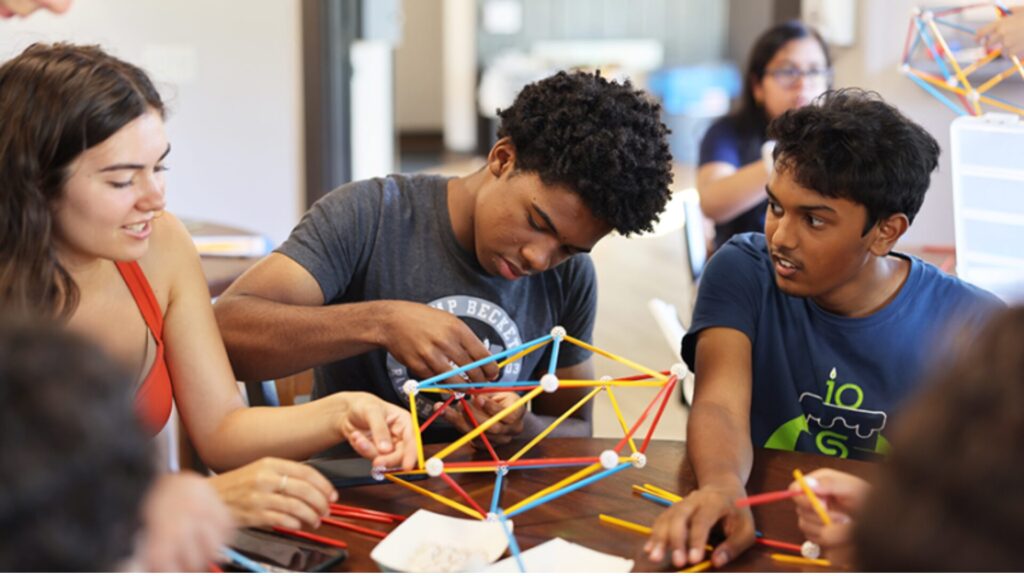
Location: Stanford University, Stanford, CA (residential) and online
Cost: $3,750 online; $8,950 residential; financial aid is available
Acceptance Rate/Cohort Size: Highly selective; approximately 40-45 students residential; approximately 64 students online
Dates: Residential Session: June 21st – July 17th; Online Sessions: June 15th – July 3rd and July 6-24
Application Deadline: February 2nd
Eligibility: High school students in grades 10 or 11 at the time of application with strong preparation in algebra, geometry, and proof-based mathematics; open to international students
Stanford University Mathematics Camp (SUMaC) is an intensive summer program designed for students who want to study mathematics well beyond the standard high school curriculum. Through daily lectures, collaborative problem sets, and discussion sections, you explore advanced topics that often include abstract reasoning, number theory, algebraic structures, and higher-level problem solving.
The camp emphasizes proofs, mathematical creativity, and the logic behind complex ideas, and you work closely with instructors and peers who share strong quantitative interests, creating an academically serious environment. If you attend the residential session, you also experience campus life at Stanford through shared housing, organized activities, and university facilities.
Why it stands out: It offers one of the most recognized proof-based math experiences for high school students, combining advanced theory, collaborative problem solving, and the opportunity to study in Stanford’s academic environment.
6. U.S. Naval Academy Summer STEM Camp
Location: United States Naval Academy, Annapolis, MD (residential, in person)
Cost: $450; need-based scholarships are available
Acceptance Rate/Cohort Size: Highly competitive; approximately 800 students per session
Dates: Session 1 (Rising 9th): June 1-6; Session 2 (Rising 10th): June 8-13; Session 3 (Rising 11th): June 15-19
Application Deadline: March 31st
Eligibility: Students typically in grades 8-11, rising by summer; applicants generally must be U.S. citizens or permanent residents and meet age requirements; not open to international students
The U.S. Naval Academy Summer STEM Program gives you the opportunity to explore engineering and applied science through hands-on challenges on one of the most distinctive college campuses in the United States. You work through projects related to robotics, cybersecurity, aerodynamics, naval engineering, and other technical fields under the guidance of Academy staff and midshipmen.
Sessions emphasize teamwork, design thinking, experimentation, and solving problems within real constraints. Living on campus also allows you to experience the structure, discipline, and daily routines of a federal service academy. You interact with current midshipmen who share insight into academics, leadership training, and student life at Annapolis.
Why it stands out: It combines practical STEM project work with a residential experience at the Naval Academy, giving you early exposure to engineering problem-solving, leadership culture, and life at a federal service academy.
7. Camp Business – Drexel University, LeBow College of Business
Location: Drexel University, Philadelphia, PA
Cost: Residential: $2,000; Commuter: $950; need-based scholarships are available
Acceptance Rate/Cohort Size: Highly competitive; approximately 40-45 students per cohort
Dates: Residential Blue Session: July 13-17; Commuter Session: July 20-24; Residential Gold Session: July 27-31
Application Deadline: May 1st; applications may close earlier if the program reaches capacity
Eligibility: High school students entering sophomore, junior, or senior year; non-native English speakers must provide proof of English proficiency; open to international students
As one of the more career-focused overnight summer camps for high school students, Camp Business at Drexel University introduces you to accounting, marketing, finance, and management while also building skills in leadership, professional image, etiquette, teamwork, and strategy. The program includes interactive lectures, team-based exercises, and activities that help you understand tools such as financial documents, stock market concepts, and business technology.
If you choose a residential session, you live in a Drexel residence hall and follow a structured schedule that combines academic sessions with supervised campus life. At the end of the week, you receive a certificate of completion and gain a clearer understanding of how business concepts are taught and applied in a university setting.
Why it stands out: It gives you a focused introduction to college-level business study at Drexel, combining core business disciplines, team exercises, and residential campus exposure in a short one-week format.
8. Ball State University – Forensic Science Camp
Location: Ball State University Campus, Muncie, Indiana
Cost: $700; scholarships are available
Acceptance Rate/Cohort Size: Selective; approximately 30 students
Dates: June 8-12
Application Deadline: Rolling basis
Eligibility: High school students, ranging from rising sophomores to rising seniors; open to international students
In this camp, you immerse yourself in a five-day residential experience exploring the intersection of science and criminal justice. You will dive into diverse topics, including forensic biology, analytical chemistry, digital forensics, and behavioral psychology. Throughout the week, you will engage in hands-on laboratory activities like analyzing blood spatter patterns, lifting fingerprints, conducting chemical tests on simulated illicit substances, and retrieving data from mobile devices.
This program combines multiple academic disciplines to provide a comprehensive look at modern forensics while allowing you to experience real college life by living in university dormitories. Ultimately, you will learn how scientific evidence formally interplays with the legal system.
Why it stands out: It offers a highly interdisciplinary curriculum that bridges hard sciences with criminal law, all while giving high schoolers an authentic residential college experience.
9. Young Leaders and Changemakers Summer Camp – Singapore
Location: Lee Kuan Yew School of Public Policy, National University of Singapore, Singapore; on-campus accommodation provided
Cost: S$3,625 + GST; S$2,900 early-bird rate until May 4th; group registration discounts are also available
Acceptance Rate/Cohort Size: Selective; cohort size not publicly specified
Dates: June 29th – July 3rd
Application Deadline: June 1st
Eligibility: Students at least 16 years old by the start of the program; open to students from Singapore and international applicants, including high school, post-secondary, and university students
The Young Leaders and Changemakers Summer Camp is a five-day residential program that introduces you to leadership, governance, and public policy through an applied university setting. Hosted at the Lee Kuan Yew School of Public Policy, the program includes workshops, case discussions, and interactive sessions on policymaking, innovation, and social impact.
You also take part in experiential learning visits across Singapore that help connect classroom ideas to real institutions, communities, and policy systems. Throughout the week, students work in teams to analyze challenges, develop solutions, and strengthen communication and decision-making skills. The program concludes with a capstone presentation where you pitch ideas addressing a real-world issue.
Why it stands out: It gives you direct exposure to public policy education at one of Asia’s leading universities while combining leadership training, real-world site visits, and a team-based policy pitch project.
10. Arts University Bournemouth 2-week Summer Course
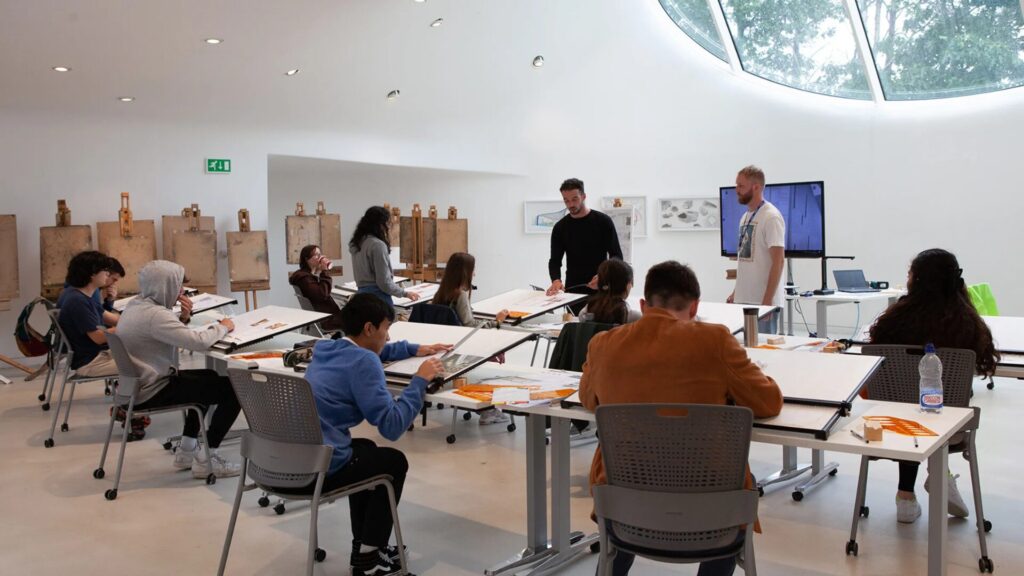
Location: Bournemouth, UK
Cost: Course only: £1,799; course + accommodation + food: £2,635; course + accommodation + food + airport transfer: £2,970
Acceptance Rate/Cohort Size: Not disclosed
Dates: August 3-14
Application Deadline: Not disclosed
Eligibility: Teenagers aged 15 to 17 years old; no formal academic qualification is required, just come with an open mind and curiosity; international students are encouraged to apply
Arts University Bournemouth’s 2-week Summer Course adds a creative design angle to the various overnight summer camps for high school students, with a structured architecture programme covering design principles, urban planning, and digital tools like CAD. You’ll work on assignments and projects throughout the two weeks, which are assessed and can be added to your portfolio.
The program focuses on building both understanding and output, so you’re consistently working on something tangible. You don’t need prior experience, which makes it accessible while still structured. You’ll build foundational knowledge, technical skills, and a working portfolio.
Why it stands out: It delivers two weeks of assessed practical training in architectural design principles and CAD without requiring prior academic qualifications.
11. Manhattan College Entrepreneurship Pre-College Camp (NY)
Location: Manhattan University, Riverdale, NY
Cost: $1,400 tuition plus a $50 non-refundable registration fee; payment plans and early bird special discounts are available
Acceptance Rate/Cohort Size: Open enrollment; cohort size not disclosed
Dates: July 6-23
Application Deadline: Rolling admissions until full
Eligibility: Students ages 15-17; open to domestic and international students who can attend in person
The Entrepreneurship Pre-College Camp at Manhattan University is a three-week program where you build a business idea from concept stage to final pitch. During the first phase, you identify a product or service, define a target audience, and create early branding materials such as logos and messaging. You then move into pricing, supplier research, prototype or MVP development, and pitch preparation with regular instructor feedback.
Students work in teams, complete milestones each week, and refine ideas through daily check-ins and collaborative sessions. The program concludes with a final presentation delivered to in-person and virtual audiences. It offers a practical introduction to entrepreneurship while helping you develop communication, teamwork, and problem-solving skills in a college environment.
Why it stands out: It focuses on the full startup process, from idea creation to final investor-style pitch, giving you hands-on entrepreneurial experience rather than only classroom theory.
12. King’s College – Health Sciences Summer Camp
Location: King’s College Campus, Wilkes-Barre, Pennsylvania
Cost: $695
Acceptance Rate/Cohort Size: Open enrollment; 7:1 student-to-counselor ratio
Dates: July 19-23
Application Deadline: May 15th
Eligibility: Current high school students interested in health sciences; open to international students
In this camp, you engage in a hands-on exploration of various medical professions. You will cover foundational topics such as anatomy, physiology, neurology, healthcare ethics, and biology. Throughout the week, you will actively participate in practical clinical activities like performing basic suturing, practicing injections, conducting full patient assessments, and utilizing advanced medical simulators.
A unique feature of this camp is that you learn directly from active healthcare practitioners while using the same clinical facilities as college majors, including access to an optional cadaver dissection lab. Ultimately, you will develop clinical skills and patient care techniques that will help you confidently map out your future career path.
Why it stands out: It allows you to physically test-drive multiple healthcare disciplines using actual professional-grade medical equipment under the direct supervision of active practitioners.
13. Oakland University – Philosophy Camp
Location: Human Health Sciences building, Oakland University, Rochester, Michigan; overnight accommodations at Oak View student housing
Cost: $675; $50 early bird discount available before April 1; need-based scholarships are available
Acceptance Rate/Cohort Size: Non-competitive; cohort size not explicitly specified
Dates: July 13-17
Application Deadline: Rolling admissions until spots are filled
Eligibility: High school students in grades 9-12; open to international students
In this camp, you immerse yourself in a weeklong residential experience designed to tackle life’s biggest questions. You will explore diverse philosophical topics, including ethics, metaphysics, political philosophy, philosophy of religion, and the nature of human identity.
Throughout the week, you will engage in dynamic classroom discussions with university professors, embark on regional educational field trips, and enjoy recreational activities like campus bonfires and murder mystery games. Ultimately, you will develop strong critical thinking, public speaking, and logical reasoning skills to effectively construct and communicate your own arguments.
Why it stands out: It provides high schoolers with incredibly rare, pre-collegiate access to formal philosophical training while building a close-knit intellectual community through traditional camp recreation.
14. University of Nevada, Las Vegas (UNLV) – BeWELL Summer Camp
Location: Rotates annually between the University of Nevada, Las Vegas (UNLV) and the University of Nevada, Reno (UNR)
Cost: $50
Acceptance Rate/Cohort Size: Competitive; 16 students
Dates: June 14-17
Application Deadline: Typically, spring
Eligibility: High school students interested in exploring careers in behavioral health, including counselling, therapy, social work, psychology, and psychiatry; open to international students
In the UNLV BeWELL Summer Camp, you are immersed in an overnight experience focused on exploring behavioral health careers. You will study core topics like psychology, counseling, social work, and psychiatry. To build practical knowledge, you will participate in wellness workshops, take guided campus tours, complete hands-on learning simulations, and present at a student-led project showcase.
The camp’s host location rotates annually between the UNLV and UNR campuses. By the end of the session, you will learn essential college readiness skills and practical strategies for supporting mental health in your community.
Why it stands out: It actively builds a future state workforce by directly connecting teens to real-world behavioral health resources and education.
15. Rice University – Tapia STEM Camps
Location: Rice University, Houston, TX (residential, in person)
Cost: $2,200 early bird before March 1; $2,500 regular fee; a limited number of scholarships are available
Acceptance Rate/Cohort Size: Open enrollment; 100-150 campers per week
Dates: Session 1: July 5-10; Session 2: July 12-17; Session 3: July 19-24
Application Deadline: Early May
Eligibility: Rising 8th – 12th grade students with an interest in STEM and readiness for collaborative project work; “Techniques of a Pro Mathematician” session requires completion of high school geometry and an understanding of basic trigonometry; open to international students
Rice University’s Tapia STEM Camps are residential summer programs built around hands-on learning in science, technology, engineering, and mathematics. You live on campus while working in teams on applied projects that may involve coding, engineering design, experiments, or analytical problem solving. University faculty, graduate students, and current undergraduates support the sessions, guiding students through technical concepts and project development.
Many activities conclude with presentations, which help you practice communication and explain ideas clearly. Students also experience residence life and the pace of a university schedule during the week. The program is especially useful if you want broad STEM exposure while developing teamwork, confidence, and project-based learning skills.
Why it stands out: It combines residential campus life at Rice with collaborative STEM projects and mentorship from university students and faculty, creating a practical introduction to college-level STEM learning.
What Overnight Camps Teach Beyond Academics
You may remember an overnight camp for the subject you studied, but its real value often comes from the routines you learn away from home.
The 15 overnight summer camps for high school students featured here place you in labs, seminars, dorms, leadership projects, campus meals, and evening activities.
At Los Alamos, Stanford, Rice, or Singapore, you practise independence by managing schedules, sharing spaces, meeting peers, and adapting to new expectations.
To make that growth last beyond summer, explore our Student Life and Cultural Immersion blogs for guidance on academics, friendships, finances, accommodation, well-being, and cultural experiences.