
 Русский (RU)
 Українська (UK)
 Türkçe (TR)
 Italiano (IT)
 Français (FR)
 Português (PT)
 中文 (中国) (ZH)
 Español (ES)
 日本語 (JA)
 ไทย (TH)
 Deutsch (DE)
 Ελληνικά (EL)
 Polski (PL)
 Bahasa Indonesia (ID)
 Nederlands (NL)
 العربية (AR)
 한국어 (KO)

If you’re interested in biology beyond your high school coursework, biology summer courses for high school students can give you an early look at how the subject is studied at the university level. Along with learning concepts from textbooks, you’ll have the opportunity to develop practical skills through laboratory work, research projects, and university-style classes.
Depending on the course, you might learn techniques such as DNA extraction, PCR, microscopy, cell culture, and gel electrophoresis, explore molecular biology, genetics, genomics, and CRISPR, or use bioinformatics tools to analyze biological data. Many also introduce you to experimental design, scientific writing, research ethics, and data analysis while allowing you to work alongside university faculty, researchers, and like-minded peers.
They can act as a foundation for your college journey by giving you a taste of what university life is like at a top institution, in person.
What kind of biology summer courses are available for high school students?
High school biology options generally begin with a foundational introductory course, which covers core life science topics such as cell structure and function, genetics, evolution, ecology, and biochemistry, often incorporating hands-on laboratory work.
Beyond the standard curriculum, you may have the opportunity to take advanced placement (AP) or honors biology for college credit, as well as specialized electives that dive deeper into specific branches like zoology (focusing on animal physiology), botany (plant biology), microbiology, human anatomy, or environmental science, depending on the school’s offerings.
To help you find the right fit, we’ve put together a list of 15 biology summer courses for high school students that offer hands-on learning, research experience, and exposure to university-level biology.
For adjacent opportunities, consider the online biology program.
Key takeaways
- Columbia’s Modern Biology & Its Real World Applications caps enrollment at 24 students and costs $6,381 for commuters or $12,838 for residential students over three weeks.
- Immerse Education’s Biology Summer School takes place at Oxford and Cambridge in small groups of seven to 10 students, open to students worldwide aged 13 to 18, culminating in an independent mini research project.
- The University of Chicago’s Research in the Biological Sciences program costs $15,200 and has students spend nearly the entire four weeks working in a laboratory progressing toward an independent project.
- Penn’s Biomedical Research Academy costs $10,050 and combines nine wet-lab sessions with four computational labs using Python-based analysis, requiring no prior programming experience.
- The University of Oxford’s UNIQ Biology program is completely free but restricted to UK state school students studying biology alongside chemistry, physics, or mathematics.
- The Biotech Summer Experience at Lawrence Livermore National Laboratory is free but restricted to Northern California students, with generated DNA sequences submitted to GenBank with student attribution.
- UC Berkeley’s Pre-College Scholars Summer Residential track costs up to $15,987 and places students directly into credit-bearing courses like General Biology 1A alongside UC Berkeley undergraduates.
- Program costs for biology summer courses range from free options like Oxford’s UNIQ Biology and the Lawrence Livermore Biotech Experience to over $15,200 for UChicago’s RIBS program.
15 Biology Summer Courses for High School Students
1. Columbia University Pre-College Programs – Modern Biology & Its Real World Applications
Location: New York City, New York
Cost: $6,381 per session (NYC Commuter) or US$12,838 per session (NYC Residential), plus a US$80 application fee; need-based full-cost scholarships are available for US-resident commuter applicants
Acceptance rate/cohort size: Selective; capped at 24 students
Dates: Summer A: June 29th – July 17th; Summer B: July 21st – August 7th
Application Deadline: Rolling basis
Eligibility: Rising 9th through current 12th grade students; NYC Residential participants aged 15 or older, with 15-year-olds turning 16 by December 31st of the year they attend; open to international students
In the Modern Biology & Its Real World Applications program, you study molecular biology, genetics, and evolution in person on Columbia’s New York City campus across three weeks. You begin with the structure and function of DNA, RNA, and proteins, then apply that foundation to genetic engineering, cancer biology, immunology, biotechnology, and virology.
Interactive lectures, group discussions, online labs, and multimedia activities build scientific literacy and fluency with the technical vocabulary of current research. Mini-units on bioethics and climate biology push you to weigh scientific discovery against social, historical, and economic contexts. The course carries no wet lab component, and Columbia notes that roughly a third of the material is already familiar to students who have taken AP Biology.
Why it stands out: It places core molecular biology beside applied units on cancer biology, immunology, virology, bioethics, and climate biology within a single three-week Columbia course capped at 24 students per section.
2. Immerse Education’s Biology Summer School
Location: Oxford and Cambridge, UK
Cost/Stipend: Varies; summer school scholarship available through our bursary programme
Acceptance rate/cohort size: Selective; an average of 7 participants per class
Dates: Multiple two-week sessions during the summer
Application Deadline: Rolling admissions across multiple cohorts
Eligibility: Students aged 13-18 worldwide
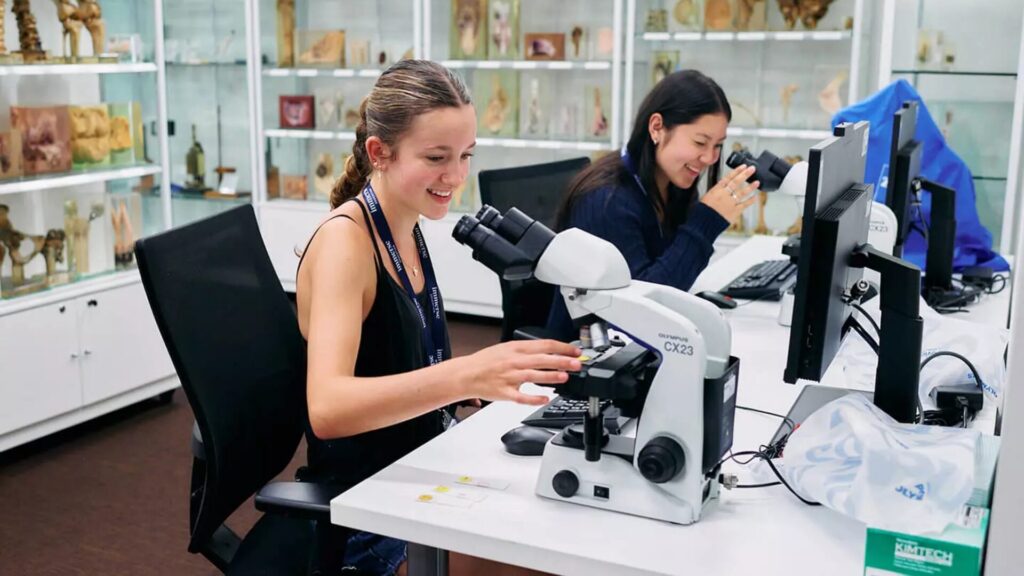
Immerse’s Biology Summer School introduces you to university-level biology through small-group seminars led by tutors from Oxford and Cambridge. You’ll study subjects including cell biology, genetics, ecology, physiology, and evolution while exploring how these concepts connect to current biological research.
Sessions emphasize discussion, problem-solving, and practical application rather than lecture-based learning alone. You’ll also complete an independent mini research project, allowing you to investigate a biological topic in greater depth while receiving individualized academic feedback. Living on campus and learning alongside an international cohort provides insight into university study before college. You receive written feedback and a certificate upon completion.
Why it stands out: It involves small tutorial-style teaching and an independent biology research project, providing a close approximation of studying biology at Oxford or Cambridge.
3. Northeastern University Accelerate Pre-College Programs – Biotechnology & The Future of Medicine
Location: Boston, Massachusetts
Cost: $7,095; need-based scholarships or program discounts are available
Acceptance rate/cohort size: Selective; typically 15-30 students
Dates: July 12-24
Application Deadline: February 27th
Eligibility: Rising high school juniors or seniors by program start; open to international students
In the Biotechnology & The Future of Medicine program, you explore biotechnology, artificial intelligence, translational research, and pharmaceutical science through the biology of drug discovery. You investigate how scientists identify drug targets, design molecules, and use advanced technologies to accelerate the discovery of new medicines. Interactive laboratory work gives you experience with biomedical and pharmaceutical research tools, while faculty-led workshops explain how biotechnology and AI are changing drug development.
You also analyze real-world case studies and trace how findings at the laboratory bench can become therapies for patients. The program builds scientific reasoning, laboratory awareness, and an understanding of career pathways in biotechnology, biomedical research, and pharmaceutical sciences.
Why it stands out: It combines hands-on biomedical research exposure with AI-enabled drug-discovery concepts and translational science connecting laboratory discoveries to human therapies.
4. Brown University Pre-College Programs – Summer@Brown – Biological and Natural Sciences courses
Location: Providence, Rhode Island
Cost: $3,096 – $10,858 depending on format and duration; scholarships are available
Acceptance rate/cohort size: Selective; roughly 6,000 students across all Pre-College programs
Dates: June 15th – July 25th
Application Deadline: May 15th
Eligibility: Students completing grades 9-12 and ages 14-18 by June 14th; open to international students
In this program, you explore biological and natural sciences through rigorous, college-level coursework without the pressure of formal grades. You gain hands-on experience in the life sciences by tackling projects that range from observational sketching and biomimetic model construction to investigating cellular biology and regenerative medicine. Depending on your chosen course, you might research environmental challenges or work through the design thinking process to develop nature-inspired solutions.
You collaborate with diverse peers in a student-centered environment that emphasizes independent research, data analysis, and clearly presenting scientific ideas. Beyond the classroom, you engage in academic planning workshops that help develop university readiness. These experiences build a strong foundation for future STEM studies.
Why it stands out: It allows high school students to engage in rigorous, college-level biological sciences coursework reflecting Brown’s Open Curriculum, focusing on pure learning and independent research without the pressure of formal grades.
5. Dartmouth Precollege – Biology: Transforming the Future of Science
Location: Online (Dartmouth College)
Cost: $1,895; need-based scholarships are available
Acceptance rate/cohort size: Selective; ~7 participants per class
Dates: Flexible; multiple lengths (1-week, 2-week, 4-week) and cohorts run throughout the year
Application Deadline: One week before each session begins
Eligibility: Students aged 13 and above; open to international students
This online biology course introduces you to systems biology by exploring how genes, proteins, and cells interact within complex biological networks. You’ll learn concepts in genomics, proteomics, immunology, and computational biology while examining their applications in personalized medicine, drug discovery, and aging research. Coursework combines scientific theory with computational analysis and case studies that reflect current biological research.
Throughout the course, you’ll receive guidance from Dartmouth instructors as you complete a capstone project applying systems biology concepts to a real-world problem. By the end of the program, you’ll be able to interpret biological networks and evaluate how computational methods support modern biological research.
Why it stands out: The combination of computational biology, faculty mentorship, and a capstone project introduces you to systems biology beyond a traditional high school curriculum.
6. Harvard Summer School, Harvard University – Secondary School Program (on-campus)
Location: Cambridge, Massachusetts
Cost: $9,100 (4-week residential); $15,735 (7-week residential); $4,180 – $8,160 (7-week commuting); plus $75 nonrefundable application fee; need-based scholarships are available for U.S. citizens, permanent residents, and DACA recipients
Acceptance rate/cohort size: Moderately competitive; cohort size not stated
Dates: 7-Week: June 20th – August 8th; 4-Week: July 12th – August 8th
Application Deadline: April 1st
Eligibility: Graduating high school and entering college in the program year or in either of the subsequent two years; at least 16 years old by June 20th and not turning 19 before July 31st; TOEFL, IELTS, or Duolingo scores when English is not the native language; open to international students
In this program, you spend four or seven weeks on Harvard’s Cambridge campus taking credit-bearing college courses in biology and allied life sciences alongside college and adult students. You can build a biology-focused summer through offerings such as Integrated Biology Laboratory, Introduction to Immunology with Laboratory Techniques, or paired premedical sciences and ethics courses.
Every course is taught by Harvard faculty or distinguished visiting faculty, carries a letter grade, and earns four or eight college credits you can list on a Harvard transcript. Outside class, you join college readiness workshops, admissions fairs, and residential activities alongside eight to twelve study hours weekly per course.
Why it stands out: It lets high school students earn genuine Harvard college credit and a letter grade in the same rigorous courses taken by college students and adult learners.
7. University of Chicago – Research in the Biological Sciences (RIBS)
Location: University of Chicago, Chicago, Illinois
Cost: $15,200 + $75 application fee; need-based financial aid is available
Acceptance rate/cohort size: Highly competitive; cohort size not publicly disclosed
Dates: June 15th – July 10th
Application Deadline: March 12th
Eligibility: High school sophomores and juniors who have completed one year of biology; open to international students
As one of the most laboratory-intensive biology summer courses for high school students, RIBS is a four-week program that introduces you to molecular biology, genetics, microbiology, and cancer biology through full-time experimental work. You’ll spend most of each day in the laboratory learning techniques such as DNA analysis, bacterial transformation, protein experiments, and cell biology methods.
Alongside laboratory work, you’ll read scientific literature, maintain a professional lab notebook, and participate in group discussions and presentations. As your skills develop, you’ll design and complete an independent research project with guidance from instructors. The experience concludes with presentations that strengthen your ability to communicate scientific findings.
Why it stands out: You’ll spend nearly the entire program working in a laboratory while progressing from learning core techniques to conducting your own independent biology project.
8. University of Pennsylvania, School of Arts and Sciences – Biomedical Research Academy
Location: Philadelphia, Pennsylvania
Cost: $10,050 tuition +$100 application fee; scholarships are available for select School District of Philadelphia students
Acceptance rate/cohort size: Selective; cohort size not stated
Dates: July 11th – August 1st
Application Deadline: Rolling basis until full
Eligibility: Current grades 9-11; one year of high school biology completed; one year of chemistry strongly advised; 3.5 minimum GPA in admissions guidance; open to international students
In the Biomedical Research Academy program, you explore the cellular, molecular, and genetic foundations of disease through a three-week residential curriculum. You attend daily lectures and Penn faculty research talks, discuss peer-reviewed papers in journal clubs, and complete small-group investigations.
In nine wet-lab sessions, you use PCR, gel electrophoresis, restriction analysis, bacterial transformation, and ELISA to study blood type, bacterial gene expression, and a mock disease outbreak. Four computational labs introduce Python-based analysis of real biological data, helping you identify patterns, interpret results, and connect bioinformatics to cancer, infectious disease, and personalized medicine. You strengthen experimental reasoning, scientific-literature critique, data interpretation, presentation, and laboratory skills, with no prior programming experience required.
Why it stands out: It combines extensive wet-lab molecular biology with dedicated Python bioinformatics sessions and daily analysis of peer-reviewed research.
9. University of Oxford – UNIQ Biology
Location: Oxford, England
Cost: None
Acceptance rate/cohort size: Selective; cohort size not stated
Dates: July 13-17
Application Deadline: January 13th
Eligibility: UK state school students in Year 12 (England or Wales), Year 13 (Northern Ireland), or S5 (Scotland) studying biology and either chemistry, physics, or mathematics; not open to international students
In the UNIQ Biology program, you immerse yourself in the life sciences at the University of Oxford. You engage in lectures and seminars that explore topics ranging from biodiversity to climate change. You participate in laboratory sessions to develop hands-on technical skills essential for biological sciences.
You reside in an Oxford college for four nights, gaining direct insight into undergraduate life while networking with students and academic staff. You receive tailored guidance on university applications, admissions tests, and interviews to help strengthen your academic trajectory. The residential experience culminates in a mini conference where you explore future pathways in biology.
Why it stands out: It removes financial and social barriers by offering a completely free, immersive Oxford academic experience paired with comprehensive university application support.
10. Biotech Summer Experience @ Lawrence Livermore National Laboratory
Location: Lawrence Livermore National Laboratory, Livermore, California
Cost: None
Acceptance rate/cohort size: Competitive; strictly limited spaces
Dates: July 13-24
Application Deadline: February 26th
Eligibility: Northern California students entering grades 11-12, 16+ years old, with ≥3.3 cumulative GPA, ≥3.5 science GPA, and completed Biology/Chemistry; students 18 or older must be U.S. citizens, and NDAA compliance prohibits citizens of certain nations; not open to international students
This two-week laboratory program introduces you to molecular biology and bioinformatics through a structured research project. You’ll perform laboratory techniques such as plasmid DNA isolation, PCR, restriction enzyme analysis, and gel electrophoresis before using bioinformatics software to analyze genetic sequences.
The curriculum focuses on the genetics of duckweed, allowing you to apply laboratory methods to an ongoing biological investigation. DNA sequences generated during the program are submitted to GenBank with student attribution, providing experience with scientific data sharing and stewardship. Throughout the program, you’ll strengthen both experimental and computational biology skills.
Why it stands out: You’ll combine wet-lab molecular biology with bioinformatics while contributing genetic sequence data to a public scientific database.
11. Georgetown University Pre-College Programs – Biotechnology for Science & Health Academy

Location: Washington, D.C.
Cost: Residential tuition and meals $6,800; commuter tuition $5,530 + $50 non-refundable application fee, waived for applications received by the early bird deadline; international health insurance fee $90; limited need-based tuition scholarships are available
Acceptance rate/cohort size: Non-competitive; cohort size not stated
Dates: June 28th – July 10th
Application Deadline: Early bird deadline: January 31st; final deadline: May 15th; later applications case-by-case; registration first-come, first-served until sections fill
Eligibility: Current 8th, 9th, 10th, 11th, or 12th grader during the academic year before the summer program; at least 15 years old by the check-in date, with no exceptions; good academic standing with a minimum 2.0 GPA; open to international students
In the Biotechnology for Science & Health Academy program, you explore how biotechnology shapes modern biology, health, and science across a two-week schedule of lectures and hands-on laboratory work. You clone a gene through DNA ligation and transformation, then analyze the resulting product to see how molecular biology becomes a working tool.
You also practice advanced DNA purification, examine the biochemical function of enzymes, purify proteins, and apply bioinformatics to biological data. Sessions cover DNA and protein diagnostics in healthcare, forensic DNA analysis, food safety applications, and basic laboratory safety. Off-site visits to Washington, D.C. institutes, companies, or research laboratories add career context, and you finish with a capstone project and a Certificate of Participation.
Why it stands out: It pairs university-level biology instruction with a full biotechnology bench sequence, including gene cloning, protein purification, forensic and diagnostic DNA work, inside a two-week residential academy in Washington, D.C.
12. Smith College – Summer Science and Engineering Program (SSEP)
Location: Northampton, Massachusetts
Cost: $4,985 per two-week session or $9,970 for both + $50 application fee, increased to US$100 after April 15th; limited need-based tuition assistance is available
Acceptance rate/cohort size: Selective; more than 100 students annually
Dates: Session 1: July 4-17; Session 2: July 19th – August 1st
Application Deadline: Priority deadline: February 1st; rolling through May 1st or capacity; international deadline: March 1st
Eligibility: Entering grades 9-12 in fall; some courses have additional grade or biology prerequisites; open to international students; English-proficiency scores required when instruction has not been in English for at least three years
In this program, you spend two or four weeks in a residential, lab-centered science experience and take one intensive course per session. Depending on your biology course, you may dissect plants, use microscopes, formulate ecological hypotheses, analyze human genetic traits, or investigate nervous-system function.
In Novel Bacteriophage Discovery, you conduct authentic research by isolating, purifying, and amplifying phages before examining them with electron microscopy and molecular biology methods. Other laboratory work can include PCR, DNA fingerprinting, restriction enzyme digestion, gel electrophoresis, brain dissections, nerve-conduction measurements, and data analysis. Working in groups of up to 17 with Smith faculty and undergraduate interns, you develop experimental design, scientific reasoning, teamwork, interpretation, and communication skills.
Why it stands out: It combines small-group faculty instruction with authentic laboratory and field research, including novel phage discovery using electron microscopy and genome-analysis techniques.
13. Carnegie Mellon University Pre-College Computational Biology Program
Location: Carnegie Mellon University, Pittsburgh, PA
Cost: Residential: $10,750; Commuter: $8,041 + $50 application fee; scholarships are available
Acceptance rate/cohort size: Highly competitive; small groups
Dates: June 20th – July 18th
Application Deadline: March 1st
Eligibility: High school students in grades 10-12; aged 16 or older by the program start date; have an academic average of B (3.0/4.0) or better; open to international students
This pre-college program introduces you to computational biology by combining laboratory science with programming and data analysis. You’ll explore DNA sequencing, microbial ecology, genome assembly, and evolutionary biology while learning to analyze biological datasets using computational tools.
Laboratory experiments are paired with coding activities and hackathon-style challenges that reinforce concepts introduced in class. You’ll also work with robotic laboratory equipment and learn how artificial intelligence supports biological research. The program concludes with a capstone project that integrates experimental results with computational analysis.
Why it stands out: You’ll develop both laboratory and bioinformatics skills while exploring how computing and biology intersect in modern research.
14. Boston University Summer Term – Summer Challenge
Location: Boston, Massachusetts
Cost: $3,730 tuition + $75 application fee, $75 service fee, $1,440 optional residential housing and dining; Scott Simenas Award scholarship available / Scott Simenas Award stipend available
Acceptance rate/cohort size: Moderately competitive; cohort size not stated
Dates: Session 1: June 14-26; Session 2: July 5-17; Session 3: July 19-31
Application Deadline: May 15th; admission decisions made on a rolling basis
Eligibility: Rising high school sophomores, juniors, and seniors; residential students required to be at least 14 years old; open to international students
In the Summer Challenge program, you explore biology through non-credit seminars like Infectious Diseases and Anatomy and Physiology, a grade-free format that distinguishes it from more competitive biology summer courses for high school students. You conduct experiments in a microbiology lab to study the physiological characteristics of microorganisms.
You also investigate human body structures using anatomical models and specimen dissections. The program allows you to dive into the mechanisms of diseases like influenza and HIV. You engage in lectures, group work, and project-based assignments without focusing on grades. By participating in interactive discussions, you develop foundational skills for future studies in the health sciences.
Why it stands out: It provides high school students the opportunity to conduct collegiate-level biology experiments and anatomical dissections in an entirely grade-free environment.
15. University of California, Berkeley – Pre-College Scholars: Summer Residential Track
Location: Berkeley, California
Cost/Stipend: $15,987 (Session C) or $14,687 (Session D), + a $25 nonrefundable application fee; one media scholarship covers tuition, room, and board for one Session C participant
Acceptance rate/cohort size: Non-competitive; limited residential places
Dates: Session C: June 22nd – August 14th; Session D: July 6th – August 14th
Application Deadline: March 17th
Eligibility: Completed 10th or 11th grade by the start of summer classes and continuing high school the following fall; overall B average (3.0, weighted or unweighted); age 16 by June 21; high school graduates eligible only when aged 16 or 17 during the summer; open to international students
In the Berkeley Pre-College Scholars Summer Residential track program, you live in chaperoned campus housing and enroll in two lower-division Berkeley Summer Sessions courses, six units in Session C or five in Session D. For biology, you can request offerings such as General Biology 1A and its companion laboratory in Session C, where prerequisites and departmental approval are enforced.
You study alongside UC Berkeley undergraduates and visiting students, and your grades appear on an official Berkeley transcript. Program staff processes your course enrollment request, so you practice checking prerequisites and listing choices like a college student. Outside class, you use Student Learning Center science tutoring, college-exploration workshops, and a California Academy of Sciences excursion.
Why it stands out: It places high school students directly into credit-bearing UC Berkeley courses, including general biology with laboratory work, with housing, meals, and supervision built into a single program fee.
Frequently asked questions: Biology summer courses for high school students
Are biology summer courses for high school students open to international students?
Most are, including Columbia’s Modern Biology program, Harvard’s Secondary School Program, and Smith College’s Summer Science and Engineering Program. A few exceptions exist: Oxford’s UNIQ Biology and the Lawrence Livermore Biotech Experience are both restricted to domestic students. Immerse Education’s Biology Summer School is also open globally to students aged 13 to 18 across Oxford and Cambridge.
How much do biology summer courses cost?
Costs vary enormously by program length and prestige. Free options include Oxford’s UNIQ Biology and the Lawrence Livermore Biotech Experience. Mid-range programs like Dartmouth’s online Biology course cost $1,895, while premium residential options include UChicago’s RIBS at $15,200 and UC Berkeley’s Pre-College Scholars at up to $15,987. Financial aid is available for most tuition-based programs listed here.
What is the difference between a wet-lab and a computational biology program?
Wet-lab programs, like UChicago’s RIBS or Penn’s Biomedical Research Academy, have you physically working with lab equipment on techniques like PCR, gel electrophoresis, and bacterial transformation. Computational biology programs, like Dartmouth’s online Biology course or Carnegie Mellon’s Computational Biology Program, instead focus on analyzing biological datasets through programming and bioinformatics tools. Several programs, like Penn’s Academy and the Lawrence Livermore Biotech Experience, combine both approaches within a single curriculum.
Do biology summer courses award transferable college credit?
Some do, though it varies. Harvard’s Secondary School Program and UC Berkeley’s Pre-College Scholars both award real, transcripted college credit since you’re enrolled in actual undergraduate coursework. Others, like UChicago’s RIBS and Immerse Education’s Biology Summer School, provide a certificate or research experience rather than formal credit. If credit matters to you, confirm this directly with each program, since even similarly structured biology programs handle this differently.
How selective are biology summer courses for high school students?
Selectivity ranges considerably. UChicago’s RIBS and the Lawrence Livermore Biotech Experience are both highly competitive, with the latter having strictly limited spaces. Others, like Georgetown’s Biotechnology for Science & Health Academy, describe themselves as non-competitive. Regardless of selectivity, meeting prerequisite coursework, like completed biology and chemistry, matters as much as overall academic strength.
Is Immerse Education a good option for exploring biology before college?
Immerse Education’s Biology Summer School is a strong choice if you want small-group, tutorial-style teaching similar to Oxford and Cambridge undergraduate study. The two week program covers cell biology, genetics, ecology, physiology, and evolution through discussion and problem-solving rather than lecture-based learning alone. You’ll complete an independent mini research project and receive individualized academic feedback, giving you a close approximation of studying biology at a top UK university, with financial aid available through its bursary programme.
Ready to Build on Your Biology Experience?
Choosing among these summer biology courses for high school students gives you a genuine introduction to laboratory work, research, and scientific reasoning.
Once the course ends, you can turn that hands-on experience into a clearer sense of your academic and career direction.
The technical skills, research exposure, and scientific thinking you built become a strong foundation for stronger university applications ahead.
Keep building on what you started this summer by exploring our University Preparation blogs for guidance on your next steps.