



 Русский (RU)
 Українська (UK)
 Türkçe (TR)
 Italiano (IT)
 Français (FR)
 Português (PT)
 中文 (中国) (ZH)
 Español (ES)
 日本語 (JA)
 ไทย (TH)
 Deutsch (DE)
 Ελληνικά (EL)
 Polski (PL)
 Bahasa Indonesia (ID)
 Nederlands (NL)
 العربية (AR)
 한국어 (KO)

College courses for high school students offer an exciting bridge between school learning and university-level academics, allowing students to step into more advanced, focused study while still in a supportive learning environment. These programs are designed to help learners develop an early mastery of college-level thinking , strengthening analytical reasoning, subject-specific knowledge, and independent learning skills that are essential for higher education and future careers.
Students engage directly with core academic concepts, practical tools, and real-world applications, often using university-style resources, lab work, research methods, and collaborative projects that mirror actual undergraduate study. College programs can act as a foundation for your college journey, giving you a taste of what university life is like at a top institution, in person.
What kind of college courses are available for high school students?
High school students can enroll in a diverse range of college courses that allow them to earn undergraduate credits, explore advanced subjects, and demonstrate academic rigor to university admissions committees. Through dual enrollment or concurrent enrollment programs, you take official college courses either at your high school, online, or directly on a local community college or university campus, covering standard general education requirements like introductory English, college algebra, psychology, and US history.
Pre-college summer programs hosted by top-tier universities offer highly specialized, immersive courses in fields typically unavailable in secondary schools, such as organic chemistry, data science, macroeconomics, or international relations. Additionally, widely accessible Advanced Placement (AP) and International Baccalaureate (IB) courses provide standardized college-level curricula taught right in high school classrooms, culminating in rigorous exams that many universities accept for placement or credit.
Key takeaways
- NYU’s Pre-College program costs between $700 and $16,016 depending on credit load, with separate application deadlines for spring, summer, and fall terms.
- Immerse Education’s Academic Insights Programme spans eight locations, including Boston, Cambridge, and Singapore, with small classes of seven to 10 students open to students worldwide aged 13 to 18.
- Harvard’s Secondary School Program costs between $4,180 and $15,735 plus a $75 application fee, letting students earn an official Harvard transcript while still in high school.
- Boston University’s High School Honors program admits approximately 130 students and lets them take two courses from over 80 subject offerings alongside current BU undergraduates.
- NYU’s CS4CS program is completely free but restricted to students living in NYC’s five boroughs or select neighboring cities, admitting typically 45 to 50 students.
- The RISD Pre-College Program costs $12,495 for residential students or $9,595 for commuters, following a five week studio-based curriculum modeled on undergraduate art education.
- Parsons Summer Intensive Studies costs $5,610 in tuition plus $265 in university fees and awards three college credits for design-focused coursework.
- Program costs for college courses range from free options like NYU’s CS4CS to over $17,935 for Brown University’s two-course Pre-Baccalaureate Program.
15 College Courses for High School Students
1. New York University – Pre-College
Location: New York University, New York, NY
Cost: $700 to $16,016 for 0-8 credits; financial aid opportunities may be available for eligible students
Acceptance rate/cohort size: Selective; class sizes vary by course
Dates: Spring: January 20th – May 13th; Summer: July 1st – August 12th; Fall: September 2nd – December 22nd
Application Deadline: Spring: January 5th; Summer: March 13th (International on-campus) or June 15th (US/Online); Fall: August 14th
Eligibility: Rising 11th or 12th grade high school students in summer or current 11th or 12th grade students in the fall or spring semesters with a minimum 3.0 GPA on a 4.0 scale; open to international students
NYU’s Pre-College program allows you to enroll in actual undergraduate courses while you are still in high school and earn university credit for completed coursework. You can select from a wide range of subjects, such as journalism, business, psychology, engineering, computer science, and the humanities, depending on what is offered during the summer term.
The courses follow standard university expectations, meaning you work through assigned readings, attend seminars and discussions, complete assignments, and manage independent coursework at a college pace. During the program, you also have access to NYU’s libraries, campus facilities, and student support services, which helps you understand how academic life is structured in a university setting.
Why it stands out: You take courses in a university setting alongside NYU students and other program participants.
2. Immerse Education’s Pre-University Summer School

Location: Cambridge, London, Oxford, Singapore, Sydney, Tokyo, and Toronto
Cost: Varies; summer school scholarship available through our bursary programme
Acceptance rate/cohort size: Selective; an average of 7 participants per class
Application Deadline: Multiple summer cohorts; rolling admissions
Program Dates: 2 weeks during the summer
Eligibility: Students across the globe aged 13-18 currently enrolled in middle or high school; open to international students
The Academic Insights Program lets high school students experience university life firsthand. You will live on campus and study in small groups of 7-10, and learn from tutors from eminent top universities like Oxford and Cambridge. You can explore a wide range of subjects, spanning over 20 options, including Architecture, AI, Business Management, Computer Science, Economics, Medicine, Philosophy, and more.
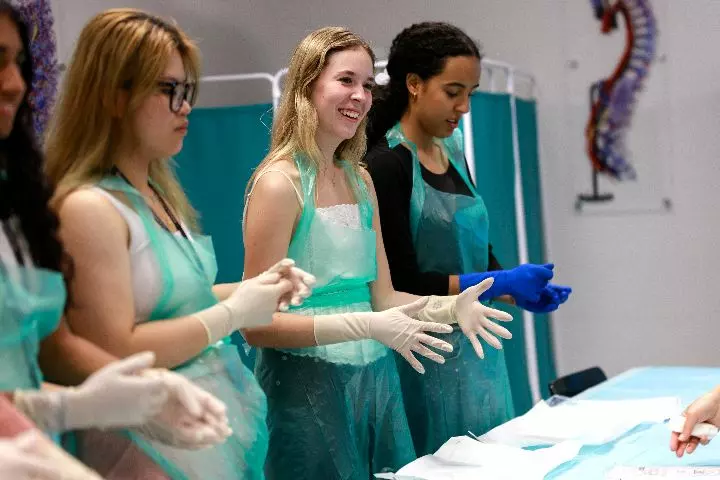
The courses are experiential and focus on hands-on learning. You may find yourself conducting dissections in medicine, designing a robotic arm in engineering, participating in a moot court for law, or building creative writing portfolios and business case studies. By the end of the program, you’ll complete a personal project, receive written feedback, and receive a certificate of completion. You can find more details about the application here.
Why it stands out: You’ll get an early start at university life and academics because the program includes an independent project, discussion-based classes, and living at a college campus.
3. Harvard Secondary School Program – Harvard Summer School
Location: Harvard University, Cambridge, MA (residential, commuting, and online options available)
Cost: $4,180 – $15,735 + $75 application fee; financial aid is available
Acceptance rate/cohort size: Selective enrollment; class sizes vary by course
Dates: July 12th – August 8th (residential) | June 20th – August 8th (residential/online/commuter)
Application Deadline: April 1st
Eligibility: High school students who are at least 16 years old by the start of the program who graduate high school in the program year or next two years; open to international students
Harvard’s Secondary School Program lets you take courses through Harvard Summer School while you are still in high school and earn college credit for completed classes. You can choose from subjects such as economics, psychology, STEM fields, literature, history, and computer science. The courses are structured around standard college formats, including lectures, discussions, assignments, labs, and regular independent study.
The academic expectations are aligned with Harvard’s summer curriculum, so you are expected to keep up with reading loads, writing tasks, and ongoing coursework at a university pace. Upon successful completion of eligible courses, you receive an official Harvard transcript reflecting your performance.
Why it stands out: You take Harvard Summer School courses for college credit while still in high school.
4. Cornell University – Pre-College Studies
Location: Cornell University, Ithaca, NY
Cost: $1,940 per credit + $75 application fee
Acceptance rate/cohort size: Selective enrollment; class sizes vary by course
Dates: Multiple summer sessions available; dates vary by selected course
Application Deadline: May 14th
Eligibility: Students aged 16-18 who have completed their sophomore year of high school; open to international students
Cornell’s Pre-College Studies program allows you to take actual Cornell undergraduate courses while you are still in high school and earn university credit for completed work. You can select from a range of subjects, including engineering, business, humanities, life sciences, architecture, veterinary science, and social sciences, depending on what is available each term.
The courses are structured at the university level, so you follow standard expectations through lectures, discussions, assignments, and independent study rather than a simplified curriculum. If you choose a residential option, you also use campus facilities such as libraries and labs and participate in student programming designed for enrolled undergraduates.
Why it stands out: You can earn Cornell credit by taking real undergraduate courses while still in high school.
5. Boston University Summer Term – High School Honors
Location: Boston University campus, Boston, MA
Cost: $6,760 + $75 application fee; housing and dining separate; limited need- and merit-based aid available for domestic students taking at least two courses
Acceptance rate/cohort size: Selective; approximately 130 students
Dates: Multiple summer sessions available; exact dates vary by course
Application Deadline: May
Eligibility: Students entering junior or senior year of high school in the fall; qualified juniors must be in Honors and/or AP courses; open to international students
In this program, you can choose two courses from over 80 available subject offerings, which comprehensively cover areas like chemistry, computer science, economics, philosophy, and political science. Throughout the term, you will attend lectures directly alongside current undergraduate students, take college-level final examinations, draft academic essays during specialized writing workshops, and participate in lively group outings to Faneuil Hall or ultimate frisbee games on the Boston Common.
A standout unique feature of this program is the ability to earn up to 8 transferable college credits while learning directly from BU’s world-class faculty in the heart of Boston.
Why it stands out: It provides a genuine collegiate environment by integrating you directly into real undergraduate courses rather than isolating you in high school-only seminars.
6. NYU’s Computer Science for Cyber Security (CS4CS)

Location: New York University (Manhattan, NY)
Cost: None
Acceptance rate/cohort size: Highly selective; typically 45-50 students
Dates: 3 weeks, July 13th – August 7th
Application deadline: May 15th
Eligibility: Currently enrolled in 8th, 9th, 10th, or 11th grade; must enter or be in high school in September and live in one of the five New York City boroughs or smaller neighboring cities such as Jersey City, Newark, or Hempstead; not open to international students
This three-week summer program introduces you to basic concepts in cybersecurity and computer science. You study introductory topics in both areas through structured lessons, guided activities, and hands-on exercises designed for high school students with different levels of prior experience. The curriculum is focused on helping you understand core ideas and how they are used in computing and security-related settings.
During the program, you learn alongside other students in a classroom environment that includes group work and collaborative activities. The structure is designed to support early exposure to STEM subjects and help you become more familiar with foundational technical concepts in a learning setting.
Why it stands out: You explore introductory cybersecurity and computer science concepts through structured, hands-on learning.
7. UC Santa Cruz Pre-College Summer Enrichment Program
Location: UC Santa Cruz, Santa Cruz, CA (in-person and/or hybrid, depending on session)
Cost: $2,500 (two weeks) | $3,750 (three weeks) + $65 application fee; very limited number of partial scholarships are available
Acceptance rate/cohort size: Selective; 6:1 student-to-instructional staff ratio
Dates: Session 1: June 15-26; Session 2 (Hybrid): June 29th – July 17th; Session 3: July 6-17
Application Deadline: February 27th (Priority/Rolling basis); general enrollment remains open until May 18th
Eligibility: High school students, ages 14-17; open to international students
The UC Santa Cruz Pre-College Summer Enrichment Program allows you to spend several weeks focusing on a chosen academic area while getting an introduction to college-level study. You can select from different tracks such as technology, healthcare, business, and digital media, with each one organized around structured lessons, guided activities, and project-based work. The coursework is designed to help you understand key ideas in your field and apply them through assignments and group tasks.
You learn in a collaborative environment alongside other students, with guidance from instructors and university-affiliated mentors. You may additionally attend sessions with professionals from academic or industry backgrounds to understand how these subjects are applied in real-world settings.
Why it stands out: You build practical skills through project-based learning in a chosen academic area at UC Santa Cruz.
8. Johns Hopkins Center for Talented Youth (CTY) Programs
Location: Online and in-person at multiple locations (U.S. and international)
Cost: Varies by course, duration, and format; need-based financial aid is available
Acceptance rate/cohort size: Highly selective; small class sizes
Dates: Year-round opportunities; dates vary by track
Application deadline: Varies by program
Eligibility: Students in grades 2-12; applicants must meet CTY eligibility criteria and course-specific requirements; open to international students
In this program, you can choose from subjects such as science, technology, mathematics, writing, history, and the humanities, with options varying based on your interests and academic goals. The courses typically cover topics in more depth than regular school classes and may progress at a faster pace. Eligibility for many CTY courses is based on academic performance or qualifying assessment results.
In these programs, you study alongside other students with similar academic preparation while completing assignments that focus on analysis, problem-solving, and independent work. Depending on the course format, you may study online or in person. Residential options also include structured activities outside class time, giving you exposure to a supervised campus environment.
Why it stands out: You study advanced academic subjects with similarly prepared students through flexible online or campus-based formats.
9. Duke Pre-College Summer Programs
Location: Duke University, Durham, NC
Cost: $6,050 (residential); $3,950 (commuter); scholarships are available
Acceptance rate/cohort size: Selective; cohort size varies by specific course
Dates: Session 1: June 13-24; Session 2: June 28th – July 9th; Session 3: July 13-24
Application Deadline: Rolling (until spots fill)
Eligibility: At least 13 years old by session start date; completed at least one year of middle school; GPA of 3.0 or above; open to international students
The Duke Pre-College Summer Programs let you spend two weeks exploring an academic subject in more depth while you are still in middle or high school. You can choose from areas such as healthcare, public policy, law, engineering, and other disciplines, with each course designed to introduce concepts that go beyond typical high school coursework. Learning takes place through seminars, group discussions, and applied activities that help you engage with the material in a more structured way.
You study alongside other students, completing assignments and collaborative projects under the guidance of university-affiliated instructors and professionals. Many courses include practical exercises, guest speakers, and examples that connect academic topics to real-world contexts.
Why it stands out: You study focused academic subjects at Duke through short, structured, campus-based programs.
10. Savannah College of Art and Design (SCAD) Joint Enrollment
Location: Online
Cost: $2,228 per class + $100 nonrefundable application fee; scholarships are available
Acceptance rate/cohort size: Selective; cohort size not specified
Dates: Fall: September 14th – November 19th; Winter: January 5th – March 12th; Spring: March 23rd – May 18th; Summer: June 15th – August 20th
Application Deadline: Rolling basis
Eligibility: High school juniors or seniors aged 16 or older; open to international students
SCAD’s Joint Enrollment winter program allows you to take college-level courses online while still enrolled in high school. The classes are taught by university instructors and follow undergraduate-level expectations, giving you exposure to college coursework in a virtual format. During the winter quarter, you can typically enroll in up to two courses and earn academic credit after completing them.
Depending on institutional policies, those credits may later be applied toward a degree at SCAD. The program includes subjects across areas such as art, design, media, communication, business, and related fields. You complete assignments, participate in discussions, and manage deadlines in a structure similar to a college course.
Why it stands out: You take online college courses taught by SCAD instructors and earn academic credit while still in high school.
11. Georgetown University Pre-College Online Program

Location: Online
Cost: Enrichment Courses: $1,895; College Credit Courses: $3,995; need-based scholarships are available
Acceptance rate/cohort size: Moderately selective; cohort varies by course
Dates: Year-round (1-12 weeks depending on course)
Application Deadline: Rolling admissions (one week before the course start date)
Eligibility: High school students aged 13+; open to international students
The Georgetown University Pre-College Online Program lets you take college-level courses in a structured online format while you are still in high school. You can choose between enrichment courses and credit-bearing courses, depending on how much depth and academic workload you want. Enrichment courses introduce key ideas and help you build foundational understanding, while credit courses are more intensive and may lead to college credit if you complete them successfully.
You can study subjects such as biology, psychology, cybersecurity, international relations, business, creative writing, marketing, law, and medicine. Across all courses, you complete assignments and participate in online activities that follow a university-style structure.
Why it stands out: You choose between enrichment or credit-bearing online courses across a wide range of subjects at Georgetown University.
12. Pre-Baccalaureate Program – Brown University Pre-College Programs
Location: Brown University, Providence, RI (residential, commuter, and online options available depending on the course)
Cost: $8,973 for one course or $17,935 for two courses; additional costs apply for housing and meal plans if residing on campus; need-based financial aid is available
Acceptance rate/cohort size: Highly selective; class sizes vary by course
Dates: June 15th – July 31st
Application Deadline: May 8th
Eligibility: Rising or recently graduated high school seniors who will be at least 17 years old by June 14th; open to international students
Brown’s Pre-Baccalaureate Program allows you to take credit-bearing university courses while experiencing Brown’s discussion-based academic environment. You can choose from subjects in the humanities, STEM, writing, interdisciplinary studies, and social sciences. The courses include readings, projects, seminars, and university-level assignments designed to reflect undergraduate study.
The structure of the program follows Brown’s approach to teaching, where class discussions and independent thinking are central to how you engage with the material. Depending on the course, you may attend in person as a residential or commuter student, or participate online during the summer session. If you complete eligible courses successfully, you may earn university credit and receive an official transcript.
Why it stands out: You take credit-bearing courses that reflect Brown’s discussion-based approach to undergraduate learning.
13. The New School: Parsons Summer Intensive Studies
Location: The New School, New York, NY
Cost: $5,610 tuition + $265 university fees (Optional housing: $2,180); scholarships are available
Acceptance rate/cohort size: Selective; small class sizes
Dates: Session 1: June 8-26; Session 2: July 6-24
Application Deadline: May 8, 2026 (April 1st for international students); Session 2: June 1, 2026 (April 1st for international students; May 8th for students applying for university housing)
Eligibility: Rising grade 11-12 students aged 16 or older; open to international students
Parsons Summer Intensive Studies is a credit-bearing pre-college program focused on design fields such as fashion, architecture, photography, and graphic design. During the summer, you work on studio-based projects, workshops, critiques, and assignments taught by Parsons faculty and practicing professionals in New York City.
The program emphasizes core design skills like visual communication, problem-solving, and portfolio development while introducing you to the structure of a university-level studio environment. You also take part in field visits and design-related activities around New York, using these experiences to inform your projects. If you complete the program successfully, you earn three college credits that can be used toward future study.
Why it stands out: You learn design in a studio environment with Parsons faculty while building portfolio-ready work in New York City.
14. Rhode Island School of Design (RISD) Pre-College Program
Location: Rhode Island School of Design, Providence, RI
Cost: Residential: $12,495; Commuter: $9,595 + $60 application fee (non-refundable) + additional costs apply; limited needs-based scholarships are available
Acceptance rate/cohort size: Non-competitive; cohort size not specified
Dates: On-Campus: June 27th – August 1st; Online: June 22nd – July 30th
Application deadline: Rolling admissions until majors are filled
Eligibility: On-Campus: Rising high school juniors and seniors (must be 16 years old by October 1st of the program year); Online: Students aged 14-18 years (must turn 14 by September 1st of the program year); open to international students
RISD’s Pre-College Program is a five-week residential program that follows a structure similar to an undergraduate studio term. You attend daily studio classes, including a major studio course, drawing, and a design class, all taught by RISD faculty. The coursework is centered on developing ideas through hands-on making, using different materials, and exploring approaches to problem-solving in art, design, and architecture.
You take part in ongoing critiques and assignments that reflect the expectations of college-level studio education. The program also includes visits to museums, talks by artists and designers, and access to RISD’s studios and fabrication facilities, giving you exposure to how work is developed in a creative university setting.
Why it stands out: You follow a studio-based curriculum at RISD that mirrors an undergraduate art and design term.
15. University of Rochester Pre-College Online Medicine Courses
Location: Online
Cost: $1,595 per course; need-based scholarships are available
Acceptance rate/cohort size: Selective; cohort size not specified
Dates: Multiple 2- and 4-week sessions offered year-round
Application Deadline: Rolling basis
Eligibility: High school students aged 13 and older; open to international students
In this program, you may study subjects such as genetics, biomedical engineering, or the foundations of orthopedic medicine and surgical care. The curriculum follows a set schedule and introduces concepts that are commonly used in medical and scientific fields. You complete readings, assignments, and learning activities that help you build a clearer understanding of each topic.
A course mentor supports you throughout the program by answering questions, giving feedback, and helping you stay on track. At the end of the course, you complete a capstone project that brings together what you have learned, which may include research, written analysis, or a presentation depending on the course structure.
Why it stands out: You study medical science topics online with mentor support and complete a final capstone project.
Frequently asked questions: College courses for high school students
Are college courses for high school students open to international students?
Most college courses welcome international students, including NYU’s Pre-College program, Harvard’s Secondary School Program, and Cornell’s Pre-College Studies. NYU’s CS4CS is a notable exception, restricted to students living in specific NYC-area locations. Immerse Education’s Academic Insights Programme is also open globally to students aged 13 to 18 across eight locations.
How much do college courses for high school students cost?
Costs vary enormously by institution and credit load. Free options exist, like NYU’s CS4CS, while mid-range programs like the UC Santa Cruz Pre-College Summer Enrichment Program cost $2,500 to $3,750. Premium options include Brown’s Pre-Baccalaureate Program at up to $17,935 for two courses and RISD’s Pre-College Program at $12,495. Financial aid is available for most of these programs, so cost alone shouldn’t rule out an option.
Do all college courses for high school students award transferable credit?
No, and it’s worth checking closely. Programs like NYU’s Pre-College, Cornell’s Pre-College Studies, and Harvard’s Secondary School Program all award transferable credit and an official transcript. Others, like Johns Hopkins CTY Programs, may or may not offer credit depending on the specific course format. RISD’s studio-based curriculum, by contrast, focuses on portfolio development rather than transferable academic credit.
What is the difference between dual enrollment and a pre-college summer program?
Dual enrollment courses, like SCAD’s Joint Enrollment or Georgetown’s Pre-College Online Program, let you take standard undergraduate courses during the regular school year, often at a reduced tuition rate. Pre-college summer programs, like Duke’s Pre-College Summer Programs or the UC Santa Cruz Pre-College Summer Enrichment Program, instead run as intensive, standalone summer sessions. If you want to build credit gradually alongside your regular coursework, dual enrollment fits better; if you want a concentrated summer experience, a pre-college program suits you more.
How selective are college courses for high school students?
Selectivity varies considerably. NYU’s CS4CS is highly selective, admitting just 45 to 50 students, while Johns Hopkins CTY Programs use eligibility-based admission tied to assessment scores. Others, like the RISD Pre-College Program, describe themselves as non-competitive. Regardless of selectivity, meeting GPA minimums, which range from 3.0 at NYU to no formal requirement at RISD, matters significantly across these programs.
Is Immerse Education a good option for exploring college-level coursework?
Immerse Education’s Academic Insights Programme is a strong choice if you want flexibility in both subject and location, spanning eight cities including Boston, Cambridge, and Singapore. The two week program places you in small groups of seven to 10 students, working on hands-on projects like designing a robotic arm in engineering or participating in a moot court for law. You’ll complete a personal project, receive written feedback, and earn a certificate of completion, giving you a well-rounded experience regardless of which academic direction interests you most.
Take Your First Step Towards University Success
Taking on university-level work early can reveal how you manage deadlines, approach complex ideas, and respond to greater academic independence.
The 15 college courses for high school students listed here provide a practical way to test subjects, strengthen study habits, and experience the pace of undergraduate learning.
Choose an option that matches your interests, schedule, preferred learning style, and goals, rather than focusing only on institutional reputation.
Ready to turn early academic experience into university confidence? Explore our University Preparation blogs for clear advice on applications, course selection, study strategies, campus life, and the practical steps that can help you move forward with purpose.