



 Русский (RU)
 Українська (UK)
 Türkçe (TR)
 Italiano (IT)
 Français (FR)
 Português (PT)
 中文 (中国) (ZH)
 Español (ES)
 日本語 (JA)
 ไทย (TH)
 Deutsch (DE)
 Ελληνικά (EL)
 Polski (PL)
 Bahasa Indonesia (ID)
 Nederlands (NL)
 العربية (AR)
 한국어 (KO)

With the rise of AI, data science, quantitative finance, and advanced computing, mathematics is showing up in more fields than ever before. Even if you don’t plan to become a mathematician, chances are you’ll encounter mathematical thinking in whatever subject you pursue in college. While school builds the fundamentals, classroom learning often leaves little room to explore how mathematics is actually used in the world, which is why math programs in the UK for high school students can be an excellent way to go beyond the syllabus and develop a deeper understanding of the subject.
Imagine spending part of your summer exploring how mathematics powers AI systems, learning how algorithms make decisions, working through challenging problems with other students, or studying concepts that most people don’t encounter until university. You might explore game theory, statistics, cryptography, mathematical modelling, or data analysis while learning how these ideas are applied across different industries. Along the way, you’ll develop ways of thinking and problem-solving that can stay valuable long after the program ends.
How do you choose the right math program?
Choosing a math program isn’t always straightforward because not every program approaches the subject in the same way. Some focus heavily on pure mathematics and abstract problem-solving, while others explore applications in fields such as economics, computer science, engineering, finance, and artificial intelligence. The best option often depends on what excites you most about mathematics and where you see your interests developing.
Beyond the academic benefits, participating in a math program can strengthen college applications by demonstrating intellectual curiosity and a willingness to pursue challenging subjects outside of school. It can also help you decide whether mathematics is something you’d like to study more seriously in college.
To help you find the best option, we have put together a list of 15 math programs in the UK for high school students!
For adjacent opportunities, consider the online math program.
Key Takeaways
- Costs range from free, as with the UNIQ Mathematics Course and UKMT National Mathematics Summer School, to £4,200 for PROMYS Europe’s six-week program at Oxford.
- Many free programs are restricted to UK state school students, including the Sutton Trust Summer School, Balliol College’s Fibonacci Access Programme, and Imperial College’s Work Experience Programme.
- Program length ranges from four days, as with Imperial’s Y9 Girls Engineering Summer School, to six weeks, as with PROMYS Europe.
- Several programs combine mathematics with adjacent fields, including CyberMath Oxford’s AI and machine learning projects and MathQuantum’s focus on quantum information science.
- International students are welcomed at a smaller set of programs, including Immerse Education’s Math Summer School, CyberMath Oxford Summer Math Camp, and MathQuantum High School Fellowships.
- COMPOS offers a notably flexible, year-round option, with free access for UK state school students and a £25 weekly fee for international and fee-paying students.
- Immerse Education’s Math Summer School is one of the few residential options open to students worldwide aged 15 to 18, combining small classes of around 7 participants with one-on-one tutoring across algebra, calculus, and statistics.
15 Math Programs in the UK for High School Students
1. PROMYS Europe
Location: Wadham College and the Mathematical Institute, University of Oxford, UK
Cost: £4200 (need-based financial aid available)
Dates: July 12th – August 22nd
Application Deadline: March 8th
Eligibility: High school students, who are at least 16 years old, having strong mathematical ability and interest, primarily pre-university students; must be European residents
PROMYS Europe is one of the math programs in the UK for high school students held at the University of Oxford for students who enjoy solving difficult problems and exploring ideas in depth. Most of your time is spent working through problem sets, looking for patterns, testing conjectures, and writing mathematical arguments. The program is centered on number theory, but the bigger goal is learning how mathematicians investigate questions when there is no obvious method to follow.
You’ll work independently, discuss problems with mentors and faculty, and regularly compare different solutions with other students. Visiting mathematicians also give talks throughout the summer. By the end of the program, you’ll be much more comfortable approaching unfamiliar mathematical problems on your own.
Why it stands out: You will develop advanced mathematical thinking through challenging problem-solving, independent exploration, and mathematical discovery.
2. Immerse Education’s Math Summer School

Location: London, Oxford, Cambridge
Cost/Stipend: Varies; summer school scholarship available through our bursary programme
Acceptance rate/cohort size: Selective; an average of 7 participants per class
Dates: 2 weeks during the summer
Application Deadline: Multiple summer cohorts; rolling admissions.
Eligibility: Students from all countries aged 15-18 currently enrolled in middle or high school
Immerse Education’s Mathematics Summer School allows you to dive deep into mathematical theories over two weeks. You will spend your time learning and solving problems in algebra, calculus, and statistics. In addition to solving problems, you will also analyse different math theories and work on group projects.
Other components of the program include attending seminars conducted by experts, one-on-one tutoring sessions, group workshops, research projects, and more, all of which aim to help you build a strong foundation in mathematics.
Why it stands out: Its mix of rigorous math academics taught by esteemed faculty and provision of residential programs at campuses will help you gain an accurate picture of life as a math undergraduate student.
3. Mathematics – Sutton Trust Summer School
Location: University of Cambridge, UK
Cost: Free
Dates: August 17-21
Application Deadline: February 12th
Eligibility: UK students meeting Sutton Trust criteria; must have at least GCSE Grade 8 (or equivalent) in Maths and be currently studying Maths at A-Level, IB, Scottish Highers, or equivalent
The Sutton Trust Mathematics Summer School gives this guide to math programs in the UK for high school students a Cambridge-based option for experiencing mathematics at university level. You’ll attend lectures, take part in small-group supervisions, and explore topics that are rarely covered in school mathematics courses. Recent areas of study have included mathematical biology, combinatorics, and theoretical physics.
The programme is designed to show how mathematics is studied at university and how mathematicians approach new problems. Alongside the academic sessions, you’ll spend time with other students who share a strong interest in mathematics. The experience also gives you a clearer picture of studying maths at Cambridge.
Why it stands out: You will explore university-level mathematics beyond the school curriculum through lectures, workshops, and group sessions while developing advanced mathematical thinking skills.
4. UKMT National Mathematics Summer School (NMSS)
Location: United Kingdom; Specific host locations vary each year
Cost: Free / Fully Subsidized
Dates: One week during the summer
Application Deadline: Direct application not applicable; invitations are sent via the school, typically in March
Eligibility: Students ages 14-16 in Years 10-11 (England/Wales), S3 – S4 (Scotland), or Years 11-12 (Northern Ireland). More information here
The UKMT National Mathematics Summer School brings together students who have performed strongly in UKMT competitions for a week of mathematics beyond the classroom. You’ll attend sessions on topics such as graph theory, geometry, logic, number theory, and mathematical proofs.
Classes are taught by mathematicians and former attendees who introduce ideas that are very different from school maths. A lot of time is spent discussing solutions and exploring different ways to approach the same problem. Outside the classroom, the programme includes social activities, excursions, and opportunities to meet students from across the UK.
Why it stands out: You will explore advanced mathematical concepts and problem-solving techniques in a highly selective environment while learning from mathematics experts and like-minded peers.
5. Balliol College Fibonacci Access Programme

Location: Hybrid – Online seminars + Residential at Balliol College, Oxford, UK
Cost: Free
Dates: In-person residential: During the summer
Application Deadline: Typically mid-December
Eligibility: UK state school students in Year 12 studying A-Level Mathematics
Balliol College’s Fibonacci Access Programme is designed for Year 12 students who want to explore mathematics at a higher level before applying to university. Throughout the programme, you’ll attend online seminars, complete mathematical problem sets, and take part in discussions with other students interested in mathematics. Each session is supported by preparatory work that helps you engage more deeply with the material.
The residential component at Oxford introduces you to tutorials and the style of mathematical thinking expected at university. You’ll spend less time on routine calculations and more time explaining ideas and constructing arguments. The programme also helps you understand what studying mathematics at Oxford is actually like.
Why it stands out: You will develop advanced mathematical thinking through seminars, collaborative problem-solving, and Oxford-style tutorials while preparing for university-level mathematics.
6. UNIQ Mathematics Course – University of Oxford
Location: University of Oxford, Oxford, UK
Cost: Free
Dates: July 13-17; July 20-24; July 27-31
Application Deadline: January 13th
Eligibility: UK state school students in Year 12 (England/Wales), Year 13 (Northern Ireland), or S5 (Scotland) who meet the general selection criteria for UNIQ (A-Level Mathematics is essential; A-Level Further Mathematics is highly recommended)
If you are looking at math programs in the UK for high school students with direct university admissions insight, the UNIQ Mathematics Course gives you a chance to explore mathematics at Oxford before applying to university. Over the week, you’ll attend lectures, work through problems in small groups, and learn how mathematicians approach topics beyond the A-Level curriculum. Recent sessions have covered areas such as calculus, number theory, matrices, and Markov chains.
You’ll also receive guidance on Oxford admissions, including information about interviews and entrance tests. The programme is designed to help you experience both the academic side of mathematics and the application process. By the end of the week, you’ll have a much clearer picture of what studying maths at Oxford involves.
Why it stands out: You will explore undergraduate-level mathematics through lectures and problem-solving sessions while gaining insight into Oxford admissions, interviews, and entrance tests.
7. Imperial College Work Experience Programme
Location: Imperial College London, South Kensington, London, UK
Cost: Free
Dates: June 29th – July 3rd
Application Deadline: March 5th
Eligibility: Year 12 students attending state schools in the UK; Must meet the eligibility and academic participation criteria
The Imperial College Work Experience Programme offers you a chance to experience life as a researcher. You’ll get to explore a range of streams through the program, including mathematics, bioengineering, materials, chemical engineering, biomedical research, and more. The program spans five days and allows you to gain in-depth exposure to the latest research conducted in your chosen stream.
You’ll attend workshops, simulate life as a professional, have lunch with your peers, and also gain access to teaching and research labs. The program also offers talks on different topics, such as the development of interview skills and writing strong personal statements.
Why it stands out: You will experience life as a researcher through hands-on exposure to cutting-edge research, laboratory environments, and academic workshops in mathematics.
8. Imperial College London Y10 Insights Summer School
Location: Imperial College, South Kensington campus, London
Cost: Free
Dates: July 29th – August 1st
Application Deadline: March 11th
Eligibility: Year 10 students living and attending school in the UK
Imperial’s Y10 Insights Summer School introduces you to university-level STEM subjects before you begin making important academic choices at school. You’ll attend taster sessions in mathematics, science, and engineering while spending several days on Imperial’s South Kensington campus.
Undergraduate mentors work closely with students throughout the programme and share what studying STEM at university is actually like. Group activities and academic workshops help you explore different subjects in a practical way. The programme finishes with a conference-style event where you’ll present a group poster based on what you’ve learned.
Why it stands out: You will explore science and engineering through hands-on academic sessions, mentorship, and residential university life while gaining insight into studying Math at the university level.
9. Imperial College London Y9 Girls Engineering Summer School
Location: Imperial College, South Kensington campus, London (non-residential program)
Cost: Free
Dates: August 4-7
Application Deadline: March 18th
Eligibility: Year 9 students attending a non-fee-paying school in the UK. More information here
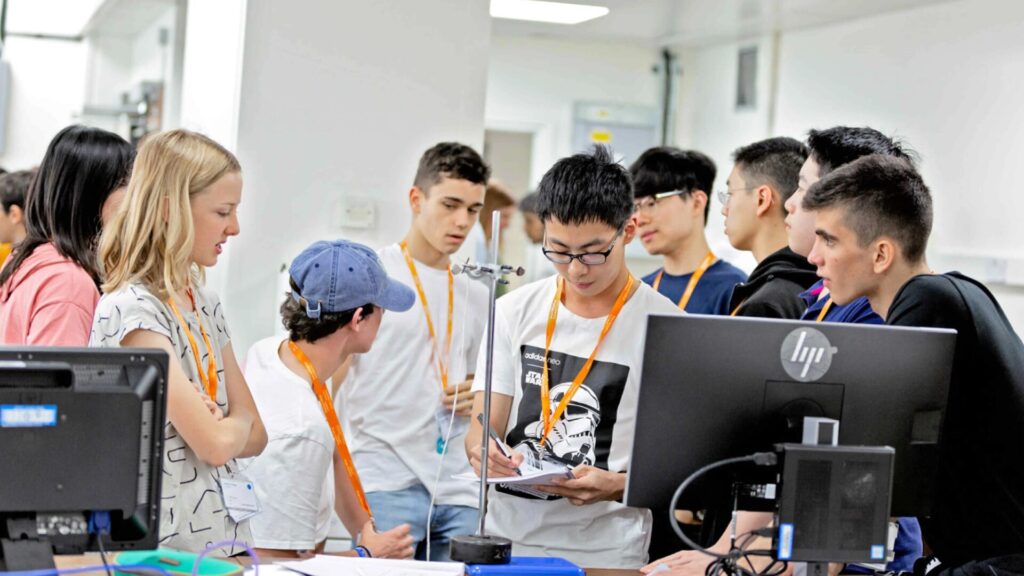
Imperial’s Y9 Girls Engineering Summer School gives you four days to explore how mathematics and science are used in different branches of engineering. Through workshops, talks, and practical challenges, you’ll learn how engineers solve problems involving structures, machines, technology, and design.
The programme includes group activities where you’ll apply ideas from the sessions to a shared challenge. You’ll also meet mentors and academics who can answer questions about studying engineering in the future. The final poster exhibition gives you a chance to present what you’ve learned to guests and fellow participants.
Why it stands out: You will explore different engineering disciplines through hands-on challenges, interactive sessions, and teamwork while learning how science and mathematics are applied to solve real-world problems.
10. University of Oxford Department of Physics Summer Schools and Work Experience
Location: University of Oxford, Oxford, England
Cost: Free
Dates: July 20-24
Application Deadline: Applications open in Spring and typically close in June
Eligibility: Year 12 students living in Oxfordshire, Berkshire, or Buckinghamshire and attending a non-fee-paying school
The University of Oxford Department of Physics Summer Schools show how mathematics is used to understand some of the biggest questions in physics. Depending on the programme, you might explore quantum technologies, work on research projects, attend lectures, or take part in laboratory activities. Mathematics appears throughout the experience as a tool for modelling physical systems and explaining scientific phenomena.
You’ll also visit research facilities and hear from academics working in different areas of physics. The programme gives you a realistic look at both university study and scientific research. It is particularly useful if you’re interested in the overlap between mathematics and physics.
Why it stands out: You will explore the connection between mathematics and physics through research projects, hands-on experiments, and advanced topics such as quantum science.
11. Imperial Year 11 Online STEM Challenge
Location: First three days: Virtual + Fourth Day: Imperial College London (South Kensington Campus), London
Cost: Free
Dates: June 23-26
Application Deadline: March 4th
Eligibility: Year 11 students living and attending school in the UK who can attend the in-campus session on day 4
The Imperial Year 11 Online STEM Challenge gives you a real problem to work on rather than a list of topics to study. For the first three days, you’ll work online with a team, meet mentors, and learn from researchers and industry professionals connected to the challenge.
Your group will investigate a STEM problem, develop a solution, and refine it based on feedback. The final day takes place at Imperial College London, where teams present their ideas to a judging panel. Along the way, you’ll see how mathematics, engineering, science, and technology often work together when tackling real-world issues.
Why it stands out: You will tackle a real-world STEM challenge through teamwork, mentorship, and problem-solving while collaborating with researchers and industry professionals to develop and present an innovative solution.
12. Cherwell College, Oxford Summer Academic Programs
Location: Cherwell College, Oxford, England
Cost: Starts at £1,375/week
Dates: Multi-week cohorts available starting on August 18th, August 25th, and September 1st
Application Deadline: Rolling basis
Eligibility: Students aged 15 to 19 studying in the UK. More information here
Cherwell College Oxford Summer Academic Programs allow you to study academic subjects in small groups while spending time in one of the UK’s best-known university cities. Depending on your level, you’ll focus on GCSE, iGCSE, A-Level, or university preparation courses. Mathematics students spend their classes working through subject material with teachers in groups much smaller than those found in most schools.
Outside lessons, you’ll take part in activities such as Oxford walking tours, cultural visits, and trips to places like Blenheim Palace. The programme combines academic study with a broader experience of Oxford and its university environment.
Why it stands out: You will experience focused academic learning in small groups while exploring subjects aligned with your educational level and enjoying cultural activities that introduce you to life in Oxford.
13. CyberMath Oxford Summer Math Camp
Location: St Edward’s School, Oxford, England
Cost: $3,899-$3,999 (Day) and $7,499-$7,699 (Residential)
Dates: July 5-18
Application Deadline: Registration is open until the end of May
Eligibility: Students ages 9-16; Open to international students
CyberMath Oxford Summer Math Camp is designed for students who want math programs in the UK for high school students that go well beyond school coursework. You’ll study proof-writing, mathematical reasoning, structured problem solving, and mathematical communication while tackling challenging questions with other students.
The programme also includes projects connected to artificial intelligence and machine learning, showing how mathematical ideas are used in modern technology. Classes are taught by mathematicians, researchers, and former competition medalists who regularly work with advanced mathematics. Alongside academics, you’ll explore Oxford and take part in organised activities around the city.
Why it stands out: You will strengthen your mathematical reasoning and problem-solving skills through advanced coursework, AI-focused projects, and mentorship from experienced mathematicians and researchers.
14. COMPOS
Location: Virtual
Cost: UK State school students: Free; Overseas and fee-paying UK students: £25 per week
Dates: Vary
Application Deadline: Registrations open in June
Eligibility: Students in Years 10-13 in a UK state school or sixth form; open to international and private school students in the UK
COMPOS offers online tutorials for students who want to study mathematics beyond the limits of the school curriculum. Classes are deliberately small, usually with around eight students, which means you’ll spend a lot of time discussing ideas and working through problems with your tutor. Sessions focus on topics that rarely appear in standard lessons and often require deeper mathematical reasoning.
You’ll complete work between classes and return to discuss different approaches and solutions with the group. The programme runs throughout the year, making it possible to continue exploring mathematics long after a summer programme ends. It is particularly popular with students preparing for mathematical enrichment and extension work.
Why it stands out: You will deepen your understanding of mathematics and other STEM subjects through small-group tutorials, challenging problem-solving, and concepts that extend beyond the standard school curriculum.
15. MathQuantum High School Fellowships
Location: Virtual
Cost: Free
Dates: 2 weeks in the summer
Application Deadline: February 13th
Eligibility: High school students worldwide
As a virtual option among the many math programs in the UK for high school students, MathQuantum High School Fellowships introduce you to the mathematics behind quantum information science through a two-week programme. You’ll attend lectures and workshops covering concepts from both mathematics and quantum computing while exploring how the two fields connect. Discussions focus on ideas that are usually encountered much later in university study, but they are presented in a way that motivated high school students can follow.
Throughout the programme, you’ll work on a small project that allows you to apply what you’ve learned and investigate a topic in greater depth. Faculty and mentors help guide students through the material and answer questions along the way.
Why it stands out: You will explore the intersection of mathematics and quantum information science through research-focused projects, lectures, workshops, and discussions while gaining experience in interdisciplinary STEM inquiry.
Frequently Asked Questions: Math Programs in the UK for High School Students
What is a math program for high school students?
A math program is a structured experience that introduces high school students to mathematical topics and ways of thinking that go beyond the standard school curriculum. Programs typically cover areas like number theory, algebra, statistics, or applications in fields such as AI and quantum computing, often through problem sets, seminars, and small-group discussion. Many are hosted at universities including Oxford and Cambridge. Most conclude with a deeper understanding of how mathematicians approach unfamiliar problems.
Do I need to be exceptionally advanced in math to apply?
It depends on the program, since some are highly selective while others are open to a broader range of students. PROMYS Europe and the UKMT National Mathematics Summer School are designed for students with strong mathematical ability and competition experience. Immerse Education’s Math Summer School is built to be accessible to students with a genuine interest in math, focusing on building a strong foundation in algebra, calculus, and statistics through small classes and one-on-one tutoring.
How much do math programs in the UK cost?
Costs range from free to £4,200 for PROMYS Europe’s six-week residential program. Free options include the UNIQ Mathematics Course, Sutton Trust Summer School, and several Imperial College programs, most of which are limited to UK state school students. Immerse Education’s Math Summer School and CyberMath Oxford Summer Math Camp are paid options open to international students, with Immerse offering bursary support for eligible students.
Can international students attend math programs in the UK?
Eligibility varies considerably across these programs. Many free options, including the Sutton Trust Summer School, UNIQ Mathematics Course, and Imperial College’s Work Experience Programme, are restricted to UK state school students. Immerse Education’s Math Summer School, CyberMath Oxford Summer Math Camp, and MathQuantum High School Fellowships are all open to students from anywhere in the world.
What age do I need to be to apply?
Age and grade requirements vary by program, generally falling between 14 and 19 years old. Immerse Education’s Math Summer School accepts students aged 15 to 18 from anywhere in the world, while CyberMath Oxford Summer Math Camp accepts a younger range of students aged 9 to 16. Programs like PROMYS Europe require students to be at least 16 with strong mathematical ability.
What topics will I study in a UK math program?
Topics vary depending on the program’s focus, ranging from pure mathematics to applied fields. PROMYS Europe centers on number theory and problem-solving, while CyberMath Oxford incorporates AI and machine learning projects alongside proof-writing and mathematical reasoning. Immerse Education’s Math Summer School covers algebra, calculus, and statistics, giving students a broad foundation through both academic study and group projects.
How do math programs help with college applications?
Participating in a math program demonstrates intellectual curiosity and a willingness to engage with challenging material outside of school requirements. Programs like the UNIQ Mathematics Course provide direct guidance on Oxford admissions, interviews, and entrance tests, while Immerse Education’s Math Summer School gives students exposure to university-style learning through seminars and research projects. Both give students concrete experiences to reference in personal statements and interviews.
What’s the difference between free UK-based programs and paid international ones?
Free UK-based programs, such as the Sutton Trust Summer School and UNIQ Mathematics Course, are typically restricted to UK state school students and tied closely to university admissions pathways like Oxford and Cambridge. Paid international programs, including Immerse Education’s Math Summer School and CyberMath Oxford, are open to students worldwide and tend to offer smaller class sizes with more individualized mentorship. The right choice often depends on whether you’re a UK state school student aiming for a specific university or an international student looking for a broader academic experience.
Keeping Your Mathematical Curiosity Growing
Great mathematical thinking often starts with a puzzle, a pattern, or a question that makes you want to look closer.
The math programs in the UK for high school students included in this guide introduce university-style ideas, from number theory and modelling to statistics, proofs, and quantum concepts.
You can keep building that momentum by reading widely, testing new methods, and exploring how different authors explain difficult ideas with clarity.
Ready to keep your maths curiosity active beyond summer? Browse our Mathematics Top Books Guide and find books that sharpen how you think, solve, and learn.