
 Русский (RU)
 Українська (UK)
 Türkçe (TR)
 Italiano (IT)
 Français (FR)
 Português (PT)
 中文 (中国) (ZH)
 Español (ES)
 日本語 (JA)
 ไทย (TH)
 Deutsch (DE)
 Ελληνικά (EL)
 Polski (PL)
 Bahasa Indonesia (ID)
 Nederlands (NL)
 العربية (AR)
 한국어 (KO)

As a high school student, you may already be wondering what college classes are really like. Perhaps you’ve discovered a subject that fascinates you, want to challenge yourself academically, or are looking for ways to strengthen your college applications. Whatever your motivation, online college courses for high school students can offer an early glimpse into university-level learning without requiring you to leave home.
Unlike traditional high school classes, these courses often emphasise independent thinking, discussion-based learning, and applying concepts to real-world problems. You might analyse business case studies, learn coding from university professors, explore scientific research, or engage with complex ideas in economics, psychology, engineering, or literature. Many programmes also connect you with participants from different countries, introducing you to diverse perspectives and collaborative learning experiences.
How do you choose the right online college courses for high school students?
With so many options available, finding the right online college course can feel overwhelming. Some programs offer introductory experiences designed to help you explore a field, while others mirror the pace and expectations of actual university classes. The best choice depends on your academic interests, learning goals, schedule, and the level of challenge you’re looking for.
When evaluating programs, consider factors such as the quality of instruction, opportunities for interaction with faculty and peers, course flexibility, and whether you’ll complete projects, assignments, or other practical work. Some courses focus on developing foundational knowledge, while others provide specialized learning in subjects like computer science, business, medicine, engineering, or the humanities. You may also want to look at whether a program offers certificates, academic credit, or access to university resources.
To help you navigate the options, we’ve compiled a list of the 15 online college courses for high school students. These programs were selected for their academic quality, accessibility, strong institutional reputations, and ability to provide meaningful exposure to college-level learning.
Key takeaways
- Cornell’s AEM 1200 Introduction to Business Management costs $5,820 for the course and lets students earn real Cornell credit and an official transcript entirely online.
- Immerse Education’s Online Research Programme offers 1:1 or small-group mentorship from tutors at Oxford, Cambridge, and Ivy League universities, open to students aged 13 to 18, with optional college credit for students 14 and older.
- Johns Hopkins’ Introduction to Psychology costs about $3,690 for three credits plus an $85 application fee, delivered asynchronously over five weeks.
- Cornell’s INFO 1100 Introduction to Programming teaches Python through live weekday classes over a condensed six week session, completing roughly fifteen weeks of coursework.
- Stanford’s online SUMaC program admits just 64 students and costs $3,750, requiring prior experience reading and writing mathematical proofs.
- Several free-to-audit Coursera courses, including Duke’s Introduction to Chemistry and the University of London’s Probability and Statistics, offer an optional paid certificate for around $49.
- Wharton’s Understanding Your Money course costs just $329 and runs entirely asynchronously, letting students progress independently through 16 topic units year-round.
- Program costs for online college courses range from free-to-audit Coursera options to $5,820 for Cornell’s credit-bearing summer courses.
15 Online College Courses for High School Students
1. Cornell University Precollege Studies Online – AEM 1200: Introduction to Business Management
Location: Online
Cost/Stipend: $5,820 ($1,940 per credit); need-based financial assistance is available
Acceptance rate/cohort size: Selective; cohort size not specified
Dates: Between June 1st and July 31st
Application Deadline: April 28th
Eligibility: Students who have completed sophomore year of high school (grade 10 or the international equivalent) before the class begins; between 15 and 19 years of age when the class starts; open to international students
As one of the credit-bearing online college courses for high school students, this course lets you engage directly with business management as a college-level discipline. You examine human resource management, marketing, finance, and strategy while analysing current issues such as technological innovation, globalisation, business ethics, teamwork, leadership, and entrepreneurship.
You apply these concepts through case analysis and an integrative group project that asks you to reason through real management decisions rather than memorize definitions. You build analytical, collaborative, and strategic-thinking skills expected in undergraduate business coursework. Because it is a genuine Cornell course taught by university faculty, you earn real college credit and a Cornell transcript.
Why it stands out: It lets high school students earn genuine Cornell University credit and an official Cornell transcript in foundational business management, taught online by Cornell faculty as a real undergraduate course rather than a simplified precollege workshop.
2. Immerse Education’s Online Summer School

Location: Fully remote
Cost: Varies; summer school scholarship available through our bursary programme
Acceptance rate/cohort size: Selective; 1:1 learning
Dates: Flexible; multiple cohorts in a year
Application Deadline: Rolling admissions; multiple dates throughout the year
Eligibility: Students around the world aged 13-18 (accredited options require age 14+)
The Online Research Program offers high school students the opportunity to conduct rigorous research with tutors from Oxford, Cambridge, and Ivy League universities. You will work with your tutor to explore a subject of your choice in depth and write an academic research paper. The program is offered in 1:1 and small group formats, and you can choose to receive college credit from universities in the US and the UK.
The virtual research program is offered in over 20 subjects, including artificial intelligence, chemistry, psychology, economics, computer science, creative writing, philosophy, and more. At the end of the program, you’ll receive a written evaluation from your tutor, an opportunity to publish your research, and an invitation to present at the Immerse Online Symposium. You can find examples of papers Immerse students have worked on here. You can find more details about the application here.
Why it stands out: You’ll get access to 1:1 Oxbridge- or Ivy-style research supervision culminating in a publishable academic paper.
3. Johns Hopkins University – Introduction to Psychology (200.101)
Location: Online (fully online, primarily asynchronous)
Cost/Stipend: $1,230 per credit hour (about $3,690 for three credits), plus an $85 non-refundable application fee; need-based financial assistance and the merit-based Dean’s Fellowship Award are available
Acceptance rate/cohort size: Selective; class size is not officially released
Dates: June 29th – July 31st
Application Deadline: Rolling admissions
Eligibility: Cumulative GPA of 3.0 or higher on a 4.0 scale; successful completion of two years of high school before the course start date; open to international students
In this course, you study psychology as a rigorous science and explore how the mind and brain shape human experience. Its primarily asynchronous five-week format makes it one of the more flexible online college courses for high school students, allowing you to learn on your own schedule while engaging with Johns Hopkins faculty and motivated peers worldwide.
You explore core topics such as perception, language, memory, decision-making, creativity, and mental illness, then grapple with enduring debates like nature versus nurture and the relationship between mind and brain. Through recorded lectures, readings, and assessments, you build skills in scientific reasoning, evidence evaluation, and psychological analysis. Upon completion, you earn college credit that transfers to most colleges and universities.
Why it stands out: It lets qualified high school students earn genuine Johns Hopkins undergraduate credit in psychology entirely online, studying the same accredited AS.200.101 curriculum taught to Hopkins undergraduates.
4. Cornell University – STSCI 2000: Essential Statistics and Data Science
Location: Online
Cost/Stipend: $5,820 ($1,940 per credit) + $75 application fee; need-based financial assistance is available
Acceptance rate/cohort size: Selective; cohort size not specified
Dates: June 22nd – July 31st
Application Deadline: May 14th
Eligibility: Completed sophomore year of high school (grade 10 or the international equivalent) by the course start; between 15 and 19 years of age when the online class begins, and high school graduates under 18 at course start; demonstrated academic ability plus English language proficiency requirements for non-native speakers; open to international students
In STSCI 2000, you study statistics and data science as a fully online Cornell course while earning 3 credits recorded on an official Cornell University transcript. You learn foundational statistical topics including sampling, data summarization and visualization, and statistical inference, along with the basics of R programming needed for exploratory data analysis. You also practice modern simulation-based inference techniques that complement classical statistical methods, working in the cloud-based Posit environment.
By the end, you can conduct descriptive and inferential analyses in R, choose appropriate summarization and uncertainty-quantification techniques for tabular data, and interpret and communicate your results. Instruction runs on a condensed six-week schedule with a weekly live Friday lecture taught by a Cornell instructor.
Why it stands out: It lets high school students earn 3 real Cornell University credits and an official transcript while building hands-on R programming and statistical inference skills entirely online.
5. University of Southern California – Analytics: The Power of Data for Businesses
Location: Online
Cost: $1,990 + a $35 nonrefundable application fee
Acceptance rate/cohort size: Selective; cohort size not specified
Dates: Online Cohort 1: Begins June 22nd; Online Cohort 2: Begins July 6th; Online Cohort 3: Begins July 20th
Application Deadline: Online Cohort 1: June 17th; Online Cohort 2: July 1st; Online Cohort 3: July 15th
Eligibility: At least 14 years old and enrolled in a high school or secondary program; open to international students
In this course, you explore how businesses turn raw information into strategic decisions. You learn what data is, how to organize it for analysis, and how to draw insights that others miss, while practicing cleaning data, visualizing it to reveal trends, and applying classification and clustering approaches businesses use to predict behavior.
Instruction comes through recorded lectures, demonstrations of data analysis, industry connections, and applied exercises. You also examine real data sets and case studies and hear from industry experts. You additionally preview where data is headed, including advances in neural nets and AI. Completing the roughly 20–25 hours of coursework earns you a Certificate of Completion.
Why it stands out: It gives you self-paced instruction in business data analytics from a USC Marshall School of Business professor, combining real data sets, case studies, and industry expert perspectives with the flexibility of rolling start dates and up to 90 days of course access.
6. University of Pennsylvania Wharton Global Youth Program – Understanding Your Money
Location: Online
Cost: $329
Acceptance rate/cohort size: Open enrollment; independent, self-paced learning; students do not interact in a cohort
Dates: Year-round, asynchronous
Application Deadline: Rolling / No deadline
Eligibility: High school students currently in grades 9-12; open to international students
In this course, you study core concepts in economics, personal finance, budgeting, banking, investing, and financial decision-making through a sequence of four instructional modules. The course includes video lectures taught by Wharton faculty, along with readings, interactive activities, quizzes, and financial literacy exercises designed to reinforce key ideas. Topics such as supply and demand, opportunity cost, compound interest, risk, return, and asset allocation introduce you to concepts commonly encountered in university-level business and economics coursework.
You progress independently through 16 topic units and complete assessments throughout the program. Upon finishing all modules, participants earn a certificate of completion that documents their learning and engagement with foundational finance and economics concepts.
Why it stands out: Its self-paced format allows students to explore university-level business topics while building practical analytical and financial decision-making skills.
7. Cornell University – INFO 1100: Introduction to Programming
Location: Online
Cost/Stipend: $5,820 ($1,940 per credit) + $75 application fee; need-based financial assistance is available
Acceptance rate/cohort size: Selective; cohort size not specified
Dates: June 22nd – July 31st
Application Deadline: May 19th
Eligibility: Completed sophomore year of high school (grade 10 or the international equivalent) by the course start; between 15 and 19 years of age when the online class begins, and high school graduates under 18 at course start; demonstrated academic ability plus English language proficiency requirements for non-native speakers; open to international students
This course is taught in Python and emphasizes practical code design skills and data processing, covering functions, conditionals, loops, basic data structures, and writing to files. You attend live weekday online classes with a Cornell instructor across the six-week session, completing roughly fifteen weeks of college coursework in a condensed, fast-paced format.
Along the way, you build algorithmic thinking, debugging habits, and structured problem-solving skills that transfer to computer science and data-focused study. You interact with instructors and classmates through Canvas, discussion boards, chat, and video conferences. You finish with an official Cornell transcript and credits that are generally transferable.
Why it stands out: It lets you earn three transferable Ivy League credits in Python programming as a high school student, learning in a regular Cornell undergraduate course without leaving home.
8. Stanford SuMaC (Stanford University Mathematics Camp)
Location: Online
Cost/Stipend: $3,750; need-based financial aid available
Acceptance rate/cohort size: Highly competitive; 64 students
Dates: June 15th – July 3rd or July 6-24
Application Deadline: February 2nd
Eligibility: Students in grades 10-11 at the time of application; have experience writing and reading mathematical proofs; strong mastery of high school geometry and algebra; open to international students
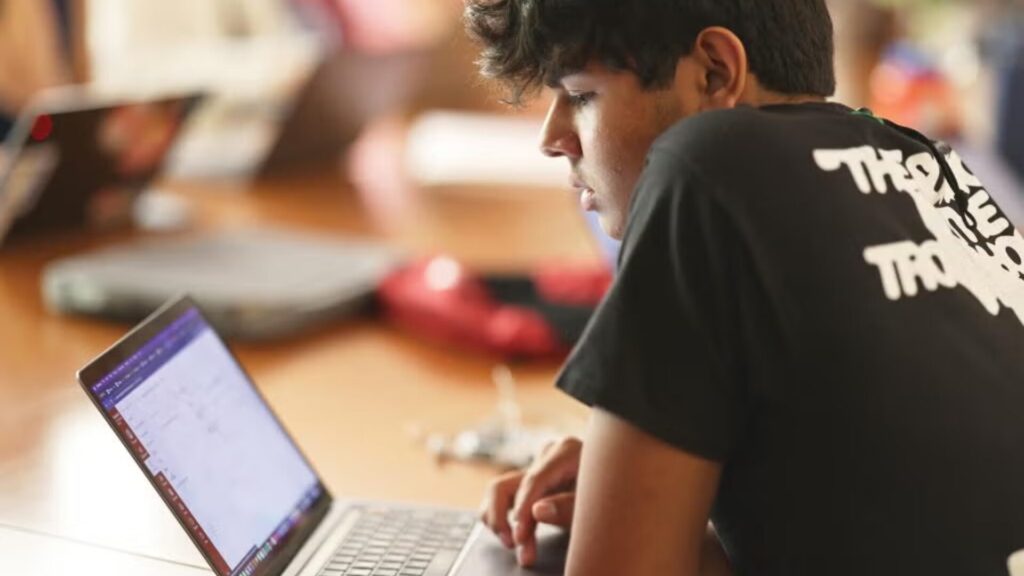
Stanford University Mathematics Camp (SUMaC) is a fully online program that introduces high school students to advanced areas of mathematics beyond a typical secondary school curriculum. You study topics such as abstract algebra, number theory, and algebraic topology through live online lectures and guided discussions led by instructors. The program incorporates synchronous problem-solving sessions facilitated by instructional assistants, allowing students to collaborate with peers and engage with challenging mathematical concepts.
You also attend virtual guest lectures featuring mathematicians and professionals who apply mathematics in research and industry settings. A central component of the program is a research-based mathematical project that students develop throughout the session. The program concludes with presentations of these projects.
Why it stands out: Its combination of live instruction, collaborative problem-solving, and final research presentations provides exposure to the style and rigor of university-level mathematics study.
9. University of Pennsylvania – Calculus Single Variable Part 3 – Integration

Location: Online
Cost/Stipend: Free to audit; ~$49 for an optional verified certificate
Acceptance rate/cohort size: Open enrollment; no published cohort size
Dates: Self-paced; approximately 4 weeks
Application Deadline: Rolling enrollment
Eligibility: High school students, college students, and adult learners worldwide; open to international students
In this course, you study core integration topics, including antiderivatives, differential equations, integration techniques, the Fundamental Theorem of Calculus, improper integrals, and trigonometric integrals. The course is delivered through recorded lectures, readings, and graded assignments that can be completed on a flexible schedule. Instruction emphasizes conceptual understanding and mathematical applications.
You engage with problem sets and assessments that reinforce theoretical ideas and analytical reasoning. The curriculum also introduces connections between integration, mathematical modeling, and scientific applications in engineering and the physical sciences. By completing the course, you gain experience with university-level calculus and build a foundation for further study in mathematics, science, engineering, and related quantitative fields.
Why it stands out: Its university-level curriculum provides a structured pathway into advanced STEM coursework through a flexible online format.
10. University of London – Probability and Statistics
Location: Online (via Coursera)
Cost/Stipend: Free to audit; optional paid certificate available
Acceptance rate/cohort size: Open enrollment; no fixed cohort size
Dates: Self-paced (approximately 22 hours of coursework)
Application Deadline: Ongoing
Eligibility: Learners worldwide, including high school students; open to international students
In this course, you study core topics in probability, descriptive statistics, estimation, hypothesis testing, and data analysis while learning how statistical methods are used to make decisions under uncertainty. Instruction is delivered through recorded lectures, readings, quizzes, and applied assignments that can be completed on a flexible schedule.
You work through practical examples involving probability models, confidence intervals, and statistical inference, and explore applications such as decision trees, risk analysis, regression, and Monte Carlo simulation. Assessments and peer-reviewed assignments allow you to apply statistical reasoning to real-world problems and build a foundation for future study in data science, mathematics, computer science, and related fields.
Why it stands out: Its combination of probability theory, statistical inference, and data-analysis techniques provides a strong academic foundation for further study in STEM and data-focused disciplines.
11. University of Southern California – Digital Marketing: From Content Creation to Strategic Planning
Location: Online
Cost/Stipend: $1,990 + a $35 nonrefundable application fee
Acceptance rate/cohort size: Selective; cohort size not specified
Dates: Cohort 1: June 22nd; Cohort 2: July 6th; Cohort 3: July 20th
Application Deadline: Cohort 1: June 17th; Cohort 2: July 1st; Cohort 3: July 15th
Eligibility: At least 14 years old and enrolled in a high school or secondary program; open to international students
In this course, you engage directly with digital marketing as taught by USC Marshall School of Business faculty, learning the key terms and concepts for building a digital marketing strategic plan. You analyze real digital marketing campaigns and content, develop a brand voice, evaluate social media platforms and their marketing advantages, and study web design elements that improve user experience.
You also build quantitative and analytical skills to interpret data, measure a campaign’s success, and connect with a target audience. Coursework combines recorded lectures, readings, activities, and industry connections totaling approximately 20–25 hours, completed at your own pace. Instruction comes from Kristen Schiele, an associate professor of clinical marketing who specializes in digital marketing and social media.
Why it stands out: It lets you learn digital marketing directly from a USC Marshall School of Business faculty member — Fulbright Scholar and Mobile Marketing Essentials co-author Kristen Schiele.
12. Yale University – The Science of Well-Being
Location: Online (via Coursera)
Cost: Free (no certificate) or ~$49 for a verified certificate
Acceptance rate/cohort size: Open enrollment; no fixed cohort size
Dates: Self-paced (approx. 6 weeks; students can start at any time)
Application Deadline: Rolling enrollment
Eligibility: Learners worldwide, including high school students and international participants; open to international students
In this course, you study common misconceptions about well-being, psychological biases that influence decision-making, and evidence-based strategies for building healthier habits. Instruction is delivered through self-paced video lectures, readings, quizzes, and practical exercises. You engage with findings from psychological studies and learn how researchers investigate topics related to well-being and behavior.
You complete a series of structured challenges that apply course concepts to real-world situations and culminate in a personal behavior-change project. The curriculum introduces methods used in university-level psychology and behavioral science courses while helping students develop analytical and reflective skills relevant to future studies in the social sciences, health sciences, and related fields.
Why it stands out: It combines psychological research with practical exercises that allow students to apply scientific findings to everyday behavior.
13. Cornell University Precollege Studies Online – ANSC 1120: Sustainable Animal Husbandry
Location: Online (delivered virtually through Cornell University’s Precollege Studies Summer Online Program, Ithaca, New York–based instruction)
Cost/Stipend: $5,820 tuition ($1,940 per credit for this 3-credit course); financial assistance is available
Acceptance rate/cohort size: Selective; cohort size not specified
Dates: June 1-18
Application Deadline: April 28th
Eligibility: Completion of sophomore year of high school (grade 10 or the international equivalent) before the course begins; age 15 to 19 at the start of class for the online program; open to international students
In this course, you explore the many roles of domestic animals and their interdependence with humans across topics like domestication, nutrition, genetics, grazing, dairy and beef cattle, sheep, swine, poultry, horses, and limited-resource animal systems. You interview a farmer of your choice, tour a variety of farms, and discuss current animal research topics with visiting Cornell animal science faculty.
You use Cornell library resources to research and critique scientific journal articles on sustainable animal production systems. You then produce a researched outline and exchange scientific ideas with classmates in an in-class debate. Along the way, you build skills in scientific literature analysis, evidence-based argumentation, and comparing animal production systems.
Why it stands out: It gives high school students an authentic Cornell animal science course, complete with farmer interviews, farm tours, faculty discussions, and a scientific debate, earning 3 real, transcripted Cornell University credits entirely online in just three weeks.
14. Duke University – Introduction to Chemistry: Reactions and Ratios
Location: Online (via Coursera)
Cost/Stipend: Free to audit (no certificate); ~$49 USD for the verified certificate track
Acceptance rate/cohort size: Open enrollment; no fixed cohort size reported
Dates: Self-paced (approximately 2 weeks of study at 10 hours per week)
Application Deadline: Rolling enrollment
Eligibility: Learners worldwide, including high school students; open to international students
In this course, you explore foundational chemistry topics related to chemical reactions, including stoichiometry, the periodic table, periodic trends, nomenclature, and quantitative problem-solving. Instruction is delivered through online video lectures, readings, quizzes, and graded assessments that allow learners to apply key concepts independently.
Throughout the course, you develop analytical skills used to interpret chemical relationships and solve calculation-based problems. It introduces methods and reasoning commonly used in scientific research and laboratory settings. You complete assignments and final assessments that demonstrate your understanding of chemical principles.
Why it stands out: The course emphasizes quantitative reasoning and chemical problem-solving, skills that are central to many university STEM programs.
15. Michigan State University – Getting Started with Music Theory
Location: Online (via Coursera)
Cost/Stipend: Free to audit; paid certificate available through Coursera
Acceptance rate/cohort size: Open enrollment; no published cohort size
Dates: Self-paced (approximately 1 week of study, 10 hours total)
Application Deadline: Rolling enrollment
Eligibility: High school students and adult learners; open to international students
In this course, you explore core concepts such as pitch, rhythm, meter, notation, scales, keys, key signatures, triads, seventh chords, and basic harmony through a series of video lectures, readings, assignments, and discussion activities. You receive direct instruction from a university faculty member and engage with exercises designed to reinforce theoretical concepts and musical analysis.
Assessments focus on reading and writing musical notation, identifying chords, and applying harmonic principles. By the end of the course, participants can read and write music in treble and bass clef, recognize major and minor keys, and harmonize simple melodies. The curriculum mirrors foundational content commonly taught in first-year university music theory courses.
Why it stands out: It provides structured exposure to university-level music theory through instruction from a Michigan State University faculty member.
Frequently asked questions: Online college courses for high school students
Are online college courses for high school students open to international students?
Yes, nearly every course in this list is explicitly open to international students, including Cornell’s Precollege Studies courses, Johns Hopkins’ Introduction to Psychology, and Stanford’s SUMaC. Immerse Education’s Online Research Programme is also open globally to students aged 13 to 18. Free-to-audit Coursera courses from Duke, Yale, and the University of Pennsylvania are open to learners worldwide with no citizenship restrictions at all.
Do online college courses actually award transferable credit?
Many do, since several are structured as real undergraduate courses rather than simplified versions. Cornell’s AEM 1200 and STSCI 2000 both award credit recorded on an official Cornell transcript, and Johns Hopkins’ Introduction to Psychology credit transfers to most colleges and universities. Free Coursera courses, like Duke’s Introduction to Chemistry, typically offer only a certificate rather than transferable credit unless you pursue a separate accredited pathway.
How much do online college courses cost?
Costs range from completely free to audit up to $5,820 for a full Cornell course. Wharton’s Understanding Your Money costs just $329, while USC Marshall’s Analytics and Digital Marketing courses cost $1,990 plus a $35 application fee. Free-to-audit options from Coursera, including courses from Yale, Duke, and the University of London, cost nothing unless you want the optional verified certificate, which typically runs around $49.
What is the difference between a self-paced and a live online college course?
Self-paced courses, like the University of Pennsylvania’s Calculus Single Variable Part 3 or Michigan State’s Getting Started with Music Theory, let you move through recorded lectures and assignments on your own schedule. Live courses, like Cornell’s INFO 1100 or Stanford’s SUMaC, require attending scheduled online classes with an instructor and interacting with classmates in real time. If your schedule is unpredictable, a self-paced course offers more flexibility; if you want more structure and live interaction, a live course provides that.
How selective are online college courses for high school students?
Selectivity varies considerably. Stanford’s SUMaC is highly competitive, admitting just 64 students, while Cornell’s Precollege courses and Johns Hopkins’ Introduction to Psychology require a minimum GPA but aren’t described as highly selective beyond that. Free-to-audit Coursera courses have open enrollment with no application process at all, making them the most accessible option if selectivity is a concern.
Is Immerse Education a good option for online college-level study?
Immerse Education’s Online Research Programme is a strong choice if you want individualized, Oxford-style mentorship rather than a structured lecture course. Offered in 1:1 or small group formats across more than 20 subjects, including AI, economics, and creative writing, the program has you work with a tutor to write an academic research paper. You’ll receive a written evaluation, the chance to publish your research, and an invitation to present at the Immerse Online Symposium, with the option to earn college credit if you’re 14 or older.
Get Ready for College-Level Expectations
University study often asks you to manage deadlines, contribute thoughtfully to discussions, and work through unfamiliar ideas without constant guidance.
Online college courses for high school students provide a practical preview of those expectations while allowing you to explore subjects at greater depth.
Rather than choosing by reputation alone, compare teaching style, assessment methods, weekly workload, credit options, and opportunities for meaningful interaction.
Wondering how to prepare for the transition ahead? Visit our University Preparation blogs for clear advice on academic planning, applications, study habits, and university life, so you can begin your next chapter informed, organised, ready, and confident.