
 Русский (RU)
 Українська (UK)
 Türkçe (TR)
 Italiano (IT)
 Français (FR)
 Português (PT)
 中文 (中国) (ZH)
 Español (ES)
 日本語 (JA)
 ไทย (TH)
 Deutsch (DE)
 Ελληνικά (EL)
 Polski (PL)
 Bahasa Indonesia (ID)
 Nederlands (NL)
 العربية (AR)
 한국어 (KO)

One of the biggest advantages of learning online is that you’re no longer limited by what’s available at your school. Online courses for high school students let you explore virtually any subject you’re curious about from home while learning from university instructors, researchers, or industry professionals, giving you the chance to begin exploring college-level topics years before you step onto a university campus.
Picture yourself spending your evenings learning how artificial intelligence works, studying international law, writing code, exploring psychology, analyzing business cases, or taking part in discussions with students from around the world. Those experiences can make a subject feel much more real than reading about it in a textbook, while helping you decide whether you’d enjoy studying it in college.
How do you choose the right online course for your interests?
Not every online course is built in the same way. Some are designed to introduce beginners to a subject, while others expect students to complete projects, participate in discussions, or tackle more advanced material. Before enrolling, think about what you’d like to gain from the experience and whether the course structure matches the way you enjoy learning.
Online courses also make it easier to learn at your own pace. Whether you have a busy school schedule, play sports, or participate in extracurricular activities, you can usually fit your coursework around the rest of your week while continuing to build new knowledge and skills.
It’s also helpful to consider who is teaching the course and what you’ll actually be doing each week. Programs that include practical assignments, instructor feedback, or opportunities to apply your learning often provide a much richer experience than those that rely entirely on recorded lectures.
To help you explore your options, we’ve compiled a list of 15 online courses for high school students!
Key takeaways
- MIT’s Beaver Works Summer Institute Quantum Software course is free for qualifying families or $2,400 otherwise, teaching quantum programming in Microsoft’s Q# language.
- Immerse Education’s Online Research Programme offers 1:1 or small-group mentorship from tutors at Oxford, Cambridge, and Ivy League universities, open to students aged 13 to 18, with the option to earn college credit for students 14 and older.
- Stanford’s SPINWIP program is entirely free, restricted to grades 9 through 11, and teaches Python programming alongside physics topics like quantum mechanics and cosmology.
- Girls Who Code’s Pathways Program is completely free and lets students choose one of five tracks, including Data Science and AI or Cybersecurity, over seven self-paced weeks.
- NASA’s GeneLab for High Schools accommodates large cohorts of over 800 students but requires US citizenship and excludes international students entirely.
- UCLA Summer Sessions lets high school students enroll in actual undergraduate courses alongside UCLA students, charging $420 per unit plus a $350 registration fee.
- Kode With Klossy Summer Camps are completely free and specifically designed for young women and gender expansive teens, requiring no prior coding experience.
- Program costs for online courses range from free options like Girls Who Code and SPINWIP to $8,692 for the University of Pennsylvania’s Modern Biology and Social Implications course.
15 Online Courses for High School Students
1. Quantum Software – Beaver Works Summer Institute (BWSI)
Location: Primarily virtual; hosted by Massachusetts Institute of Technology
Cost: Free for qualifying families; otherwise, a $2,400 summer program fee for families with income above $200,000
Acceptance rate/cohort size: Highly selective
Dates: July 6th – August 2nd
Application Deadline: Summer application deadlines occur in spring; teacher recommendation due April 3rd
Eligibility: High school students residing and physically attending school in the United States; must be current 9th – 11th graders (rising seniors eligible). Students must complete the prerequisite online coursework before consideration
Quantum computing is no longer something reserved for graduate school, and MIT’s Beaver Works Summer Institute gives you an early chance to explore it through software. Before the summer even begins, you’ll complete online coursework covering programming, linear algebra, and the mathematical foundations needed for quantum computing.
Once you’re in the program, you’ll write quantum programs in Microsoft’s Q# language while learning how qubits, quantum gates, entanglement, and quantum algorithms actually work. Much of the learning happens through coding, debugging, and solving technical problems that gradually increase in complexity. You’ll also work with a team on a research-inspired project before presenting your results at the end of the program.
Why it stands out: Few high school programs teach quantum computing using Microsoft’s Q# language while combining MIT-developed coursework with research style team projects.
2. Immerse Education’s Online Summer School

Location: Fully remote
Cost: Varies; summer school scholarship available through our bursary programme
Acceptance rate/cohort size: Selective; 1:1 learning
Application Deadline: Rolling admissions; multiple dates throughout the year
Program Dates: Flexible; multiple cohorts in a year.
Eligibility: Students around the world aged 13-18 (accredited options require age 14+)
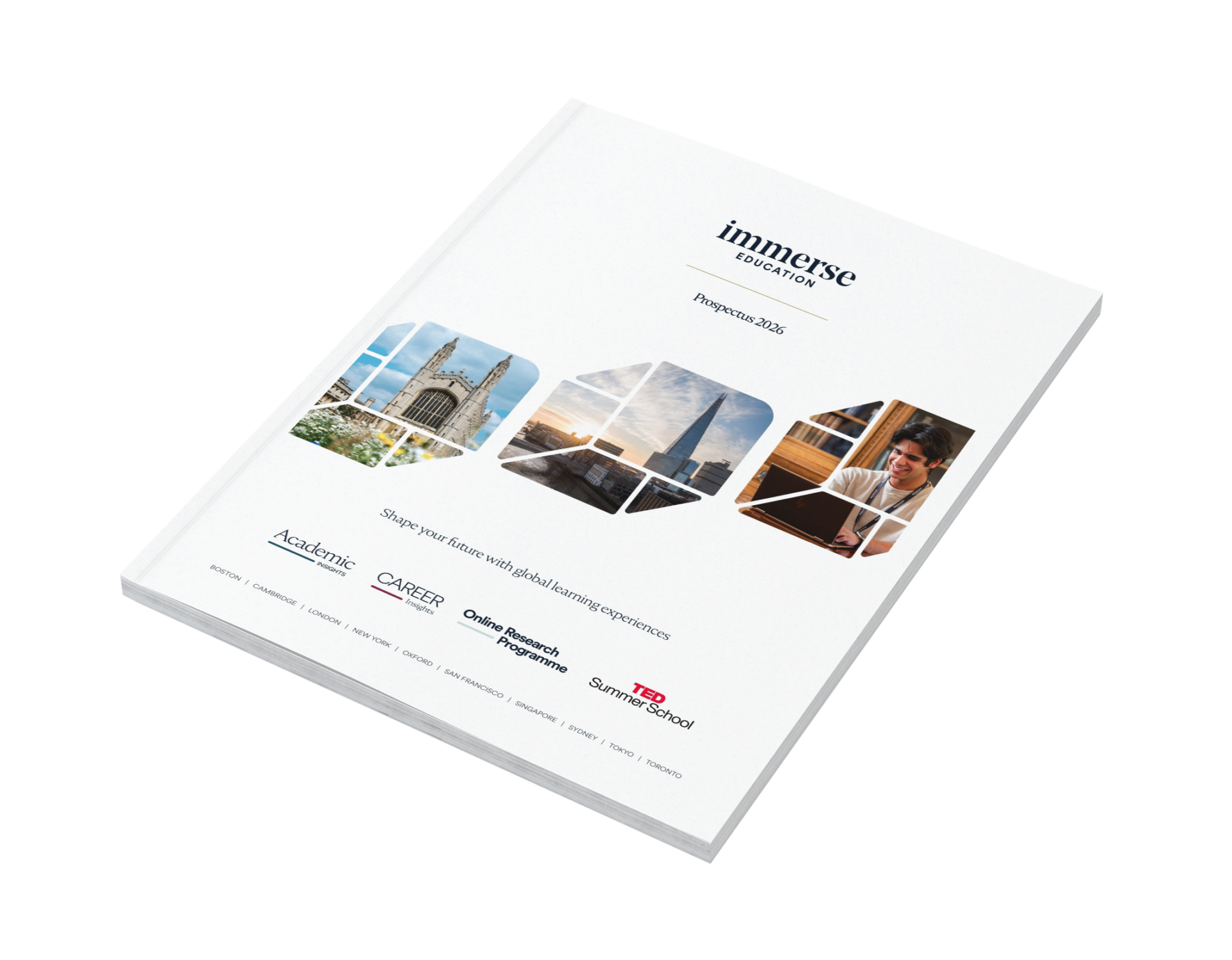
The Online Research Program offers high school students the opportunity to conduct rigorous research with tutors from Oxford, Cambridge, and Ivy League universities. You will work with your tutor to explore a subject of your choice in depth and write an academic research paper. The program is offered in 1:1 and small group formats, and you can choose to receive college credit from universities in the US and the UK.
The virtual research program is offered in over 20 subjects, including artificial intelligence, chemistry, psychology, economics, computer science, creative writing, philosophy, and more. At the end of the program, you’ll receive a written evaluation from your tutor, an opportunity to publish your research, and an invitation to present at the Immerse Online Symposium. You can find examples of papers Immerse students have worked on here. You can find more details about the application here.
Why it stands out: You’ll get access to 1:1 Oxbridge- or Ivy-style research supervision culminating in a publishable academic paper.
3. Wake Forest University – Bioscience: An Inside Look at Infectious Disease
Location: Virtual (Online)
Cost: $1,595 program fee; need-based scholarships are available
Acceptance rate/cohort size: Selective; cohort size not specified
Dates: Multiple 2 – week and 4 – week sessions offered throughout the summer
Application Deadline: One week before the course start date
Eligibility: Open to students ages 13 and older; open to international students
Every outbreak has a scientific story behind it, and this Wake Forest course walks you through how researchers uncover it. You’ll explore how viruses, bacteria, and other pathogens infect the body while learning about immunity, disease transmission, diagnostics, and epidemiology. Case studies on COVID-19, HIV, tuberculosis, cholera, and Zika help connect biological concepts to real public health questions.
Along the way, you’ll examine biomedical research methods and learn how scientists investigate infectious diseases in laboratories and communities. Discussions and assignments also introduce you to reading scientific literature and communicating scientific ideas clearly. The course wraps up with a capstone project that brings together the concepts you’ve studied throughout the program.
Why it stands out: The course combines molecular biology, epidemiology, and public health around real infectious disease case studies that shaped modern medicine.
4. Stanford Program for Inspiring the Next Generation of Women in Physics (SPINWIP)
Location: Virtual, hosted by Stanford University
Cost: Free to attend
Acceptance rate/cohort size: Selective
Dates: July 6-24
Application Deadline: May 1st; Applicants were notified by June 10th
Eligibility: High school students in grades 9-11 at the time of application. International students may apply. Students from underrepresented or under-resourced backgrounds in physics are especially encouraged to apply
Physics starts looking very different once you move beyond textbook equations, and SPINWIP is built around that transition. Hosted by Stanford University and the Kavli Institute for Particle Astrophysics and Cosmology, the program introduces you to subjects like quantum mechanics, astrophysics, cosmology, and quantum computing. You’ll also learn Python and use it for computational activities connected to the physics you’re studying.
Small mentor groups led by Stanford undergraduates make it easy to discuss ideas, ask questions, and work through challenging concepts together. Workshops on research, university pathways, and careers in physics are woven into the schedule as well. Everything happens online, making it accessible to students from around the world.
Why it stands out: The partnership with Stanford’s Kavli Institute gives you exposure to frontier topics in physics alongside mentoring from students actively studying the subject.
5. Mechanics: Motion, Forces, Energy and Gravity, from Particles to Planets
Location: Online through Coursera and UNSW Sydney
Cost: Free to audit with an optional paid certificate through Coursera
Acceptance rate/cohort size: Open-enrollment course with over 75,000 learners enrolled
Dates: Self-paced; approximately 2 weeks at 10 hours per week
Application Deadline: Rolling
Eligibility: Open to all learners; designed for senior high school and beginning university students. Requires basic high school mathematics, including algebra, quadratic equations, and trigonometry
Newton’s laws explain far more than classroom problems, and this course gradually shows you just how far they reach. Offered by UNSW Sydney through Coursera, it covers motion, forces, momentum, energy, gravity, projectile motion, and circular motion using videos, simulations, practice exercises, and optional home experiments. Mathematics stays within reach of high school students while still building a solid understanding of classical mechanics.
As the course progresses, you’ll apply the same physical principles to objects on Earth as well as planets, stars, and orbital systems. It’s self paced, so you can move through the material whenever your schedule allows. By the end, you’ll have a much stronger intuition for how mechanics connects everyday motion with astronomy.
Why it stands out: Developed by UNSW physicists, the course links introductory mechanics to planetary motion in a way that few high school physics courses attempt.
6. University of Pennsylvania Pre-College Online Program – Modern Biology and Social Implications

Location: Online
Cost: $8,692; scholarships are available for Philadelphia residents
Acceptance rate/cohort size: Selective; limited cohort size
Dates: July 2nd – August 7th
Application Deadline: June 1st
Eligibility: Current 10th or 11th grade student; open to international students
Biology didn’t become modern overnight, and this University of Pennsylvania course traces the discoveries that changed how scientists understand life itself. You’ll move from classical genetics to molecular biology while examining the experiments and ideas that shaped each breakthrough. Along the way, you’ll read primary research papers, explore historical case studies, and learn how scientific thinking has evolved over time.
Live classes and writing assignments ask you to connect biology with questions around medicine, ethics, and society. You’ll also spend time working with academic databases and university-level sources, building research skills that extend beyond biology. By the end of the course, you’ll have a stronger understanding of both the science itself and the conversations that continue to shape it today.
Why it stands out: Penn approaches biology through both science and history, giving you the chance to earn Ivy League credit while studying how major biological discoveries reshaped medicine and society.
7. Girls Who Code – Pathways Program
Location: Virtual (open to students worldwide; select cities may offer in-person Industry Immersion Days)
Cost: Free
Acceptance rate/cohort size: Selective
Dates: June 29th – August 14th; More info here
Application Deadline: Early: February 25th; General: April 10th
Eligibility: High school girls and non-binary students (including rising 9th graders, graduating seniors, returning participants, and Summer Programs alumni); More info here
Girls Who Code’s Pathways Program lets you explore different areas of computer science without needing years of coding experience first. You’ll choose one learning track, including Data Science and AI, Web Development, Cybersecurity, Game Design, or AI and Society, then work through projects over seven weeks. The lessons are self paced, so you can build your schedule around school or other commitments.
Throughout the summer, you’ll join live sessions hosted by technology companies and hear directly from people working across the industry. A private Discord community also gives you space to ask questions, share projects, and meet other students with similar interests. It’s a practical introduction to coding that also helps you understand where those skills can take you.
Why it stands out: Girls Who Code pairs technical learning with direct access to engineers and technology companies, making the program feel connected to the industry’s current work.
8. Philosophy of Artificial Intelligence – Stanford Pre-Collegiate Summer Institutes
Location: Virtual (Online)
Cost: $3,200 (financial aid available based on demonstrated need)
Acceptance rate/cohort size: Competitive; average class size of 16 students
Dates: Session One: June 15-26; Session Two: July 6-17
Application Deadline: March 13th
Eligibility: Academically ambitious students in grades 8-11 at the time of application; international students are welcome to apply
Artificial intelligence is rapidly reshaping our world, but understanding its impact requires looking beyond standard algorithms. Offered through Stanford’s Pre-Collegiate Summer Institutes, this course challenges you to examine the cognitive and ethical frameworks behind thinking machines. You’ll explore fundamental questions about machine consciousness, neural network ethics, the Turing test, and what it truly means to possess a mind.
Instead of passive lectures, the daily schedule centers on live, synchronous discussions where you will debate complex ideas, work through philosophical texts, and complete group projects alongside peers from around the world. The program is entirely ungraded, giving you the freedom to dive deep into university-level intellectual inquiry without the pressure of a traditional GPA. You’ll wrap up the two weeks with a final presentation or project that integrates the conceptual tools you’ve sharpened throughout the program.
Why it stands out: The course shifts the focus from writing software to interrogating its cognitive and ethical boundaries, pairing Stanford-designed philosophical seminars with highly interactive, live peer debates.
9. GeneLab for High Schools (GL4HS)
Location: Virtual (asynchronous online program)
Cost: None
Acceptance rate/cohort size: Not selective; typically, large cohorts (>800 students)
Dates: June 1st – August 28th
Application Deadline: March 15, or 1,000 applications, whichever is earlier
Eligibility: U.S. citizens and permanent residents attending U.S.-based high schools; rising juniors, seniors, or incoming college freshmen in Fall; have completed at least one biology course; maintain a minimum unweighted GPA of 3.0; have access to a computer with reliable internet; not open to international students
NASA’s GeneLab for High Schools explores what happens to living organisms once they leave Earth. Across twelve weeks, you’ll study space biology, bioinformatics, and computational biology using real datasets collected through spaceflight research. The coursework combines recorded lessons with JupyterLab coding exercises, allowing you to build technical skills at your own pace.
Optional office hours with scientists provide extra support as you work through genomic and protein data analysis. Students who complete the program can apply for the Capstone Project, where small teams carry out original bioinformatics research using NASA data before presenting their work at a final symposium. It’s an accessible way to learn how biology, programming, and space science increasingly overlap.
Why it stands out: The program gives you access to NASA’s GeneLab database, letting you analyze biological datasets collected from real spaceflight experiments.
10. Summer Academy of Actuarial and Mathematical Sciences (SAAMS)
Location: Virtual (primary) with final week in-person at Morgan State University, Baltimore, MD
Cost: Free to participate; stipend provided to accepted students
Acceptance rate/cohort size: Selective
Dates: June 29th – July 24th
Application Deadline: Priority deadline: February 28th; General deadline: April 30th
Eligibility: Rising 11th or 12th graders, or graduating seniors entering Morgan State University
Mathematics doesn’t only belong in classrooms, and SAAMS shows how it powers fields like finance, insurance, and data analysis. Hosted by Morgan State University, the program introduces you to actuarial science, computer science, and applied mathematics through virtual classes and professional workshops. You’ll solve quantitative problems while learning how mathematical models are used to evaluate uncertainty and risk.
Faculty, mentors, and industry professionals also discuss college pathways and careers that rely on strong analytical thinking. The program finishes with an on campus week at Morgan State, giving you a chance to experience university life while meeting the rest of your cohort. If numbers, probability, and problem solving are your thing, this is a worthwhile introduction to actuarial science.
Why it stands out: Morgan State is one of the few universities that offers a dedicated actuarial science summer program for high school students, complete with a stipend and an on campus experience.
11. Coding in Python I
Location: Online or the University of Washington Seattle campus
Cost: $895 – $995 plus a nonrefundable $50 registration fee
Acceptance rate/cohort size: Open enrollment (first-come, first-served)
Dates: Multiple sessions from January to August
Application Deadline: Rolling enrollment until sections fill
Eligibility: Incoming 9th – 12th graders; no prior programming experience required; international students are welcome to apply
Everyone starts somewhere, and the University of Washington’s Coding in Python I is built for students who have never written code before. You’ll learn the basics of Python through topics like variables, loops, functions, dictionaries, debugging, and file handling, then put those ideas into practice with short coding exercises. The course also focuses on computational thinking, showing you how programmers break large problems into smaller, manageable pieces.
As your confidence grows, you’ll begin writing longer programs and testing your own solutions. The final project is a text based game that you design and code yourself, bringing together everything you’ve learned over the course. You can join either online or on the Seattle campus, and you’ll receive a digital badge after completing the program.
Why it stands out: University of Washington’s beginner friendly curriculum builds toward a complete Python project, giving first time programmers something tangible to show for their work.
12. Introduction to Data Science – Stanford Pre-Collegiate Studies
Location: Virtual
Cost: $3,200 tuition; additional course materials may cost up to $100. Financial aid available based on demonstrated need
Acceptance rate/cohort size: Selective
Dates: Session One: June 15-26; Session Two: July 6-17
Application Deadline: Financial aid application deadline is March 20th; document submission deadline is March 27th. General admissions deadline not specified
Eligibility: Students worldwide in grades 9-11 at the time of application. Applicants should have prior exposure to a programming language and a working knowledge of statistics
Data is everywhere, and this Stanford course shows you how to make sense of it. You’ll work with real datasets while learning the foundations of data science, machine learning, and statistical analysis using the R programming language. Along the way, you’ll write code, explore patterns, and build simple models that answer practical questions across science and society.
Daily live classes are paired with independent assignments that strengthen both programming and analytical thinking. The course also introduces topics like bias, privacy, and responsible AI, encouraging you to think carefully about how data should be used. If you already know some programming and basic statistics, it’s a solid next step into one of today’s fastest growing fields.
Why it stands out: Stanford combines live instruction with real research style datasets and R programming, giving you an experience that closely reflects introductory university data science courses.
13. UCLA Summer Sessions – High School Approved Summer Courses
Location: Online
Cost: Non-refundable registration fee of $350, plus tuition of $420 per unit, a $61 Instructional Enhancement Initiative (IEI) fee, and a $50 document fee for first-time students
Acceptance rate/cohort size: Open enrollment (first-come, first-served)
Dates: Multiple sessions from June 22nd to September 11th, 2026 (including 3-, 6-, 8-, 9-, and 10-week sessions)
Application Deadline: Registration opens February 18th, 2026; deadlines vary by session (domestic visiting student deadline is June 1st for Sessions C/D)
Eligibility: High school students around the world who are at least 15 years of age or older (as of June 22nd, 2026); may enroll in 1-2 approved courses (maximum 10 units)
Want to know what a real college class feels like? UCLA Summer Sessions lets you enroll in approved undergraduate courses alongside UCLA students and earn official university credit while you’re still in high school. You can choose from subjects like computer science, artificial intelligence, engineering, neuroscience, economics, psychology, mathematics, and more.
Classes follow the same expectations as regular UCLA courses, so you’ll manage assignments, exams, and discussions just like any other undergraduate. Depending on your schedule, you can study online, in person, or in a hybrid format. It’s a good way to challenge yourself academically while getting comfortable with the pace of college level work before you graduate from high school.
Why it stands out: UCLA opens its regular undergraduate classrooms to high school students, making this one of the few programs where you study as an actual university student instead of in a separate pre-college cohort.
14. Kode With Klossy Summer Camps
Location: Virtual globally, with select in-person camps in cities including New York City, San Francisco, Seattle, Chicago, and London
Cost: Free
Acceptance rate/cohort size: Selective
Dates: Multiple 2-week sessions from June to August
Application Deadline: Rolling waitlist through early August
Eligibility: Young women and gender expansive teens ages 13-18; no prior coding experience required; international students can apply
Kode With Klossy makes learning to code feel approachable, even if you’ve never opened a programming editor before. Across two weeks, you’ll choose a track such as Web Development, Mobile App Development, Artificial Intelligence & Machine Learning, or Data Science, then build projects using tools like Python, JavaScript, HTML, CSS, or SQL.
The lessons mix coding with discussions about topics like AI ethics, data visualization, and user experience, helping you understand how technology is used beyond the classroom. You’ll spend plenty of time writing code, solving small challenges, and improving your projects with feedback from instructors. By the end, you’ll have a portfolio of projects and a clearer picture of where coding can take you.
Why it stands out: Kode With Klossy has built one of the largest coding communities for young women and gender expansive students, pairing free technical training with a strong alumni network.
15. Mobile Coding for Apps and Games (Create & Learn)
Location: Online (Live)
Cost: $395.91; discounts and trial classes available
Acceptance rate/cohort size: small groups of 2-3 students per class
Dates: 12 weeks course; multiple start dates available; Year-round offerings
Application Deadline: Rolling
Eligibility: Students from all nationalities in grades 5-10; prior experience with Scratch or familiarity with loops, conditionals, and variables recommended
If you’ve ever wanted to build an app instead of just using one, this course gives you a place to start. Using Thunkable, you’ll learn how mobile apps are designed, programmed, and tested through live online classes with very small groups. You’ll build games and interactive apps while working with concepts like user input, event handling, interface design, and app logic.
As the course progresses, you’ll connect your projects to phone features such as cameras and sensors, then explore cloud storage, authentication, and databases using tools like Firebase and Airtable. Every project adds another layer, so your apps become more capable over time. By the final week, you’ll have several working mobile applications and a solid understanding of how modern apps come together.
Why it stands out: Create & Learn goes beyond simple app design by introducing backend tools like Firebase, giving you experience with both the front end and the logic that powers real mobile apps.
Frequently asked questions: Online courses for high school students
Are online courses for high school students open to international students?
Most online courses welcome international students, including Immerse Education’s Online Research Programme, the UNSW Sydney Mechanics course on Coursera, and Wake Forest’s Bioscience course. A notable exception is NASA’s GeneLab for High Schools, which requires US citizenship. SPINWIP and the Philosophy of AI course at Stanford also explicitly welcome international applicants, making most options in this list accessible regardless of citizenship.
How much do online courses for high school students cost?
Costs range from completely free to over $8,000. Free options include SPINWIP, Girls Who Code’s Pathways Program, GeneLab for High Schools, and Kode With Klossy. Mid-range courses like Wake Forest’s Bioscience course cost $1,595, while premium university-credit options like the University of Pennsylvania’s Modern Biology course cost $8,692. Financial aid is available for several of the tuition-based programs, including MIT’s Beaver Works Summer Institute and Stanford’s Pre-Collegiate courses.
Do online courses for high school students award college credit?
Some do, though it varies. UCLA Summer Sessions and the University of Pennsylvania’s Modern Biology course both offer official transferable college credit since you’re enrolled in actual undergraduate coursework. Immerse Education’s Online Research Programme offers credit through specific accredited pathways for students aged 14 and above. Most other courses, including Stanford’s Pre-Collegiate offerings and Girls Who Code, provide a certificate or portfolio of projects rather than formal credit.
What is the difference between a coding-focused and a concept-focused online course?
Coding-focused courses, like the University of Washington’s Coding in Python I or Create & Learn’s Mobile Coding course, walk you through hands-on programming exercises building toward a tangible final project. Concept-focused courses, like Stanford’s Philosophy of Artificial Intelligence or the UNSW Mechanics course, instead emphasize discussion, theory, and critical analysis without requiring extensive coding output. If you want to build technical skills directly, a coding-focused course is the better fit; if you want to explore ideas and debate, a concept-focused course suits you better.
How selective are online courses for high school students?
Selectivity varies considerably. MIT’s Beaver Works Summer Institute and Girls Who Code’s Pathways Program are both described as selective, admitting cohorts based on application review. Others, like the University of Washington’s Coding in Python I or UCLA Summer Sessions, use open, first-come enrollment rather than a competitive process. Regardless of selectivity, meeting prerequisite coursework, like prior programming experience for Stanford’s Data Science course, matters as much as the strength of your application.
Is Immerse Education a good option for pursuing independent research online?
Immerse Education’s Online Research Programme is a strong choice if you want individualized, Oxford-style mentorship without needing to travel or hold specific citizenship. Offered in 1:1 or small group formats across more than 20 subjects, including AI, economics, and creative writing, the program has you work with a tutor to write an academic research paper. You’ll receive a written evaluation, the chance to publish your research, and an invitation to present at the Immerse Online Symposium, with the option to earn college credit if you’re 14 or older.
Your Online Course Was Just Step One
Choosing among these online courses for high school students gives you a genuine introduction to college-level material, taught by real instructors and researchers.
Once the course ends, you can turn that self-directed experience into a clearer sense of your academic and career direction.
The independence, technical skills, and academic habits you built become a strong foundation for stronger university applications ahead.
Keep building on what you started this summer by exploring our University Preparation blogs for guidance on your next steps.