
 Русский (RU)
 Українська (UK)
 Türkçe (TR)
 Italiano (IT)
 Français (FR)
 Português (PT)
 中文 (中国) (ZH)
 Español (ES)
 日本語 (JA)
 ไทย (TH)
 Deutsch (DE)
 Ελληνικά (EL)
 Polski (PL)
 Bahasa Indonesia (ID)
 Nederlands (NL)
 العربية (AR)
 한국어 (KO)

Starting high school can feel exciting and intimidating at the same time. At 14, you’re beginning to explore subjects more seriously, meet students with similar interests, and think about what you might want to study in the future. Summer camps for 14 year olds can give you a structured way to explore those interests outside regular school classes.
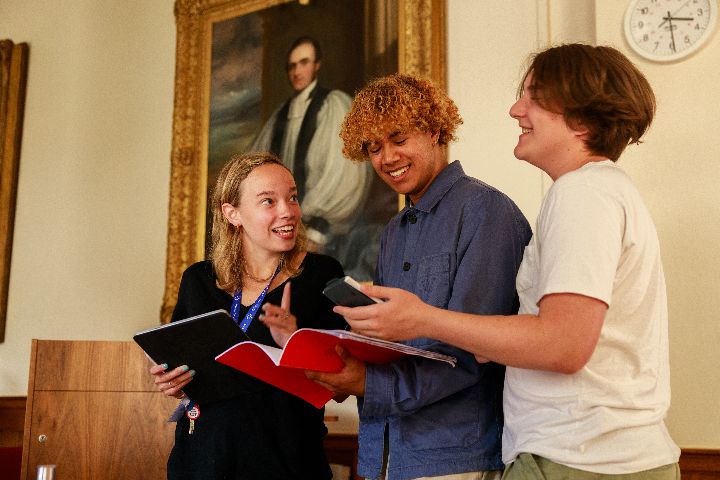
The best summer camps for 14-year-olds go beyond simple classroom learning. You might find yourself building engineering prototypes, debating ethical questions, writing original stories, conducting science experiments, exploring cybersecurity, or living on a college campus for the first time. These experiences introduce students to university-style learning and help them develop independence before the more demanding years of high school begin.
How do you choose the right summer camps for 14-year-olds?
Not every summer program is designed with younger high school students in mind. Some programs mainly target older juniors and seniors, while others are specifically structured to help freshmen explore subjects in a more supportive environment. That’s why getting the right information is essential, so you can pick the best summer camp.
Many universities, nonprofits, and research organizations now offer programs that are accessible to younger high school students without sacrificing academic depth. You’ll find opportunities in physics, engineering, philosophy, creative writing, business, coding, journalism, medicine, and more. Some emphasize hands-on projects and teamwork, while others focus on discussion, mentorship, or career exposure.
Of course, every program is different, and the right fit depends on your interests, learning style, and goals. To make your search easier, we’ve put together a list of the 15 Best Summer Camps for 14 Year-olds. These programs were selected for their accessibility to younger students, strong academic and creative experiences, and opportunities for meaningful learning beyond the classroom.
For adjacent opportunities, consider the online research program for 14-year-olds.
15 Summer Camps for 14 Year Olds
1. The New York Academy of Sciences Junior Academy
Location: Virtual through the NYAS Launchpad platform
Cost: Free
Dates: Challenge periods run throughout the academic year
Application Deadline: July 2nd
Eligibility: Students worldwide aged 13-17
The Junior Academy is one of the more globally focused summer camps for 14 year olds, giving you the chance to work with students from around the world on real science and technology challenges. You collaborate in international teams while receiving mentorship from STEM professionals and industry experts throughout the program cycle. You’ll learn research methods, design thinking, and data analysis before applying those skills to collaborative projects focused on global issues.
Most communication and project work happens through the online Launchpad platform, where students participate in discussions, workshops, and mentor sessions. The time commitment is relatively manageable at around three to four hours per week during active challenge periods, which makes it easier to balance alongside school and extracurriculars. The program is especially well-suited for students who enjoy collaborative problem-solving and want early exposure to international STEM communities.
Why it stands out: The Junior Academy combines global collaboration with structured mentorship, giving younger high school students access to real-world STEM challenges without requiring prior research experience.
2. Immerse Education’s Pre-University Summer School
Location: Cambridge, London, Oxford, Singapore, Sydney, Tokyo, and Toronto
Cost: Varies; summer school scholarships available through our bursary programme
Application Deadline: Multiple summer cohorts; rolling admissions
Program Dates: 2 weeks during the summer
Eligibility: Students worldwide aged 13-18 currently enrolled in middle or high school
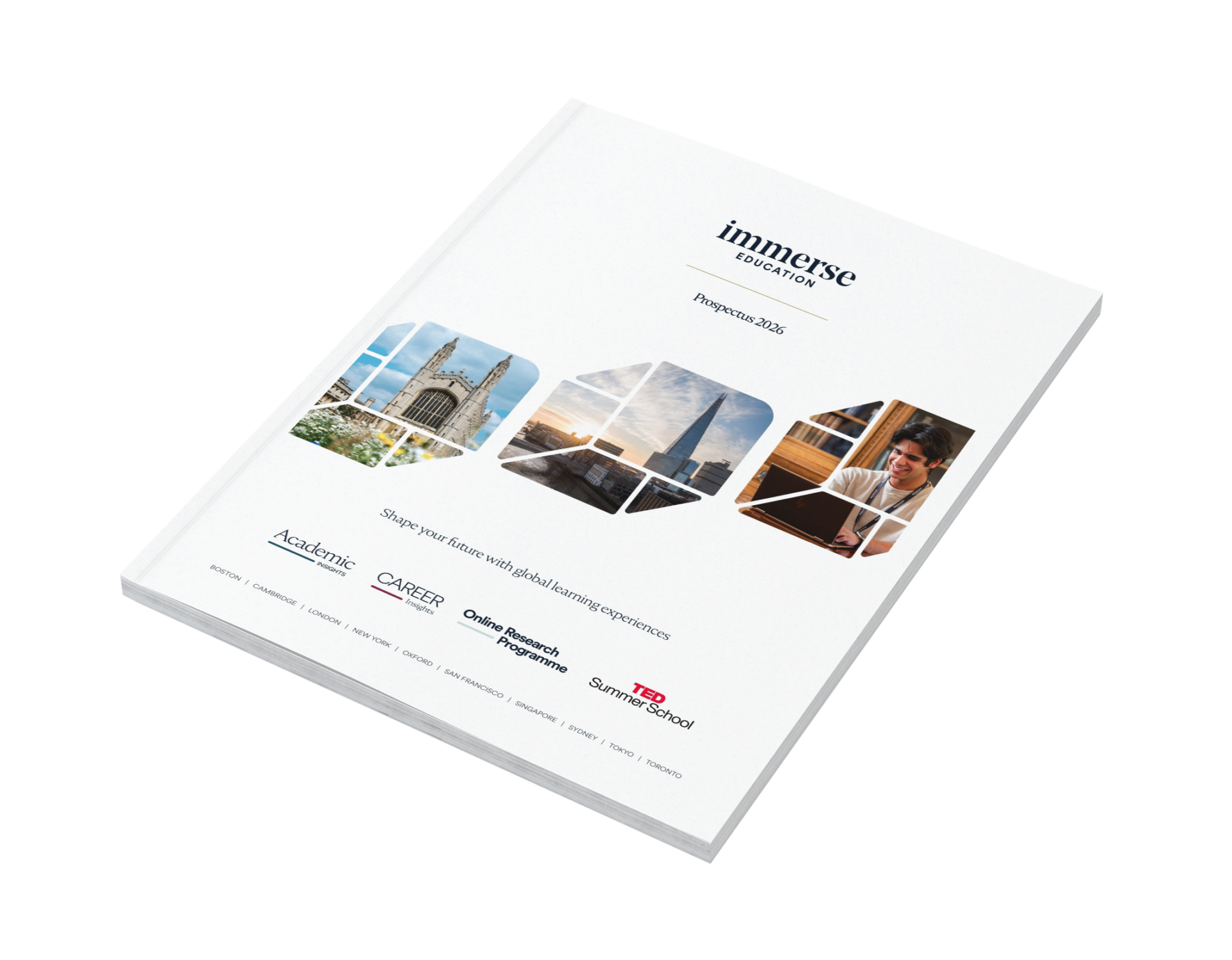
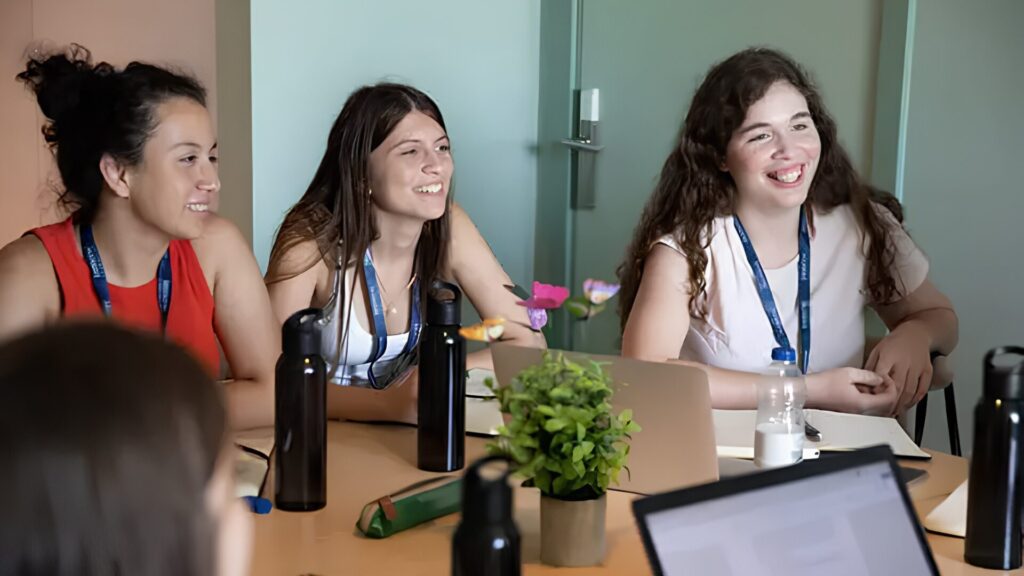
For students ready to experience university-style learning early, the Academic Insights Program is a strong choice among the many summer camps for 14 year olds. You will live on campus and study in small groups of 7–10, learning from tutors from top universities like Oxford and Cambridge. Participants can explore over 20 subjects, including Architecture, AI, Business Management, Computer Science, Economics, Medicine, Philosophy, and more.
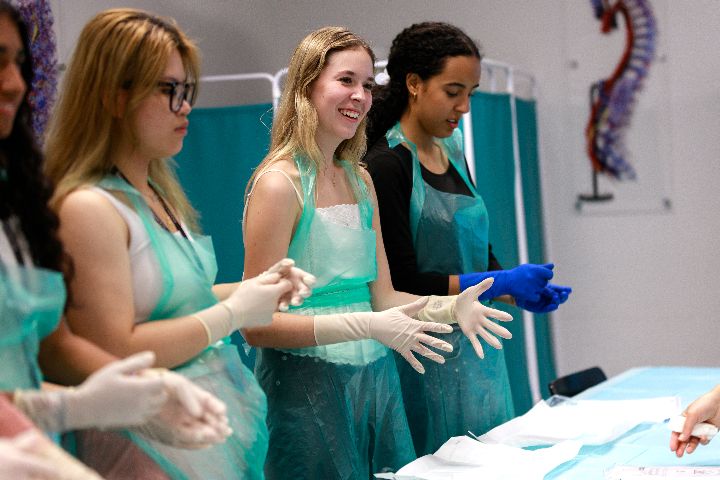
The courses are experiential and hands-on: you may find yourself conducting dissections in medicine, designing a robotic arm in engineering, participating in a moot court for law, or building creative writing portfolios and business case studies. By the end of the program, you’ll complete a personal project, receive written feedback, and receive a certificate of completion. You can find more details about the application here.
Why it stands out: You’ll study under expert academics, be guided daily by a university student mentor, complete a project you can show in future applications, and experience genuine university college life — with other campuses worldwide as alternatives.
3. English Teacher Assistant Volunteer Program – Instituto Hemingway
Location: Bilbao, Spain
Cost: €500 per week
Dates: Flexible placements ranging from one week to one year
Application Deadline: Rolling admissions
Eligibility: Ages 14 and above; international students can apply
This volunteer program places students in classrooms and community learning settings in northern Spain, where you help support English language education for children and teens. You may assist instructors with lesson planning, reading activities, games, homework support, and conversational English practice. The experience is much more interactive than a traditional classroom volunteer role since you work directly with younger students throughout the day.
Outside of teaching activities, participants join cultural events and excursions, including museum visits, local tours, hiking trips, and social activities around Bilbao. Since placements can vary in length, students have some flexibility in how long they participate. The program works particularly well for students interested in education, cultural exchange, languages, or international travel experiences at a relatively young age.
Why it stands out: It combines volunteer teaching experience with cultural immersion, giving students the opportunity to live abroad while working directly with local communities.
4. Stanford University SPINWIP (Stanford Program for Inspiring the Next Generation of Women in Physics)
Location: Virtual
Cost: Free
Dates: July 6-24
Application Deadline: Applications closed; decisions released by June 10th
Eligibility: High school students worldwide in grades 9-11
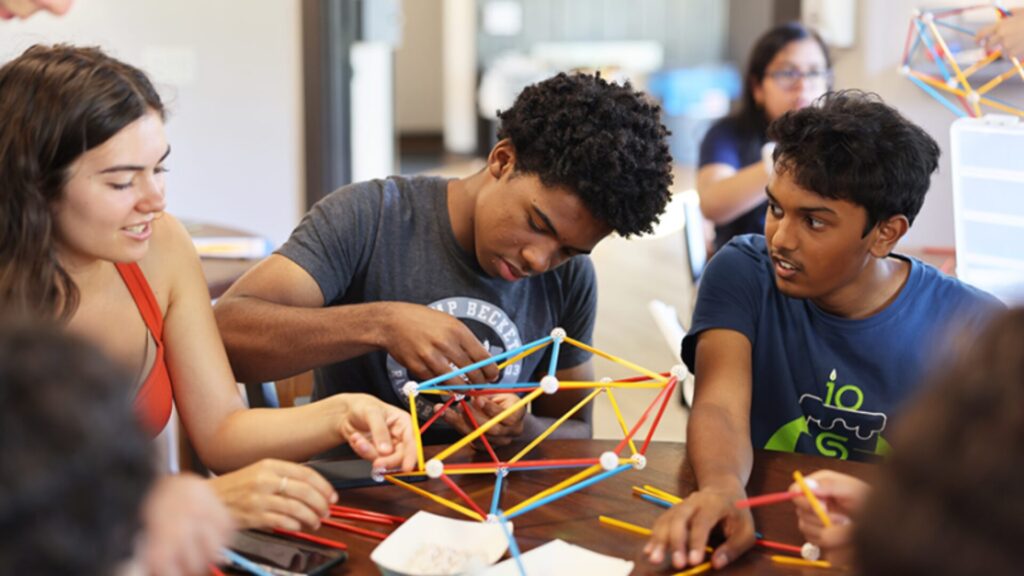
SPINWIP is a three-week virtual summer physics program where students explore advanced STEM topics through lectures, projects, and coding workshops led by Stanford faculty and undergraduate mentors. You’ll attend sessions covering subjects like astrophysics, cosmology, quantum mechanics, and quantum computing while also learning introductory Python programming. The program is designed to make higher-level physics more approachable, even if you don’t already have advanced coursework or coding experience.
Alongside lectures, students participate in collaborative small-group projects and attend workshops focused on college planning and STEM careers. Because the program is virtual and relatively short, it can be a good entry point for younger students who want exposure to university-level STEM topics without committing to a full residential experience.
Why it stands out: SPINWIP introduces students to advanced physics concepts through a beginner-friendly structure that blends academic exploration with mentorship from Stanford researchers and students.
5. Department of the Navy Science and Engineering Apprenticeship Program (SEAP)
Location: Department of the Navy laboratories across the United States
Cost/Stipend: $4,000 for new participants; $4,500 for returning participants
Dates: Eight-week summer internship
Application Deadline: November 1st
Eligibility: U.S. high school students who have completed at least Grade 9 and are currently enrolled in high school
SEAP places students in Navy research laboratories where they work alongside scientists and engineers on STEM research and technology projects. Depending on the lab placement, students may contribute to projects involving engineering, computer science, robotics, materials science, or defense-related research. You’re exposed to professional research environments early on, which can make the experience feel closer to a university or industry lab than a traditional summer camp.
Students develop technical and analytical skills while learning how large-scale research teams operate in real settings. The application process is fairly competitive and usually favors students with strong academic preparation and demonstrated interest in STEM subjects. Because placements vary across dozens of laboratories, individual experiences can look quite different from one student to another.
Why it stands out: SEAP gives high school students direct access to government research laboratories and mentorship from working scientists and engineers in highly technical fields.
6. The Scripps Research Institute Student Research Internship Program
Location: La Jolla, California
Cost/Stipend: Not specified
Dates: June 1st – August 7th or June 15th – August 7th
Application Deadline: March 30th
Eligibility: Local high school students
The Student Research Internship Program at Scripps Research introduces high school students to biomedical and translational research through mentored summer projects. Students work with researchers on topics connected to genomics, mobile health technologies, computational biology, and clinical research methods. Most participants spend significant time working with data analysis, statistics, and computational tools, making the experience more research-focused than many traditional lab internships.
Some students may also have access to wet-lab experiences depending on mentor placement and project availability. Throughout the program, interns learn how scientific discoveries move from laboratory research toward real-world healthcare applications. Because Scripps Research is a major biomedical research institution, the internship tends to be academically rigorous and particularly well-suited for students already interested in scientific research careers.
Why it stands out: The program exposes students to translational medicine and biomedical research environments that are usually difficult to access before college.
7. Ethics in the 21st Century: Business, Politics and Technology
Location: University of Southern California, Los Angeles, California
Cost: $85 application fee + program fees not specified
Dates: Summer session dates not specified
Application Deadline: Not specified
Eligibility: High school students around the world
This USC pre-college course explores major ethical questions connected to politics, business, technology, and modern society through philosophy, debate, and writing. Throughout the program, you study topics like socioeconomic inequality, immigration, business ethics, AI, algorithmic bias, and universal basic income while reading philosophical texts and analyzing current events. You’ll participate in structured debates, argumentative writing assignments, and discussions that encourage you to defend your ideas while respectfully considering opposing viewpoints.
The course also includes field trips and collaborative activities that connect classroom ideas to real-world policy and social issues. Since the curriculum emphasizes critical thinking and communication rather than memorization, it works particularly well for students interested in humanities, politics, law, economics, or public policy. The classroom environment is discussion-heavy, so students who enjoy questioning ideas and participating in debates will likely get the most out of the experience.
Why it stands out: The program combines philosophy, politics, and technology ethics in a way that feels highly connected to current social and economic issues students already encounter online and in everyday life.
8. The Science of Food, Nutrition, and the Biological World
Location: University of Southern California, Los Angeles, California
Cost: $85 application fee + program fees not specified
Dates: Summer session dates not specified
Application Deadline: Not specified
Eligibility: High school students from all nationalities who have completed at least one year of high school biology with a grade of B or above
This interdisciplinary USC course uses food and nutrition as a way to introduce students to biology, biochemistry, microbiology, genetics, and public health. You’ll study topics like macronutrients, metabolism, fermentation, GMO foods, and the environmental impact of agriculture while participating in hands-on lab and cooking activities. Rather than learning biology only through lectures, students apply scientific concepts directly through experiments, food preparation, fermentation projects, and nutritional analysis.
The program also includes field trips and practical assignments tied to food science and public health issues. Along the way, students learn laboratory techniques such as DNA extraction, PCR, and gel electrophoresis while designing experiments and analyzing scientific data. The course is especially appealing for students interested in biology, nutrition, medicine, environmental science, or culinary science.
Why it stands out: The course blends laboratory science with real-world applications through cooking, food production, and nutrition, making complex biology concepts feel more tangible and interactive.
9. The Philosophy of Economic Markets, Money, and Property
Location: University of Southern California, Los Angeles, California
Cost: $85 application fee + program fees not specified
Dates: Summer session dates not specified
Application Deadline: Not specified
Eligibility: High school students around the world
This USC summer course explores the philosophical and ethical questions behind markets, economics, money, and public policy. Students study concepts from decision theory and game theory before applying them to topics like contracts, distributive justice, wealth, cooperation, cryptocurrencies, and property rights. You’ll participate in debates, simulations, bargaining games, and social experiments that make abstract economic and philosophical ideas feel much more interactive.
The program also includes argumentative essay writing, group discussions, and presentations focused on analyzing contemporary ethical and economic issues. While the course introduces some quantitative reasoning, the emphasis is primarily on critical thinking, logic, and evaluating competing perspectives. It tends to work well for students interested in economics, philosophy, politics, business, or law who enjoy discussion-based learning environments.
Why it stands out: The program approaches economics through both philosophy and behavioral decision-making, giving students a broader perspective than traditional introductory economics courses.
10. SPS High School Academy: Career Edge
Location: New York University, New York City, New York
Cost: $2,579 tuition and program fees, $684 housing and dining fees, plus a $50 application fee
Dates: Multiple one-week sessions from June 29th to August 7th
Application Deadline: March 14th for international students, May 8th for residential U.S. students, June 12th for commuter U.S. students
Eligibility: Students worldwide who have completed grades 9, 10, or 11
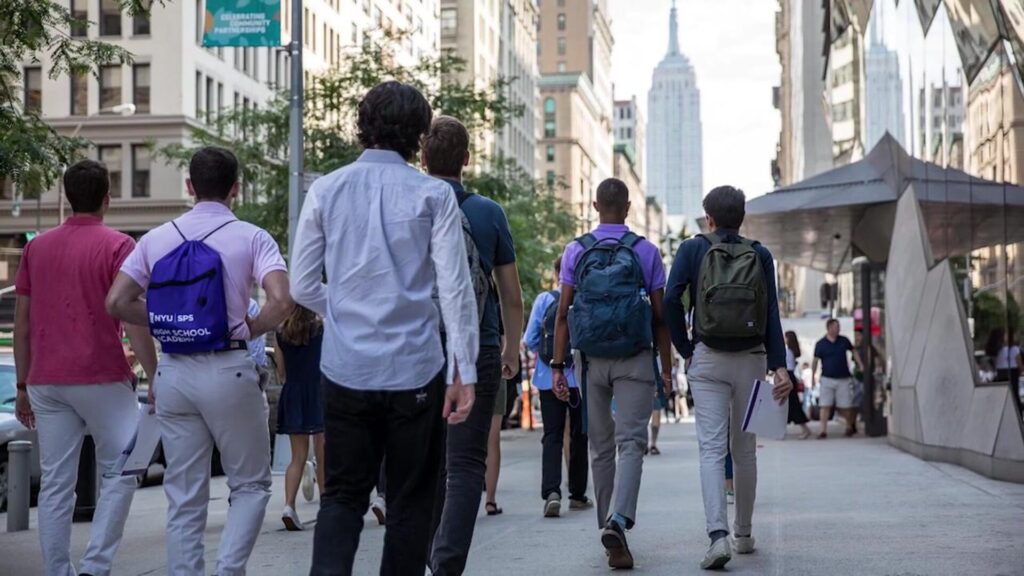
NYU’s Career Edge program fits well among the various summer camps for 14 year olds because it offers a one-week residential pre-college experience where students explore fields such as business, healthcare, law, publishing, finance, and event planning while living on campus in New York City. Students take immersive short courses taught through the NYU School of Professional Studies while also participating in extracurricular and cultural activities around the city. The program is designed to give students an early look at both college life and career exploration in a fast-paced urban environment.
Outside the classroom, participants stay in NYU residence halls, eat in campus dining facilities, and attend social activities with students from around the world. Since the sessions are only one week long, the program can work well for younger high school students who want a shorter introduction to residential pre-college programs before committing to longer summer experiences.
Why it stands out: The program combines career-focused coursework with a residential NYC college experience, making it especially approachable for students exploring academic interests early in high school.
11. Tisch Online High School Screenwriters Workshop
Location: Online
Cost: $8,008
Dates: July 6-31
Application Deadline: Priority deadline May 11th; regular deadline June 10th
Eligibility: High school students from around the world in grades 9-12 with a minimum 3.0 GPA
This online NYU Tisch workshop introduces students to the fundamentals of screenwriting for film and television through intensive writing exercises and collaborative workshops. Throughout the four-week program, students develop story concepts, build characters, learn screenplay structure, and study film language while completing daily and weekly writing assignments. You’ll spend much of the course actively writing and revising scripts rather than only studying storytelling theory.
The course combines asynchronous lectures with scheduled live sessions involving faculty, teaching assistants, and classmates, which gives students some flexibility while still maintaining regular interaction and feedback. Participants also earn four college credits by the end of the workshop. The program tends to work best for students seriously interested in filmmaking, storytelling, creative writing, or media production.
Why it stands out: The workshop offers a structured introduction to screenwriting through NYU Tisch while allowing students to build a substantial creative portfolio piece entirely online.
12. Innovation, Entrepreneurship, and the Science of Smart Cities (ieSoSC)
Location: NYU Tandon School of Engineering, Brooklyn, New York
Cost: Full scholarship provided
Dates: July 6th – August 7th
Application Deadline: May 15th
Eligibility: Students currently enrolled in grades 8-10 who live in New York City
ieSoSC is a five-week engineering and entrepreneurship program where students design technology solutions connected to urban infrastructure and smart city challenges. Participants study topics related to computer science, engineering, entrepreneurship, and design thinking before working in teams to create prototypes for apps or devices using Internet of Things technology. The second half of the program is heavily project-based, with students collaborating to design and present solutions to real urban problems.
Students learn directly from NYU faculty and graduate students while gaining experience with prototyping, public speaking, and engineering design processes. The program ends with a public presentation where teams showcase their ideas to engineers, urban planners, and STEM professionals. Since it is tuition-free and highly hands-on, the program can be particularly appealing for younger students interested in engineering and innovation.
Why it stands out: ieSoSC combines engineering, entrepreneurship, and public presentation training in a collaborative environment focused on solving real-world city challenges.
13. Computer Science for Cyber Security (CS4CS)
Location: NYU Tandon School of Engineering, Brooklyn, New York
Cost: Full scholarship provided
Dates: July 13th – August 7th
Application Deadline: May 15th
Eligibility: Students in grades 8-11 who live in New York City or neighboring cities such as Jersey City, Newark, or Hempstead
CS4CS is a tuition-free cybersecurity summer program that introduces students to computer science concepts through hands-on activities and cybersecurity challenges. Students learn topics such as digital forensics, cryptography, steganography, and ethical hacking while attending classes taught by NYU faculty and graduate students. The program is specifically designed for beginners, so prior experience in coding or cybersecurity is not required.
Throughout the program, students complete collaborative exercises and technical activities that emphasize problem-solving and practical application rather than lecture-heavy instruction. The curriculum also focuses on expanding access to STEM education for groups historically underrepresented in technology fields. Because students commute daily to campus, the experience feels more like a structured academic program than a residential summer camp.
Why it stands out: CS4CS gives younger high school students an accessible introduction to cybersecurity through hands-on technical projects in a university engineering setting.
14. Creative Writing Camp
Location: Point Park University, Pittsburgh, Pennsylvania
Cost: $800 commuter, $1,550 residential, including room and board
Dates: July 27-31
Application Deadline: Not specified
Eligibility: High school students around the world aged 14-18 and 2026 high school graduates
Point Park University’s Creative Writing Camp is a week-long summer program where students explore fiction, monologues, horror writing, and creative nonfiction through workshops, collaborative exercises, and local field trips. Throughout the week, students create original characters and fictional worlds, experiment with storytelling techniques, and participate in group workshops focused on voice, imagery, and narrative structure.
The camp leans heavily into imaginative and genre-based storytelling, especially horror and dramatic writing, which gives the experience a more playful and creative atmosphere than a traditional academic writing course. Students also visit locations like the University of Pittsburgh’s Horror Archives and the August Wilson Center while participating in acting exercises, live readings, and collaborative discussions.
Why it stands out: The program combines creative writing, performance, horror storytelling, and field experiences in a way that feels especially interactive and community-oriented for younger writers.
15. Sports Broadcast Camp
Location: Point Park University, Pittsburgh, Pennsylvania
Cost: $800 commuter, $1,550 residential, including room and board
Dates: July 20-24
Application Deadline: Not specified
Eligibility: Students worldwide entering grades 9-12 and 2026 high school graduates
Point Park University’s Sports Broadcast Camp introduces students to sports journalism, commentary, broadcasting, photography, podcasting, and media production through hands-on workshops and live experiences. Students learn directly from communication professionals and sports broadcasters while practicing skills like play-by-play commentary, sports reporting, and on-camera broadcasting.
A major part of the program takes place in professional sports environments, including mock broadcasts and press activities at PNC Park. Participants also tour production facilities, practice live broadcasting in studio settings, and attend a Pittsburgh Pirates game while observing behind-the-scenes media operations.
Why it stands out: The program gives students direct exposure to real sports broadcasting environments while combining journalism, production, and live commentary experience in one short summer program.
Use Summer Camps to Prepare for Bigger Academic Steps
Summer camps can turn early curiosity into practical confidence, helping younger students test subjects, routines, friendships, and independence before high school becomes more demanding.
The 15 summer camps for 14 year olds in this guide introduce STEM, writing, business, ethics, research, cybersecurity, media, and creative study.
Each experience can build habits that matter later: asking better questions, managing time, joining discussions, completing projects, and adapting to new academic expectations.
For stronger preparation after camp, use our University Preparation blogs to plan subject choices, study skills, applications, interviews, and future academic steps with clearer direction and less guesswork as school progresses steadily.