
 Русский (RU)
 Українська (UK)
 Türkçe (TR)
 Italiano (IT)
 Français (FR)
 Português (PT)
 中文 (中国) (ZH)
 Español (ES)
 日本語 (JA)
 ไทย (TH)
 Deutsch (DE)
 Ελληνικά (EL)
 Polski (PL)
 Bahasa Indonesia (ID)
 Nederlands (NL)
 العربية (AR)
 한국어 (KO)

Summer at 13 sits at an interesting junction; you’re old enough to engage seriously with academic material, and young enough to have several summers ahead to explore different fields, campuses, and learning environments. Summer programs for 13 year olds can give you access to instructors, equipment, and intellectual culture that secondary school curricula rarely replicate.
You’ll leave with more than subject knowledge; you’ll leave with a clearer sense of what kind of learner you are and what interests you most. These experiences can also act as a foundation for your high school and college life, giving you an early taste of your future.
What are the benefits of pursuing a summer program as a 13 year old?
Summer programs are basically a cheat code for getting 13-year-olds through that tricky middle-school transition with a bit more confidence. At an age where you are craving independence but still need a safety net, a good summer program gives you the perfect sandbox to step away from your screens and try out new interests, whether that means building a robot, acting in a play, or just navigating a new social circle outside of your usual school cliques.
You work on your area of interest alongside other ambitious students, with professors and researchers guiding the coursework. Whether you want to push your limits in math, explore the sciences, or get your first taste of advanced academics, a summer program is a solid place to start.
Ultimately, it is less about the specific technical skills you learn and more about the autonomy you gain; figuring out how to manage a new routine, collaborate with strangers, and solve problems on your own gives them a massive, tangible confidence boost that pays real dividends when they head back to class in the fall.
To help you get ahead, we’ve curated the top 15 summer programs for 13-year-olds.
For adjacent opportunities, check out online summer programs for 13 year olds.
15 Summer Programs for 13-Year-Olds
1. Purdue University GER²I Youth Programs – Summer Residential Camps
Location: West Lafayette, Indiana (Purdue University campus; campers live in on-campus residence halls)
Cost/Stipend: Commuter: $1,250; Residential: $1,495, Star: $2,990; Pulsar: 2,990 +$100 application fee; optional $100 Saturday field trip fee for Star and Pulsar campers; various types of discounts and financial aid are available
Acceptance rate/cohort size: Selective; roughly 225–315 students
Dates: June 28th – July 25th, offered in 1-, 2-, or 4-week sessions by age group (Comet for grades 5-6, Star for grades 7-8, Pulsar for grades 9-12)
Application Deadline: Late spring (around June 1st)
Eligibility: Students who have completed grades 5 through 12; demonstrated academic, creative, or artistic ability documented by two qualifying items such as a 3.5/4.0 GPA in the talent area, an intelligence test score of 120 or higher, or a 90th-percentile achievement/aptitude score; open to international students
In this program, you attend a residential academic camp on Purdue University’s campus, living in the residence halls and taking one intensive, fast-paced course in your chosen talent area spanning STEM and the humanities. You might design and 3D-print prototypes, build functional devices using coding, circuitry, and 3D modeling, run forensic-style investigations, create an environmental design portfolio in Photoshop, Illustrator, and InDesign, or dive into philosophy, creative writing, and performance.
Working in small classes led by faculty, graduate students, and experienced teachers, you use Purdue’s labs, computing facilities, and libraries. Outside class, counselors organize field trips, tournaments, and social events, and you finish by showcasing your projects alongside peers from many states and countries.
Why it stands out: It is operated by a dedicated gifted-education research institute, giving you genuine university labs, faculty-designed courses, and a globally diverse cohort within a structured, well-supervised residential setting.
2. Immerse Education’s Pre-University Summer School

Location: Cambridge, London, Oxford, Singapore, Sydney, Tokyo, and Toronto
Cost: Varies; summer school scholarships available through our bursary programme
Acceptance rate/cohort size: Selective; an average of 7 participants per class
Dates: 2 weeks during the summer
Application Deadline: Multiple summer cohorts; rolling admissions
Eligibility: Students aged 13-18 currently enrolled in middle or high school; open to international students
The Academic Insights Program lets high school students experience university life firsthand. You will live on campus and study in small groups of 7–10, learning from tutors from top universities like Oxford and Cambridge. Participants can explore over 20 subjects, including Architecture, AI, Business Management, Computer Science, Economics, Medicine, Philosophy, and more.
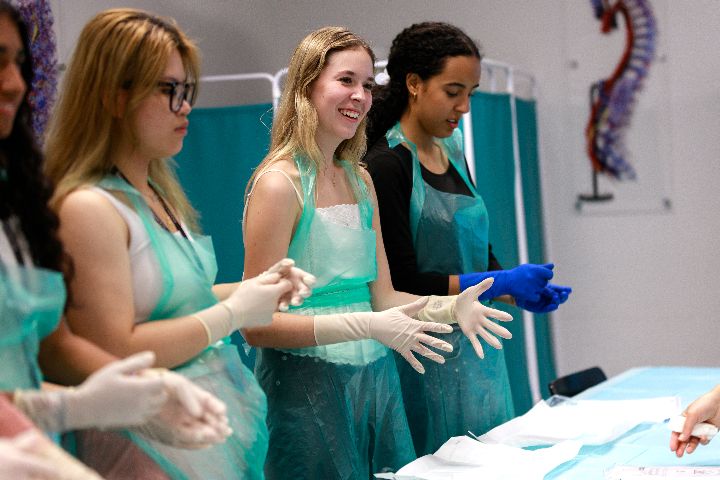
The courses are experiential and hands-on; you may find yourself conducting dissections in medicine, designing a robotic arm in engineering, participating in a moot court for law, or building creative writing portfolios and business case studies. By the end of the program, you’ll complete a personal project, receive written feedback, and a certificate of completion. You can find more details about the application here.
Why it stands out: You’ll study under expert academics, be guided daily by a university student mentor, complete a project you can show in future applications, and experience genuine university college life, with other campuses worldwide as alternatives.
3. Johns Hopkins Center for Talented Youth
Location: Multiple residential sites across the U.S.
Cost: Residential – varies by course and site; need-based financial aid is available; $15 application fee applies (waived for financial aid applicants)
Acceptance rate/cohort size: Highly selective; small class sizes
Dates: Term A: late June – Mid-July (3 weeks); Term B: mid-July – early August (3 weeks)
Application Deadline: Rolling; enroll by May 22nd for Session 1, by June 8th for Session 2
Eligibility: Students in grades 5-12 through age 17; qualifying scores on an approved standardized test (SAT, ACT, or grade-level tests for younger students) are required; open to international students
Johns Hopkins CTY is one of the most selective summer programs for 13 year olds, letting you choose from dozens of courses across mathematics, sciences, humanities, and writing. Each course is taught by instructors with advanced academic credentials and designed to move faster and deeper than a standard school curriculum. You live in residence halls with peer counselors who organize evening and weekend activities.
The program does not award grades, which reduces performance pressure and allows students to engage with challenging material without concern for their GPA. Multiple sites across the country offer students options in geography and course availability.
Why it stands out: Because admission is based on a standardized test score rather than a teacher’s recommendation or school reputation, students from any school background have the same access to CTY as students from well-funded ones.
4. Davidson Institute – Gifted Summer Programs
Location: University of Nevada, Reno, NV
Cost/Stipend: $1,550 for new DSP participants; $1,525 for returning DSP participants; financial aid is available
Acceptance rate/cohort size: Highly selective; limited capacity
Dates: Session 1 (Ages 8-11): June 14-18; Session 2 (Ages 8-11): June 21-25; Session 3 (Ages 11-13): July 5-9; Session 4 (Ages 11-13): July 12-16
Application Deadline: March 13th
Eligibility: 8-13-year-olds; U.S. citizens or permanent residents; accepted member of the Davidson Young Scholars program, which requires scoring in the 99.9th percentile or 145+ on approved intelligence/achievement tests; not open to international students
In this program, you take two college-level courses and can earn up to six transferable credits from UNR while living in campus housing alongside other participants. It covers a range of disciplines and is taught by university faculty; courses have included topics in mathematics, psychology, philosophy, and the sciences, with offerings varying by year.
The credit-bearing structure distinguishes it from most enrichment programs: you leave with a university transcript entry that reflects actual college-level coursework. Admission considers both test scores and the fit between a student’s interests and available course offerings. The Davidson Institute also offers separate residential programs.
Why it stands out: The six credits come from an accredited public research university, meaning they carry the same recognition as credits earned by any UNR undergraduate and transfer through standard college credit systems.
5. Brown University STEM for Rising 9th and 10th Graders

Location: Brown University campus, Providence, RI
Cost: $6,052; partner scholarships are available
Acceptance rate/cohort size: Selective; cohort size not specified
Dates: July 12-24
Application Deadline: May 15th
Eligibility: Students completing grades 8-9; ages 13-15 by June 14th; open to international students
Brown’s STEM 9/10 program places you on an Ivy League campus for 12 days of hands-on coursework in the STEM disciplines. Courses span biology, chemistry, engineering, and computational subjects, and each is assessed on a completion basis rather than by letter grade. You have opportunities to engage with Brown graduate students throughout the program, providing direct exposure to graduate-level research.
Every student who completes the program receives a Digital Certificate of Completion and a Course Performance Report. The program draws participants from across the U.S. and internationally, and the competitive admissions reflect Brown’s expectation that students arrive prepared for the coursework.
Why it stands out: Brown is the only Ivy League institution on this list with a pre-college STEM program explicitly open to students as young as 13.
6. COSMOS (California State Summer School for Mathematics and Science)
Location: Six UC campuses: UC Davis, UC Irvine, UCLA, UC Merced, UC San Diego, and UC Santa Cruz
Cost/Stipend: $5,518 tuition + $46 application fee; full and partial need-based scholarships are available
Acceptance rate/cohort size: Highly selective; 160-200 students per campus
Dates: July 5th – July 31st (UC Irvine, UC San Diego); July 5th – August 1st (UC Davis, UCLA, UC Merced, UC Santa Cruz)
Application Deadline: February 6th
Eligibility: California residents entering 9th – 12th grade; 8th-grade applicants must be academically advanced in STEM; not open to international students
In this program, you choose a cluster, a focused interdisciplinary topic such as robotics, marine biology, astrophysics, computational biology, or biomedical engineering, and spend the four weeks working within that cluster under instruction from UC faculty. The curriculum includes lectures, laboratory sessions, and a research project presented to faculty at the program’s conclusion.
COSMOS is one of the few summer programs for 13-year-olds structured as a formal state educational initiative rather than a fee-for-service enrichment program, which means the selection process prioritizes academic merit. Students who complete the program receive a certificate from the University of California system.
Why it stands out: No other public university system in the United States operates a four-week, multi-campus residential STEM program at this level for secondary students.
7. Northwestern Center for Talent Development
Location: Northwestern University, Evanston, IL
Cost/Stipend: $1,005-$6,105 (varies by course length and format); need-based financial aid is available
Acceptance rate/cohort size: Selective; small class sizes
Dates: Summer programs: June 28th – August 7th; residential programs run in fixed 3-week sessions within that window
Application Deadline: Open until full; tuition increases by $100 for all courses after May 31st
Eligibility: Students entering grades 6-12 in fall; must score in the top 5% or 10% on national tests (like MAP or STAR), take tests made for older students (like the SAT or ACT), or give a report card with a teacher recommendation; open to international students
For students entering grades 6 through 8, the Spectrum Summer residential program provides three-week sessions across a range of disciplines, from mathematics and science to writing and the social sciences. CTD’s three-week residential format creates a substantive on-campus academic community, and access to Northwestern’s facilities means students are working in the same buildings and laboratories as undergraduate researchers.
Students are admitted based on qualifying scores from a range of nationally normed assessments, making the process transparent and consistent. The program has operated for several decades at Northwestern and draws students from across the United States and internationally.
Why it stands out: CTD offers year-round academic programs beyond the summer residential session, allowing students to maintain a sustained academic relationship with Northwestern’s gifted education faculty well after the summer.
8. Duke Pre-College Programs
Location: Duke University campus, Durham, NC
Cost: $6,050 (residential); $3,950 (commuter); financial aid is available
Acceptance rate/cohort size: Selective; cohort size varies by specific course
Dates: Session 1: June 13-24; Session 2: June 28th – July 9th; Session 3: July 13-24
Application Deadline: Rolling; enrollment continues until individual courses reach capacity
Eligibility: At least 13 years old by session start date; completed at least one year of middle school; GPA of 3.0 or above; open to international students
Duke Pre-College Programs stand out among the various summer programs for 13 year olds because you choose a single course per session from subject areas including engineering, law, writing, business, health sciences, and the social sciences. You then spend two weeks working through that subject alongside a cohort of peers with similar academic interests.
Duke’s pre-college middle school track gives 13-year-olds structured exposure to discipline-specific content at a level of intellectual seriousness that most school curricula do not introduce until later in secondary school. Duke administers the program directly through its own offices, meaning the academic standards reflect the university’s broader institutional expectations. Students who complete the program receive a certificate of completion.
Why it stands out: The breadth of subjects at Duke, including law, business, and health sciences alongside STEM, makes it one of the only programs on this list suited to students whose strongest interests lie outside mathematics and the physical sciences.
9. University of Chicago Young Scholars Program
Location: University of Chicago, Chicago, IL
Cost: Sliding scale based on family income; ability to pay does not affect admissions decisions; scholarships and financial assistance are available for qualifying students
Acceptance rate/cohort size: Highly competitive; extremely limited cohort size
Dates: June 29th – July 24th
Application Deadline: April 10th
Eligibility: Mathematically talented students entering grades 7-12 (13-year-olds are placed in the 7th/8th grade cohort); open to international students
This program focuses on a single advanced topic, where you work through a curriculum that extends well beyond standard school mathematics, engaging with proofs, abstract reasoning, and open mathematical questions under the guidance of instructors who hold advanced degrees in the field. YSP does not use grades, reflecting the University of Chicago’s broader educational philosophy and creating an environment where mathematical exploration takes precedence over performance.
Students come from a range of grade levels, and the selective admissions process emphasizes mathematical enthusiasm and aptitude rather than prior coursework. Since the program runs as a day camp, it is primarily accessible to students who can commute to the Hyde Park campus or arrange accommodation locally.
Why it stands out: The University of Chicago’s Department of Mathematics consistently ranks among the top three in the United States, which means YSP connects students directly with the mathematical culture of one of the world’s leading research environments.
10. Vanderbilt Summer Academy
Location: Vanderbilt University, Nashville, TN
Cost/Stipend: $2,150 + $50 application fee; need-based financial assistance and monthly payment plans are available
Acceptance rate/cohort size: Highly selective; small classes
Dates: Session 1: June 7-12; Session 2: June 14-19 (for rising 7th and 8th grade students)
Application Deadline: Rolling until full
Eligibility: Rising 7th – 8th grade students; test scores at or above the 90th percentile on a nationally normed assessment (ACT, SAT, PSAT, MAP/NWEA, ITBS, ERB, CogAT, or similar); strong academic record in advanced courses also considered; open to international students
Vanderbilt Summer Academy is administered by Vanderbilt University’s Programs for Talented Youth and places gifted middle school students on campus for a one-week residential experience. Students choose from courses in the humanities, social sciences, and STEM disciplines, taught by educators trained in gifted pedagogy. The program includes on-campus housing, access to campus dining, and organized evening activities throughout the week.
The 90th-percentile admissions threshold means the student cohort is consistently composed of high-achieving peers, which shapes the intellectual dynamic both inside and outside the classroom. Vanderbilt’s Programs for Talented Youth has operated for several decades and draws on the Johns Hopkins-developed talent-identification model that also underpins CTY.
Why it stands out: At one week, VSA is a short residential program, making it a lower-commitment entry point for students who want to experience a research university campus before committing to a longer program.
11. UC Berkeley ATDP – Secondary Division

Location: UC Berkeley campus for in-person courses, with a remote option offered live online via Zoom
Cost/Stipend: $60 application fee for domestic students ($90 for students attending school outside the U.S.), plus course tuition ranging from $790 to $1,320; need-based financial aid available, and a $40 sibling tuition discount per student
Acceptance rate/cohort size: Selective; 20-24 students
Dates: June 22nd – July 31st
Application Deadline: May 29th
Eligibility: Students currently in Grades 7 through 11; some courses carry academic prerequisites; current 6th graders who previously attended ATDP may apply for a small selection of courses with a very strong application; open to international students
In this program, you join a six-week academic program at UC Berkeley where you immerse yourself in a single subject, choosing from over 40 accelerated and enrichment courses in areas such as mathematics, writing and literature, computer science, and social sciences. You complete honors- or AP-level coursework, attend highly interactive class sessions held in person or live online, and spend roughly three to ten hours preparing for each class meeting.
You can pursue topics like precalculus, biotechnology, law, or literary analysis, building strong analytical, writing, and quantitative skills through deep single-subject study. Small classes and a low teacher-to-student ratio support you, and many courses count toward UC and CSU college entrance requirements.
Why it stands out: It lets academically advanced students as young as Grade 7 pursue honors-level, college-preparatory coursework taught at what most schools would list as honors level on the UC Berkeley campus, with many courses counting toward UC and CSU college entrance requirements.
12. VAMPY (Verbally and Mathematically Precocious Youth) at Western Kentucky University
Location: Western Kentucky University, Bowling Green, KY
Cost/Stipend: $4,200; need-based financial aid available
Acceptance rate/cohort size: Selective; capped at 16 students
Dates: June 21st – July 11th
Application Deadline: Rolling basis
Eligibility: Students completing grades 7-10; qualifying ACT or SAT scores as a 7th grader (or adjusted equivalents for students in older grades); open to international students
In this program, you choose from advanced courses across disciplines, including mathematics, science, literature, and law, with the program’s name reflecting its dual emphasis on verbal and mathematical reasoning. Having run continuously since 1984, VAMPY has a track record and an alumni community that few residential programs for this age group can match.
The three-week duration is long enough for students to form substantive peer relationships in a structured campus environment. Admission operates on an out-of-level testing model, similar to the Johns Hopkins Talent Search framework, meaning 7th-grade applicants take a test designed for older students to measure their academic ceiling.
Why it stands out: VAMPY’s dual emphasis on verbal and mathematical reasoning makes it one of the few programs on this list suited to students whose academic strengths span the humanities and mathematics rather than being concentrated in one area.
13. William & Mary Camp Launch
Location: William & Mary, Williamsburg, VA
Cost: None
Acceptance rate/cohort size: Selective; approximately 300 students total across all four grade levels
Dates: Two-week residential program, typically held in mid-to-late July
Application Deadline: Typical, early Spring (February/March)
Eligibility: Rising 7th – 10th grade students; family income at or below 185% of the US HHS Poverty Guidelines; 90th percentile or above on at least one standardized test subscale, or a recommendation supported by documented evidence of high academic performance; not open to international students
In this program, you take courses in STEM, writing, and personal and professional development, all delivered by educators with expertise in gifted pedagogy. It is one of the few free residential summer programs at a competitive research university that specifically targets students at the intersection of academic giftedness and demonstrated financial need.
William & Mary’s Center for Gifted Education has conducted research in gifted education for several decades, and the program reflects that institutional expertise in its curriculum design and teaching approach. Eligibility requires documentation of family income and either qualifying standardized test scores or a recommendation backed by specific academic evidence.
Why it stands out: The income threshold at 185% of federal poverty guidelines extends eligibility well beyond the lowest income brackets, making Camp Launch accessible to a broader range of working and middle-income families.
14. Belin-Blank Center – Blank Summer Institute for Arts & Sciences (BSI)
Location: University of Iowa campus, Iowa City, Iowa (residential, with housing in a residence hall near the Blank Honors Center)
Cost/Stipend: $400 program fee after a $900 Blank Scholarship is applied to the $1,300 total cost; additional financial aid is available and may cover up to 50% of the remaining cost
Acceptance rate/cohort size: Selective; exact overall cohort number is not published
Dates: June 14-19; June 21-26
Application Deadline: February 2nd
Eligibility: Current 7th- and 8th-grade students enrolled in Iowa; nominated by a school official; demonstrated high motivation, task commitment, and emotional maturity; first preference offered to students who have not previously attended; not open to international students
In this program, you spend one residential week on the University of Iowa campus immersed in a single advanced class chosen from disciplines spanning STEM, the arts, and creative writing. Depending on your course, you might run chemistry, biology, and physics labs, solve real-world data problems in Math Problem Solving, use computer-aided design and 3D printing in Engineering, or explore typography, digital illustration, and video production in Graphic Arts & Design.
Field Science students gather temperature, rainfall, wind, and soil-moisture readings with real sensors, while arts and writing students develop studio work, playwriting, and multi-genre pieces. Evenings add seminars, field trips, and recreational activities with intellectually similar peers.
Why it stands out: It is a highly selective, nomination-only residential institute where some of Iowa’s most talented middle schoolers spend a full week studying one subject in depth at a major university, with most of the cost covered by a $900 scholarship.
15. Texas State Mathworks Junior Summer Math Camp
Location: Texas State University, San Marcos, TX
Cost/Stipend: $2,200; need-based scholarships are available
Acceptance rate/cohort size: Selective; approximately 76 students
Dates: June 7-19
Application Deadline: Rolling admissions until the program fills
Eligibility: Students currently enrolled in grades 6-8; open to international students
For students who want summer programs for 13 year olds focused on advanced mathematics, Texas State Mathworks runs the Junior Summer Math Camp, a two-week residential program for middle school students at Texas State University. Instruction is led by university faculty and covers advanced topics including counting principles, number theory, combinatorics, advanced geometry, probability, and algebraic problem-solving.
The curriculum is structured to develop critical thinking through mathematical ideas that go substantially beyond what middle school students encounter in a standard school curriculum. Texas State Mathworks also runs a separate Honors Summer Math Camp for high school students, and participation in the Junior program can serve as a pathway into that more advanced camp in subsequent years.
Why it stands out: Texas State Mathworks functions as both a summer camp and a mathematics education research center, meaning the curriculum reflects ongoing academic work in how middle school students learn mathematics rather than a generic enrichment format.
Move From Middle School Curiosity to Academic Direction
At 13, you can start turning curiosity into direction by testing new subjects, routines, and learning environments beyond school.
Through these summer programs for 13 year olds, you can explore advanced academics, meet motivated peers, and build confidence in age-appropriate settings.
These experiences help you notice what excites you, strengthen study habits, complete projects, and make future academic choices with clearer purpose.
To keep moving forward, use our University Preparation blogs for guidance on subject planning, applications, study strategies, and long-term academic readiness.