
 Русский (RU)
 Українська (UK)
 Türkçe (TR)
 Italiano (IT)
 Français (FR)
 Português (PT)
 中文 (中国) (ZH)
 Español (ES)
 日本語 (JA)
 ไทย (TH)
 Deutsch (DE)
 Ελληνικά (EL)
 Polski (PL)
 Bahasa Indonesia (ID)
 Nederlands (NL)
 العربية (AR)
 한국어 (KO)

In high school, STEM can start to feel like a loop: solve the problem set, run the lab experiment, take the test, move to the next unit. Free STEM internships for high school students can help bridge the gap between classroom learning and real-world application, giving you a clearer sense of how scientific concepts are used in meaningful work.
Imagine spending your summer processing water samples alongside a fisheries biologist or working in a federal lab analysing satellite data for a NASA research project. You could be inside the Broad Institute in Cambridge, contributing to original genomics research, or building out a radar physics project at Georgia Tech’s research campus. These experiences make hands-on STEM access possible, often with a paid stipend and without requiring you to pay tuition or travel far from home.
What kinds of free STEM internships are available for high school students?
Finding a genuinely worthwhile STEM internship as a high school student takes some digging. A lot of programs that come up in a basic search aren’t real research; they’re observation-based, or they’re expensive summer programs with “internship” somewhere in the name. The ones that actually move the needle involve working on a real project, being mentored by a professional in the field, and having something concrete to show for it at the end.
Federal agencies, national laboratories, and university research institutes tend to offer the strongest options. You might work at a U.S. Army research lab on cybersecurity, biology, or materials science. You might spend the summer at the National Library of Medicine doing computational biology, or at Oak Ridge National Laboratory alongside ORNL scientists.
To help you cut through the noise, we’ve put together a list of 15 free STEM internships for high school students.
For adjacent opportunities, have a look at the online biology program, the online chemistry program, and the online computer science program.
Key takeaways
- The NIH Summer Internship Program pays $2,530 for pre-graduation participants or $2,840 for post-graduation participants over an eight week placement at NIH campuses, primarily in Bethesda, Maryland.
- Immerse Education’s Engineering Summer Internship runs two weeks across locations including Sydney, Singapore, Tokyo, and London, with age-specific curricula for students aged 13 to 15 and 16 to 18.
- The Smithsonian NMNH High School Internship Program offers a $5,600 stipend, among the highest of any listed program, for eight weeks of work at the National Museum of Natural History.
- NIST’s Summer High School Internship Program is unpaid but free, requiring participants to live within 50 miles of the Gaithersburg or Boulder campus and hold a minimum 3.0 unweighted GPA.
- The Broad Summer Scholars Program pays a $3,600 stipend for six weeks of original genomics research, restricted to rising seniors within commuting distance of the Broad Institute in Cambridge.
- The Hutton Junior Fisheries Biology Program pays $3,000 and places students locally with a fisheries professional, making it accessible without requiring relocation, across all 50 states, Canada, Mexico, Puerto Rico, and the Pacific Islands.
- The AMNH Science Research Mentoring Program runs a full academic year from August through June and pays a $2,500 stipend for original research alongside museum scientists.
- Nearly every free STEM internship in this list requires US citizenship or permanent residency, with Immerse Education’s Engineering Summer Internship standing out as the primary option open to international students.
15 Free STEM Internships for High School Students
1. NIH Summer Internship Program (SIP)
Location: Multiple NIH campuses; primarily Bethesda, MD
Stipend: $2,530 (pre-graduation); $2,840 (post-graduation)
Dates: 8 weeks full-time during the summer (typically mid-May through August)
Application Deadline: Mid-February
Eligibility: U.S. citizens or permanent residents; enrolled at least half-time as a high school senior at the time of application; must have graduated from high school before the internship begins; must be 18 by September 30th of the program year; not open to international students
The NIH Summer Internship Program places high school seniors inside one of the country’s most respected biomedical research institutions for a full summer. You’ll work in a research group led by a Principal Investigator, contributing to projects across biology, chemistry, engineering, epidemiology, computer science, bioinformatics, mathematics, and more.
The summer closes with two standout events: a Graduate and Professional School Fair and NIH-wide Summer Poster Day in August, where you present your research to the broader scientific community.
Why it stands out: You’ll do real research at one of the world’s leading biomedical institutions with professional development resources most high school students won’t encounter until graduate school.
2. Immerse Education’s Engineering Summer School

Location: Cambridge, Oxford, London, Singapore, Sydney, Tokyo,and Toronto
Cost: Varies; summer school scholarship available through our bursary programme
Application Deadline: Multiple cohorts with rolling admissions
Program Dates: 2 weeks during the summer
Eligibility: Students around the world aged 13-18 currently enrolled in middle or high school
The Academic Insights Engineering Summer School is a structured way to learn about university-level engineering from top professors at schools like Oxford and Cambridge. The program combines theory with hands-on learning in small classes with an average of 7 students. The course teaches students aged 13 to 15 the basics of mechanics, forces, materials, and basic electronics. You learn how engineers solve problems through guided workshops and design tasks. For students ages 16 to 18, the curriculum moves on to mechanical systems, electrical circuits, sustainability, and applied engineering design.
You work on more independent projects and look at real engineering problems, which helps develop the reasoning skills expected of college students. Learning includes university-style lectures, problem-solving sessions, weekly one-on-one tutorials, and a personal engineering project that ends with written feedback and a certificate.
Why it stands out: Age-specific syllabi tailored to students’ academic stages, expert tutors from leading universities, small-group teaching that encourages discussion, and personalised feedback that supports meaningful academic growth and university readiness.
3. NIST Summer High School Internship Program (SHIP)
Location: NIST campus in Gaithersburg, MD or Boulder, CO
Stipend: None
Dates: June 22nd – August 7th
Application Deadline: January 26th
Eligibility: U.S. citizens; current high school junior or senior; minimum unweighted GPA of 3.0; must live within a 50-mile radius of NIST Gaithersburg or NIST Boulder; not open to international students
NIST SHIP is a seven-week research internship at the National Institute of Standards and Technology, one of the federal government’s leading physical science laboratories. You’ll be assigned your own research project and work directly with NIST scientists and engineers; this isn’t observation, it’s original scientific work.
Research spans a wide range of disciplines, and useful but not required skills include Python, physics, chemistry, electronics, and math. The program is unpaid, but entirely free, and gives juniors and seniors access to federal research infrastructure.
Why it stands out: You get project-based research inside a federal science lab, your own assigned work, not just shadowing.
4. STEM Enhancement in Earth Science (SEES)
Location: Remote; on-site at the University of Texas at Austin and virtual symposium
Stipend: None
Dates: Distance Learning Modules: May 15th – July; Virtual Project Work: June – July 21st; On-site Internship: July 5-18; Virtual Science Symposium: July 20-21
Application Deadline: February 22nd
Eligibility: U.S. citizens; at least 16 years of age by July 1st; current high school sophomores or juniors (10th or 11th grade); strong academic record (typically a minimum 3.0 GPA); not open to international students
SEES runs in two phases: you start remotely in June, completing Earth and space science learning modules and connecting with project mentors online, then travel to UT Austin for two weeks of in-person research in mid-July.
You’ll work alongside NASA subject matter experts on mission-based projects in aerospace, astronomy, planetary science, remote sensing, and space geodetic techniques, building skills in data analysis, engineering design, and systems modeling. All interns present their findings at the SEES Virtual Science Symposium in late July.
Why it stands out: You’ll do authentic NASA research and have earlier access to space science.
5. Broad Summer Scholars Program (BSSP)
Location: Broad Institute, Cambridge, MA
Stipend: $3,600
Dates: June 29th – August 7th
Application Deadline: January 21st
Eligibility: Rising high school seniors; must attend a Massachusetts high school within commuting distance of the Broad; minimum B in science and math; U.S. citizens, permanent residents, or non-U.S. citizens with employment authorization; not open to international students without U.S. work authorization
The Broad Summer Scholars Program pairs rising seniors with Broad Institute scientists for six weeks of original research at one of the world’s leading genomics institutions. You’ll work on a real research project in areas like cancer biology, computational biology, infectious disease, psychiatric disease, or chemical biology, matched to a scientist based on your interests.
Beyond the lab, you’ll attend scientific talks, receive training in poster creation and presentation, and close the program with a poster session in front of the Broad community, plus a college fair and social events.
Why it stands out: The stipend, no-cost attendance, and one-on-one scientist mentorship make it one of the most financially accessible and research-rigorous high school programs in the country.
6. Joint BioEnergy Institute (JBEI)
Location: Emeryville, CA
Stipend: $3,000
Dates: Prep week June 8-12 (virtual); in-person June 20th – August 1st
Application Deadline: Mid-March
Eligibility: Current high school sophomores or juniors; 16 years old by June 15th; resident of Alameda, Contra Costa, or San Francisco County; annual household income below area thresholds; GPA of at least 2.5 with Algebra 1 and Biology completed; U.S. citizens or permanent residents; not open to international students
If you’re a Bay Area sophomore or junior whose household meets the income eligibility criteria, iCLEM is a strong option for real lab experience over the summer. You’ll complete a hands-on research project in JBEI’s laboratories, mentored by researchers and UC undergraduates, covering microbiology, molecular biology, biochemistry, biofuels, and synthetic biology.
The program also includes career exploration sessions with STEM professionals, visits to local biotech and pharmaceutical companies, and dedicated time to work on your college personal statement and learn about financial aid.
Why it stands out: It’s one of the few paid lab programs built specifically for students from economically disadvantaged backgrounds, with scientific mentorship and college prep support combined.
7. Hutton Junior Fisheries Biology Program
Location: All 50 states, Canada, Mexico, Puerto Rico, and the Pacific Islands
Stipend: $3,000
Dates: June through August (flexible, 8 weeks)
Application Deadline: January 25th
Eligibility: Rising high school seniors or rising college freshmen; must be 16 years old by the internship start date; not open to international students
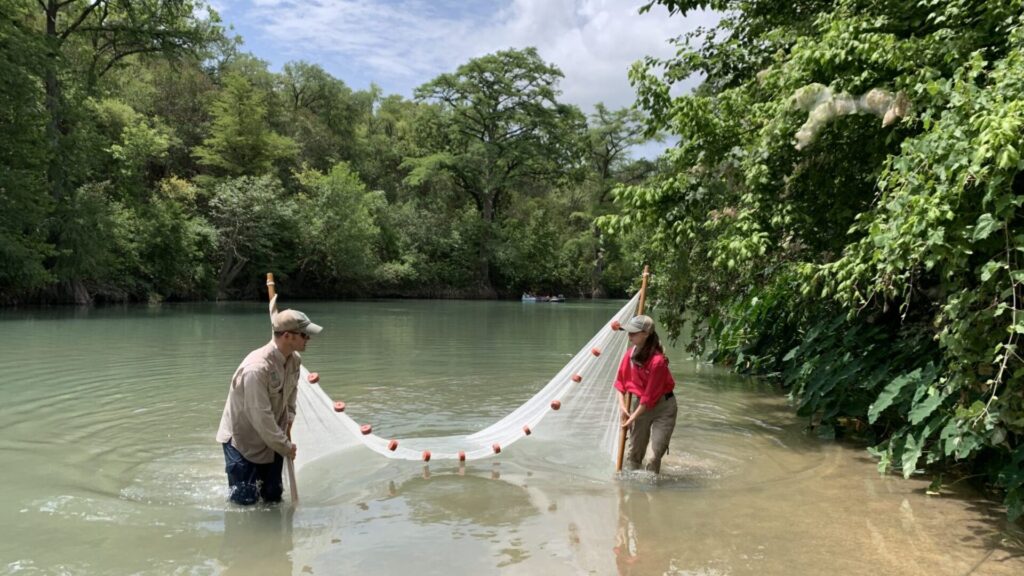
If you’re curious about aquatic science, conservation, or environmental research, the Hutton Program is one of the most accessible paid internships out there. You’ll be matched with a fisheries professional near your home and spend eight weeks doing real fieldwork alongside them.
Activities range from fish population surveys and electrofishing to water quality testing and data processing, depending on where your mentor works. Some projects include overnight or multi-day field trips. Since mentors work across government agencies, research institutions, and conservation organizations, no two Hutton experiences look the same.
Why it stands out: The locally placed mentorship model means you get a paid, hands-on research internship without having to relocate.
8. NLM Data Science & Informatics (DSI) Scholars Program
Location: NIH main campus, Bethesda, MD
Stipend: Paid, amount not disclosed
Dates: Starts in June; runs 8-12 weeks
Application Deadline: Rolling from mid-January; closes mid-to-late February
Eligibility: U.S. citizens or permanent residents; enrolled at least half-time as a high school senior; at least 18 years old by the internship start date; GPA of 3.2 or higher; completed coursework in computer science, data science, informatics, or mathematics; not open to international students
The NLM DSI Scholars Program is a full-time summer research internship at the National Library of Medicine for students with a background in data science or computational methods who want to apply those skills to biology and health.
You’ll be paired one-on-one with a research mentor and spend 8 to 12 weeks contributing to computational projects in the biological sciences. The program includes seminars and workshops, and closes with presentations at both the NLM Summer Poster Day and NIH-wide Summer Poster Day.
Why it stands out: It’s one of the only federally-funded data science internships that includes high school seniors, making it a strong fit if you’re interested in health informatics or computational biology.
9. Smithsonian NMNH High School Internship Program
Location: National Museum of Natural History, Washington, DC
Stipend: $5,600
Dates: June 23rd – August 14th
Application Deadline: March 20th
Eligibility: Currently enrolled in grades 9-12, ages 15-18 at start of internship; must read, write, and converse fluently in English; must be within commuting distance of NMNH; US citizens or permanent residents; not open to international students
The Smithsonian NMNH internship places you inside one of the country’s most well-known natural history institutions for eight weeks, working directly with museum staff on active projects. Project areas include botany, paleobiology, science education, anthropology, and science communications; you’re matched with a specific department based on availability and interest.
Science-track interns could find themselves mapping plant specimen data for conservation assessments, using scanning electron microscopes to image ancient foraminifera, or preparing paleontological samples for microscope analysis. Enrichment days include field trips, behind-the-scenes tours, and sessions on public engagement and job-skill preparation.
Why it stands out: The $5,600 stipend is among the highest for any high school internship, and the access to Smithsonian scientists and collections is genuinely rare.
10. Fermilab Program for Research, Innovation, and STEM Mentorship (PRISM)
Location: Batavia, IL
Stipend: $500 per week
Dates: July 13th – August 7th
Application Deadline: March 1st
Eligibility: U.S. citizens; current high school seniors or current high school graduates; enrolled in an Illinois high school; proof of medical insurance required; not open to international students
The Fermilab PRISM program is a paid summer experience at one of the country’s leading particle physics laboratories, open to Illinois high school seniors and recent graduates. Each week is built around a different scientific theme like particle physics, quantum science, engineering design, and artificial intelligence, explored through hands-on activities, expert-led lectures, and tours of Fermilab’s research facilities.
You’ll engage with Fermilab STEM professionals through mentorship and professional development, and wrap up the program with a research abstract, poster, and final presentation.
Why it stands out: Four weeks, four scientific fields; it’s one of the few programs that gives you structured exposure to particle physics, AI, quantum science, and engineering all in a single summer.
11. Carnegie Mellon University’s Summer Academy for Math and Science (SAMS) Pre-College Program
Location: Carnegie Mellon University, Pittsburgh, PA
Cost/Stipend: None
Acceptance rate/cohort size: Selective
Dates: June 20th – August 1st
Application Deadline: February 1st
Eligibility: 11th-grade students at the time of application;16 years old; U.S. citizen or permanent resident
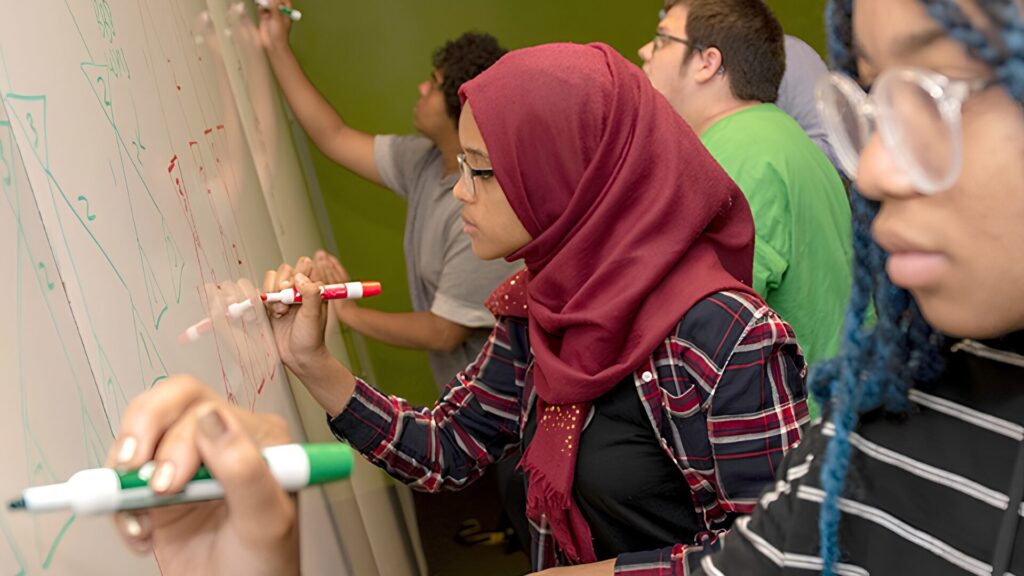
The Summer Academy for Math and Science is a multi-phase pre-college program where you build STEM skills through coursework, projects, and mentorship from Carnegie Mellon faculty.
You begin with a virtual “jumpstart” focused on foundational skill-building, followed by a six-week in-person session with full-day classes, workshops, and collaborative projects. During the residential phase, you work on hands-on assignments and team-based projects that apply concepts from math, science, and engineering. You also engage with faculty, graduate mentors, and peers while developing problem-solving and academic skills in a structured environment. The program concludes with a symposium where you present your project work.
Why it stands out: Combines preparatory virtual training with an intensive in-person experience, making the transition into rigorous STEM coursework more structured and supportive.
12. STEM@GTRI High School Summer Internship
Location: Atlanta, GA
Stipend: Paid hourly, rate not disclosed
Dates: June 8th – July 17th
Application Deadline: January 18th
Eligibility: Georgia residents attending a public, private, charter, or home school in Georgia; graduating in the program year or the next two years; at least 16 years old by the application deadline; hold U.S. citizenship or U.S. Person status; not open to international students
As one of the more engineering-focused free STEM internships for high school students, the STEM@GTRI program places you inside Georgia Tech Research Institute laboratories for five weeks of hands-on science and engineering work. You’ll be paired directly with GTRI researchers and Georgia Tech students, contributing to projects in areas like piezoelectric systems, rapid prototyping, robotics, drones, and radar physics.
Tasks could range from building educational kiosks to developing piezoelectric tiles for energy generation. You’ll work up to 24 hours per week within standard business hours, with an all-day orientation at the start and a final project presentation at the end. Lab tours and training sessions are built into the experience.
Why it stands out: You’ll do real engineering research inside one of the country’s leading applied research institutes, working directly alongside GTRI scientists and Georgia Tech students.
13. Berkeley Lab Experiences in Research (EinR)
Location: Berkeley, CA
Stipend: $500 per week
Dates: June 15th – July 24th
Application Deadline: March 22nd
Eligibility: Current 10th, 11th, or 12th grade student enrolled in a Northern California high school; at least 16 years old by June 15th; some experience with independent work; not open to international students
Berkeley Lab’s Experiences in Research program connects Northern California high school students with professionals at Lawrence Berkeley National Laboratory for six weeks of paid, project-based work. You’ll indicate your interests during the application process and be matched to a project in one of four areas: administration and communication, coding-dependent work, data science, or experimental research and data collection.
Students within 20 miles of the Berkeley or Emeryville campus should apply to hybrid or in-person projects; those further away should prioritize virtual. Former interns are not eligible to reapply.
Why it stands out: The ability to express project preferences in the application across a genuinely wide range of STEM fields means you can shape your internship experience from the start.
14. AMNH Science Research Mentoring Program (SRMP)
Location: American Museum of Natural History, New York City
Stipend: $2,500
Dates: August – June
Application Deadline: March 1st
Eligibility: Must live and attend school in New York City; currently in 10th or 11th grade; passing all classes for the last three or more semesters; must have completed or be enrolled in a qualifying AMNH program (AIS, SNP, EAP, LANG, SAP, or HE³AT), OR attend a partner school; not open to international students
The AMNH Science Research Mentoring Program is a year-long paid research experience where NYC high school students work with Museum scientists on original projects that genuinely haven’t been done before. You’ll be contributing to research that has covered topics from the genetic basis of foraging in spiders to how we determine stellar mass using space-based telescope data, to studying what the ancient Maya ate.
No prior research experience is expected; the program builds those skills together, including DNA lab techniques, data analysis, Python and R coding, scientific writing, and presentation skills.
Why it stands out: A full academic year of original, never-before-done research with a Museum scientist and optional college credit is a combination you won’t find in many high school programs.
15. Oak Ridge National Laboratory – Next Generation STEM Internships (NGSI) Program
Location: Oak Ridge, TN
Stipend: $500 per week
Dates: Summer and spring cohorts are available
Application Deadline: Summer: Late February; Spring: Late October
Eligibility: U.S. citizens or legal permanent residents; rising juniors or seniors, or recent high school graduates (within two years, not yet enrolled in college) from an accredited high school or home school in Anderson, Blount, Campbell, Knox, Loudon, Morgan, Roane, or Sevier County, TN; minimum GPA of 3.0; at least 16 years old; not open to international students
The NGSI program gives you direct access to Oak Ridge National Laboratory, one of the Department of Energy’s largest science and energy research institutions. You’ll work on real STEM projects with ORNL researchers and professional staff, with summer participation running full-time from early June through late July.
Beyond your core project, the program offers optional professional development, including workshops, lab tours, lectures, poster sessions, seminars, and networking opportunities with scientists and engineers from around the country. Spring and fall appointments run part-time and virtually, making it one of the few programs that extend beyond the summer.
Why it stands out: Students in eligible Tennessee counties get a rare, stipend-paid entry point into a world-class national research laboratory with both summer and school-year participation options.
Frequently asked questions: Free STEM internships for high school students
Are free STEM internships for high school students open to international students?
Almost all of the free or stipend-paid STEM internships listed here are restricted to US citizens or permanent residents, including the NIH Summer Internship Program, NIST SHIP, and the Smithsonian NMNH internship. If you’re an international student, Immerse Education’s Engineering Summer Internship is a notable exception, welcoming students worldwide aged 13 to 18 across locations including Sydney, Singapore, Tokyo, and London, with bursary support available.
Which free STEM internships actually pay a stipend?
Many of the internships on this list combine free participation with a paid stipend. The Smithsonian NMNH internship offers $5,600, the Broad Summer Scholars Program and Hutton Junior Fisheries Biology Program both pay $3,000 or more, and Berkeley Lab’s Experiences in Research and Oak Ridge’s NGSI program each pay $500 per week. A few programs, like NIST SHIP and SEES, are unpaid but remain free to attend, so check each listing to understand what “free” means for that specific program.
How selective are free STEM internships for high school students?
Selectivity varies widely. Highly funded research placements like the Broad Summer Scholars Program and Berkeley Lab’s EinR are very competitive, admitting small cohorts through detailed applications. Others, like NIST SHIP, are free and less about stipend size, making them somewhat more attainable if you meet the residency and GPA requirements. Regardless of selectivity, meeting every eligibility detail, including residency radius and required coursework, matters significantly for these programs.
Do free STEM internships require you to live near the host institution?
Many do, since several of these programs are tied to a specific federal lab or research campus. NIST SHIP requires living within 50 miles of Gaithersburg or Boulder, and the Broad Summer Scholars Program requires commuting distance from Cambridge, Massachusetts. Exceptions exist, like the Hutton Junior Fisheries Biology Program, which matches you with a mentor near your own home anywhere in the covered regions, or NIH’s SIP, which houses participants for the summer regardless of home location.
What kind of research do you actually do in a free STEM internship?
The nature of the work depends heavily on the host institution, but most of these programs place you in an active, ongoing project rather than a classroom setting. NIH SIP interns join a Principal Investigator’s research group across fields like bioinformatics and epidemiology, while SEES interns work on NASA mission-based projects in aerospace and planetary science. Fermilab’s PRISM program rotates through a different scientific theme each week, covering particle physics, quantum science, and AI. Nearly all programs conclude with a poster session or final presentation.
When should you apply for a free STEM internship?
Deadlines vary considerably, so starting your research in the fall or early winter is wise. The Hutton Junior Fisheries Biology Program closes January 25, the Broad Summer Scholars Program closes January 21, and NIH’s SIP deadline falls in mid-February. Because free and stipend-paid programs tend to be competitive, submitting a complete, polished application well before the deadline can matter more than for less selective options.
From Scientific Curiosity To University Direction
Real STEM experience gives you more than subject knowledge. It helps you test your interests, build confidence, and understand how research happens.
The 15 free STEM internships for high school students listed here show routes through biomedical science, data, engineering, conservation, space research, and national laboratories.
With lab work, field research, coding, mentorship, and poster presentations, these experiences can give you stronger material for future academic planning.
Ready to turn that experience into a stronger application? Explore our University Preparation blogs for study advice, application tips, and next steps.