

 Русский (RU)
 Українська (UK)
 Türkçe (TR)
 Italiano (IT)
 Français (FR)
 Português (PT)
 中文 (中国) (ZH)
 Español (ES)
 日本語 (JA)
 ไทย (TH)
 Deutsch (DE)
 Ελληνικά (EL)
 Polski (PL)
 Bahasa Indonesia (ID)
 Nederlands (NL)
 العربية (AR)
 한국어 (KO)
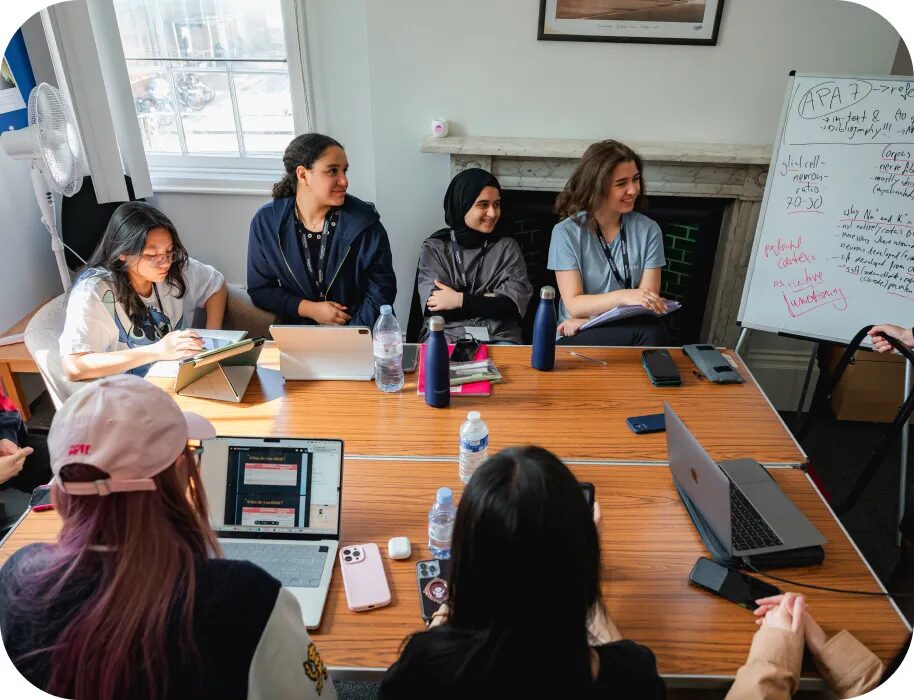
In a lively summer classroom, one participant might be asking why people behave the way they do, while another is analysing research methods. The right psychology school age range helps both learn at the right level.
At Immerse Education, Psychology programmes are generally available for ages 13 to 18, with the 13-15 age group focusing on foundations and guided exploration, while the 16-18 age group takes a more advanced, pre-university approach.
In this article, we’ll explore the Psychology pathways available, including in-person, online, and accredited online study, before explaining which age groups can access each.
Let’s begin with the age range.
Key Takeaways
- Immerse Education’s Psychology summer school options are generally available for learners aged 13-18, with the right programme depending on age, location, pathway, and study format.
- Residential Psychology programmes are available for ages 13-15 in Cambridge and Sydney, giving younger learners access to a guided introduction to the subject.
- Residential Psychology programmes are available for ages 15-18 in London, Sydney, Tokyo, and Toronto, while ages 16-18 can study Psychology in Cambridge, Oxford, Singapore, and Sydney.
- Online Psychology study is available for ages 13-18, offering a flexible way to explore the subject from home.
- Learners aged 14+ can upgrade to an accredited online Psychology programme, giving them access to a more formal academic pathway.
- The 13-15 syllabus focuses on foundations such as child, clinical, developmental, and experimental psychology, while the 16-18 syllabus moves into more advanced topics such as the brain, decision-making, behavioural genetics, cognitive psychology, animal psychology, and psychopathology.
Psychology Summer School Age Range Overview
Our Psychology summer school programmes are designed for participants aged 13-18. However, the right option depends on age, academic stage, location, and study format.
Here are the different age groups at Immerse, and how each one shapes the Psychology learning experience.
Residential Programme
- Ages 13-15: This age group focuses on foundations and guided exploration, helping younger participants understand what psychology is, how behaviour is studied, and how areas such as child, developmental, clinical, and experimental psychology connect.
- Ages 15-18: Some residential locations are available for this wider high-school age range, giving participants access to Psychology study when they are ready for more independent academic discussion.
- Ages 16-18: This age group takes a more advanced pre-university approach, with participants exploring topics such as the brain, reasoning and decision-making, stereotypes, behavioural genetics, cognitive psychology, animal psychology, and psychopathology.
Online Programme
- Ages 13-18: Our online Psychology option is available for participants across this full age range, offering flexible academic study from home.
- Ages 14+ accredited option: Online participants aged 14 and above can upgrade to an accredited programme, giving them the opportunity to complete a more formal academic pathway with additional recognition for their work.
Psychology
In-person
Uncover the complexities of human behaviour in Cambridge,...

Psychology
In-person
Explore psychology in Sydney through university-style learning. Develop...

What Psychology Pathways Are Available?
At Immerse, Psychology is not limited to one type of programme. Instead, participants can choose a pathway based on their age, academic goals, preferred learning style, and study format.
Here are the different pathways available for Psychology at Immerse.
1. In-Person Academic Insights
Our Academic Insights pathway is our flagship residential summer programme for ambitious high-school participants aged 13-18 who want a clearer sense of university-level study before they apply.
Across two weeks, participants study undergraduate-level subjects in small classes of up to 12. These sessions are taught by expert academics from world-leading universities.
In Psychology, this means exploring the human mind and behaviour through cognitive psychology, behavioural studies, psychological theories, case studies, experiments, and interactive academic sessions. The experience also supports skills that matter beyond the subject, including analytical thinking, research confidence, communication, and critical reasoning.
It is designed for participants who want academic challenge, expert guidance, and an immersive introduction to university-level Psychology. This gives them a clearer sense of how the subject feels in practice.
2. Online Psychology Programmes
For participants who want to study Psychology without travelling, the online pathway offers a flexible way to explore the subject from home while still receiving structured academic guidance.
It is available for ages 13-18 and focuses on helping participants investigate the human mind, behaviour, cognition, social dynamics, and psychological theory through a research-led format.
The Psychology Online Research Programme includes dedicated subject tutoring in psychological principles and research methodologies, with the opportunity to complete an independent research project.
Participants can study through one-to-one tutorials or group lessons, with a programme structure of around 10-15 hours. It also supports academic skills such as critical thinking, communication, problem-solving, academic writing, referencing, and argumentation.
3. Accredited Online Psychology Programmes
For participants who want formal recognition alongside their Psychology research, our accredited online pathway provides a more structured option. It builds on the Online Research Programme with a clearer academic framework.
This option is available to participants aged 14-18, and participants must be 14 or over to enrol on our accredited online research programmes.
The accredited route includes one-to-one tutoring, advanced subject study, and personal research project development over 15 hours. Participants can choose the UK accredited option, which awards eight UCAS points, or the USA accredited option, which awards three college credits through our partner organisation.
In Psychology, this gives participants the chance to develop research, writing, referencing, and critical thinking skills while working closely with a specialist tutor from Oxford, Cambridge, or an Ivy League university.
Join the Immerse Education 2025 Essay Competition
Follow the instructions to write and submit your best essay for a chance to be awarded a 100% scholarship.
Psychology Summer School Age Availability by Location
Psychology age availability varies by residential location, with 2026 Academic Insights options available for ages 13-15, 15-18, and 16-18.
Here are the different residential Psychology age groups and where they are available.
Residential Programme
- Ages 13-15: Cambridge and Sydney
- Ages 15-18: London, Sydney, Tokyo, and Toronto
- Ages 16-18: Cambridge, Oxford, Singapore, and Sydney
The 13-15 Psychology Syllabus
The 13-15 Psychology syllabus is designed as an introduction to the subject, helping younger participants understand what psychology is and how it explains thought, behaviour, development, emotion, and mental health.
Topics in the 13-15 Psychology syllabus might include:
- Introduction to Psychology: A first look at what psychology is, where psychoanalysis originated, and how the subject is applied across different fields today.
- Foundations of Psychology: Covers the basic processes behind learning, memory, motivation, emotion, personality, and intelligence.
- Child Psychology: Explores how children grow and develop, including the physical and cognitive changes that take place during childhood.
- Experimental Psychology: Introduces how psychologists investigate behaviour, including links to philosophy, linguistics, neurophysiology, probability theory, and statistics.
- Clinical Psychology: Looks at how clinical psychologists use observation, interviews, psychometric testing, and psychological intervention in applied settings.
- Developmental Psychology: Focuses on how humans grow, change, and adapt across the full lifespan, from childhood to adolescence and adulthood.
- History of Psychology Studies: Traces how psychology has developed over time, from Ancient Greek ideas to structuralism, functionalism, behaviourism, and modern approaches.
The 16-18 Psychology Syllabus
For older participants, the 16-18 Psychology syllabus offers a more advanced pre-university approach. It focuses more on research, evidence, analysis, and independent thinking.
Topics in the 16-18 Psychology syllabus might include:
- Introduction to Psychology and the Brain: Explores the interdisciplinary nature of psychology, including cognitive, biological, developmental, individual differences, and social psychology, alongside brain structure, fMRI images, and famous case studies.
- Reasoning and Decision Making: Looks at how humans use logic, judgement, and probability, while questioning why people sometimes make irrational decisions.
- Stereotypes, Prejudice, and Discrimination: Examines how stereotypes form, how they can lead to prejudice and discrimination, and how psychologists use questionnaires to explore social attitudes.
- Behavioural Genetics: Covers how genes and environment may influence behaviour, including twin studies, candidate gene studies, genome-wide association studies, and questions around heritability.
- Family Psychology: Brings attention to family dynamics and child development, including how modern relationships and online connections may shape a young person’s environment.
- Cognitive Psychology: Focuses on interpreting and presenting research carefully, especially when limited data could lead to weak or misleading conclusions.
- Animal Psychology: Introduces animal cognition, intelligence, and the challenges researchers face when studying behaviour in non-human species.
- Bad Psychology: Uses practical examples to show why psychologists must avoid assuming patterns without enough evidence.
- Psychopathology: Examines how mental health problems can be diagnosed, why symptoms can overlap, and how social media, environmental factors, and individual differences may affect psychological wellbeing.
13-15 vs. 16-18 Psychology Syllabus
While the younger age group focuses on building foundations in psychology, the older age group moves into more advanced topics, research skills, and university-style analysis.
With that said, here are the differences between the two Psychology syllabuses in more detail.
| Area | 13-15 Syllabus | 16-18 Syllabus |
| Academic Level | Introductory, with guided academic challenge. | More advanced and pre-university focused. |
| Main Learning Aim | Builds understanding of psychology, behaviour, development, and core subject areas. | Develops scientific, analytical, and independent thinking skills. |
| Topic Focus | Covers broad foundations such as child, clinical, developmental, and experimental psychology. | Explores specialist topics such as the brain, decision-making, behavioural genetics, and psychopathology. |
| Research Skills | Introduces experiments, observation, interviews, and applied psychology methods. | Focuses more on research design, data, case studies, questionnaires, and evidence. |
| Future Study Preparation | Helps participants decide whether Psychology interests them. | Supports participants considering Psychology or related degrees at university. |
FAQs
Do I Need To Have Studied Psychology Before Joining A Summer School?
You don’t need to have studied Psychology before joining a summer school. Introductory programmes, especially for ages 13-15, are designed to help you build a foundation in the subject from the beginning.At Immerse, younger learners explore core areas such as child psychology, developmental psychology, clinical psychology, experimental psychology, and the history of psychology.
Older learners may study more advanced topics, but the programme still provides academic guidance so you can engage with new concepts confidently.
What Level Of English Do I Need For A Psychology Summer School?
You should have a B2 level of English to take part in academic discussions, understand tutor feedback, and complete written or presentation-based work at Immerse. Psychology involves reading, discussion, analysis, and subject-specific vocabulary, so confidence in spoken and written English will help you engage fully with the programme.
A strong level of English is especially useful for exploring research methods, case studies, and psychological theories. It also helps with more advanced topics in the 16-18 syllabus.
Will I Receive A Certificate After Completing The Psychology Programme?
You will receive a certificate after completing an Immerse Psychology programme. This recognises your participation and engagement during the programme. Depending on the pathway, you may also receive tutor feedback or a participant evaluation that reflects your academic progress, contribution, and project work.
For online learners aged 14 and above, the accredited online option provides a more formal academic pathway. It also offers additional recognition beyond the standard programme certificate.
Can International Students Join An Immerse Psychology Summer School?
International students can join an Immerse Psychology summer school. We welcome learners from a wide range of countries. This creates an academic environment where you can study alongside peers with different perspectives and experiences.
This is especially valuable in Psychology, where discussion often involves behaviour, culture, development, decision-making, and social interaction. International learners can choose from residential locations such as Cambridge, Oxford, London, Sydney, Tokyo, Toronto, and Singapore, or study online from home.
Can A Psychology Summer School Help With University Applications?
A Psychology summer school can help with university preparation by giving you a clearer understanding of the subject before you apply. You can explore topics beyond the standard school curriculum, build research and analytical skills, and develop stronger confidence in academic discussion.
For students considering Psychology, neuroscience, mental health, social sciences, medicine, or related degrees, this experience can clarify their interests. It can also help them explain their academic motivation and future study goals more confidently.
How Do I Choose Between Cambridge, Oxford, London, Sydney, Tokyo, Toronto, And Singapore For Psychology?
You should choose a Psychology summer school location based on your age group, academic goals, and preferred environment. Cambridge and Sydney offer Psychology for ages 13-15, while Cambridge, Oxford, Singapore, and Sydney offer options for ages 16-18. London, Sydney, Tokyo, and Toronto are available for ages 15-18.
Younger learners should start by checking age eligibility first. Older learners can then compare location, programme dates, and the academic and cultural experience they want.
Conclusion
Choosing the right programme starts with understanding how age shapes the learning experience and academic challenge from the very beginning of the journey.
For younger participants, our Psychology summer school study can open the door to behaviour, development, mental health, and the brain at an age where curiosity is growing quickly.
Older participants can go further, exploring research methods, evidence, specialist topics, and university-style thinking before choosing future degree pathways, making the next step even more exciting.
Ready to explore psychology in seven global locations? Explore our Psychology Summer School and find the programme that sparks your next academic step today.