
 Русский (RU)
 Українська (UK)
 Türkçe (TR)
 Italiano (IT)
 Français (FR)
 Português (PT)
 中文 (中国) (ZH)
 Español (ES)
 日本語 (JA)
 ไทย (TH)
 Deutsch (DE)
 Ελληνικά (EL)
 Polski (PL)
 Bahasa Indonesia (ID)
 Nederlands (NL)
 العربية (AR)
 한국어 (KO)

In high school, the fall can be a great time to explore academic interests beyond regular coursework and build skills during the school year. Fall programs for high school students provide structured opportunities for advanced academic and career exploration, research, and leadership development within focused settings. These programmes place you in academic and professional environments such as universities, research institutions, and specialised educational organisations to engage in advanced coursework, research activities, or hands-on fieldwork. You will also interact with peers who share similar interests, develop teamwork and leadership abilities, and gain insight into future pathways.
Whether you are interested in STEM, medicine, business, law, social sciences, humanities, or creative disciplines, these structured opportunities allow you to deepen your interests while gaining exposure to university-style learning experiences. Participating in these opportunities can help you examine your academic interests, expand your intellectual curiosity, and prepare you for future educational goals.
What kinds of fall programs are available for high schoolers?
Universities, independent educational organizations, and research institutes offer fall programs across disciplines such as engineering, medicine, computer science, business, psychology, economics, law, literature, social sciences, and the arts. These programs may include workshops, lectures, research projects, simulations, mentorship sessions, networking opportunities, and final presentations designed to mirror university-level learning environments.
Not all fall programs offer the same type of experience. Some focus on intensive academic coursework at prestigious universities, while others emphasise research exposure, career exploration, leadership training, or creative skill-building. Certain programs are highly specialised for students pursuing a particular field, whereas others encourage broader interdisciplinary learning and exploration.
To make selection easier, we have curated a list of 15 fall programs for high school students.
For adjacent opportunities, consider summer programs for high school students.
15 Fall Programs for High School Students
1. Columbia University’s College Edge: Academic Year
Location: Columbia University Morningside Campus, New York, NY
Cost: $2,672/point + $80 application fee (non-refundable)
Dates: Fall: September 8th – December 23rd | Spring: January 20th – May 15th
Application deadline: July 3rd (fall)
Eligibility: Current high school students in grades 11-12 in the U.S.
As one of the most academically rigorous fall programs for high school students, College Edge lets you enrol in actual Columbia University undergraduate courses, earn genuine college credit, and learn alongside current college students on campus. You can choose from science, maths, statistics, and language courses during the fall.
You will learn from faculty in classes and participate in college preparation seminars, workshops on professional development, and activities designed to help you develop leadership skills and learn about yourself. You will also build college readiness topics during the program. You’ll have access to various campus resources, including libraries, athletic facilities, and cultural centers.
Why it stands out: You get to earn actual college credit while taking undergraduate courses alongside Columbia students, getting a direct preview of authentic university academics and campus life.
2. Immerse Education’s Online Summer School

Location: Fully remote
Cost: Varies; summer school scholarship available through our bursary programme
Application Deadline: Rolling admissions; multiple dates throughout the year
Program Dates: Flexible; multiple cohorts in a year.
Eligibility: Students around the world aged 13-18 (accredited options require age 14+)
The Online Research Program offers high school students the opportunity to conduct rigorous research with tutors from Oxford, Cambridge, and Ivy League universities. You will work with your tutor to explore a subject of your choice in depth and write an academic research paper. The program is offered in 1:1 and small group formats, and you can choose to receive college credit from universities in the US and the UK.
The virtual research program is offered in over 20 subjects, including artificial intelligence, chemistry, psychology, economics, computer science, creative writing, philosophy, and more. At the end of the program, you’ll receive a written evaluation from your tutor, an opportunity to publish your research, and an invitation to present at the Immerse Online Symposium. You can find examples of papers Immerse students have worked on here. You can find more details about the application here.
Why it stands out: You’ll get access to 1:1 Oxbridge- or Ivy-style research supervision culminating in a publishable academic paper.
3. NYU SPS High School Academy Weekend Workshops
Location: New York University School of Professional Studies, New York, NY
Cost: $850 + $50 non-refundable application fee
Dates: Spring and fall sessions available; dates vary by year
Application deadline: Varies by session; fall deadlines TBA
Eligibility: High school students, international student eligibility not specified
The NYU SPS High School Academy Weekend Workshops stand out among the various fall programs for high school students by introducing students to college-level learning through short-term courses focused on professional and academic exploration. You will enrol in courses, examine topics connected to potential majors and career paths, and prepare for the college admissions process. The programme emphasises practical coursework through projects and short assignments that mirror college classroom expectations.
You will gain exposure to professional fields while strengthening academic writing, critical thinking, and independent learning skills. Courses are designed to help you evaluate different areas of study and understand how academic interests connect to future careers. The workshops will also provide insight into the structure and expectations of college academic environments.
Why it stands out: The program combines career-focused coursework with structured college readiness preparation in a short-term weekend format.
4. New York University’s Pre-College Program
Location: Remote or NYU campus, New York, NY
Cost: $50 application fee + tuition: $700 – $16,016, depending on the number of credits
Dates: Fall: September 2nd – December 14th | Summer: July 1st – August 12th | Spring: January 20th – May 5th
Application deadline: Fall: August 14th | Summer: June 15th for U.S. students or March 13th for international students | Spring: January 5th
Eligibility: Current 11th and 12th-grade students with a minimum GPA of 3.0 on a 4.0 scale; international students can apply
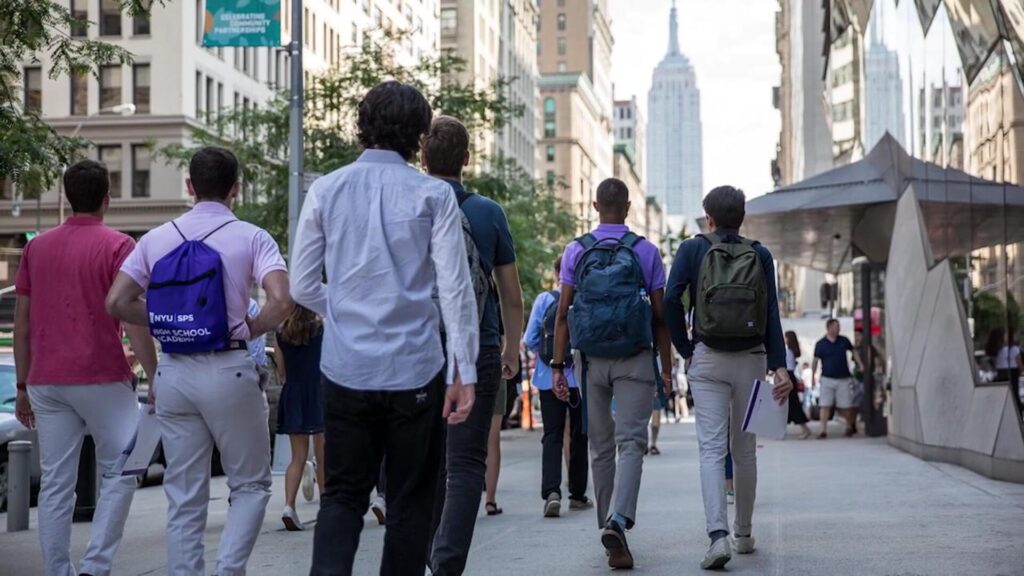
NYU Precollege is one of the more university-focused fall programs for high school students, letting you enrol in for-credit undergraduate courses on campus. You can choose tracks across STEM, the arts, and business, and attend classes led by NYU faculty alongside college students.
Assignments, exams, and project work are part of the experience to help you understand standard university expectations and get a realistic preview of NYU academics. Beyond coursework, you will attend College 101 sessions covering topics such as admissions strategy, financial aid, and academic planning. Whether you commute or live on campus, you will gain access to the university’s resources and tutoring services.
Why it stands out: You will enroll in college courses and earn credit while experiencing the pace and rigor of NYU academics.
5. AFRL Scholars Program
Location: Air Force Research Laboratory sites across the U.S.
Stipend: Paid; amount varies by site (check details here)
Dates: Summer, fall, and spring internships available; minimum duration is eight weeks (exact date varies by project and site)
Application deadline: January 10th; applications open on October 10th
Eligibility: U.S. high school students who are 16 or older, preferably with a GPA of at least 3.0 on a 4.0 scale (check details here); international students are not eligible
AFRL Scholars Program places students in labs to work alongside Air Force scientists and engineers on technical STEM projects. Depending on the placement, you may contribute to research and explore questions and experiments in areas like robotics, engineering, aerospace systems, cybersecurity, materials science, or artificial intelligence.
You will spend the fall connecting with scientists and learning through direct experimentation and analysis. The program is also designed to help you build professional skills through mentorship and technical presentations.
Why it stands out: It lets you work on real-world research within Air Force laboratories while getting paid for your contributions.
6. Alley Pond Environmental Center’s Field Biology Internship
Location: Alley Pond Environmental Center, Douglaston, NY
Cost: $200; financial aid available upon request
Dates: Fall: September 26th – October 31st (Saturdays) | Summer: June 30th – August 5th (Tuesdays or Wednesdays) | Spring: March 14th – May 2nd (Saturdays)
Application deadline: August 1st (fall) | May 1st (summer) | January 2nd (spring)
Eligibility: Students who are at least 14 years old and in high school; applicants must be able to participate in outdoor activities for at least two hours. International student eligibility is not specified, but the program is designed for NY students
This fall program is designed to help you study organisms in their natural environment through hands-on field and biological work in parks across New York City. You will spend three hours during each session exploring urban ecosystems, learning from professionals, and gaining practical skills in environmental data collection and research design.
Your work will include activities such as bird observations, biodiversity surveys, water-quality sampling, and macroinvertebrate identification. You will also connect with other student interns during the program. At the end, you will present your scientific findings to the cohort.
Why it stands out: It offers a structured internship experience multiple times a year, helping you gain fieldwork experience and explore real biological and environmental work.
7. Internships @ American Psychological Association
Location: Remote
Cost/Stipend: No cost; stipend and academic credit (unpaid) opportunities available
Dates: Spring, summer, fall, and winter internships available; exact dates vary depending on the opportunity
Application deadline: Varies based on the opportunity
Eligibility: Students enrolled in school at least part-time, authorized to work in the U.S. through E-Verify, and residents of a U.S. state where APA is registered as an employer; students under 18 need to submit a D.C. Work Permit
The American Psychological Association Internship Program introduces students to professional psychology-focused work environments through internships in areas such as policy, research, communications, publishing, education, and operations. You will apply psychological knowledge within a nonprofit professional organization while working directly with supervisors on department-specific projects and responsibilities. You will gain practical workplace experience through research tasks, group projects, workshops, and professional discussions connected to psychology and public service.
You will learn about non-traditional psychology career pathways while developing communication, analytical, and organizational skills in a professional setting. Depending on the internship, you may also complete writing assignments, collaborative projects, or research-related tasks. The program encourages networking with APA staff and professionals across different divisions and offices.
Why it stands out: It offers year-round psychology-focused internships across multiple professional fields within a major nonprofit association.
8. Internship Opportunities @ Foreign Policy Research Institute (FPRI)
Location: Remote or in person at the Foreign Policy Research Institute, Philadelphia, PA
Cost/Stipend: No cost; paid internships with need-based stipends + part-time unpaid internships available
Dates: October – December (Fall Session)
Application deadline: Varies by session
Eligibility: High school students and college students authorized to work in the U.S.
The FPRI offers internships to students interested in public policy, global affairs, and international relations. During the fall program, you will work on projects involving research, writing, communication, and professional collaboration. Internship placements are available in several areas, including events, research, communications, and operations. Depending on the track you choose, you will help with social media content development, FPRI event organization, study of regions such as Africa, the Middle East, or Asia, background research, data analysis, and policy-related work.
Some roles may require in-person participation or prior experience in areas like quantitative analysis or academic work. The program also offers access to seminars on foreign policy topics, exposure to career pathways, and opportunities to write or contribute to articles for the institute’s student publications.
Why it stands out: It offers exposure to region-specific policy work within a foreign affairs think tank.
9. Stanford Clinical Skills Internship
Location: Virtual or at Stanford Medicine, Stanford, CA
Cost: Fall: $75 application fee + $2,480 program fee | Summer: $95 application fee + $4,580 program fee
Dates: Fall: September 9th – November 11th | Summer: July 13-24; July 27th – August 7th
Application deadline: Fall: June 2nd | Summer: February 9th
Eligibility: Rising high school juniors and seniors, ages 16 and up, and undergraduate pre-med students; international student eligibility not specified
This Stanford program offers virtual and on-campus hands-on medicine-focused learning experiences to high school and undergraduate students. During the program, you will learn about medical topics and disciplines through instructional sessions, simulations, and expert-led activity-based sessions. You will also gain experience in administering injections, performing dissections, suturing, and conducting physical exams.
You will work on real clinical cases, learning how to offer differential diagnosis and develop treatment plans. You will additionally work on medical challenges with a small group of peers. The curriculum is designed to help you learn about various specialties and develop the technical skills required for a career in the field.
Why it stands out: It offers insights into medical careers through hands-on activities led by Stanford instructors, helping you prepare for medical school and beyond.
10. University of Pennsylvania’s Young Scholars High School Program: Academic Year track
Location: University of Pennsylvania, Philadelphia, PA
Cost: $4,714 for one course unit | $9,428 for two course units + a nonrefundable $100 application fee
Dates: Fall semester: August 25th – December 17th; spring sessions also available
Application deadline: August 1st (fall)
Eligibility: High school juniors within commuting distance of the University of Pennsylvania; International students may apply if they meet English proficiency requirements
The University of Pennsylvania Young Scholars Program allows high school juniors to enroll in credit-bearing undergraduate courses through Penn’s College of Liberal and Professional Studies. You will attend university-level classes in tracks like economics, psychology, sociology, anthropology, mathematics, philosophy, and film studies alongside other academically advanced students. .
The program emphasizes academic rigor through in-person coursework, analytical writing, classroom discussion, and independent study. You will complete assignments and assessments designed for college students while learning how to navigate university academic systems and course registration procedures. You will also gain exposure to the pace and structure of a research university environment while balancing high school coursework.
Why it stands out: You will get to take credit-bearing University of Pennsylvania courses during the school year while exploring your academic interests.
11. U.S. Treasury Department Headquarters Student Internship Program
Location: Treasury Department office, Washington, D.C.
Cost/Stipend: None
Dates: September – December (fall) | January – May (spring) | May – August (summer)
Application deadline: June (for fall) | October (for spring) | December (for summer)
Eligibility: Students in high school or college who are U.S. citizens enrolled at or accepted to accredited institutions
The Treasury Department gives students the opportunity to work directly on issues affecting the United States economy, financial stability, and national security during the school year or the summer. You will gain real work experience in one of the Treasury’s main offices, such as Domestic Finance, Tax Policy, Economic Policy, or International Affairs, depending on your interests and qualifications.
Your responsibilities may include analyzing data, researching policy topics, drafting briefing materials for Treasury leaders, attending Congressional hearings, and helping organize high-level meetings. You will work alongside federal employees and other interns while observing how a cabinet-level agency operates from the inside. Over the course of the semester-long internship, you will build professional skills, build a network in the government, and gain insight into careers in public service.
Why it stands out: It offers direct exposure to policy work at the highest levels of the federal government, as well as professional skill-building opportunities.
12. University of Michigan Stamps School of Art & Design Fall Pre-College Programs
Location: University of Michigan, Ann Arbor, MI
Cost: $0 – $250/program; scholarships available
Dates: September 29th – November 1st
Application deadline: September 5th
Eligibility: Current students in grades 9-12; No information available regarding international student eligibility
This is a series of programs, workshops, and events that give you the chance to explore art and design through both virtual and in-person courses taught by university faculty. You can choose from virtual studios in disciplines like 3D modeling, digital photography, graphic design, illustration, drawing, and stop motion animation, each track meeting twice weekly for 10 sessions.
If you prefer to learn in person, you can attend weekend workshops in drawing, painting, and alternative photography processes, or participate in drawing sessions at the University of Michigan museums, where you will sketch from real collections in botanical gardens, archaeology museums, and music instrument collections. The program also offers a free augmented reality and virtual reality design workshop, free application preparation workshops, and free career panels featuring recent alumni discussing creative careers.
Why it stands out: You can choose from free and low-cost classes in a wide range of art and design disciplines, with many options available online, making it a flexible program to consider in the fall.
13. Tufts University Pre-College Programs: Dual Enrollment
Location: Tufts University, Medford/Somerville, MA
Cost: $995 – $1,300/credit + $65 registration fee; additional lab/material fees may apply
Dates: Fall semester; dates TBA
Application deadline: TBA
Eligibility: Students entering grades 10-12, including international students
Tufts Dual Enrollment Courses are among the most practical fall programs for high school students if you want to enrol in undergraduate-level classes while still in high school. You can choose between courses alongside Tufts undergraduates or classes designed specifically for high school students. The programme emphasises academic independence, college-level writing, and subject-specific analysis across disciplines. You will learn through lectures, discussions, projects, and assignments that follow university standards.
Credit and audit options are available depending on the course. Some classes may also include laboratory or studio components with additional fees. You will gain exposure to the pace and expectations of college academics while strengthening your ability to manage advanced coursework.
Why it stands out: You can directly enroll in real Tufts undergraduate courses while still in high school and earn transferable university credit.
14. Fashion Institute of Technology Fall Courses
Location: FIT campus, New York, NY
Cost: $550; financial aid available
Dates: September 26th – December 5th
Application deadline: September 16th
Eligibility: High school students; international student eligibility not specified
Fashion Institute of Technology runs 10-day courses in the fall across fashion, art, and design disciplines. The offerings change each year, but you will typically attend 10 three-hour sessions in the fall, learning from FIT instructors and building fashion-focused creative and technical skills.
You will explore FIT majors and connect with like-minded peers during the program. You will leave with independent work that you can add to your portfolio.
Why it stands out: You will learn from college faculty, build portfolio pieces, and refine design skills over the course of 10 days.
15. New Jersey Institute of Technology’s Academy College Credit Courses for High School Students
Location: New Jersey Institute of Technology (NJIT), Newark, NJ
Cost: $60 non-refundable application fee + FED 101: $1,320 | MATH 111: $2,640
Dates: September 5th – December 19th (Saturdays); other sessions are also available during the year
Application deadline: August 19th
Eligibility: High-achieving students entering grades 11 and 12 who are able to maintain a “B” average or higher; international student eligibility not specified
NJIT’s Academy College Credit Courses are college-level STEM courses that you can take in the fall while you are in high school. You will study in small in-person classes taught by NJIT faculty on the Newark campus, engaging with structured engineering and mathematics coursework.
You will also gain exposure to university academic systems, grading standards, and transcript-based evaluation. Your grades will be recorded on an official NJIT transcript and may transfer to other universities depending on institutional policies. At the end, you will earn college credits.
Why it stands out: You will earn official NJIT college credit through small Saturday classes designed specifically for advanced high school students.
Build College Confidence This Fall
Fall can be a smart time to deepen your interests while balancing school, activities, and future academic goals.
The fall programs for high school students listed here include college courses, research internships, weekend workshops, fieldwork, and creative skill-building.
Through these experiences, you can practise independent learning, test possible majors, strengthen applications, and understand what university-level work may involve.
Want to feel more confident before applications begin? Explore our University Preparation blogs for practical guidance on study habits, subject choices, admissions planning, essays, interviews, and academic readiness.