
 Русский (RU)
 Українська (UK)
 Türkçe (TR)
 Italiano (IT)
 Français (FR)
 Português (PT)
 中文 (中国) (ZH)
 Español (ES)
 日本語 (JA)
 ไทย (TH)
 Deutsch (DE)
 Ελληνικά (EL)
 Polski (PL)
 Bahasa Indonesia (ID)
 Nederlands (NL)
 العربية (AR)
 한국어 (KO)

If you’re thinking about studying computer science in college, or pursuing a career in software engineering, AI, or data science, building a strong foundation early can make a real difference. Computer science teaches you how to solve complex problems, design algorithms, and understand the systems behind the technology you use every day. As a high school student, one of the smartest ways to explore the field is through a computer science course that goes beyond your school’s curriculum.
Imagine spending part of your summer building your own app, writing code alongside students who share your interests, or learning how machine learning models, algorithms, or cybersecurity systems actually work. You might tackle coding challenges, work on hands-on projects, or receive guidance from university instructors and industry professionals. Unlike internships or research programmes, computer science courses are designed to help you build knowledge first, making them an accessible way to explore the subject before taking on more advanced opportunities.
How do you choose the right computer science course for high school students?
The first step is deciding which area of computer science interests you most. Some courses provide a broad introduction to programming and computational thinking, while others focus on artificial intelligence, data science, game development, web development, or cybersecurity. If you’re completely new to coding, choose a programme that builds the fundamentals. If you’ve already worked on personal projects or taken programming classes, you may benefit from a more specialised course that lets you tackle larger, more challenging problems.
It’s also worth looking at how the course is taught. Programs led by universities or experienced software engineers often include practical projects, collaborative learning, and personalized feedback that help you apply what you’ve learned. Completing a rigorous computer science course can also strengthen your college applications by demonstrating initiative, technical curiosity, and a willingness to explore university-level concepts while you’re still in high school.
To help you get started, we’ve compiled a list of 15 computer science courses for high school students!
For adjacent options, consider the online computer science camp.
Key takeaways
- MITES Summer is completely free but restricted to US citizens or permanent residents entering their final year of high school, covering computer science within a broader STEM curriculum.
- Immerse Education’s Computer Science Summer School takes place in Cambridge or Oxford over two weeks, open to students worldwide aged 13 to 18, covering algorithms, data structures, and machine learning.
- Princeton AI4ALL is completely free and restricted to low-income students living and attending school in the United States, exploring AI through the lens of social impact and responsible technology.
- The University of Washington’s Changemakers in Computing program is free and pays a $1,200 stipend, restricted to Washington State students who can commute to the Seattle campus.
- Texas Tech’s Anson L. Clark Scholars Program admits just 12 students, pairing them one-on-one with faculty mentors in computing-related research fields with a stipend upon completion.
- The University of Chicago’s Data Science Institute Summer Lab is free with a stipend, restricted to Chicago-area students who reside in the area year-round.
- Stony Brook’s Simons Summer Research Program requires school nomination and admits students to work under faculty mentors on computing-related research, culminating in a poster symposium.
- Nearly every intensive research-based computer science program in this list restricts eligibility to US citizens or specific regional residents, with Immerse Education’s Computer Science Summer School standing out as an option open to international students.
15 Computer Science Courses for High School Students
1. MITES Summer – Massachusetts Institute of Technology (MIT)
Location: Massachusetts Institute of Technology, Cambridge, Massachusetts
Cost: Free; MITES covers tuition, housing, meals, and programme-related expenses
Acceptance rate/cohort size: Highly selective; the current cohort size is not publicly stated on the official programme page
Dates: Six-week residential programme held during the summer
Application Deadline: February 1st
Eligibility: Students must be in Grade 11 or the equivalent when applying and must be U.S. citizens or permanent residents with a current Green Card. International students and students living outside the United States are not eligible
MITES Summer is a six-week residential STEM programme for students entering their final year of high school. You take five intensive courses across mathematics, science, engineering, and the humanities, with classes designed to reflect the pace and expectations of university study. Computer science may be included as one part of the broader STEM curriculum, but MITES Summer is not exclusively a computer science course. You also participate in laboratory work, collaborative projects, admissions workshops, and activities that introduce you to STEM research and careers.
The programme is intended to support students from backgrounds that have historically had limited access to advanced STEM opportunities. Since the experience covers several disciplines, it is best suited to you if you want broad preparation for a future STEM degree rather than a specialised coding course.
Why it stands out: You receive a fully funded, residential introduction to rigorous MIT-level STEM study alongside academic advising and college preparation.
2. Immerse Education’s Computer Science Summer School

Location: Cambridge or Oxford (campus‑based, UK)
Cost: Varies; summer school scholarship available through our bursary programme
Application Deadline: Multiple cohorts with rolling admissions
Program Dates: 2 weeks during the summer
Eligibility: Students worldwide aged 13-18 currently enrolled in middle or high school
Immerse Education’s Computer Science Summer School places you in an academically structured environment where you study foundational and advanced computing concepts with expert tutors from leading universities. You cover important topics like algorithms, data structures, programming languages, and software engineering principles, as well as applications like machine learning and artificial intelligence.
Small classes let you get personalized feedback and talk to tutors and classmates from all over the world on a regular basis. When you go to a place like Cambridge or Oxford in person, you also get to experience campus life and structured activities that are similar to how you would study at a university. By completing this summer school, you gain clearer insight into how computer science is studied at the tertiary level and develop technical skills that support future academic and career decisions in computing fields. You can find more details about the application here.
Why it stands out: You’ll be taught by top faculty, work on an independent project, and live on campus, giving you a complete experience of future university life.
3. NYU Tandon School of Engineering – SPARC (Summer Program for Automation, Robotics, and Coding)
Location: NYU Tandon School of Engineering, Brooklyn, New York
Cost: $3,300 (includes $2,800 tuition and $250 course materials); optional residential housing is $638 with a mandatory $398 meal plan.
Acceptance rate/cohort size: Selective; the acceptance rate and cohort size are not publicly available
Dates: Two-week, full-day summer programme
Application Deadline: Not specified
Eligibility: Rising Grades 9-12 students with strong academics, an interest in robotics, and knowledge of Algebra II, trigonometry, and advanced or AP-level math. Open to students beyond New York City; international students should confirm visa requirements with NYU
SPARC introduces you to robotics, mechatronics, programming, and automated systems through a two-week engineering course. You learn how mechanical components, electronics, sensors, and code interact within a functioning robotic system. Practical activities guide you through designing, assembling, programming, and testing devices rather than conducting a faculty-led research project.
The programme is intended for academically strong students, although previous robotics experience is not required. You are expected to use mathematical reasoning, take initiative, and work collaboratively during technical challenges. By completing the programme, you gain a clearer understanding of how robotics brings together computer science, electrical engineering, and mechanical design.
Why it stands out: You combine coding with electronics and mechanical design while building and testing automated systems at NYU Tandon.
4. MIT Women’s Technology Program (WTP)
Location: Massachusetts Institute of Technology, Cambridge, Massachusetts
Cost: Free to apply and free to attend; housing, meals, and programme materials are provided
Acceptance rate/cohort size: Highly selective; approximately 20 students for the Mechanical Engineering programme
Dates: June 27th – July 25th
Application Deadline: December 15th (tentatively)
Eligibility: U.S. residents in Grade 11 who will enter Grade 12 after the program. Designed for young women from underrepresented or underserved groups in engineering. Students whose permanent home is outside the U.S. are not eligible
MIT’s Women’s Technology Program is a four-week residential summer program that introduces you to computer science and mechanical engineering through intensive coursework and hands-on programming projects, making it a standout pick if you’re browsing computer science courses for high school students built specifically for young women. You learn core topics such as Python programming, algorithms, computational thinking, and software development while attending classes taught by MIT instructors and researchers.
The program also includes collaborative labs, mentorship from MIT students, admissions advising, and exposure to life on MIT’s campus. Because the curriculum is designed for students with little or no prior programming experience, it provides a strong foundation for future computer science study. The experience can help you determine whether a computer science degree aligns with your academic interests before applying to college.
Why it stands out: It offers a fully funded introduction to computer science at MIT, combining programming coursework with mentorship and a residential university experience.
5. Columbia University – SHAPE (Summer High School Academic Program for Engineers)
Location: Columbia University, New York City, New York
Cost: $6,241 per three-week commuter session or $11,492 per residential session; limited need-based scholarships are available to eligible domestic students
Acceptance rate/cohort size: Selective; the acceptance rate and cohort size are not publicly available
Dates: Session 1: July 6-24; Session 2: July 27th – August 14th
Application Deadline: March 2nd
Eligibility: Rising high school sophomores, juniors, seniors, and recent high school graduates with demonstrated interest in STEM. International students may apply, but financial aid is available only to domestic students and families
SHAPE allows you to study computer science through a two-week project-based course at Columbia Engineering, and its range of tracks, from AI to cybersecurity, makes it one of the more flexible computer science courses for high school students on this list. Depending on your course selection, you explore topics such as programming, artificial intelligence, cybersecurity, data science, robotics, or software engineering while working with Columbia faculty and instructors.
You complete hands-on laboratory activities and team projects that mirror introductory university engineering coursework. Outside the classroom, you experience campus life through residential activities, engineering workshops, and interactions with current Columbia students. The program offers a practical introduction to computer science while helping you understand what studying engineering at university is like.
Why it stands out: It combines project-based computer science learning with a residential experience at Columbia Engineering, giving you an early look at university-level engineering education.
6. Princeton AI4ALL
Location: Princeton University, Princeton, New Jersey
Cost: Free; programme costs, housing, meals, and the programme trip are covered, with travel assistance available
Acceptance rate/cohort size: Highly selective; the cohort size is not publicly stated
Dates: July 9-30
Application Deadline: April 9th
Eligibility: Students must be in Grade 10 when applying and entering Grade 11 the following fall, live and attend school in the United States, and meet at least one of the programme’s stated income or financial-aid criteria. Students living or studying abroad are not eligible. No previous programming or AI experience is required
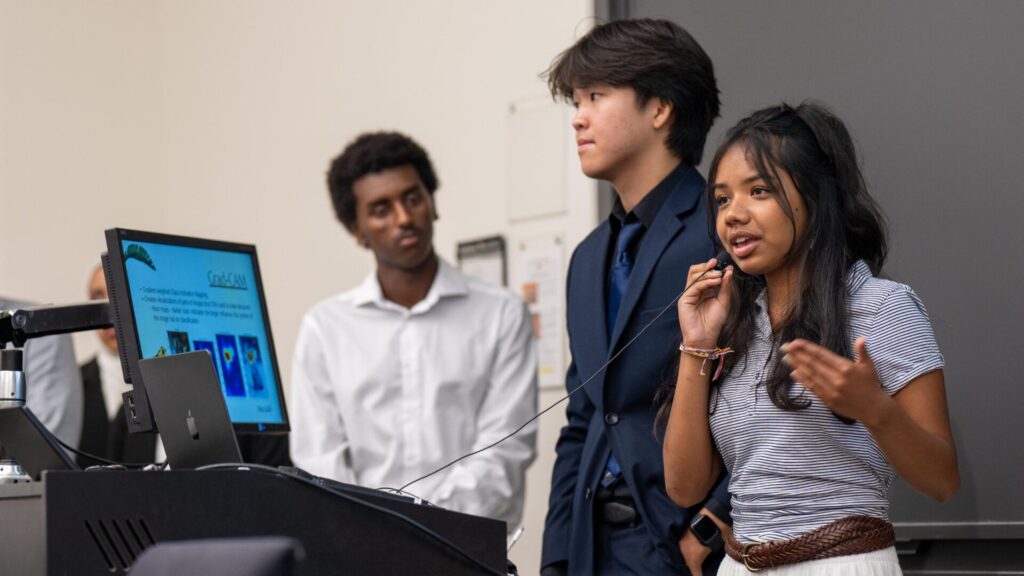
Princeton AI4ALL introduces you to artificial intelligence through the lens of social impact and responsible technology. Over the programme, you’ll learn core AI concepts through lectures, technical workshops, and collaborative projects without needing any previous programming or AI experience. The curriculum explores how AI is applied in fields such as medicine, biodiversity, public policy, and social good, helping you understand both the technology and its real-world implications.
You’ll also work closely with Princeton faculty, graduate student mentors, and fellow participants while developing group projects that apply AI to practical challenges. Living on campus gives you a taste of university life while helping you explore future pathways in artificial intelligence, computer science, data science, and technology policy.
Why it stands out: It gives low-income students early access to AI learning at Princeton, with project work, mentorship, and a fully funded residential experience.
7. Oxford Saïd Teen Technology and Innovation Summer Academy (University of Oxford)
Location: Saïd Business School, University of Oxford, Oxford, UK
Cost: Program fees apply
Acceptance Rate/Cohort Size: Selective; acceptance rate and cohort size are not publicly available
Dates: Two-week summer program
Application Deadline: Rolling admissions until full
Eligibility: Students aged 15-18. International students are welcome
Oxford Saïd’s Teen Technology and Innovation Summer Academy introduces you to emerging technologies, innovation strategy, and entrepreneurship in a university business-school setting. You explore topics such as artificial intelligence, technology-driven business models, digital transformation, and innovation challenges through lectures, workshops, and team-based work.
You also develop and present ideas connected to technology and real-world problem-solving. The program gives you exposure to Oxford’s academic environment while helping you evaluate whether computer science, technology entrepreneurship, or business innovation fits your academic direction.
Why it stands out: You’ll study technology and innovation at Oxford Saïd while working on practical ideas shaped by emerging tech and entrepreneurship.
8. Changemakers in Computing (CiC) – University of Washington, Paul G. Allen School of Computer Science & Engineering
Location: Seattle, WA
Cost: Free; participants receive a $1,200 stipend
Acceptance Rate/Cohort Size: Selective; acceptance rate and cohort size are not publicly available
Dates: Four-week summer program
Application Deadline: Early April
Eligibility: Current 10th- or 11th-grade students attending school in Washington State who can commute to the University of Washington Seattle campus
Changemakers in Computing (CiC) at the University of Washington’s Paul G. Allen School of Computer Science & Engineering explores how computing can be used to address real-world social challenges. Throughout the four-week programme, you’ll build introductory coding skills through project-based learning while examining topics such as technology, ethics, justice, and the social impact of computing.
You’ll work in small mentor groups led by University of Washington undergraduates, complete collaborative coding projects, and attend sessions on career exploration, college pathways, and different areas of computer science. Daily activities include technical lessons, project work, discussions on responsible technology, and mentorship sessions that help connect computing with real-world applications.
Why it stands out: It combines coding, mentorship, social-impact projects, and a stipend, making computer science more accessible for Washington students.
9. MIT Beaver Works Summer Institute (BWSI)
Location: Cambridge, MA
Cost: Free; participants are responsible for housing and personal expenses if attending in person
Acceptance Rate/Cohort Size: Highly selective; cohort size varies by course
Dates: Four-week summer program preceded by a required online prerequisite course
Application Deadline: Varies by course after completion of the prerequisite
Eligibility: Primarily rising high school seniors who complete the required online prerequisite. International eligibility varies by course
MIT’s Beaver Works Summer Institute (BWSI) introduces you to university-level engineering and computer science through intensive, project-based courses. Before the summer programme begins, you’ll complete a required online prerequisite course that builds the technical foundation needed for the residential experience. Once on campus, you can choose from subjects such as autonomous systems, machine learning, cybersecurity, quantum software, robotics, and computer vision, working in teams to solve real engineering challenges.
Throughout the programme, you’ll design, build, test, and refine projects with guidance from MIT faculty, researchers, and industry mentors. The curriculum closely mirrors the pace and collaborative nature of university engineering, giving you hands-on experience with applied computer science and emerging technologies.
Why it stands out: You’ll complete an MIT-designed preparatory course before tackling advanced computing projects in a fully funded residential program.
10. NextGen Bootcamp – Computer Science Summer Certificate Program
Location: New York City, NY, or Live Online
Cost: Tuition-based
Acceptance Rate/Cohort Size: Open enrollment
Dates: Multiple sessions offered throughout the year
Application Deadline: Rolling admissions
Eligibility: High school students. International students may participate in the live online program and the in-person program if they can legally attend in the U.S.
NextGen Bootcamp’s Computer Science Summer Program introduces you to programming through an intensive, project-based curriculum centred on Java and Python. During the programme, you’ll learn programming fundamentals, algorithms, object-oriented programming, file handling, and data structures before using Python for data science and introductory machine learning.
The curriculum also explains how programming connects to artificial intelligence through practical coding exercises and real-world projects. Classes are taught in small groups with live instruction, giving you regular opportunities to ask questions, receive feedback, and work directly with instructors. The programme also includes one-on-one mentoring, class recordings, and a certificate of completion.
Why it stands out: It provides structured instruction in Python and Java through project-based coding exercises.
11. University of Chicago Data Science Institute (DSI) Summer Lab
Location: Chicago, IL
Cost: Free; participants receive a stipend
Acceptance Rate/Cohort Size: Highly selective; cohort size is not publicly available
Dates: Eight-week summer program
Application Deadline: Mid-January
Eligibility: Chicago-area high school students who will be at least 16 years old by the start of the program. Participants must reside in the Chicago area year-round
The University of Chicago Data Science Institute’s Summer Lab allows you to work on an eight-week research project alongside faculty mentors and researchers in a university lab. Depending on your placement, you may contribute to projects in computer science, data science, social science, climate and energy policy, public policy, materials science, or biomedical research. Throughout the programme, you’ll learn research methodologies, data science techniques, and collaborative research practices while working as part of a research team.
You’ll also take part in professional development workshops, weekly talks by leading data science researchers, and cohort activities that introduce different applications of data science. The programme concludes with an end-of-summer research symposium, where you’ll present your work through a research video and discuss your findings with mentors and other researchers.
Why it stands out: You’ll gain paid research experience while working with University of Chicago faculty on real-world data science projects.
12. Texas Tech University’s Anson L. Clark Scholars Program
Location: Lubbock, TX
Cost: Free; participants receive a stipend upon completion
Acceptance Rate/Cohort Size: Highly selective; 12 students
Dates: Seven-week residential summer program
Application Deadline: Mid-February
Eligibility: Applicants must be at least 17 years old by the start of the program and should graduate in the current or following academic year. International applicants should confirm eligibility directly with Texas Tech
The Clark Scholars Program is a competitive undergraduate research program where you work one-on-one with a Texas Tech faculty mentor in your chosen field. Students interested in computer science may be matched with faculty conducting research in computing, artificial intelligence, software systems, or related disciplines, depending on mentor availability.
Alongside research, you attend seminars, field trips, and professional development activities that introduce you to the university’s research culture. The program is well-suited if you want an early experience conducting independent research before college.
Why it stands out: It combines one-on-one faculty research mentorship with a stipend, making it one of the most selective high school research programs in the U.S.
13. Wake Forest University Summer Immersion Program – Coding and Computer Science Institute
Location: Winston-Salem, NC
Cost: $3,500
Acceptance Rate/Cohort Size: Selective; cohort size is not publicly available
Dates: One-week sessions offered during the summer
Application Deadline: Rolling admissions until full
Eligibility: Current 9th – 12th-grade students. International students should confirm visa and travel requirements directly with Wake Forest
Wake Forest’s Coding and Computer Science Institute offers separate tracks for beginners and intermediate/advanced students. You study Python, Java, data structures, algorithms, ethics in computing, and high-performance computing, depending on your level.
Hands-on activities may include building Python games, working with Raspberry Pis, analyzing datasets, developing mobile apps, and completing a group coding project. The advanced track also includes machine learning, AI, GitHub, command line tools, and UI/UX concepts. You receive a Wake Forest University Certificate of Completion, though the course does not carry school or college credit.
Why it stands out: It gives you a short residential introduction to coding, software development, and computing projects on Wake Forest’s campus.
14. Meta Summer Academy
Location: Menlo Park, CA, and other Meta locations in the San Francisco Bay Area
Cost: Free; participants receive a stipend
Acceptance Rate/Cohort Size: Selective; cohort size is not publicly available
Dates: Six-week summer program
Application Deadline: Mid-February
Eligibility: Current high school sophomores who are full-year residents of East Palo Alto, Belle Haven, North Fair Oaks, or Redwood City and meet the GPA requirement
Meta Summer Academy introduces you to the technology industry through a six-week paid career exploration programme hosted at Meta offices in the San Francisco Bay Area. Alongside an introduction to coding, you’ll take part in workshops on financial literacy, media, networking, and workplace communication, giving you a broader understanding of how a major technology company operates.
Throughout the programme, you’ll meet Meta employees, guest speakers, and mentors who share their career journeys and provide insight into different roles across the company. The experience also includes activities that strengthen professional skills such as communication, collaboration, and reflection while helping you explore future pathways in computer science, technology, and related careers.
Why it stands out: It gives local Bay Area students early exposure to coding, tech careers, and professional networks inside Meta’s ecosystem.
15. Stony Brook University’s Simons Summer Research Program
Location: Stony Brook, NY
Cost: Free; participants receive a stipend upon successful completion
Acceptance Rate/Cohort Size: Highly selective; acceptance rate is not publicly available
Dates: Six-week summer research program
Application Deadline: Early February (school nomination required)
Eligibility: Current 11th-grade students who are at least 16 years old by the start of the program, are U.S. citizens or permanent residents, and are nominated by their school
The Simons Summer Research Program places you in a Stony Brook research group under the guidance of a faculty mentor. If matched with a computing-related project, you may work in areas connected to computer science, applied mathematics, engineering, data analysis, or computational research.
You take responsibility for a research project, learn relevant tools or lab techniques, and produce both a written abstract and a research poster. The program also includes faculty research talks, workshops, tours, and a closing poster symposium. It is a strong fit if you want a selective research experience before applying to STEM or computer science programs.
Why it stands out: It gives you one-on-one faculty research mentorship at a major research university, with a final poster and stipend.
Frequently asked questions: Computer science courses for high school students
Are computer science courses for high school students open to international students?
Most of the highly selective, stipend-paying research programs in this list, including MITES Summer, Princeton AI4ALL, and the MIT Women’s Technology Program, restrict eligibility to US citizens or residents. However, NYU Tandon’s SHAPE program and NextGen Bootcamp’s live online option welcome international students. Immerse Education’s Computer Science Summer School is also open globally to students aged 13 to 18.
Do you need prior coding experience for a computer science course?
It depends on the program. The MIT Women’s Technology Program and Princeton AI4ALL are both explicitly designed for students with little or no prior programming experience. Others, like NYU Tandon’s SPARC, expect knowledge of Algebra II, trigonometry, and advanced math as a prerequisite. Check each program’s eligibility section closely, since expectations range from complete beginner access to fairly specific technical or mathematical prerequisites.
How much do computer science courses cost?
Costs range from completely free to several thousand dollars. Free, often stipend-paying options include MITES Summer, Princeton AI4ALL, and Meta Summer Academy. Mid-range programs like NextGen Bootcamp are tuition-based with flexible pricing, while premium options include NYU Tandon’s SPARC at $3,300 and Columbia’s SHAPE at up to $11,492 for the residential track. Financial aid is available for most tuition-based programs.
What is the difference between a broad STEM program and a dedicated computer science course?
Broad STEM programs, like MITES Summer, include computer science as one component within a wider curriculum covering math, science, and engineering. Dedicated computer science courses, like Immerse Education’s Computer Science Summer School or NextGen Bootcamp, instead focus entirely on programming, algorithms, and software development. If you already know computer science is your specific interest, a dedicated course offers deeper technical engagement; if you want broader STEM exposure, a program like MITES provides that context.
How selective are computer science courses for high school students?
Selectivity ranges from extremely competitive to open enrollment. MITES Summer and the MIT Women’s Technology Program are both highly selective, admitting small cohorts from large applicant pools. Stony Brook’s Simons Summer Research Program requires school nomination. Other programs, like NextGen Bootcamp, use open, rolling enrollment. Regardless of selectivity, meeting specific eligibility criteria, like regional residency for Changemakers in Computing, matters as much as academic strength.
Is Immerse Education a good option for exploring computer science before college?
Immerse Education’s Computer Science Summer School is a strong choice if you want a genuine UK university experience without needing US citizenship or residency. The two week program covers algorithms, data structures, programming languages, and applications like machine learning and AI, taught by expert tutors in small classes at Cambridge or Oxford. You’ll experience campus life alongside your coursework and gain clearer insight into how computer science is studied at the university level, with financial aid available through the program’s bursary scheme.
What Comes After Your CS Course?
Choosing among these computer science courses for high school students gives you a genuine introduction to algorithms, programming, and technical problem-solving.
Once the course ends, you can turn that coding experience into a clearer sense of your academic and career direction.
The technical skills, project work, and analytical thinking you built become a strong foundation for stronger university applications ahead.
Keep building on what you started this summer by exploring our University Preparation blogs for guidance on your next steps.