

 Русский (RU)
 Українська (UK)
 Türkçe (TR)
 Italiano (IT)
 Français (FR)
 Português (PT)
 中文 (中国) (ZH)
 Español (ES)
 日本語 (JA)
 ไทย (TH)
 Deutsch (DE)
 Ελληνικά (EL)
 Polski (PL)
 Bahasa Indonesia (ID)
 Nederlands (NL)
 العربية (AR)
 한국어 (KO)

Students are often unsure of how to end a personal statement. A strong personal statement conclusion makes all the difference in whether your application gets noticed by admissions officers or not.
If you’ve just finished writing your personal statement and you’re stuck on your ending, then don’t worry! This article will walk you through the essentials of a personal statement conclusion. If you’re writing a 3-part personal statement, this advice can apply to the ends of your individual answers.
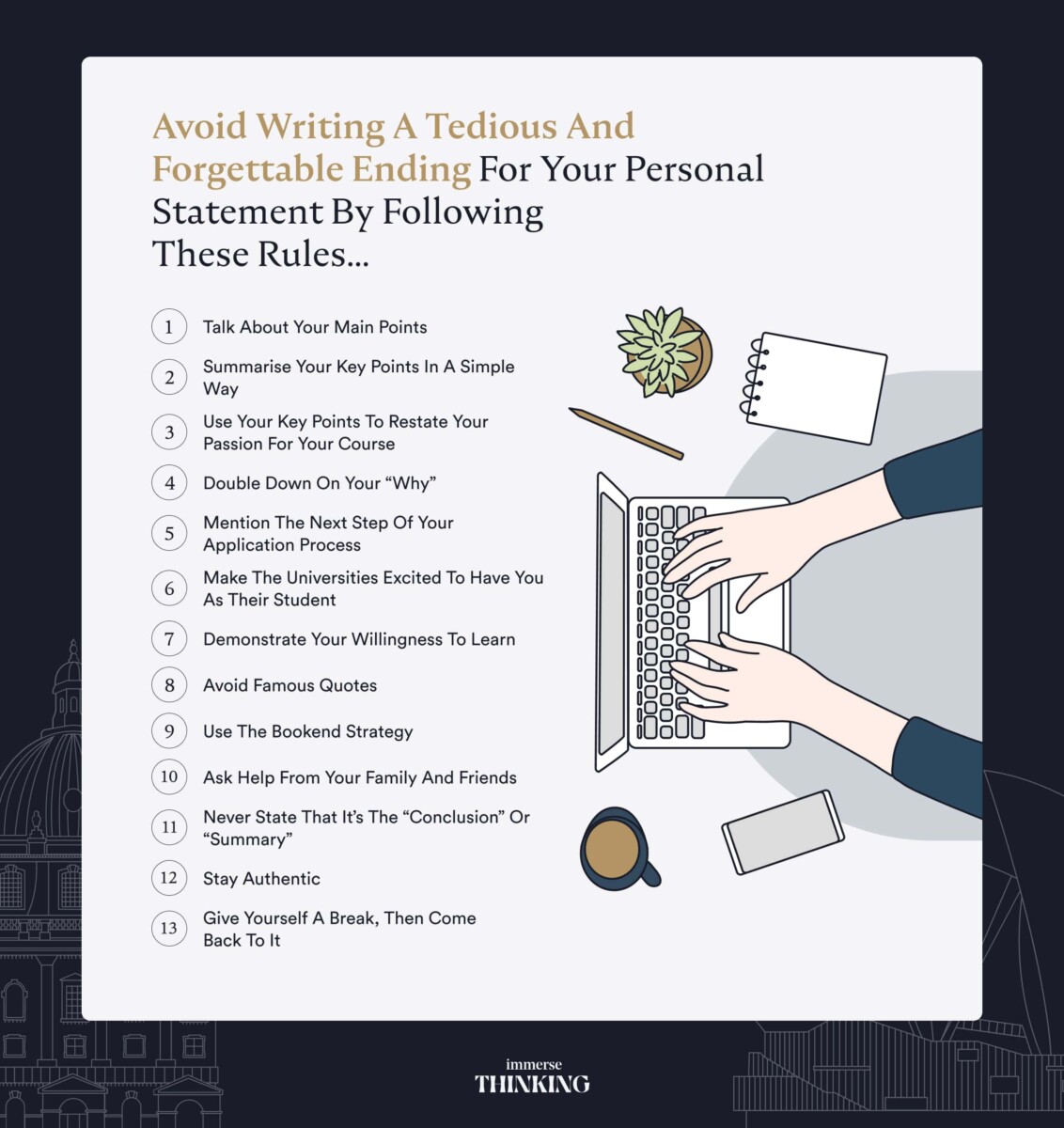
Avoid writing a tedious and forgettable ending for your personal statement by following these rules.
Talk About Your Main Points
Don’t end your final paragraph by stating something you haven’t mentioned already. Remember, the purpose of your personal statement conclusion is to wrap up the package.
You shouldn’t say, “I’m motivated by the opportunity to pursue the passion for engineering that these experiences kindled,” if you didn’t mention these “experiences” in the first place!
Summarising your key main body points is a great conclusion in many cases.
Summarise Your Key Points In A Simple Way
After reading thousands of personal statements, the admissions committee will be happy to see you concluding your personal statement with a clear summary of the vital points.
Go over your personal statement and jot down the main takeaway of each paragraph. Once you have that list, find a way to integrate them into your conclusion.
You can dedicate a sentence to each key point, tie them all together, and you now have a conclusion that does what it’s supposed to do!
Business Management
In-person
Cultivate leadership skills in New York, where multinational...

Coding
In-person
Master the language of technology in Cambridge, a...

Use Your Personal Statement Conclusion To Restate Your Passion For Your Course
If you’re wondering how to end your personal statement, try to use your key points to restate your passion for the course you’re applying for.
You’ll have introduced key points including your skills and experiences in the main body. Wrap them up by saying, “With my [specific skills] and as a result of [specific experiences] I’ve gained over the years, I’m committed to [mention your course].”
By doing so, you’re hitting two birds with one stone. One, you’re reminding the admissions committee that you have the skill set necessary to succeed in your course. Two, you’re demonstrating your dedication to your desired course.
Join the Immerse Education 2025 Essay Competition
Follow the instructions to write and submit your best essay for a chance to be awarded a 100% scholarship.
Double Down On Your “Why”
Another powerful ending is to remind the reader of your “why.” Many students pursue their chosen course because they’re not sure what else to take.
So being clear on your purpose sets you apart from the rest.
To do this, take the most heart-moving story from the body of your personal statement on what inspired you to apply for your course. Mention the main idea of it in a sentence or two, then end with a “for this reason, I believe pursuing [mention course] is the best way to achieve my purpose of… [state your why].”
Say you’re writing a medical personal statement. Maybe your “why” is to forward technology that helps safeguard the elderly from falling accidents because you witnessed your grandparent suffer injuries from a fall when you were young.
Doubling down on your “why” shows your conviction and direction on why you’re applying for your course.
Mention The Next Step Of Your Application Process
What’s the next step after the admissions committee accepts your personal statement? For many courses, they’ll call you up for an interview. Go ahead and mention this in your conclusion!
Write something along the lines of “I’m looking forward to dedicating myself to this course, and I would love to receive an invitation for the interview.”
The reader will right away recognise that you’ve done your research. You know what the next step should be. You are serious about this application!
Make The Universities Excited To Have You As Their Student
Studying at a university is not merely a means to an end. It’s a profound journey in and of itself! You’ll meet new colleagues, form lifelong communities, and discover mentors who will guide you along with your future career.
Think of them when you’re pondering on how to end a personal statement. What can you contribute as a student to make the university a better place? Demonstrate your excitement in meeting them, building relationships with them, and serving them!
A statement as straightforward as “I am eager to establish new, lifelong relationships and use my [mention your skills] to help make the university a better place for learning and community-building” could be effective, so long as it’s sincerely meant and flows nicely on from the main body of your answer.
Demonstrate Your Willingness To Learn
Universities exist to train and mould students, not the other way around! A little humility goes a long way. Show yours by demonstrating your willingness to learn. Nothing excites teachers more than willing students.
To pull this off, make sure you know what values your course upholds. It could be service, excellence, inclusivity, and so on. State in your conclusion that “I’m looking forward to learning how to embody [write down the course’s values you resonate with], to grow and succeed in [mention your field of study].”
There’s so much value packed in this simple personal statement ending. Tweak it and make it yours!
Avoid Famous Quotes
Many students insert famous quotes from well-known persons when ending their personal statements. Avoid this tactic as much as possible because you’re driving attention away from YOU as the applicant.
If you want to include famous quotes, put them at the beginning of your personal statement to grab attention. To keep your reader’s attention focused on you in the end, why not come up with a memorable, relevant quote of your own?
Use The Bookend Strategy to Conclude Your Personal Statement
Bookends are sturdy objects placed at either end of upright books to keep them standing. When you translate that into writing, the bookend strategy is when the introduction and conclusion statements connect to support the body between them.
You may start your personal statement with a heart-wrenching story about how you watched your beloved pet die of the wrong diagnosis. Then, for your conclusion, you can call back on this story and state how this event fuels you to pursue veterinary practice.
The bookend strategy is a clean and efficient way how to end your personal statement.
Ask Help From Your Family And Friends
If you’re still stuck on how to end a personal statement, don’t be afraid to ask for help. Approach your family and friends because they know you more than anyone. Read to them the introduction and body of your personal statement.
Ask them what particular line struck them the most. Maybe they know something about you that you missed in your personal statement. What characteristics do they see in you that will help you succeed in your course?
Gather their answers in one place, and after reading them in one go, you’ll have a decent idea of what to emphasise in your conclusion statement.
Never State That It’s The “Conclusion” Or “Summary”
The most boring, generic way to end a personal statement is to write “In conclusion” or “In summary.” It’s actually one of the topics we cover in what not to put in a personal statement.
Avoid this writing style at all costs. A good conclusion statement doesn’t require explicit announcements.
By its style and structure alone, the reader knows immediately they’re about to read a closing statement. So don’t hesitate to proceed straight to the main points. As long as the conclusion connects seamlessly with the previous paragraph, you’re good to go!
Stay Authentic
Universities hold honesty in high esteem.
The best way to radiate honesty in your personal statement is to write from the right mindset. When you work on your personal statement, your objective is to show who you are and demonstrate why you are a worthy candidate for the course.
Don’t try to impress. If you come from that standpoint, you’re more likely to add embellishments. The experienced admissions committee can smell insincere personal statements from a mile away. So stick with who you are and let your personality shine through.
Give Yourself A Break, Then Come Back To It
When working on how to conclude a personal statement, you need to give yourself time. After writing a rough draft of your conclusion statement, take a break and return to it after a few days.
When you return to it, you’ll be surprised to notice details you haven’t seen before. Edit as you like, and make it better. Keep the old versions of your conclusion at hand so you can readily compare them with your newest, edited text. Compare and choose which one sounds better.
5 Bad Examples Of A Personal Statement Conclusion
These are 5 personal statement examples for conclusions that don’t meet the criteria outlined above.
- In this application essay, I have made it clear I am an outstanding candidate for a degree because I think everyone will love my positive attitude and I deserve it.
- In summary, you can see my highlighted qualifications and experience, I know they’re not the best, but I want to stress that my passion for this field is what sets me apart as a candidate. It shouldn’t matter if the others are more qualified or experienced than me.
- Remember the skills I have, that’s really what sets me apart from other students, they don’t have what it takes to break the rules creatively and not follow the book.
- Finally, I would like to thank you for considering me for this opportunity and I hope you will make the right decision by choosing me, otherwise, I may cry and be disappointed.
- As a final note, it’s easy to see how qualified I am for this degree and how I will excel in it – but you should accept me because I’m cool and will get along with everyone else.
5 Memorable Examples Of A Personal Statement Conclusion
- Technology isn’t just my passion—it’s my playground, my puzzle, and my proving ground. I’ve spent countless hours debugging code, not because I had to, but because I couldn’t walk away from a challenge that demanded to be solved. Whether it’s optimizing algorithms or designing intuitive interfaces, I’m constantly searching for ways to push the limits of what technology can achieve. The prospect of engaging with leading researchers and like-minded peers in this program excites me because I see it as the next frontier in my pursuit of innovation.
- If there’s one thing I’ve learned from shadowing doctors and volunteering in hospitals, it’s that medicine is as much about curiosity as it is about compassion. I’ve always been drawn to the complexities of the human body, not just in textbooks but in real-life cases that challenge conventional wisdom. Studying here means immersing myself in an environment that values inquiry and discovery, and I can’t wait to contribute to that conversation—whether in the lab or at a patient’s bedside.
- I can still remember the first time I disassembled [a household appliance] just to understand how it worked—an act that probably frustrated my parents but ignited a lifelong fascination with mechanical systems. Engineering, for me, has always been about exploration and application. I’m eager to bring my problem-solving mindset to a program where experimentation isn’t just encouraged, as I’ve seen featured in your [insert course aspect/module], but expected. With each new challenge, I hope to refine my skills and create solutions that have tangible, lasting impact.
- Justice isn’t abstract to me—it’s personal. Growing up in a community where access to legal resources was limited, I saw firsthand the power of knowledge and advocacy. That experience didn’t just inspire me to study law; it fueled my determination to understand it from every angle. This program offers an unparalleled opportunity to sharpen my analytical skills and engage with the kind of legal scholarship that drives meaningful reform. I’m ready to take that step.
- The natural world has never been something I’ve observed from a distance—it’s something I’ve studied, questioned, and actively worked to protect. Whether it’s analyzing soil samples for a local conservation project or researching sustainable urban development for [name of organisation], I approach environmental science with both urgency and optimism. I see this degree as more than an academic pursuit; it’s a chance to be part of the solution to some of the world’s most pressing challenges.
How Long Should the Personal Statement Conclusion Be?
As a general rule, your conclusion should be around 10% of the total word count. If you’re writing a personal statement in three parts for UCAS 2026 entry, that might look like around 100-150 words for each 1000-1500 word section.
Do You Feel More Confident Writing A Personal Statement Conclusion?
To end your personal statement in the best possible way, you need to know the body’s key points. Use them as pillars when deciding which direction your conclusion takes.
Will you highlight your future goals? Maybe you want to focus on your why? Take the time to decide. And if you’re stuck, don’t hesitate to ask for help from your family and friends so you can leave a lasting impression on the applications committee.
How much did this article help you out? Don’t forget to bookmark this page for future reference!